You're standing in a queue when your heart starts pounding. Your vision feels hazy, your legs feel heavy, and you wonder whether you need to sit down or whether you're overreacting. Later, your watch shows a sharp heart-rate rise, but you're still left asking what it means.
POTS, or postural orthostatic tachycardia syndrome, symptoms can look like this, but other conditions can cause the same experience. The useful question isn't just how high your pulse went. It's what happened when you stood up, how long it lasted, what else you felt, and what was happening around you.
POTS Symptoms at a Glance and How Often They Occur
A pounding heart on standing can mean POTS. It can also reflect dehydration, anxiety or a short night's sleep. Because the same sensation can point in several directions, a symptom list is a starting point for describing your experience, not a verdict on its cause.
Published cohorts show which symptoms tend to cluster together. Every percentage in the table comes from a single large symptom summary, and a separate smaller cohort reached a similar ordering, rating lightheadedness as the symptom most disruptive to quality of life.
Reported POTS symptoms and how often they appear
| Symptom | Reported frequency (clinical review's symptom summary, about 4,034 patients) | What it often feels like |
|---|---|---|
| Lightheadedness | 99% | Woozy or faint when standing |
| Tachycardia (fast heart rate) | 97% | Pulse racing or pounding on standing |
| Presyncope (near-fainting) | 94% | Vision dimming, feeling about to pass out |
| Shortness of breath | 88% | Air hunger or needing deeper breaths upright |
| Palpitations | 87% | Fluttering, skipping sensations, or thumping in the chest |
| Chest pain | 79% | Tightness or discomfort while upright |
| Syncope (fainting) | 36% | Loss of consciousness, sometimes after prolonged standing |
| Fatigue on standing | Commonly reported | Heavy, drained feeling that builds with upright time |
These figures describe people already enrolled in published POTS cohorts. They are not the chance that a person with a given symptom has POTS, which is a different question entirely. Read the numbers in both directions: a 36% fainting rate means most of these patients never lost consciousness, and a 99% rate for lightheadedness still doesn't make it proof on its own. Chest discomfort deserves assessment on its own merits whatever the table says.
Look for a pattern, not a symptom count
The characteristic pattern is symptoms that appear or worsen while you're upright and ease when you lie down. You don't need every symptom on the list, and fainting isn't required. One dramatic episode carries less weight than the same story repeating across ordinary days, and one unremarkable reading settles nothing either.
Palpitations and tachycardia aren't interchangeable. Tachycardia is a measured fast heart rate; palpitations are your awareness of the heartbeat, which can feel forceful even at normal speeds. Recording both your sensations and your measurements keeps the two from being confused.
Published cohorts predominantly describe women of reproductive age, often with symptoms beginning during adolescence. That familiar profile shouldn't become a gatekeeping rule: people outside it can still need evaluation, and population prevalence remains uncertain because POTS has historically been underrecognized.
Mark the rows that resemble your experience. Beside each one, note whether it happens standing, sitting, lying down or during activity, and roughly how long it takes to settle. That context is more useful than counting matches.
What Defines POTS and How to Read Heart-Rate Numbers
Two minutes into a ten-minute stand, your watch shows 134 beats per minute. By minute five it reads 102. Which number describes you? Without a starting point and a timeline, neither one can. That gap between a single reading and a pattern is exactly what the formal definition of POTS tries to close.
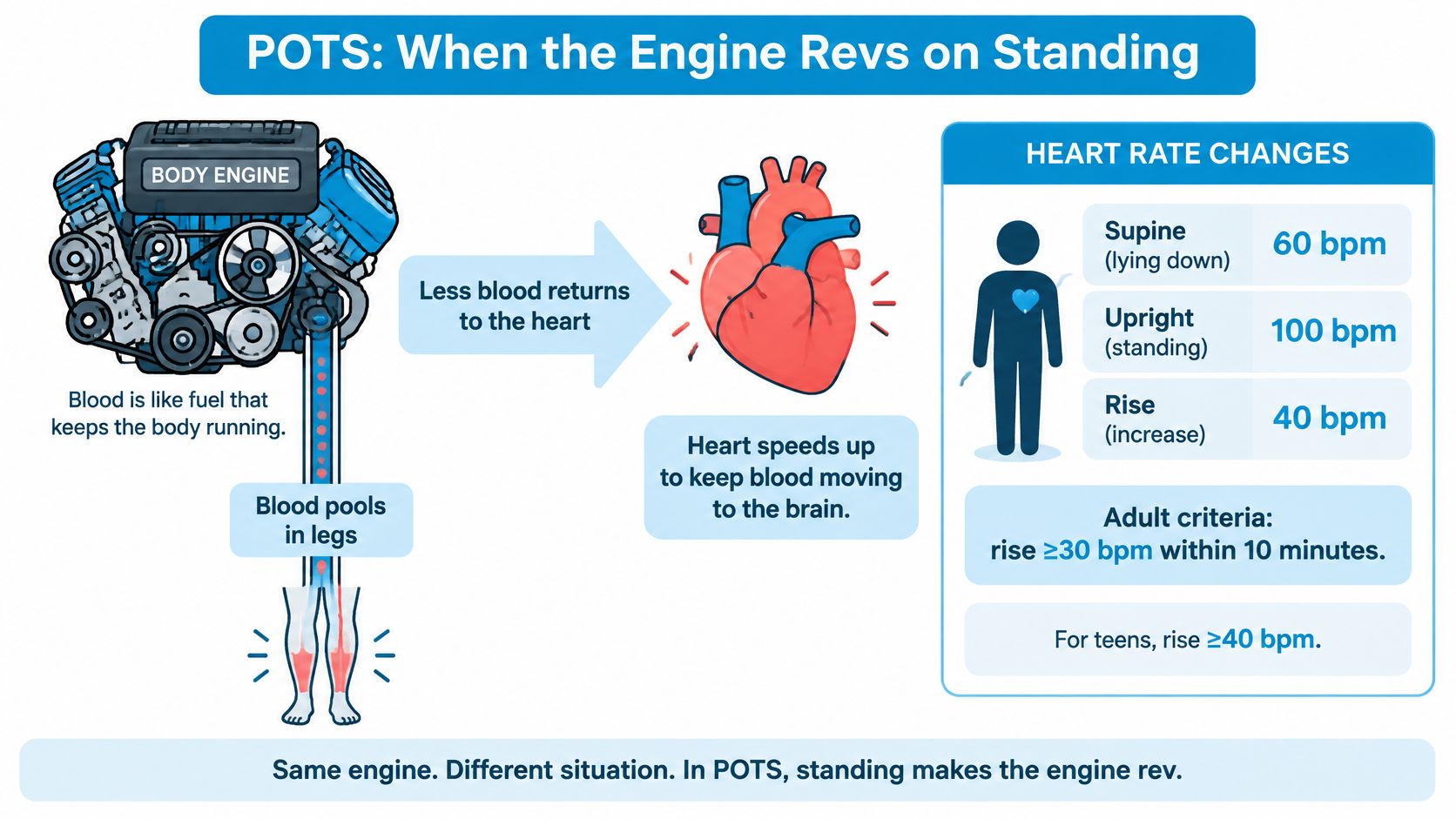
The usual explanation involves blood pooling in the lower body when you stand, so less blood returns to the heart and the heart speeds up to keep circulation going. That describes one compensating mechanism and still leaves much of each person's POTS unexplained.
The criteria work together
A clinical review of diagnostic criteria describes a sustained rise of at least 30 beats per minute within 10 minutes of standing or head-up tilt in adults, with a threshold of at least 40 beats per minute for adolescents aged 12 to 19. The same framework requires chronic upright symptoms, commonly lasting at least 3 months, and no orthostatic hypotension, typically defined as a blood-pressure fall of at least 20 mmHg systolic or 10 mmHg diastolic.
Earlier descriptions sometimes applied a shorter observation window and a longer minimum symptom duration, which helps explain why older webpages may quote different figures.
Sustained matters. A brief spike during the movement of getting up isn't the same as an elevation that persists while you remain standing. Duration matters too: a new episode during an acute illness doesn't establish a chronic syndrome. And blood pressure is part of the distinction, because a clinician reads the pulse change alongside your symptoms, posture, and blood-pressure response.
Read the pattern without treating it as a verdict
A peak number answers one question: how fast did your heart go. The more useful questions are where the rise started, whether it was sustained, and what else might explain it. That is the difference between a reading and a pattern.
Suppose two mornings, same ten-minute stand. On the first, your watch jumps to 131 beats per minute as you rise, then settles to 95 and stays there. On the second, it climbs from a resting 76 to 108, 111, and 109 over eight minutes of quiet standing. The first morning produced the bigger number. The second produced the more informative one: a sustained rise of about 30 beats per minute measured against a plausible baseline.
Even that second result isn't a verdict. A 2024 long-term outcomes survey notes that the commonly used 10-minute standing test is neither standardized nor validated, so a home version needs careful interpretation rather than automatic pass-or-fail labeling. Hydration, heat, illness, medication timing, sleep, recent exertion, and how long you rested before standing can all shift the result. Don't stop medication or restrict fluids to produce a more striking reading.
Sensor limits matter too. Consumer heart-rate data can be incomplete, delayed, or inaccurate, particularly during movement or poor sensor contact. A gap in the graph isn't proof that nothing happened, and a sharp jump deserves context.
Practical rule: A dramatic episode doesn't prove POTS, and a normal reading doesn't settle an ongoing symptom pattern.
Repeated, context-rich observations give a clinician something to evaluate. They support an evaluation rather than requiring you to reach a diagnosis before asking for help.
Atypical Symptoms That Are Easy to Miss
You finish a shower and need to lie down, but you wouldn't describe yourself as dizzy. Perhaps the main problem is exhaustion, difficulty thinking, or feeling unexpectedly shaky. Those complaints deserve attention even when they don't resemble the familiar image of someone nearly fainting.
The term atypical here means easy to overlook, not necessarily rare. People may notice several kinds of symptoms:
- Fatigue and cognitive difficulty. You might struggle to follow instructions while standing to cook, or feel increasingly drained as upright time accumulates.
- Digestive and temperature complaints. Nausea, bloating, and difficulty tolerating warmth may be more noticeable than a racing pulse.
- Sensory and visual changes. Tingling, blurred vision, tremor, or headache can be difficult to connect with posture unless you record when they begin.
- Exercise intolerance. Activity may produce disproportionate symptoms or an abrupt need to stop. Describe what happened rather than assuming every post-activity crash has the same explanation.
None of these symptoms is specific to POTS. Their value in an appointment comes from the pattern: what you were doing, whether you were upright, and what changed afterward.
Being overlooked doesn't remove diagnostic uncertainty
A 2025 study of 500 patients found greater autonomic symptom burden in women than men, with COMPASS-31 scores of 50.5 versus 42.4, and longer mean diagnostic delays of 7.0 versus 3.8 years. Women were also more likely to report that their symptoms had been attributed to anxiety.
Those findings support taking symptoms seriously. They don't establish that every unexplained palpitation is POTS, or that anxiety can't coexist with a physical condition.
Research representation is also limited for men, racial and ethnic minorities, and gender-nonconforming people. The familiar patient profile therefore shouldn't substitute for listening to the person in front of the clinician.
You can ask for a careful physical assessment without claiming certainty about the diagnosis.
Try replacing a broad description such as “I'm exhausted all the time” with a concrete observation: “While standing at the sink, I became shaky and couldn't concentrate; lying down helped.” Keep the broader complaint too, but add timing and posture so a clinician can assess whether the symptoms belong together.
Triggers and Timing That Make Symptoms Worse
A hot shower on a warm afternoon. A queue that keeps you on your feet for twenty minutes. A large lunch followed by a walk back to your desk. These are the ordinary moments when POTS symptoms tend to announce themselves, and often more than one trigger is present at the same time. Heat, poor sleep and low fluid intake can stack together, so a single difficult morning may reflect several small drains on your reserve rather than one cause.
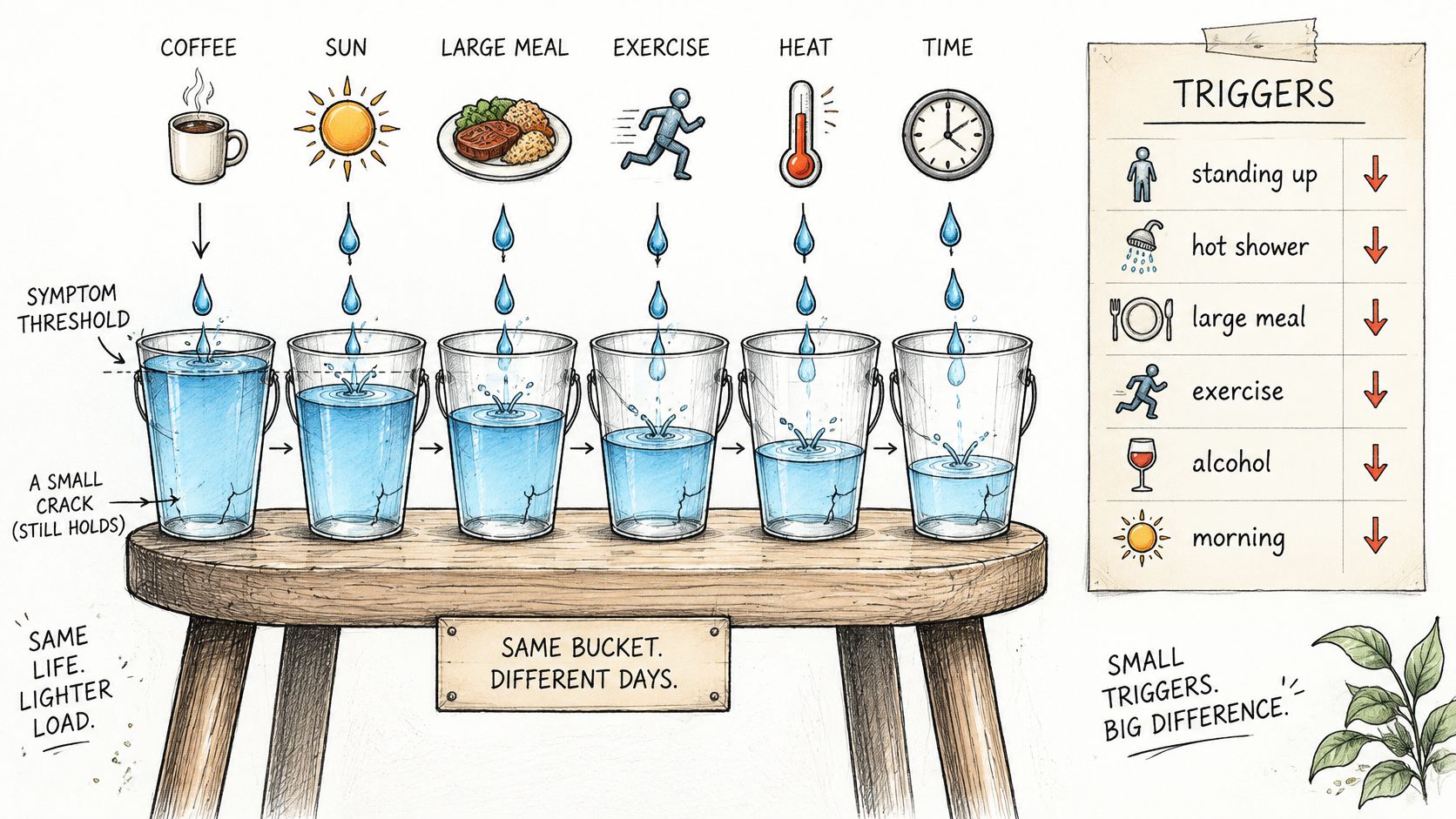
Common POTS triggers, timing and typical effect
Use these as prompts for observation, not a prediction of what you personally will experience.
| Trigger | When it usually shows up | Typical effect |
|---|---|---|
| Heat or hot baths and showers | Warm weather, afternoons, long soaks | Faster pulse and lightheadedness sooner after standing |
| Low fluid intake | Mornings or days with little drinking | Feeling faint on standing, fatigue |
| Low or unbalanced salt intake | Days after changes in diet | Symptoms that start earlier or feel stronger |
| Large meals | After heavy or large meals | Fullness, palpitations, feeling drained |
| Prolonged standing | Queues, long shifts, cooking, events | Lightheadedness and a racing pulse |
| Exercise and recovery | During or shortly after exertion | Heart-rate elevation that can resemble an orthostatic episode |
| Poor sleep or illness | After a bad night or during infection | Brain fog, weakness, a higher-than-usual resting pulse |
Separate a trigger from a coincidence
Start with the most obvious environmental details. Was the shower unusually hot? Had you been standing still for a long time? Record those facts before deciding that the day was a bad day.
Fluid and salt intake need similar care. Note changes from your usual routine, but don't treat symptom tracking as permission to make large dietary changes. Salt and fluid recommendations should fit your medical history and clinician's advice.
Meal-related symptoms deserve their own timing notes. Digestion redirects blood toward the gut, so note whether discomfort followed eating, standing afterward, or both. "Ate a large lunch, felt lightheaded ten minutes after standing up" gives a clinician more to work with than "felt bad in the afternoon."
A clinical discussion of practical POTS monitoring emphasizes posture-linked, sustained heart-rate changes with symptoms, while noting that exercise and recovery can independently raise heart rate. A pulse rise while climbing stairs therefore needs a different description from a rise while standing still after resting.
Poor sleep and illness can complicate the whole picture. If those circumstances aren't recorded, you and your clinician may struggle to distinguish an unusual day from a recurring upright pattern.
One dramatic episode settles very little, and one symptom-free day does not cancel a pattern either. The guide to POTS triggers offers additional prompts for organizing those observations. Look for recurring combinations rather than trying to identify a single culprit from an isolated event.
Conditions That Can Mimic POTS and How to Rule Them Out
The same racing pulse can point in different directions. It may reflect a posture-related circulatory response, dehydration, medication effects, or a heart rhythm problem. POTS requires both a compatible pattern and assessment for other explanations, not just an exclusion checklist.
A clinical review of POTS assessment emphasizes excluding alternative causes such as anemia, thyroid disease, medication effects, arrhythmia, and dehydration through clinical assessment, blood-pressure measurement, an ECG, and appropriate laboratory testing.
Conditions that overlap with POTS and the usual checks
| Condition | Overlapping symptoms | Usual check |
|---|---|---|
| Anemia | Fatigue, breathlessness, palpitations | Complete blood count and iron studies when indicated |
| Thyroid overactivity | Tremor, palpitations, weight change | Thyroid function tests |
| Dehydration | Lightheadedness, thirst, fatigue | Fluid history and blood-pressure check |
| Orthostatic hypotension | Lightheadedness, blurred vision, faintness on standing | Lying and standing blood-pressure measurements |
| Vasovagal syncope | Faintness, nausea, sweating after prolonged standing or stress | Clinical history; tilt-table testing when appropriate |
| Medication effects | Fast pulse, dizziness | Full medication review with timing |
| Heart rhythm problems | Palpitations, chest discomfort | ECG or ambulatory ECG monitor |
| Anxiety or panic | Palpitations, breathlessness | Pattern review and assessment for physical causes |
| Deconditioning | Exercise intolerance, fatigue | Activity and exercise history |
What each check helps clarify
Anemia can reduce oxygen-carrying capacity, making everyday activity feel unusually demanding. Thyroid overactivity can produce a fast pulse and shakiness beyond standing-related episodes, so symptoms outside upright periods matter too.
Dehydration may explain a temporary orthostatic response, which is why a fluid history matters. Orthostatic hypotension requires actual blood-pressure measurements; symptoms alone can't reliably distinguish it from other forms of orthostatic intolerance.
Vasovagal syncope is assessed through the sequence surrounding a faint, including warning symptoms and triggers. A tilt-table test isn't necessary for everyone, but it can help when the history leaves uncertainty.
Medication effects become easier to assess when you bring prescription medicines, nonprescription products, supplements, and their timing. Heart rhythm problems may require an ECG recording during symptoms, because a pulse graph alone doesn't identify the rhythm.
Anxiety or panic deserves thoughtful assessment rather than use as a default explanation. Deconditioning can contribute to exercise intolerance, but an activity history should include whether symptoms caused you to become less active in the first place.
These problems can coexist, although an alternative cause that fully explains the tachycardia must be addressed before labeling it POTS. The guide to POTS diagnosis and testing can help you prepare questions about which checks fit your history.
Red Flags That Need Urgent Care
Seek urgent medical assessment for chest pain or pressure, severe shortness of breath, a new irregular heartbeat, or fainting with injury or no clear trigger. If symptoms are severe, ongoing, or accompanied by collapse, contact emergency services rather than waiting for an appointment.
Don't assume a concerning symptom is POTS because you've had similar sensations before. A familiar label, including an established diagnosis, doesn't explain every new event.
- Fainting or near-fainting. Prompt assessment is especially important when episodes are unexplained, recurrent, cause injury, or occur during exertion.
- Chest pain or pressure. New or significant discomfort needs evaluation, particularly with breathlessness or feeling faint.
- A new irregular heartbeat. Palpitations accompanied by breathlessness, weakness, or near-collapse warrant urgent attention.
- Severe breathing difficulty. Don't try to interpret this through a wearable reading.
- Rapid deterioration. Symptoms that are getting noticeably worse need timely review rather than continued observation at home.
These signs don't mean you have POTS. They mean other causes need assessment first.
Chronic upright symptoms also deserve a clinical appointment when they disrupt school, work, showering, cooking, or other daily tasks, even without emergency warning signs. You don't need an alarming heart-rate number to justify asking for help.
This is guidance for seeking care, not a home diagnostic checklist. Don't delay treatment to finish a symptom log, capture another reading, or produce a more complete graph.
What to Track Before Your Appointment
A useful record lets a clinician reconstruct what happened without making you retell every difficult day. Keep it brief enough that you can maintain it when you're tired. A notebook or a simple app entry can work.
Safety first: Record naturally occurring symptoms when it's safe. Don't keep standing through near-fainting or deliberately provoke an episode to improve your notes.
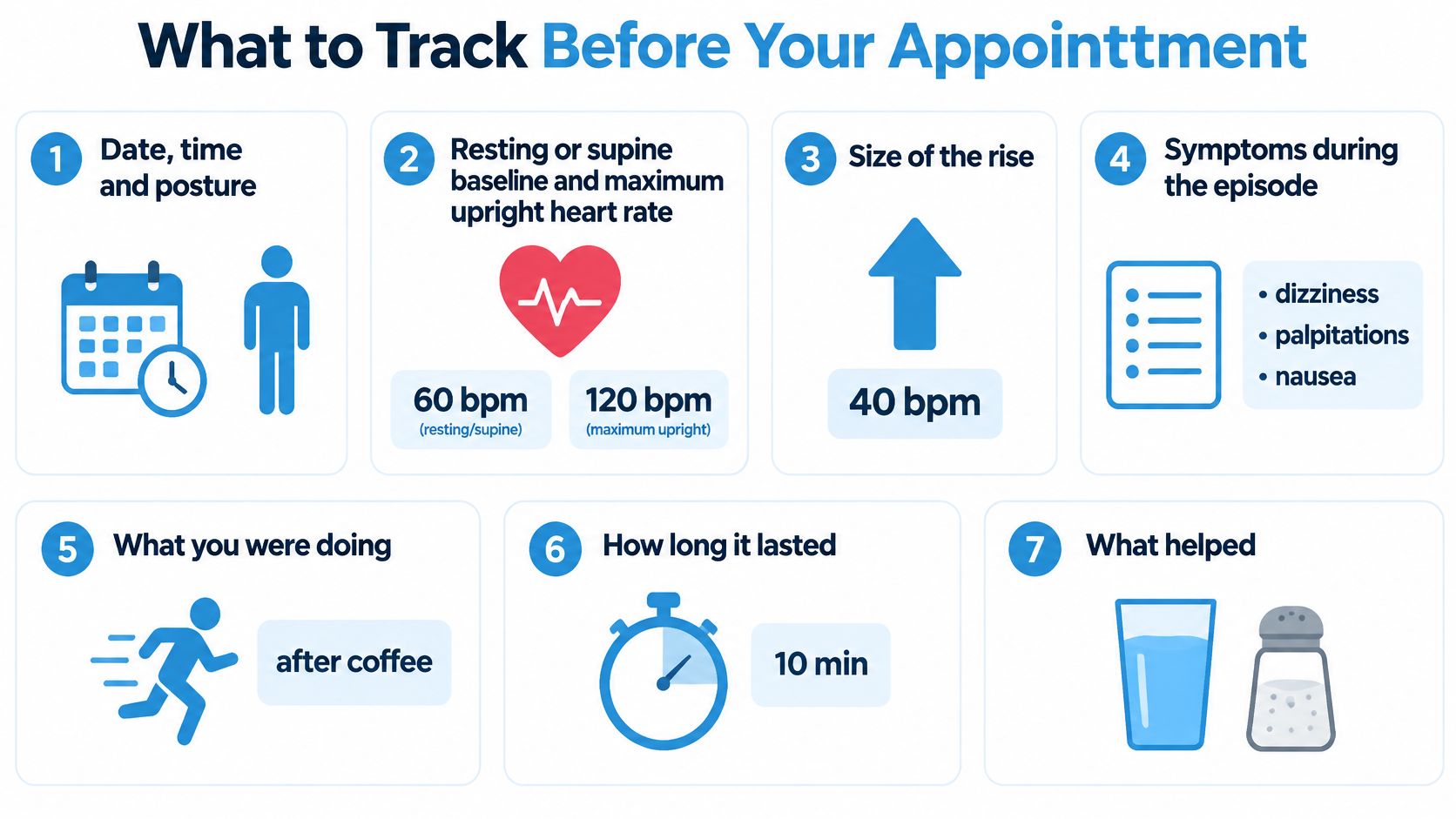
Build an episode record
Date, time, and posture. Note whether you were lying down, seated, standing still, or walking. Include the position you changed from, rather than writing only “got up.”
Resting baseline and maximum upright heart rate. Preserve the original readings if available. If you don't have a reliable baseline, say so instead of estimating one from memory.
Size of the rise and when it began. Record the difference between baseline and upright pulse, along with how soon you noticed the change after standing. Mark uncertain timing as approximate.
How long the elevation persisted. Distinguish a brief jump from an elevation that continued while upright. Note when you sat or lay down and whether symptoms changed afterward.
Symptoms and their impact. Write dizziness, palpitations, fatigue, brain fog, nausea, or whatever you experienced. Use consistent severity words such as mild, moderate, or severe, and add what you had to stop doing.
The surrounding circumstances. Include hydration, salt intake, sleep, medication timing, heat, prolonged standing, meals, illness, and recent exertion. Separate an episode during effort from one while standing still, and label recovery periods clearly.
A concise hypothetical entry might read: “Standing at the counter after a warm shower. Pulse rose from the resting reading and stayed high until I lay down. Felt shaky and couldn't finish making breakfast. Poor sleep; medication taken with breakfast.”
The entry doesn't need a conclusion. Avoid adding “definitely POTS” or “only anxiety”; those labels can obscure the observations you're trying to preserve.
Bring a summary, not just screenshots
Collect recurring observations over several days if you can do so without delaying care. Include relatively comfortable periods too, so your clinician can compare the circumstances rather than seeing only your worst moments.
Most consumer watches don't measure blood pressure, so their records can't confirm the absence of orthostatic hypotension. Reproducible clinical heart-rate and blood-pressure measurements remain necessary.
If you use Cardiogram, our episode log lets you add dizziness, palpitations, fatigue, and brain fog, along with hydration, salt, sleep, medications, and how you feel. Our PDF report brings episodes, trends, and symptoms together and states the exact criterion used; it's a tracking aid, not a diagnostic result.
Use the symptom journal guide to organize your notes, then book an appointment with the record, your medication list, and results of tests already completed. Existing results can help your clinician decide what needs repeating and what still needs checking.
Visit Cardiogram to organize heart-rate episodes alongside symptoms and everyday context. Bring its episode, trend, and symptom report to your appointment so you and your clinician can discuss the pattern rather than chase a single number.