You stand up from the couch to get a glass of water, and the room tilts. Your heart pounds as if you just ran for the bus, even though you only crossed the kitchen. You sit back down, and within a minute the pounding eases. That pattern, worse while you are upright and better once you lie flat, is one of the clearest clues that the body's automatic controls may be struggling.
Dysautonomia is the name for that kind of malfunction. It isn't one disease with one cause. It's a group of conditions that scramble signals for heart rate, blood pressure, digestion, sweating, and more. A watch can show the racing pulse. It can't, by itself, prove the diagnosis or tell a clinician which pattern you have.
What Dysautonomia Is and Who It Affects
Say you stand quickly after a long meeting. Your vision grays at the edges, your legs feel heavy, and your pulse jumps before you've taken three steps. Nothing in the room changed. What changed is the job your body does every time you leave a chair.
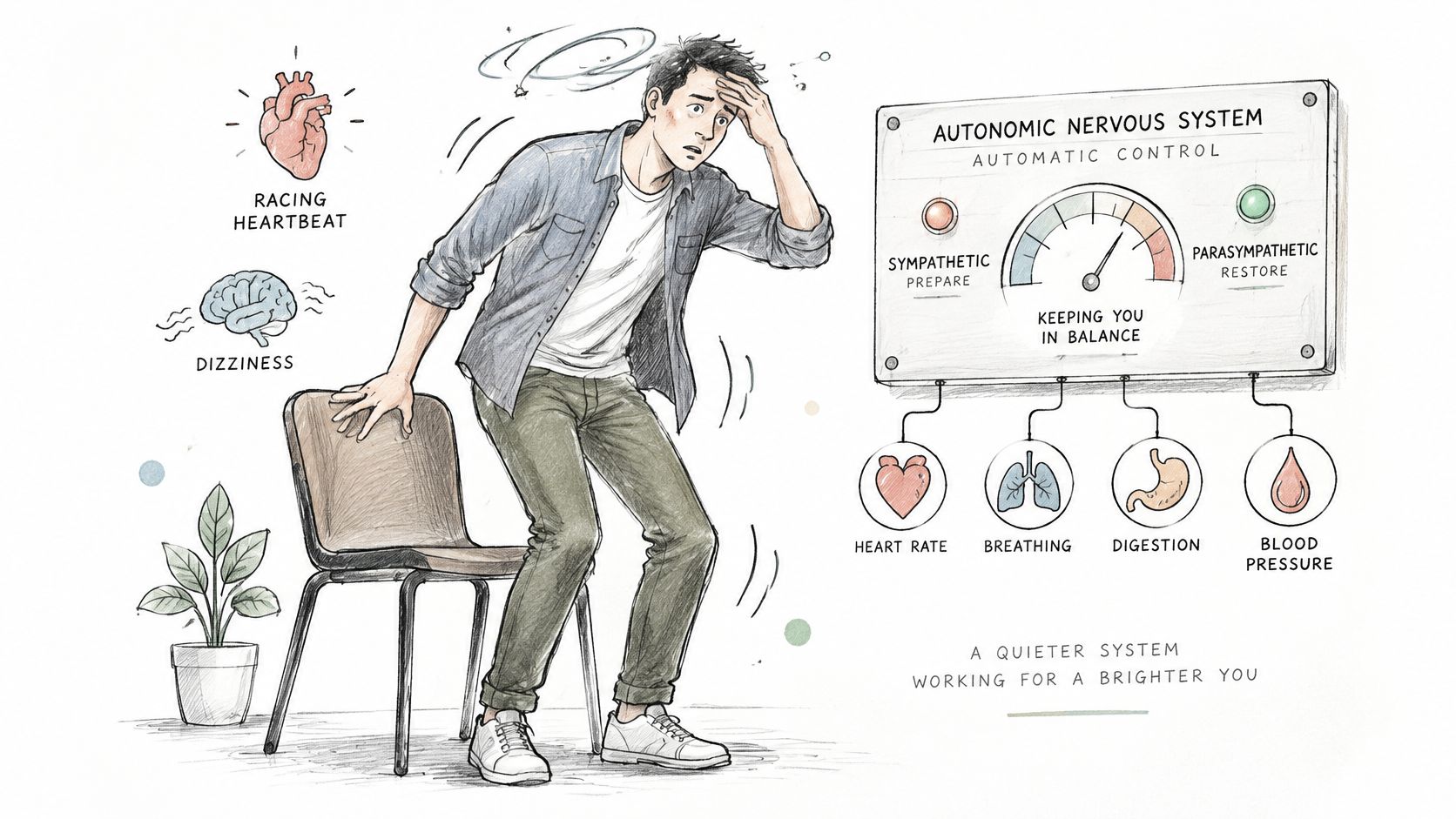
Think of the autonomic nervous system as an automatic control panel. You don't flip switches for heart rate, blood pressure, gut movement, sweating, temperature, or bladder tone. The panel does that in the background, all day. When the panel misfires, the result is dysautonomia: not a single illness, but a family of disorders in which those involuntary jobs go off script.
Because the label covers many conditions, there is no single accepted count of how many people have it. The best-known subtype, postural orthostatic tachycardia syndrome (POTS), is estimated to affect approximately 500,000 to 3,000,000 people in the United States, according to a review in PMC. That same review notes that POTS most commonly affects people aged 15 to 45, and that approximately 80% of affected patients are female.
Why the headcount stays fuzzy
Those figures are large enough to take seriously, and still too rough to treat as a global census. Studies don't use the same ages, recruitment methods, test protocols, or rules for how long symptoms must last. A clinic that tests only people who already feel faint on standing will find a different rate than a survey of healthy teenagers. Selected groups can look very different from a whole country, so those higher rates shouldn't be read as "one in ten people has this."
Practical rule: A big estimated range means the condition is common enough to ask about, not that every dizzy spell is POTS.
What you can take from the numbers is simpler. Millions of people in one country may be living with this pattern, women in the teen-to-midlife years show up most often in clinic series, and standardized counts that travel cleanly from one country to another still don't exist. If your own story sounds like that kitchen moment, the useful next move is to match the pattern, not to guess a percentage.
Dysautonomia Subtypes Compared at a Glance
Place your standing symptoms against a row before you try to name the condition. Two patterns get mixed up constantly, and they point clinicians in different directions.
| Subtype | Core Feature | Typical Pattern | Key Test |
|---|---|---|---|
| POTS | Heart rate rises 30+ bpm within 10 minutes of standing | Racing heart and light-headedness on standing, often in young women | Active stand or tilt test |
| Neurogenic orthostatic hypotension | Systolic blood pressure falls more than 20 mmHg on standing | Dizziness or faintness on standing, often with nerve disease | Standing blood pressure with monitoring |
| Vasovagal syncope | Reflex faint from a sudden drop in heart rate and blood pressure | Fainting after heat, pain, emotion or long standing | Medical history, tilt test if needed |
| Pure autonomic failure | Autonomic loss without other nervous system signs | Gradual onset, often midlife or later | Autonomic reflex testing |
| Multiple system atrophy | Autonomic failure with movement problems | Progressive, with balance and coordination changes | Neurological exam and autonomic testing |
| Familial dysautonomia | Inherited condition present from birth | Mainly in people of Ashkenazi Jewish descent | Genetic testing |
| Post-COVID dysautonomia | Autonomic symptoms after COVID-19 infection | Symptoms that began after the infection | Clinical assessment of heart rate and blood pressure |
The two rows people swap
POTS is defined by the heart-rate rise. Blood pressure stays up. You feel the race, the light head, the need to sit, and the cuff doesn't show a big drop.
Neurogenic orthostatic hypotension is defined by the blood-pressure fall itself. A systolic drop of more than 20 mmHg on standing is the core feature, often alongside known nerve disease. You can feel just as awful, and the number that matters first is pressure, not pulse.
A fast pulse with a stable pressure and a falling pressure with or without a fast pulse are not the same row. Bringing the wrong row to a visit sends the workup down the wrong path.
The other patterns on the list
Vasovagal syncope is a reflex faint. Heat, pain, a long stand in a queue, or a strong emotion can trigger a sudden drop in both heart rate and blood pressure. Many people have one or two faints in a lifetime and never develop a daily standing problem.
Pure autonomic failure builds slowly, often from midlife onward, without other nervous system signs such as tremor or coordination loss. Multiple system atrophy pairs autonomic failure with movement and balance changes, and it progresses. Familial dysautonomia is inherited and present from birth, mainly in people of Ashkenazi Jewish descent, and genetic testing is the key test.
Post-COVID dysautonomia is the row for autonomic symptoms that began after the infection. A 2023 Greek cross-sectional study of 122 people with post-COVID-19 syndrome found that 27.8% manifested post-COVID-19 dysautonomia. That figure describes that group, not everyone who had COVID-19. Timing still matters: symptoms that started after the illness belong in the history even when the final label is POTS or something else.
A hyperadrenergic pattern, with a racing heart plus tremor or a blood-pressure rise on standing, sits inside POTS rather than as its own row. A closer look at hyperadrenergic POTS symptoms helps if that mix sounds familiar.
Match the row to what happens when you stand, then take that row to the visit. You are not diagnosing yourself. You are handing over a cleaner starting point.
How POTS Makes the Heart Race on Standing
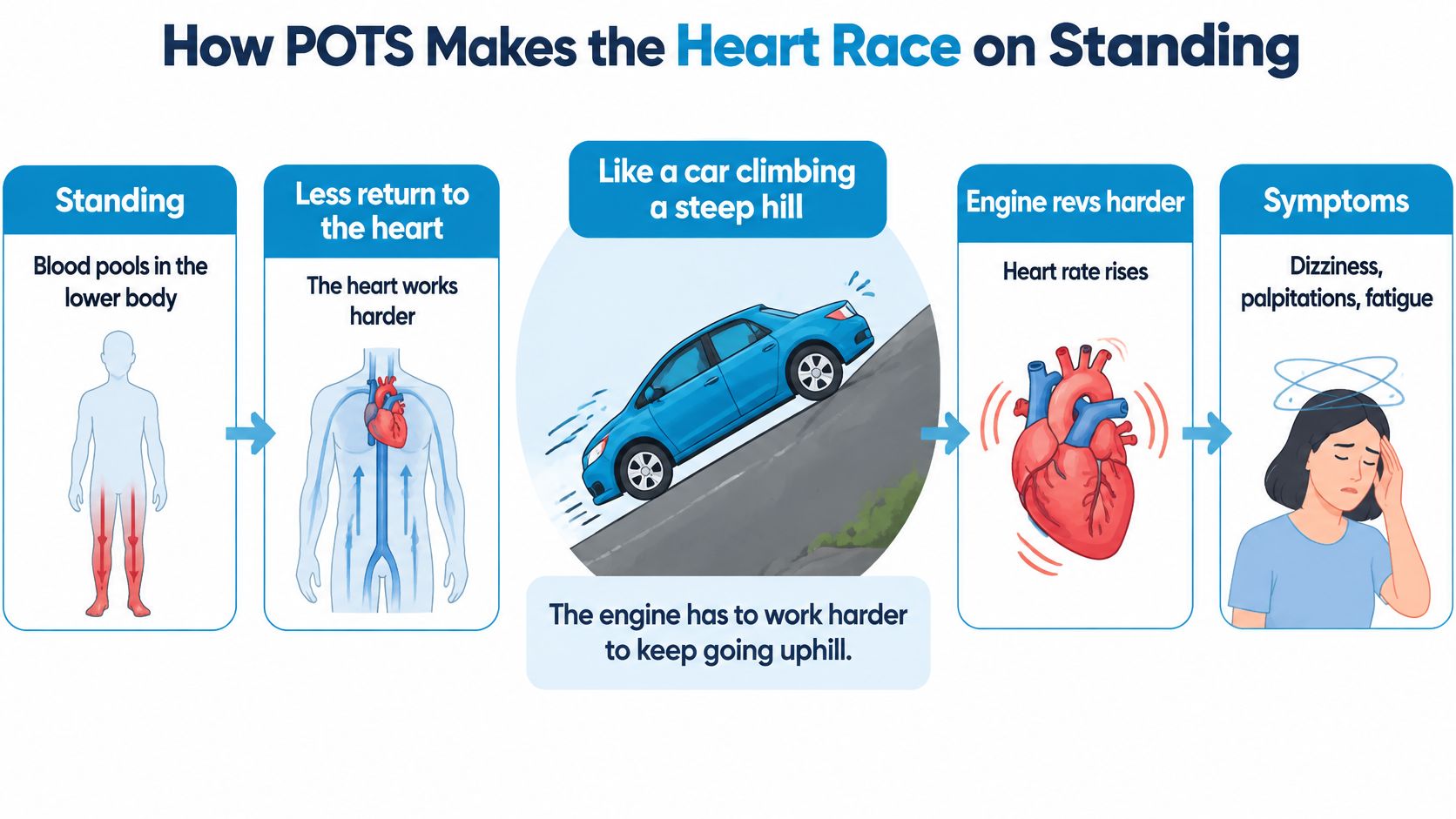
Picture a small car on a steep hill with a fuel line that can't keep up. The engine doesn't quit. It revs harder, louder, working past its comfortable range just to hold speed. Standing asks your circulation for a similar climb.
Gravity pulls blood toward your legs and abdomen. Less blood returns to the heart, so each beat sends out less. Sensors read that shortfall and the sympathetic system answers with a surge. Heart rate climbs to move the smaller amount of blood often enough to keep you upright. The revving is compensation, not a random glitch in the heart muscle.
Four ways the hill gets steeper
A StatPearls review describes POTS tachycardia as a shared final response from several mechanisms, not one disease process. Four patterns show up again and again.
- Low blood volume: Reported blood-volume reduction in POTS can range from approximately 10% to 30%. Less "fuel" in the tank means the engine revs sooner.
- Weak leg-vessel squeeze: If vessels in the legs don't tighten on standing, blood pools and return to the heart falls further.
- Deconditioning: Time in bed after illness shrinks the heart's pumping reserve, so ordinary standing costs more.
- Hyperadrenergic drive: A useful marker is standing plasma norepinephrine of at least 600 pg/mL, often with palpitations, tremor, anxiety, tachycardia, and a standing systolic-pressure rise of at least 10 mmHg.
Say you are a week past a stomach bug. You lost fluid, you ate little salt, and you barely left the sofa. At the kitchen counter your heart races hard enough that you grip the edge. The next morning, after broth and a quieter night, the same counter is easier. The posture didn't change. The tank and the squeeze did.
Hydration, salt balance, illness, sleep, and medication changes can all shift how often that revving shows up and how hard it feels. A pulse number with no context hides which of the four patterns was active that hour.
The same doorway can feel fine on Tuesday and unbearable on Thursday, because the compensation has several moving parts.
That is why a useful record ties each fast episode to what else was true, instead of treating the pulse as a lone score. The recording habits come next.
Symptoms That Show Up Across Body Systems
The control panel doesn't run the heart alone, so the symptoms don't stay in the chest. People often collect separate explanations, one for the gut, one for the fog, one for the heat, before anyone lines them up.
Heart and circulation
- Palpitations: A pounding or fluttering you notice most when you are on your feet.
- Light-headedness: The room dims or sways in the first minutes upright.
- Near-fainting: You feel you must sit or you will go down, even if you never fully black out.
Brain and thinking
- Brain fog: Sentences take longer, and focus slips while you are standing.
- Word-finding trouble: The word is there, then gone, then back once you lie down.
Energy and effort
- Fatigue out of proportion: A short errand costs the energy of a long day.
- Exercise intolerance: You need to sit or lie down far sooner than your fitness would suggest.
Gut
- Nausea and bloating: Fullness arrives after a few bites.
- Changing bowel habit: Constipation and diarrhea can trade places across the week.
Skin, temperature, and bladder
- Heat and sweat: You overheat in a warm room, or your hands and feet look cold and mottled.
- Bladder signals: Urgency, or a sense you didn't empty fully.
When the symptoms cluster
Most of these flare while you are upright, in heat, after meals, or late in the day, and they ease when you lie down. A hot shower, a large lunch, or a stuffy afternoon can be the trigger even when the morning felt ordinary. That timing is the pattern to write down, because a symptom list without the clock is easy to file under "vague."
A sudden stress on the body can unmask the same cluster. In a 2024 prospective study from Washington University researchers, 76 adults had colonoscopy with fentanyl–propofol sedation. Afterward, 23.7% (18 people) had orthostatic hypotension and/or POTS, and 18.4% reported orthostatic-intolerance symptoms. That result shows a procedure can reveal a standing problem. It does not mean sedation causes dysautonomia.
Picture a teacher who manages the morning, then fades after a long afternoon on their feet in a hot classroom with no water. By the last period their heart is racing, the board looks fuzzy, and nausea shows up on the drive home. Lying on the sofa settles it. The classroom didn't create a new disease each day. It stacked upright time, heat, and low fluid on a control panel that was already thin.
How Doctors Confirm Dysautonomia With Heart-Rate Criteria
A single high number on a watch is a clue. Confirmation is a sequence, and every stage has to agree with the others.
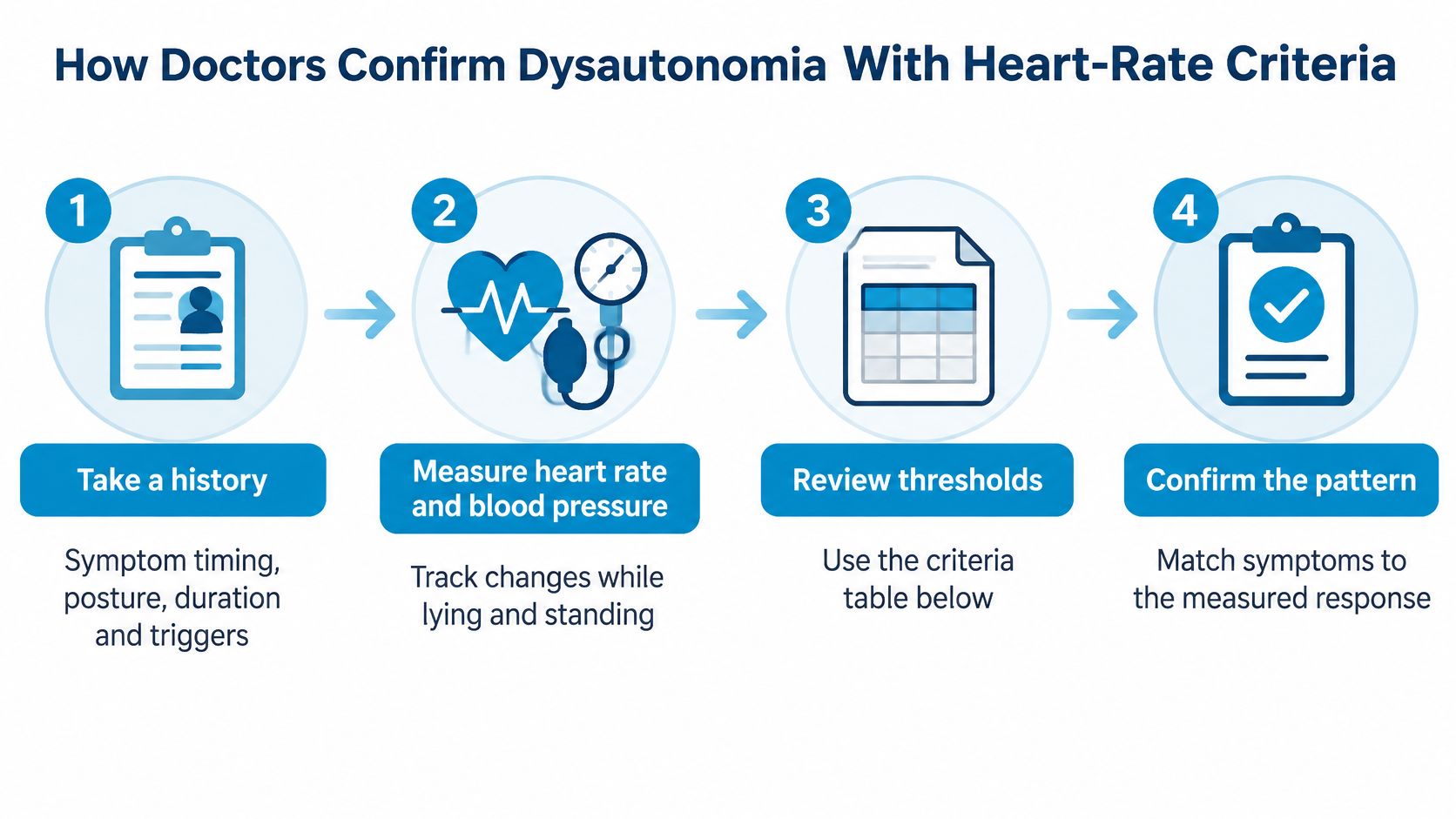
- Take the history. When do symptoms start, in what posture, how long do they last, and what sets them off? Heat, meals, standing still, and the first minutes out of bed belong in that story.
- Measure both numbers, in order. Heart rate and blood pressure come first while you are lying down, then after you stand or during a tilt. Keep the resting baseline, the peak, and the minute each one happened.
- Apply the age rule. Adults and teens don't share the same heart-rate bar. The table below is the reference, not a screenshot from one afternoon.
- Check that symptoms have lasted. A bad week during a fever is not the same as a pattern that has stayed for months.
- Rule out a blood-pressure fall. If pressure drops past the line in the table, the label changes even when the pulse is fast.
- Look for other causes. Anemia, thyroid disease, dehydration, medication effects, and acute illness can copy the same feelings and need their own checks.
A Canadian Journal of Cardiology review31550-8/fulltext) defines POTS as orthostatic symptoms for at least 3 months, with heart rate up by at least 30 beats per minute within 10 minutes of standing in adults, or at least 40 beats per minute in adolescents aged 12 to 19. The rise must be sustained, and it must occur without orthostatic hypotension: a systolic fall greater than 20 mmHg or a diastolic fall greater than 10 mmHg within 3 minutes.
| Group | Heart-rate Rise | Duration | Blood-pressure Rule |
|---|---|---|---|
| Adults | 30+ bpm within 10 minutes of standing | 3 months or more | No systolic drop over 20 mmHg or diastolic drop over 10 mmHg within 3 minutes |
| Adolescents aged 12-19 | 40+ bpm within 10 minutes of standing | 3 months or more | Same blood-pressure rule as adults |
| Adults with a blood-pressure fall | Rise may still occur | Any | Classed as orthostatic hypotension, not POTS, and evaluated separately |
| Single high reading or brief spike | Not sufficient on its own | Under 3 months | Not diagnostic; repeat under standardized conditions |
Where the 30-beat idea came from
The term POTS was first used in 1982, and Mayo Clinic researchers characterized the condition more formally in 1993, as traced in a later PMC review. Those original criteria came from an 80-degree head-up tilt of 16 symptomatic patients, including only 3 men, drawn from 188 people seen in an autonomic clinic. Later consensus statements kept the adult rise of at least 30 beats per minute and set at least 40 for adolescents aged 12 to 19. The number survived because clinicians kept testing it against posture, time, and symptoms, not because one small study settled the question.
A cuffless watch can flag candidate episodes and show time-of-day patterns. It cannot establish POTS. Diagnosis still needs symptom length, a posture-specific check, a blood-pressure reading that excludes a fall, and a look at anemia, thyroid disease, medicines, dehydration, and acute illness. If you want a walk-through of how clinics structure that visit, see this guide to POTS diagnosis testing.
One high reading is never enough. The heart-rate number counts only when duration, the blood-pressure rule, and the symptoms all line up.
Tracking Episodes at Home Without Over-Reading Them
A single heart-rate reading tells you almost nothing. A dated log tells a story a clinician can test.
Consumer hardware can miss beats, lag, or drift, especially during movement or when the sensor loses skin contact. Treat every alert as a candidate, not a verdict. Our detection flags a 30+ bpm rise within 5 minutes, then logs the baseline, the peak, and how long the rise lasted, and you can add symptoms as they happen. That 5-minute flag is a net for review. It is tighter than the clinical 10-minute window, so it will not match every formal test, and it will also catch rises you should throw out.
What to write next to each episode
- Posture: Note whether you had just stood, were still standing, or were already walking.
- Symptoms in the moment: Dizziness, palpitations, fatigue, and brain fog, named while they are happening, beat a summary written at night.
- Fluid, salt, and sleep: You can log hydration, salt, sleep, medications, and how you feel, then set those notes beside the heart-rate trace.
- Meals, heat, and pills: A large lunch, a hot shower, or a dose taken an hour earlier often explains a cluster.
- Exercise and recovery: Keep workouts and the cooldown after them out of the episode list. A run is supposed to raise your pulse.
Build the habit for two weeks before you look for a pattern. Say the first week shows four flagged rises. Two came during a commute walk, so they leave the list. The other two hit within eight minutes of standing, both on days under two liters of fluid, both with dizziness written at the time. Week two adds three more after hot showers and none on the days you salted breakfast. That is a pattern. Forty unlabeled spikes are not.
More data adds confusion when you skip the filter. State the rule in plain words at the top of any summary you share: what rise you counted, over what window, and that workouts were removed. A clinician can then see what you measured and what you left out.
Bring three things, not the raw dump. A weekly summary, the triggers that repeat, and two or three questions the log raises. "Do these standing rises, with no logged pressure drop, justify a formal stand test?" is a useful question. "Is my watch broken?" usually isn't. A simple symptom journal structure keeps those fields in the same order every day, which is what makes week one comparable to week two.
Treatment Principles That Ease Symptoms Day to Day
Medication is a later lever. The plan works better when the subtype and the main trigger pick the first move, and when you can see whether a change helped.
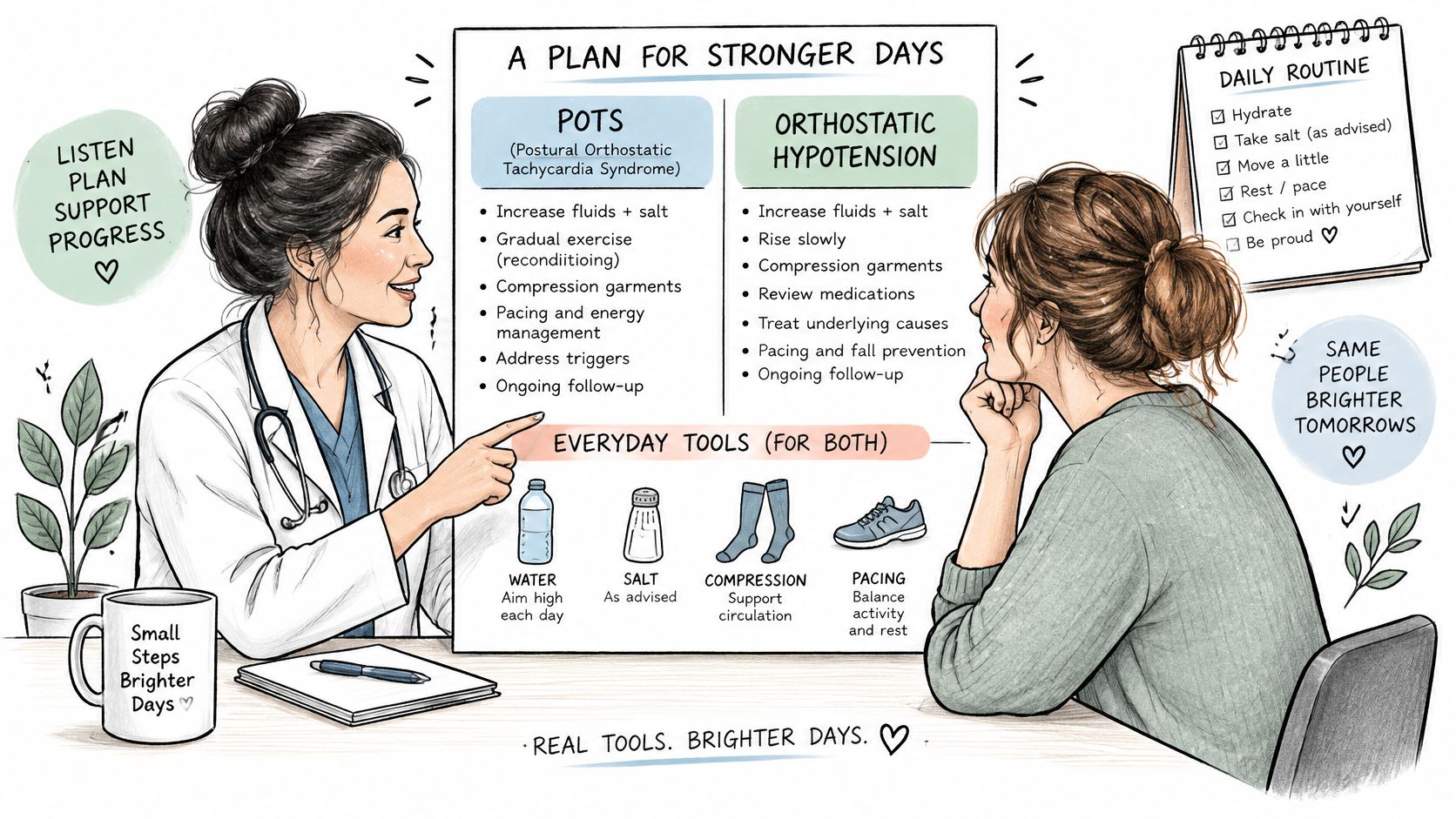
Match the plan to the row. POTS, with a fast heart and stable pressure, and orthostatic hypotension, with a falling pressure, don't share one recipe. Compression and volume help many people in both groups, but a drug that raises pressure is a poor fit for someone whose pressure already climbs on standing. If your log shows the worst hours after heat and low fluid, start there. If the worst hours are a tremor-heavy surge, that is a different conversation with the specialist.
Build volume and circulation before you add a pill. Low blood volume is common in POTS, which is why fluid and salt targets belong in the plan, set with a clinician who knows your kidneys and blood pressure. Compression garments on the legs and abdomen reduce pooling while you are upright. Reconditioning starts seated or lying down, then moves toward standing work as symptoms allow. Long still standing and hot rooms stay on the avoid list. Regular sleep and steady meal timing remove two triggers you can schedule.
Medicines are selected, not borrowed. Beta blockers, ivabradine, midodrine, and fludrocortisone each help some people and bother others. A specialist weighs side effects against your subtype. Don't start, stop, or swap them because a friend improved. Your log is the comparison: count episodes for a few weeks before a change and for a few weeks after, with the detection rule held still so you aren't comparing different nets.
Say a nurse adds an electrolyte drink each morning, wears compression tights on shifts, and keeps the same bedtime. Four weeks later the standing episodes on workdays are fewer, and the off days barely change. That split tells you the shift conditions were the lever, not a random good month. Someone whose row is a blood-pressure fall may need a different garment plan and different drugs, and may improve on a different clock.
Improvement is often measured in weeks to months, and two people with similar pulse spikes can need different tools.
If a change does nothing after a fair trial, that result is still useful. It tells the next visit what not to repeat.
Confirm Your Next Step Before the Appointment
Waiting feels passive. It isn't. In a 2025 Australian registry study of 500 people, women waited an average of 7.0 years for a POTS diagnosis, compared with 3.8 years for men. 25.5% reported delays longer than 10 years. Reporting on that study also said that 70% of women initially had symptoms dismissed as anxiety or a psychosomatic illness. The same registry tied POTS to unemployment, less ability to do usual activities, fewer social outings, and low quality of life. Delay isn't paperwork. It is years of a smaller life.
A dated log pushes back on that dismissal without pretending a wearable printout is a diagnosis. Memory blurs which mornings were worst. A timestamp doesn't. Over the next 30 days, build a packet: the weekly summaries, a one-page symptom list, every medicine and supplement with the hour you take it, and any standing blood-pressure readings you already have. Patterns across sleep, fluid, meals, and heat give a clinician a reason to order a formal stand test or to chase anemia and thyroid disease first.
Who to see, and what not to postpone
Primary care can screen and refer. Cardiology or electrophysiology fits when the question is heart rhythm. Autonomic clinics take complex cases, and they are unevenly spread, so a complete packet matters more when the wait is long. Caregivers can note episodes you are too foggy to write down and can sit in the visit so the timeline gets said once, clearly.
Dysautonomia International publishes education and research updates you can read while you wait. Local POTS and dysautonomia support groups, plus regional cardiology or autonomic centers, are the practical next names to collect. None of them replaces the clinician who can examine you.
Some symptoms should not sit inside a 30-day plan. Fainting that causes injury, chest pain, breathlessness, confusion, or new weakness or numbness on one side needs urgent care. Those can look like an autonomic flare and still be something that cannot wait.
Three questions finish the packet. Which subtype row fits what happens when you stand? Which measurements are still missing, usually blood pressure on standing? Which clinician should you see first? Answer those on paper before you book, and the visit starts from evidence instead of from a shrug.
Cardiogram is built for people with POTS and dysautonomia who need heart-rate rises turned into dated episodes, not a pile of unlabeled spikes. You can pair those episodes with symptoms, fluid, salt, sleep, and medicines, then export a summary that states the detection rule for your clinician. If you are ready to make the next month of readings usable, visit Cardiogram.