Sinus tachycardia is a regular heart rhythm that starts in the heart's natural pacemaker, the sinoatrial node, at a resting rate above 100 beats per minute in adults. The usual adult resting range is 60 to 100 beats per minute, and a regular rhythm above that upper line gets the label.
So why does the same reading earn a shrug when you've just climbed four flights of stairs and a same-day referral when you're sitting still?
Because a faster rate is often the body doing exactly what it should. A watch buzzes, a number appears, and the mind jumps to "something is wrong with my heart" when the heart may be meeting a demand for more blood flow.
Sinus tachycardia is a description of a rhythm, not a diagnosis. Think of the word "fast." Fast on a racetrack and fast in a school zone are the same speed in two completely different situations. What matters is context, and whether the rate comes back down when the context changes.
What is sinus tachycardia is the kind of question that sounds like it wants a yes or no. The honest answer comes in three parts: where the beat started, how fast it's going, and why.
That third part, the why, is the one worth learning to read.
What Sinus Tachycardia Means in Plain Terms
Sinus tachycardia means the heart's own pacemaker is firing faster than 100 beats a minute and the beat it produces stays regular.
The "sinus" part names the sinoatrial node, a small patch of tissue in the upper right chamber that sets the tempo for every heartbeat. When it fires above the adult threshold, the rhythm carries that name. When it fires between 60 and 100, it's ordinary sinus rhythm. The wiring doesn't change. Only the tempo does.
The 100 line deserves a caveat, because people treat it like a wall with a guard posted on it. The commonly cited adult resting range of 60 to 100 beats per minute is, as a clinical review of sinus tachycardia describes it, a practical consensus rather than a sharply defined biological cutoff. A person who rests at 98 and a person who rests at 102 are not on opposite sides of a medical event. They're inside the ordinary spread of human variation.
| Measure | Threshold | What it means |
|---|---|---|
| Normal adult resting range | 60-100 bpm | Commonly cited range; the upper edge is a practical consensus |
| Sinus tachycardia in adults | Above 100 bpm, regular rhythm, normal P wave before each QRS | Starts at the sinus node and is often an appropriate response |
| Persistent rate above 100 at rest | Repeats without a clear cause | Warrants assessment rather than waiting |
Why the Number Alone Doesn't Answer Much
A heart rate is a reading, and readings need context the way a temperature needs a known thermometer placement. Above 100 during exertion is expected. Above 100 while you're lying on the sofa is a question.
That's the fork in the road. During exercise, emotional stress, pain, fever or a drop in circulating volume, the fast rate is the mechanism doing its job: it raises cardiac output to match demand. The rhythm is the response, not the problem. When the elevation is persistent or unexplained at rest, a clinician starts looking for the reason sitting behind it.
The working question: not "is my heart rate over 100?" but "what was I doing, and does it settle when I stop?"
A Five-Minute Self-Check
Before you read anything into a single reading:
- Sit still for five minutes. No phone in hand, no stairs in the last ten minutes.
- Count your pulse for 30 seconds at the wrist or neck, then double it.
- Note the conditions. Were you stressed, unwell, dehydrated, short of sleep, or recently active? Had you had coffee, a decongestant, or a vape?
- Repeat it tomorrow at the same time, in the same posture.
One high reading is a data point. A pattern across several days is information a doctor can use. Everything comes down to two questions: why is the rate up, and does it come down on its own.
How the Heart Sets a Fast Sinus Rhythm
Think of the sinoatrial node as a metronome with a dial on the side. Left alone at rest, it clicks along somewhere in the 60 to 100 range. The dial is your autonomic nervous system, and it turns in both directions.
Here's the chain from a demand signal to a fast sinus beat on paper.
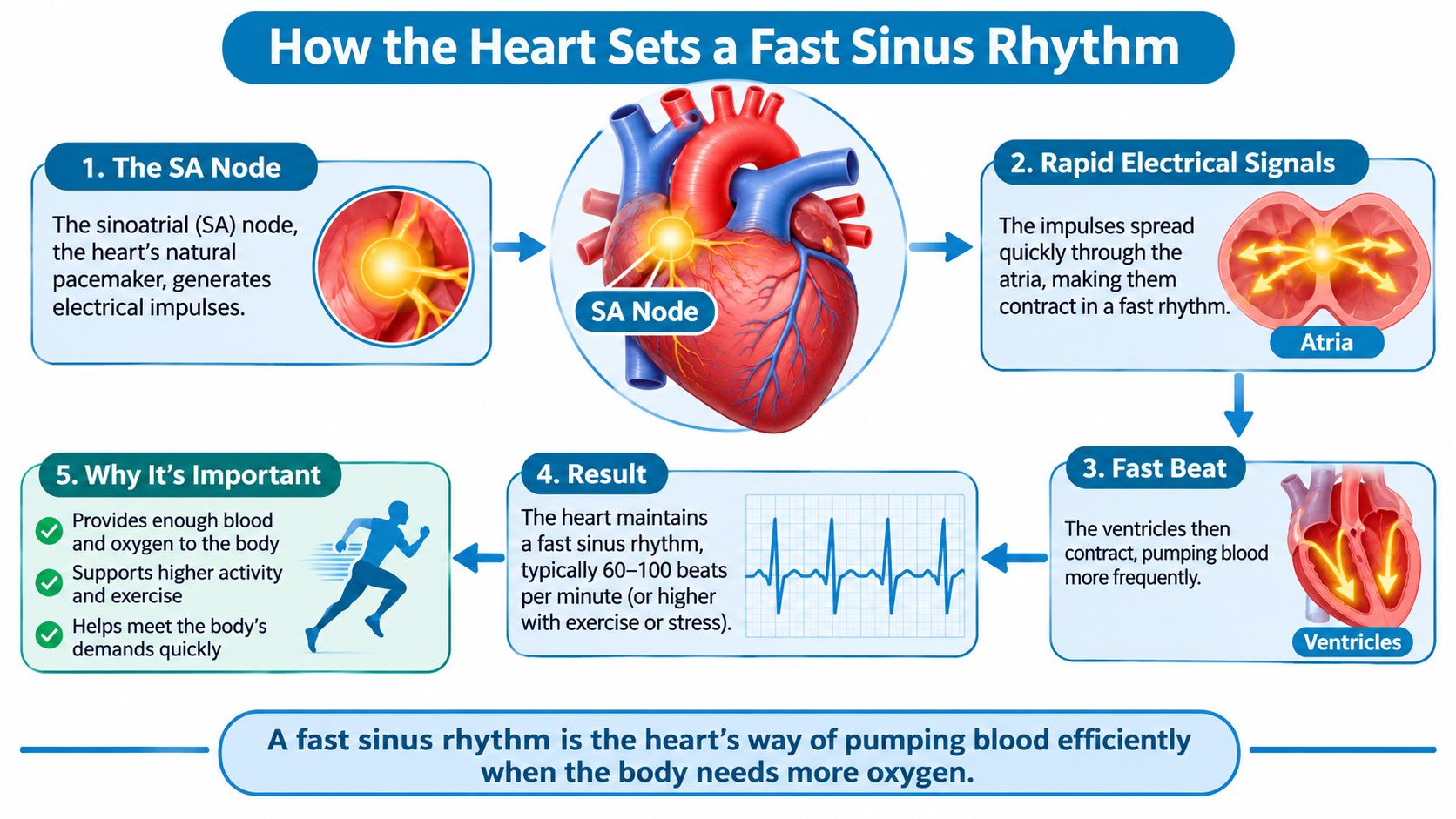
When you take the stairs two at a time, your muscles need more oxygenated blood within seconds. Sympathetic activation turns the dial up, the node fires more often, and cardiac output rises. Sit down and the opposite happens, though not instantly. The rate tends to climb and ease over a minute or two rather than switching on and off, which is one reason a jump from 70 to 160 with no build-up reads differently to a clinician than a gradual climb.
What the P Wave Tells a Clinician
On an ECG, every normal beat shows a small bump called the P wave before the tall spike, the QRS complex. That bump is the electrical signature of the atria being activated from the sinus node. A normal-looking P wave ahead of every QRS is the proof that the signal started in the right place.
Fast rhythms that begin elsewhere can look different: irregular spacing, no visible P waves, or a rate that starts and stops like a switch. That's the line between sinus tachycardia and several other tachyarrhythmias, and it's why a wearable can flag a rate without ever naming a rhythm.
Three Everyday Examples
- The staircase. You climb four flights, your pulse reaches 130, and within a couple of minutes of sitting it's back near 80. Proportional, brief, self-correcting.
- The flu. Fever raises metabolic demand, so the resting rate drifts upward for a few days, often higher than the fever alone would explain. It settles as the illness does.
- The long, dry day. A hot afternoon, two coffees, no water, and a resting rate in the low 100s by evening. Low circulating volume, and a heart compensating for it.
A fast pulse is not automatically a heart problem. It's a message about demand, and reading the message means looking at what the body was asking for.
Common Triggers From Harmless to Serious
Most fast heart rates have an obvious cause, and most of those causes are temporary. The table below sorts the common ones by how they behave, so you can match what you noticed to a pattern and see where the line sits for getting help.
| Trigger | Typical pattern | When to look further |
|---|---|---|
| Exercise or climbing stairs | Rate rises with effort and settles within minutes of rest | Rate stays high long after you stop |
| Anxiety, stress or excitement | Comes on with a stressful moment and eases as you calm down | Keeps happening at rest with no clear reason |
| Fever or infection | Rises with body temperature, often with other illness signs | Persistent fever, confusion or breathing trouble |
| Pain or injury | Eases as the pain is treated | Unexplained chest pain or a rate change after trauma |
| Dehydration or low blood volume | Worse when standing, after heat, vomiting or diarrhea | Dizziness or fainting, or no improvement with fluids |
| Anemia or bleeding | Often with tiredness, pale skin or breathlessness | Heavy bleeding, black stools or ongoing fatigue |
| Caffeine, nicotine, decongestants or stimulants | Begins within about an hour of intake | Lasts long after the substance wears off, or occurs with no intake |
| Hyperthyroidism | Ongoing fast resting rate with weight loss, tremor or heat intolerance | Any persistently high resting rate |
| Low blood oxygen or lung disease | Breathlessness, cough or bluish lips | Any new or worsening breathlessness |
| Pulmonary embolism | Sudden breathlessness, chest pain or leg swelling | Emergency; call emergency services |
| Heart failure or other heart disease | Breathlessness lying flat, swelling or fatigue | Needs prompt cardiology review |
How to Read the Table
Three things separate a harmless trigger from one that needs attention: time course, whether the rate settles once the trigger is gone, and whether symptoms arrive with it.
Caffeine, nicotine, decongestants and stimulant drugs are the fastest movers. A rate that climbs within about an hour of intake and eases as the substance clears is behaving the way the pharmacology predicts. If you want the timing detail, how caffeine affects heart rate walks through it, hour by hour. Stopping the substance for a few days is the cleanest test available, and it costs nothing.
Reversible medical causes come next. Anemia, dehydration, fever and low blood oxygen all push the rate up through the same final pathway, and all four are things a clinician checks for rather than guesses at.
The rule of thumb: a trigger you can name and remove is good news. A rate that stays high after the trigger is gone is the reason to book an appointment.
The Serious End of the List
Three entries deserve their own sentence. Pulmonary embolism can arrive as sudden breathlessness, chest pain or a swollen leg, and it is an emergency. Heart failure often announces itself with breathlessness when lying flat, ankle swelling and unusual fatigue. Hyperthyroidism produces a resting rate that stays high alongside weight loss, tremor or heat intolerance.
None of those is diagnosed by a pulse reading. All of them are reasons to stop waiting for it to pass.
Symptoms You Might Feel and What They Suggest
Not everyone feels anything. Some people learn their rate sat at 120 for an hour because a watch said so, and they felt entirely normal throughout. Others feel every single beat.
The common sensations:
- A racing or pounding heartbeat in the chest or throat, sometimes loud enough to feel through a pillow.
- A fluttering feeling, which is more often an irregular rhythm than plain sinus tachycardia and deserves an ECG.
- Lightheadedness or a floaty feeling, especially on standing up.
- Shortness of breath that's out of proportion to what you were doing.
- Fatigue and sweating, the two symptoms people most often dismiss.
- A wave of anxiety that arrives with the rate. It's usually a companion of the fast pulse rather than its cause.
What Symptoms Do and Don't Tell You
Symptoms help a clinician match a rate to a context. They don't settle the diagnosis on their own, because the same pounding sensation can come from a strong coffee, a fever, or a thyroid problem.
One pattern specialists track separately is inappropriate sinus tachycardia, where the resting rate remains high without an obvious physiological trigger. Guidance published in the American Heart Association's circulation and electrophysiology journal recommends a 12-lead ECG to confirm the sinus P-wave pattern and exclude atrial tachycardia or other supraventricular rhythms before that label applies, followed by targeted evaluation for reversible causes. The label comes last, not first.
Describing an Episode So a Doctor Can Use It
When it happens, note five things: when it started, how long it lasted, what you were doing, what you'd eaten, drunk or taken, and what made it ease. That's the difference between "my heart races sometimes" and a description someone can act on.
Symptoms that show up on standing rather than at rest point somewhere more specific.
How Doctors Confirm a Sinus Rhythm
A workup isn't one test. It's a sequence that narrows from "the rate is high" to its cause, and each step answers a question the previous one raised.
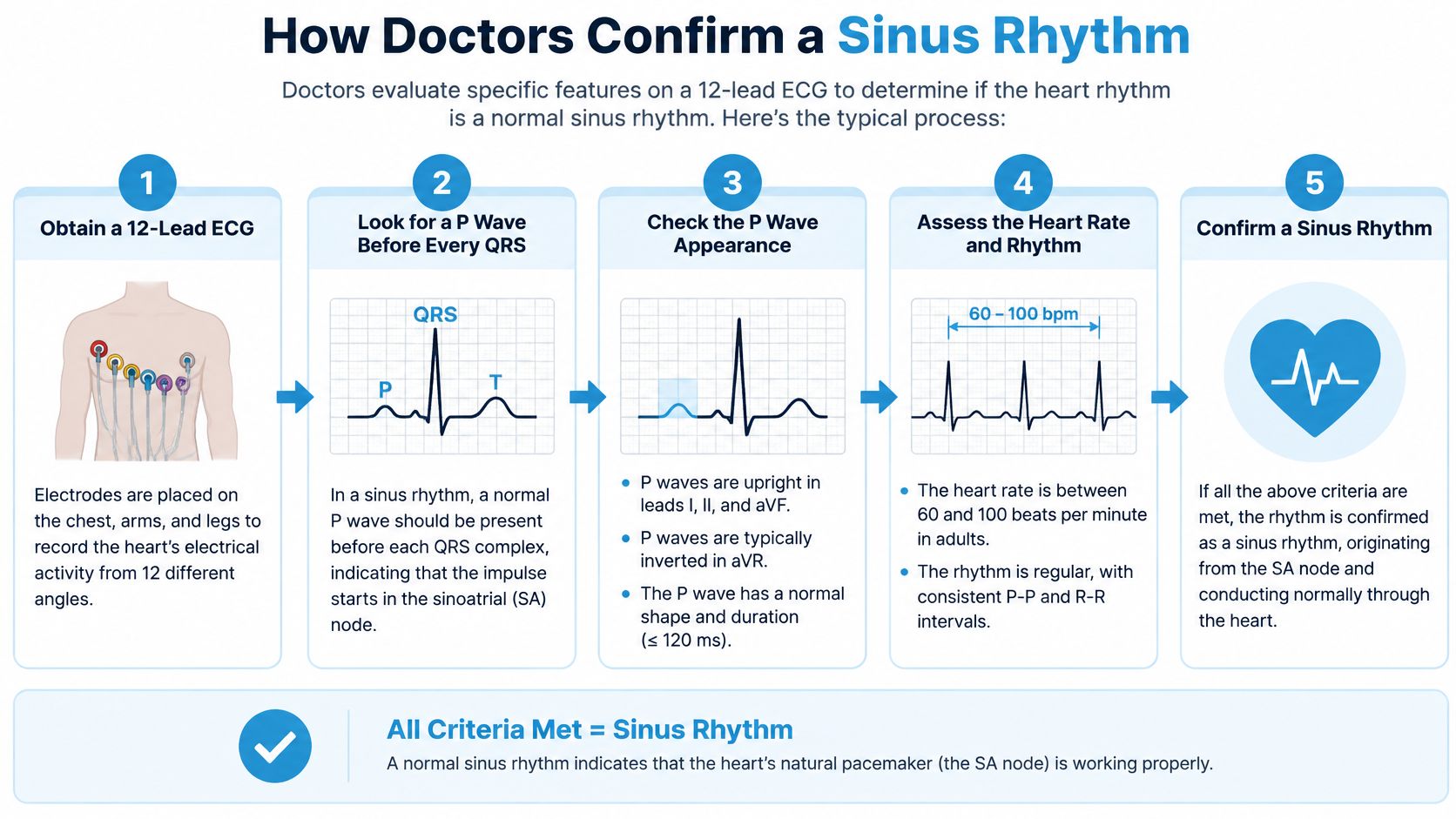
Step 1 is a 12-lead ECG. As the clinical reference on sinus tachycardia explains, the tracing shows whether each normal-appearing P wave precedes a QRS complex, which separates sinus tachycardia from supraventricular tachyarrhythmias driven by re-entry or abnormal atrial activation.
Step 2 is a medication and substance review. Prescriptions, over-the-counter decongestants, supplements, caffeine, nicotine and recent illness sit among the most common reversible causes, and checking them costs nothing.
Step 3 is blood work. A complete blood count for anemia and blood loss, electrolytes and kidney function for hydration and medication effects, glucose, and thyroid testing when the resting rate stays high.
Step 4 is oxygen saturation plus a lung check, with chest imaging or clot testing when the story points that way.
Step 5 is longer monitoring or an echocardiogram when episodes come and go, or when structural heart disease is suspected.
What Each Test Answers
| Test | What it checks | When it is typically used |
|---|---|---|
| 12-lead ECG | Confirms the P wave before each QRS and the rhythm pattern | First test for any fast heartbeat |
| Complete blood count | Anemia and blood loss | When fatigue, bleeding or pallor is present |
| Electrolytes and kidney function | Potassium, sodium and hydration state | When dehydration or medication effects are possible |
| Thyroid tests | Overactive thyroid | When the resting rate stays high |
| Blood glucose | Low blood sugar | When symptoms are unexplained |
| Oxygen saturation | Blood oxygen level | At any visit with breathlessness |
| Holter or extended monitoring | Rhythm over a day or more | When episodes are intermittent |
| Echocardiogram | Heart structure and pumping function | When heart failure or valve disease is suspected |
| Chest imaging and D-dimer testing | Lung causes such as pulmonary embolism | When the history points to the lungs or a clot |
Where Wearable Data Fits
A watch can show timing, recurrence, posture-related patterns and how symptoms line up with rate. What it can't do is establish that a rhythm started in the sinus node, exclude an arrhythmia, or stand in for an ECG.
The cause matters more than the number. Persistent, unexplained tachycardia at rest is a reason to be seen, not a reason to wait and see. If you're unsure what a tracing can and can't reveal, what an EKG can show about heart problems is worth ten minutes before your appointment.
Treating the Underlying Cause
Treatment targets the cause, not the number on the screen. In most cases the rate falls on its own once the trigger is handled, which makes the order of steps matter.
- Remove the chemical trigger. Cut back caffeine, nicotine, decongestants and stimulant products. Review every prescription and over-the-counter medicine with a clinician before changing anything, since beta-blocker withdrawal can itself drive a fast rate.
- Restore volume. After vomiting, diarrhea, heat or poor intake, fluids and salt rebuild circulating volume. Rest until the dizziness passes.
- Treat anemia or bleeding. Iron replacement for iron-deficiency anemia, and urgent care for active bleeding.
- Manage the thyroid, the infection, or the oxygen problem. An overactive thyroid, a fever and low blood oxygen each need their own treatment pathway.
- Follow the specialist route for heart failure or pulmonary embolism. Neither is a watch-and-wait condition.
One caution worth repeating: rate-slowing drugs such as beta-blockers should never be started or stopped without a prescriber. The right choice depends on why the rate is high, and the wrong one can mask a cause or destabilize blood pressure.
If the rate stays high after the cause has been treated, that's your cue to go back to the workup rather than accept the number as your new normal. The outlook is generally good when the underlying cause is found early.
Standing Heart Rate and POTS
Standing is where a fast sinus rate becomes a recognizable clinical pattern. In postural orthostatic tachycardia syndrome (POTS), a form of dysautonomia, the rate climbs further after getting upright than the body needs. The mechanism can involve impaired peripheral vasoconstriction, venous pooling, reduced effective circulating volume, autonomic dysfunction, or compensatory sympathetic activation.
The consensus criteria, as set out in a review of orthostatic tachycardia and POTS, run as a sequence rather than a single number:
- A sustained rise of at least 30 beats per minute within 10 minutes of standing or head-up tilt in adults, or at least 40 beats per minute at ages 12 to 19.
- Symptoms of orthostatic intolerance for at least six months.
- Symptoms that improve when you lie down.
- No sustained orthostatic hypotension, defined as a blood-pressure fall greater than 20/10 mmHg.
An upright rate of at least 120 bpm may accompany the rise, but it doesn't decide the diagnosis. A 30-day wearable study of posture and heart rate found mean increases on standing ranging from 6.60 to 27.02 bpm in healthy controls and 8.15 to 27.71 bpm in people with hypermobile Ehlers-Danlos syndrome, as reported through Purdue University's data repository. The ranges overlap, and plenty of people below the threshold still feel awful on standing.
Before any POTS label sticks, exercise, panic, pain, caffeine, alcohol, dehydration, anemia, thyroid disease and beta-blocker withdrawal have to be ruled out. Those 30 and 40 bpm figures are reference points, not diagnostic criteria in themselves.
Keep a log with the resting baseline, the time after standing, the peak rate, how long it lasted, symptoms, and confounders such as a workout or a missed meal. That's supporting evidence for a clinician, not proof of anything on its own.
Heart-rate data from consumer hardware can be incomplete, delayed or inaccurate, particularly during movement or with poor sensor contact. Formal confirmation comes from a standardized stand or tilt test in clinic, not from a watch graph. If the symptoms described here sound like your own, this guide to POTS and postural orthostatic tachycardia syndrome symptoms sets out what to track before your appointment.
Know When to Get Checked Right Away
The decision comes down to three tiers, and the boundaries are practical rather than academic.
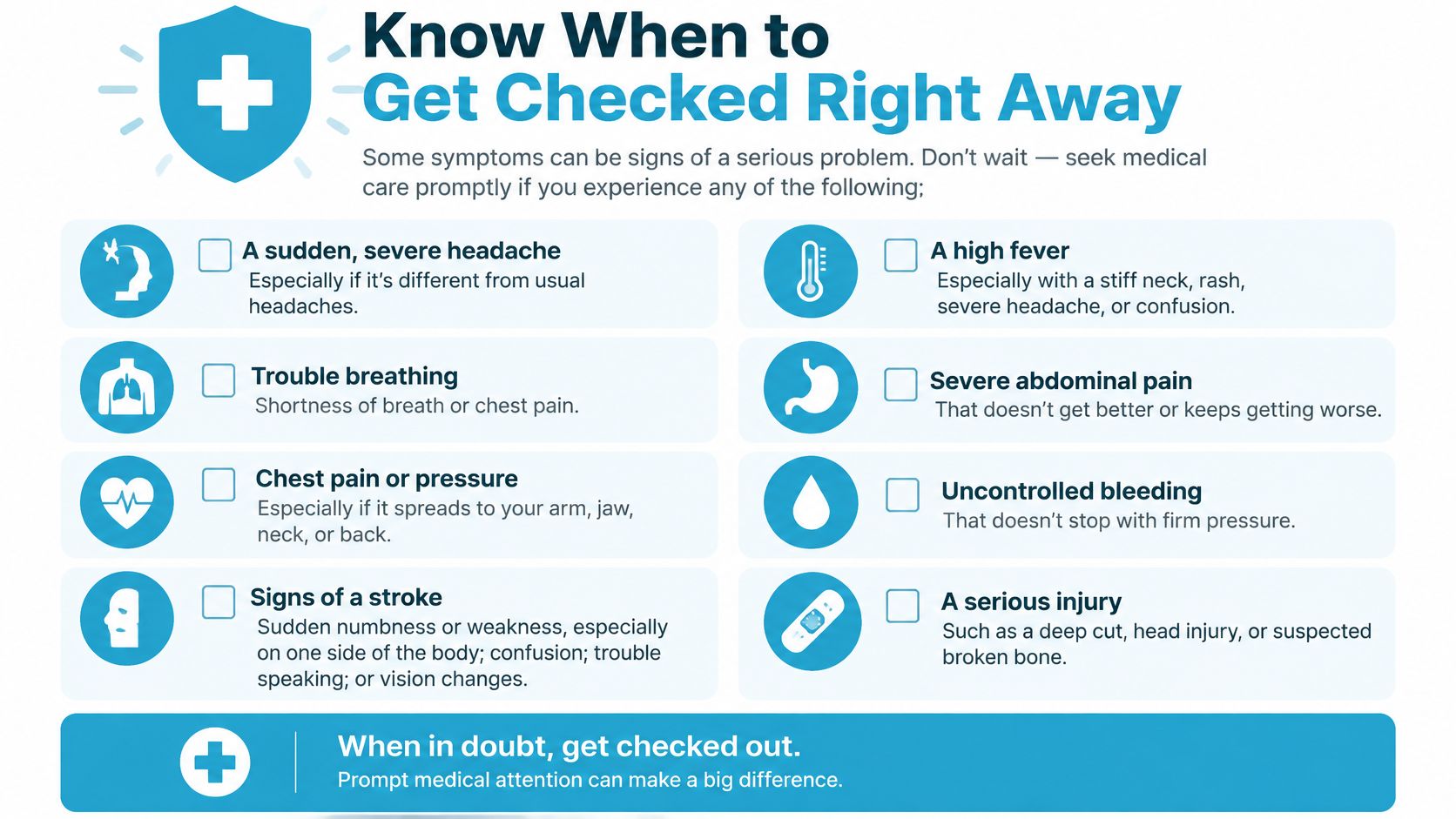
- Call emergency services now for chest pain or pressure, fainting or near-fainting, severe shortness of breath, a racing heartbeat with confusion, weakness on one side of the body, or sudden breathlessness with leg swelling.
- Book a doctor visit within days for a resting rate above 100 that repeats without a clear cause, dizziness or faintness on standing, unexplained fatigue or breathlessness on exertion, or a rate that stays high after a trigger has been removed.
- A routine review fits a fast pulse that appears only during stress, exercise or illness and settles on its own.
Start a dated log today and keep it for two weeks: rate, activity, symptoms, fluids, medicines, and the start time of every episode. A dated report makes the appointment faster and gives the clinician something concrete to work with. Cardiogram Pro detects episodes automatically, exports doctor-ready PDF reports and sends real-time alerts, and the app itself is an information tool rather than a medical device, so it won't diagnose anything or replace your doctor.
When you're in the room, ask for the ECG. Ask which of the blood tests and checks are worth doing for you, given your history. That's the conversation a fast pulse deserves.
A heart rate that spikes on the stairs, during a fever or after three coffees is usually your sinoatrial node doing its job, and the useful work is noticing the pattern rather than panicking at one number. Cardiogram watches your Apple Health heart rate, logs every 30 bpm rise within five minutes with its baseline, peak and duration, and lets you attach symptoms as they happen, so a fortnight of episodes becomes a dated record instead of a vague memory. Visit Cardiogram to see how the app turns watch data into something you can hand to a clinician.