You've noticed the pattern again. You stand up from your desk, your heart starts racing, and dizziness or shakiness makes you sit back down. Your Apple Watch shows a marked rise in heart rate, so you bring the record to an appointment hoping it will provide a clear answer. Instead, you hear that a fast heart rate alone doesn't prove POTS.
That response can feel frustrating, but it reflects an important distinction. A POTS diagnosis test isn't a single heart-rate reading. It's a structured assessment of posture, heart rate, blood pressure, symptoms, timing, and alternative explanations. Wearable data can help reveal repeated patterns, while clinical testing supplies the context needed to interpret them safely.
Introduction to POTS Diagnosis Test Methods
Consider a patient who experiences dizziness whenever she rises from a chair. Her watch captures several episodes in which her heart rate climbs sharply, often alongside palpitations and fatigue. The records are useful, but they don't show whether she started from a standardized resting position, whether her blood pressure fell, or whether the episode occurred during exercise, illness, dehydration, or another trigger.
That's why clinicians usually combine several kinds of evidence. The initial evaluation may include a careful symptom history, physical examination, orthostatic vital signs, and an electrocardiogram. An active stand test can assess the response to standing in an ordinary clinical setting, while a head-up tilt-table test offers more controlled positional exposure. Selected patients may need broader autonomic testing or ambulatory rhythm monitoring.
The practical value of a wearable is longitudinal. A single clinic visit captures one moment, but repeated home records may show whether symptoms and heart-rate changes recur in a recognizable upright pattern. The record becomes more useful when it includes timestamps, activity or posture context, symptoms, medications, hydration, sleep, and blood-pressure readings where available.
Practical rule: Treat a watch alert as a reason to organize a clinical conversation, not as a diagnosis.
This approach also reduces two common errors. A clinician shouldn't dismiss repeated positional symptoms because one office reading was normal, and a patient shouldn't assume that every large heart-rate increase represents POTS. The strongest evaluation connects daily-life observations with reproducible clinical measurements and a review of competing explanations.
Understanding POTS Diagnostic Criteria
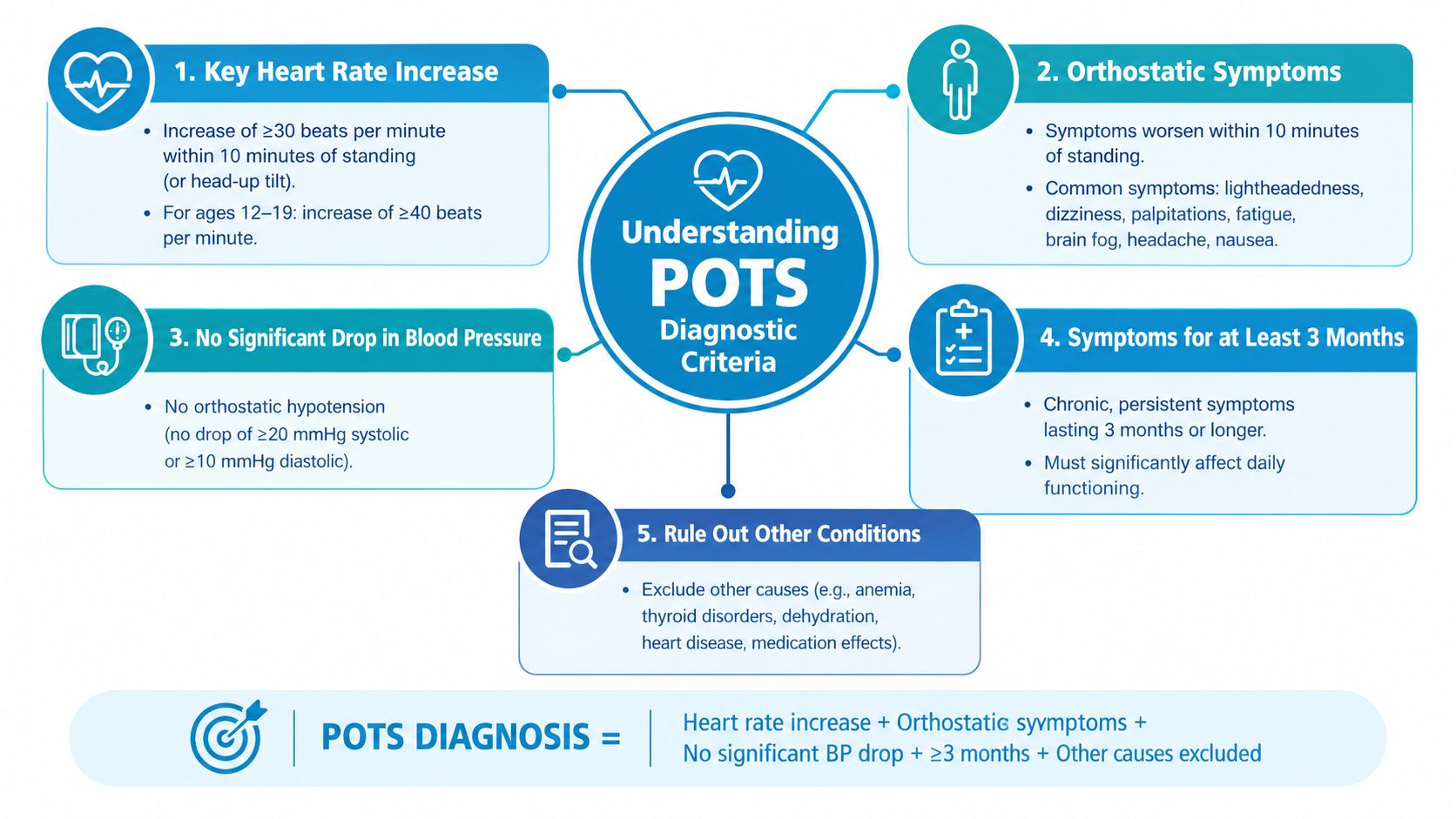
POTS, or postural orthostatic tachycardia syndrome, is defined by a pattern that develops when a person becomes upright. The heart-rate response matters, but it must occur alongside compatible orthostatic symptoms and without the blood-pressure fall that defines orthostatic hypotension.
For adults, consensus criteria generally require a sustained heart-rate increase of at least 30 beats per minute within 10 minutes of standing or head-up tilt. For adolescents aged 12 to 19, the threshold is at least 40 beats per minute. Symptoms commonly worsen while upright and improve when the person lies down. Earlier frameworks often used a symptom-duration requirement of at least six months, while newer guidance and clinical practice may apply duration differently depending on the context. The NIH consensus report on POTS emphasizes that diagnosis requires more than the heart-rate change.
A clinically useful active-stand protocol begins after 5 to 10 minutes lying supine, allowing the clinician to record baseline heart rate and blood pressure. Measurements are then repeated during upright posture at approximately 1, 3, 5, 8, and 10 minutes, with the increase appearing on at least two upright readings. Orthostatic hypotension must be absent, typically meaning there isn't a systolic blood-pressure fall of at least 20 mmHg or a diastolic fall of at least 10 mmHg. These thresholds and the measurement approach are described in the clinical review of POTS evaluation.
Why the surrounding evidence matters
A watch may identify a 30-bpm rise, but it usually can't establish the required posture, blood-pressure response, symptom relationship, or rhythm type. It also can't independently exclude dehydration, anemia, hyperthyroidism, medication effects, stimulant use, pain, panic, exercise-related tachycardia, or inappropriate sinus tachycardia. Each can produce a fast heart rate without POTS.
That distinction is central to interpreting dysautonomia diagnosis criteria. Screening asks, “Is there a pattern worth investigating?” Diagnosis asks, “Does the complete clinical picture satisfy the criteria after other explanations have been assessed?”
Clinical Orthostatic Testing Methods
The two principal clinical tests are the active stand test and the head-up tilt-table test. Both examine what happens as the body moves from horizontal to upright, but they create different testing conditions.
During an active stand test, the patient rests supine, commonly for about 10 minutes, while a clinician records baseline heart rate and blood pressure. The patient then stands, ideally remaining still and supported for safety, and measurements are repeated at approximately 1, 3, 5, and 10 minutes. Some protocols include an additional reading around 8 minutes. The purpose is to observe a sustained response across the diagnostic window rather than react to one isolated spike.
Preparation affects interpretation. The clinical team should review medications and relevant health conditions, consider hydration and recent illness, and document anything that could alter the response. Patients shouldn't change prescribed medication or deliberately alter fluid or salt intake unless their clinician instructs them to do so.
A tilt-table test uses a motorized table to move the patient passively from supine to an upright angle commonly greater than 60 degrees. Heart rate and blood pressure are monitored continuously or at repeated intervals. Because the table supplies the change in position, the test is more standardized and can be especially useful when an active stand is inconclusive, unsafe, or difficult to perform consistently. Clinical reviews describe it as the accepted gold-standard assessment for orthostatic intolerance, although many patients can be evaluated with history, examination, orthostatic vital signs, and ECG.
| Test Type | Preparation | Advantages | Limitations |
|---|---|---|---|
| Active stand test | Supine rest with baseline heart rate and blood pressure, followed by supervised standing | Practical, accessible, and closely related to daily upright activity | Results can be affected by movement, muscle pumping, safety concerns, and inconsistent timing |
| Head-up tilt-table test | Supine monitoring followed by passive tilt to an upright angle | More standardized, with continuous or repeated cardiovascular monitoring | Requires specialized equipment and may not be necessary when a careful stand assessment is conclusive |
A reliable record should include the starting values, every timed reading, symptoms, posture, and any safety intervention. The orthostatic heart-rate change guide can help patients understand why the difference between baseline and upright measurements matters, but home measurements shouldn't substitute for supervised assessment when symptoms are severe.
Advanced Autonomic and Monitoring Tests
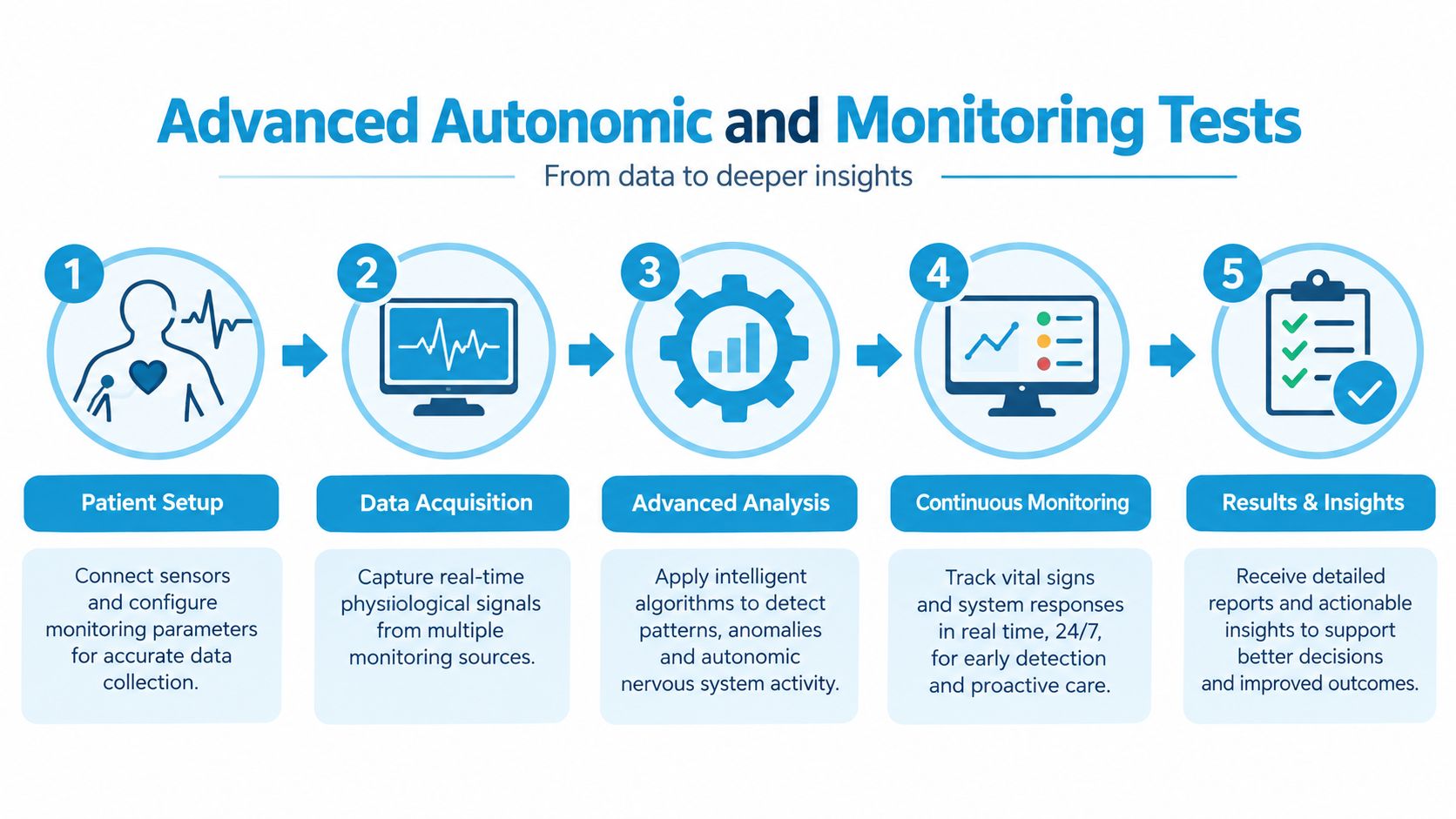
Most evaluations begin with history, examination, orthostatic vital signs, and a resting ECG. Broader autonomic testing is usually reserved for cases in which the initial assessment is unclear, symptoms are complex, or clinicians need to investigate a particular autonomic function.
A tilt-table test can provide controlled orthostatic exposure with continuous heart-rate and blood-pressure monitoring. It's particularly useful when a bedside stand test is inconclusive, unsafe, or difficult to standardize. The NINDS overview of POTS assessment describes tilt-table and broader autonomic testing as selected investigations rather than automatic requirements for every patient.
Autonomic reflex screening may examine how heart rate and blood pressure respond during controlled breathing or a Valsalva maneuver. These tests ask different physiological questions from an orthostatic assessment. A clinician may also consider sweat-function testing or targeted laboratory evaluation when symptoms and examination suggest small-fiber or other autonomic involvement. The exact selection depends on the clinical question, not on a generic testing checklist.
Choosing the right escalation
Ambulatory heart-rate monitoring serves another purpose. It records rhythm patterns during ordinary life and may help correlate palpitations with activity, rest, sleep, or symptoms. It can be useful when a clinician needs to distinguish recurrent sinus tachycardia from a possible rhythm disorder, or when symptoms don't occur during a short appointment.
A decision pathway might look like this:
- Start with clinical context. Document upright symptoms, triggers, medical history, medications, and examination findings.
- Perform orthostatic measurements. Use a standardized active stand or consider tilt-table testing when a controlled assessment is needed.
- Add ECG or ambulatory monitoring. Use rhythm information when palpitations are unexplained or an arrhythmia needs evaluation.
- Escalate selectively. Consider broader autonomic studies when the initial findings don't explain the symptoms or a specialist identifies a specific reason.
Testing access, scheduling, and coverage can vary, so patients should ask which question each proposed test is intended to answer. More testing isn't automatically better if it doesn't address a remaining diagnostic uncertainty.
Integrating Wearable Heart Rate Data
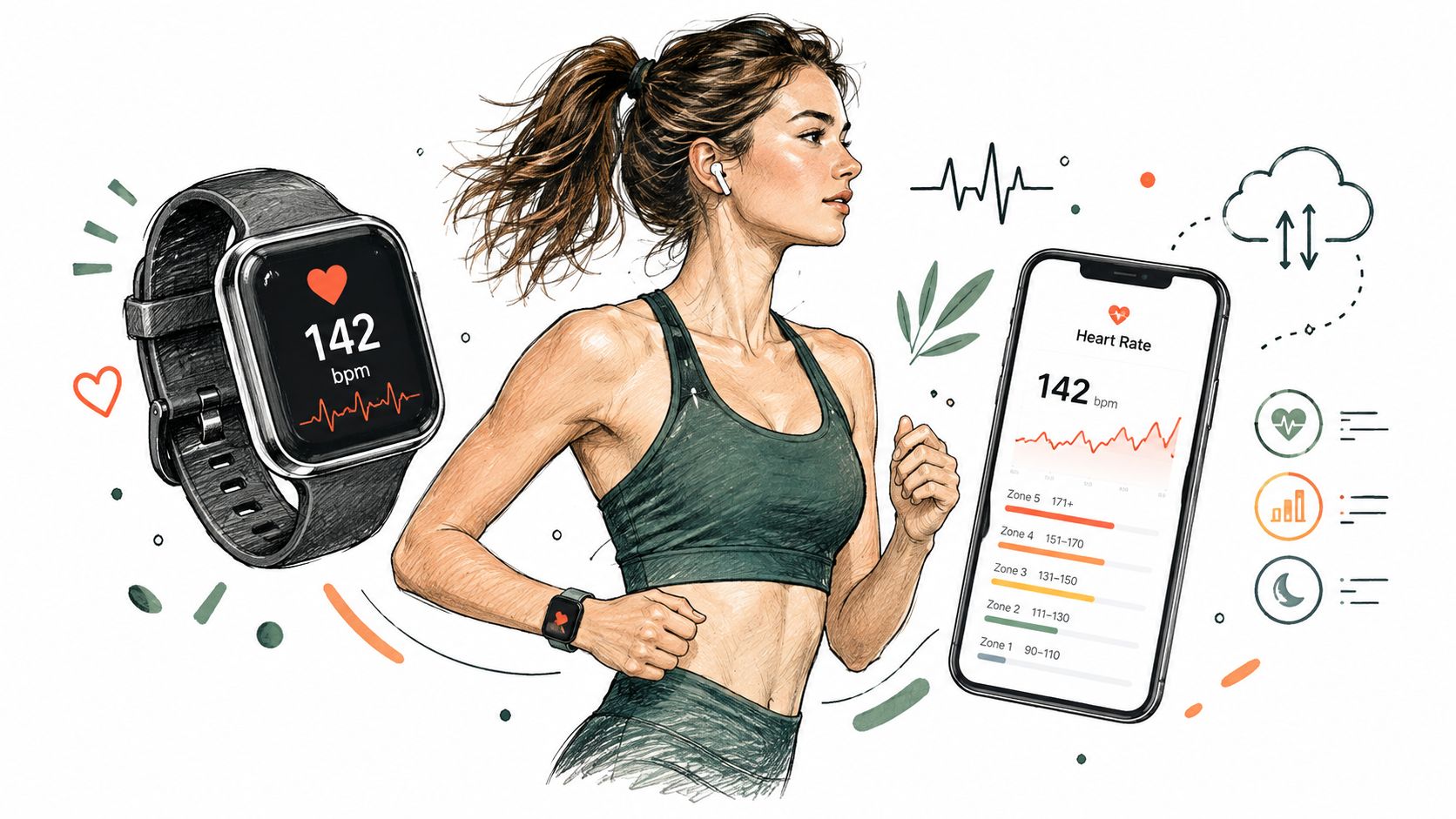
Wearable data works best as a longitudinal screening layer. It can show when heart-rate episodes happen and whether they repeatedly coincide with dizziness, palpitations, fatigue, or brain fog. It can't replace the clinical measurements that establish posture, blood-pressure behavior, symptoms, and exclusion of alternative causes.
A useful home record answers practical questions:
- What was the baseline? Record the resting heart rate before the episode when possible.
- How large was the change? Note the difference between baseline and peak, not just the peak value.
- How long did it last? A sustained pattern is more informative than a brief isolated spike.
- What was happening? Mark standing, walking, exercise, meals, illness, heat, and recovery.
- What did you feel? Link dizziness, shakiness, palpitations, fatigue, or other symptoms to the timestamp.
- What could have influenced it? Add notes about hydration, sleep, medications, and relevant triggers.
For example, a patient might notice that several episodes occur shortly after standing from a seated or lying position, with symptoms that ease after sitting or lying down. That pattern can support a request for formal orthostatic testing. A similar rise during exercise, however, answers a different clinical question and shouldn't be presented as evidence of POTS.
Turning raw records into an appointment summary
Generic heart-rate graphs can be difficult to interpret because they may mix sleep, exercise, recovery, and ordinary activity. A focused report should separate likely orthostatic episodes from exercise-associated changes and preserve the surrounding context. A symptom diary can fill gaps that the watch can't capture, especially whether the person was upright and whether lying down improved the episode.
Cardiogram analyzes Apple Health heart-rate data to identify tachycardic episodes, record baseline and peak values, duration, and timing, and connect episodes with logged symptoms and triggers. It can also produce a PDF summary for clinical discussion. Patients can use Apple Health analytics to think about how raw records become more useful when organized around a specific clinical question.
The report should be shared as supporting evidence, not as a diagnostic verdict. The formal clinician assessment still needs blood-pressure information, symptom review, posture confirmation, and evaluation for competing explanations.
Interpreting Results and Next Steps
A result that meets the heart-rate threshold is meaningful only when it fits the full clinical picture. The clinician will ask whether symptoms occur while upright, whether they improve when recumbent, whether blood pressure remains outside the orthostatic-hypotension range, and whether another condition better explains the tachycardia.
A result that doesn't meet the criteria on one occasion also needs careful interpretation. Symptoms and orthostatic tachycardia can fluctuate, so a normal single test doesn't reliably rule out POTS. The POTS Foundation clinical resource notes that repeat testing may be appropriate when suspicion remains high.
Building a clearer follow-up plan
Bring the clinician a concise timeline rather than an unfiltered data dump. Include the dates of notable episodes, posture or activity, symptoms, medication and hydration context, sleep, and any home blood-pressure readings. Ask what the clinical test showed at baseline and at each upright time point, and ask which alternative explanations have been assessed.
Common next steps may include an ECG review, targeted blood tests, medication assessment, or ambulatory monitoring when indicated. Clinicians may consider anemia, dehydration, hyperthyroidism, electrolyte problems, medication effects, acute illness, inappropriate sinus tachycardia, and arrhythmia as part of the differential. A specialist referral or tilt-table test may add value when the bedside assessment is unclear, unsafe, or difficult to reproduce.
A wearable report is most useful when it helps a clinician decide what to measure next.
Keep the goal practical. You're not trying to make a diagnosis from a watch graph. You're building a reproducible record that helps your care team compare everyday episodes with formal orthostatic testing and decide whether further evaluation is justified.
Cardiogram organizes Apple Health heart-rate data into episodes with timing, baseline, peak, duration, and logged symptoms or triggers, then provides a clinician-ready PDF summary. If you're tracking unexplained tachycardia while preparing for a POTS evaluation, visit Cardiogram to see how it can support a more focused appointment.