
You're at the kitchen sink after a short night, the floor feels uneven, and by the time you sit the details have already gone soft. Was that ten minutes upright, or two? Did you drink before breakfast? A symptom journal is the short record that keeps those moments from vanishing before your next visit. It isn't a diagnosis, and it isn't proof that sleep, salt, or a hot walk caused the spell. It's a conversation aid: a few fields you can finish in under a minute so your clinician can see timing, posture, and what you tried. I would keep the form small on purpose. A packed day won't survive a long checklist.
Symptom Journal Fields to Track Every Day
Write the line within minutes of onset. A JMIR paper on POTS diaries reported completion of 96.8% in the first 15 weeks and 97.8% across 32 weeks, and found paper compliance above 90% against verified compliance of 11%.
| Field | What to Record | Example Entry | When to Log |
|---|---|---|---|
| Symptom | Dizziness, palpitations, fatigue, or brain fog | Dizzy at the kitchen sink | At onset |
| Severity | Intensity on a fixed 0 to 10 scale | 6/10 at onset, 8/10 at peak | At onset and at peak |
| Posture or activity | Standing, sitting, lying, or walking, plus minutes | Standing 10 min after lunch | At onset |
| Heart rate | Baseline and peak beats per minute | 72 bpm baseline, 110 bpm peak | From the watch at the start |
| Fluids | Water intake in millilitres | 500 ml by 9 am | Running total through the day |
| Salt | Grams or servings of salty food or drink | One salty lunch | With each meal |
| Sleep | Hours slept and whether sleep was broken | 6 hours, woke twice | Each morning |
| Medications | Name, dose, and time taken | Morning dose at 8 am | When taken |
| Recovery | Minutes until symptoms eased, and what helped | 25 min lying down | When symptoms ease |
Rate severity on 0 to 10 at onset and again at peak. Keep fluids as a running total. Morning sink episode: 6 hours of broken sleep, dizzy, 500 ml by 9 am. Afternoon episode after a hot walk: 1,200 ml by 3 pm.
How to Set Up Your Symptom Journal in Six Steps
A review of nine health studies found electronic diaries generally produced less missing data and fewer entry errors than paper, and in two studies that timed the work electronic entry took about 4 hours compared with 96 hours on paper, while 5 of the 9 studies still reported occasional technical problems, most often battery, power, hardware or software failures. Pick one home for the notes, and keep a backup plan for a dead battery.
The setup below is the whole routine, built as the minimum a busy week can sustain. Six moves, then you stop adding chores. Treat it as a conversation aid for your clinician, not as proof of a diagnosis or a trigger.
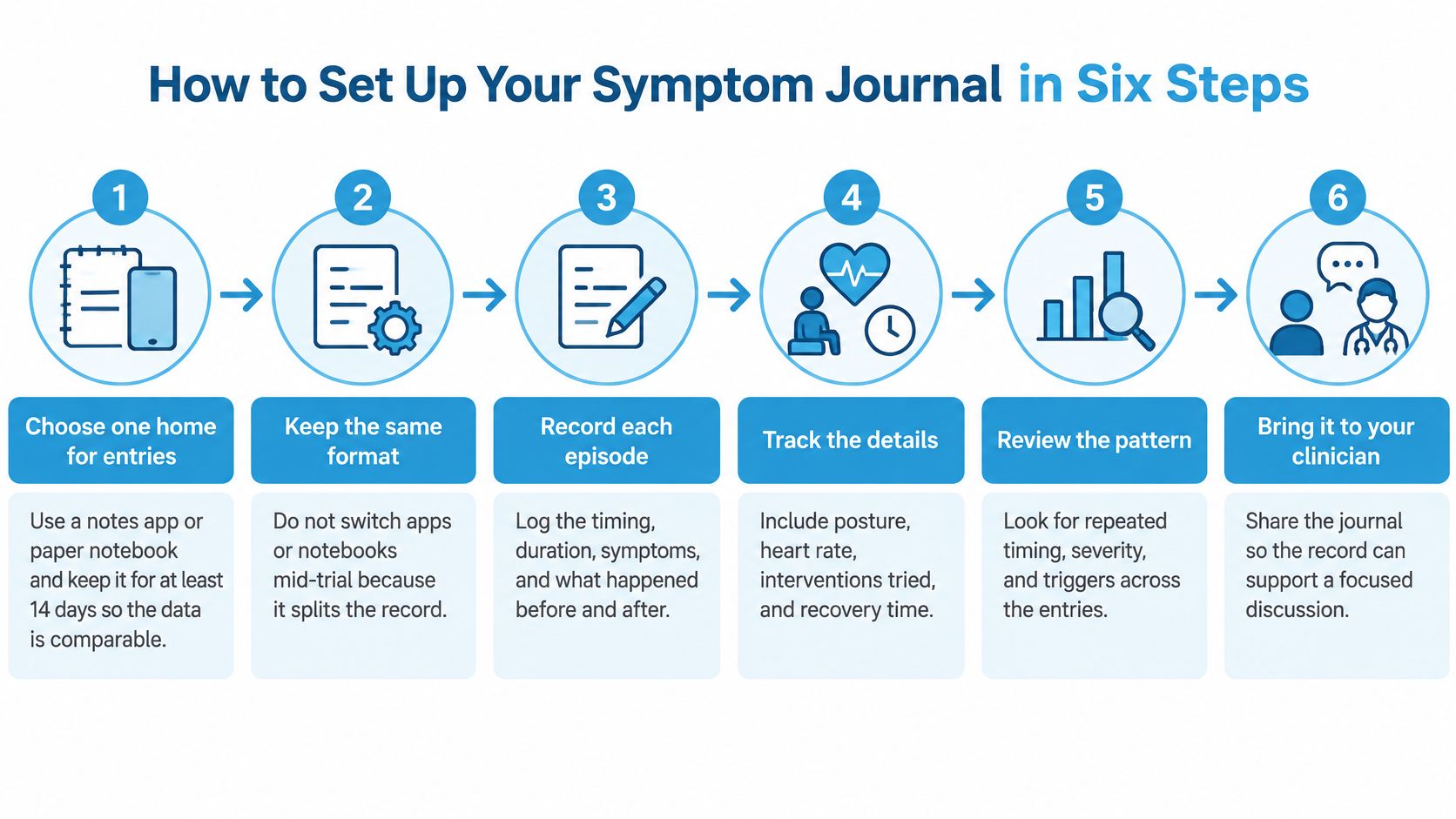
- Choose one home for entries. A notes app or a paper notebook both work if you use the same one for at least 14 days. Comparable days matter more than a pretty layout. Switching apps mid-trial splits the record into two piles nobody can read together.
- Keep only fields you will fill. Start from the daily template and drop anything you know you'll skip. Fifteen boxes feels thorough on day one and empty by day five. A blank salt column every day teaches your clinician nothing.
- Set two reminders, then add an event habit. One ping mid-morning and one mid-afternoon catch the quiet days. The entry that matters is the one you write the moment a symptom starts. A single evening alarm misses the afternoon spell you no longer remember clearly.
- Leave the watch on your wrist. Checking a pulse by hand during dizziness is awkward, and that check often gets skipped. Charge overnight so a dead battery doesn't erase the one number you wanted. If the watch fails, write "no reading" instead of guessing later.
- Park daily context at fixed points. Fluids after breakfast, salt with lunch, sleep each morning. Fixed points beat "I'll remember tonight." Medication goes in when you take it, including a dose you moved by an hour.
- Book a 10-minute review on the same weekday. Put it in the calendar before the first episode, not after a bad week when you're too tired to look.
Practical rule: Log what you did, not what you meant to do. A late entry marked "written at 9 pm about 9 am" is more honest than a tidy line that pretends you were on time.
What the first week should hold
A realistic first week includes about 10 to 12 entries across several days, with two days left blank on purpose. Those blanks stay visible, because a working journal looks a bit uneven. That unevenness is the record, and it is enough to show your clinician where the week went.
Linking Journal Entries to Heart-Rate Episodes
At 9:14 am in a shop, the dizziness hits. Resting baseline was 76 bpm. Four minutes after you stood up, the peak was 118 bpm. The rate stayed high for 22 minutes. You had logged a glass of water at 8:30 am. That single scene is the unit your clinician can use: one symptom, one clock time, one rise, one recovery.
The reference rise
A rise of 30 bpm or more within 5 minutes, measured from your own baseline, is the usual adult reference point. 40 bpm is the reference used for ages 12 to 19. Both are reference points rather than diagnostic criteria, and a heart rate log is the companion record if you want to read those rises before you start adding symptoms.
No new hardware is involved, and you don't have to hand-log every beat. Cardiogram watches your Apple Health heart rate, catches a rise of 30 bpm or more within five minutes, and records the baseline and peak for you. The human step is tying the symptom you felt to the episode the watch already timed. That join is what turns a graph into something you can discuss at an appointment.
How to attach the symptom
Use the same order every time so a month of notes can be scanned quickly.
- Symptom first: Name it in a few words, with the clock time you felt it.
- Start and peak next: Baseline, peak, and how many minutes from standing or sitting up.
- Duration third: How long the rate stayed up, not how long the day felt bad.
- Recovery last: Minutes until it eased, and whether you sat, lay down, drank, or waited.
Keep workouts and the cooldown after them in a separate pile. A gym session or a long walk will raise heart rate for ordinary reasons. Mix those minutes into the upright-spell count and the week looks worse than your standing tolerance really is.
A heart-rate rise with no symptoms is still worth recording. Symptoms with no rise are still worth recording.
You'll see both mismatches, and both belong in the journal. A climb with a clear head is something to raise at the visit, especially if it clusters at the same hour. Dizziness without a climb can point toward heat, poor sleep, a missed dose, or something else your clinician will want named. Don't delete the boring one to make the journal look cleaner.
For each episode, the note that travels well is short: time, baseline, peak, duration, posture, symptoms, and recovery. If you only have four of those, write the four. Inventing the peak an hour later makes the line look precise and leaves it unreliable.
Weekly Review Metrics That Reveal Patterns
A single bad Tuesday is an anecdote. A week of repeated notes is something you can count. The method comes from diary research: treat entries as repeated within-person observations, set a 7 to 14 day baseline before a treatment change when you can, define an episode with an explicit rule, keep baseline, peak, duration, and recovery, and keep exercise out of the symptom count. The same Neurology diary study reported fluid-intake recommendation compliance of 75.8% of days in the first 15 weeks and 80.1% across 32 weeks. Read those figures as a realistic expectation for your own adherence, not as a target to beat.
| Metric | How to Calculate | What to Compare It With |
|---|---|---|
| Episode frequency | Episodes divided by days logged | Fluid intake and salt on the same days |
| Median duration | Middle value of all episode lengths | Sleep and recovery time |
| Severity spread | Count of episodes in each 0 to 10 band | Medication timing and posture |
| Time-of-day pattern | Episodes counted per morning, afternoon, and evening | Meals and standing time |
| Missing days | Days with no entry at all | Noted separately, never filled in |
Median duration beats the average when one episode runs for hours. One 90-minute spell will drag an average up and make five short spells look longer than they were. The middle value stays with the spells you have most often.
One sample week
Five logged days produced six episodes, most between 10 am and 1 pm, after standing at a market. The lengths, in order, put the median at 18 minutes. Two of those days also had low fluid notes. Sleep was short on one of them and ordinary on the other.
Low fluid and a market queue traveled together, and so did a bad night. That is the honest limit of a single week: overlapping exposures. You can name both and still not pull them apart. Compare the same metrics for at least three weeks before you walk in with a story. One bad day after one bad night can look like a pattern by chance.
Missing days get their own count. Don't copy yesterday's episode into a blank day, and don't assume a quiet day was a good day if you never opened the note. People skip entries for all sorts of reasons, and those reasons aren't random. A clinician-facing page should say the rule you used, the dates covered, what you excluded (workouts, for example), and whether a number came from you or from the watch.
A weekly page is one sheet: frequency, median, severity bands, time of day, missing days, and the exposures you wrote down. Salt, sleep, and medication timing belong on that sheet only if you logged them. For ideas on what else might be worth a column later, see common POTS triggers, then add one, not five.
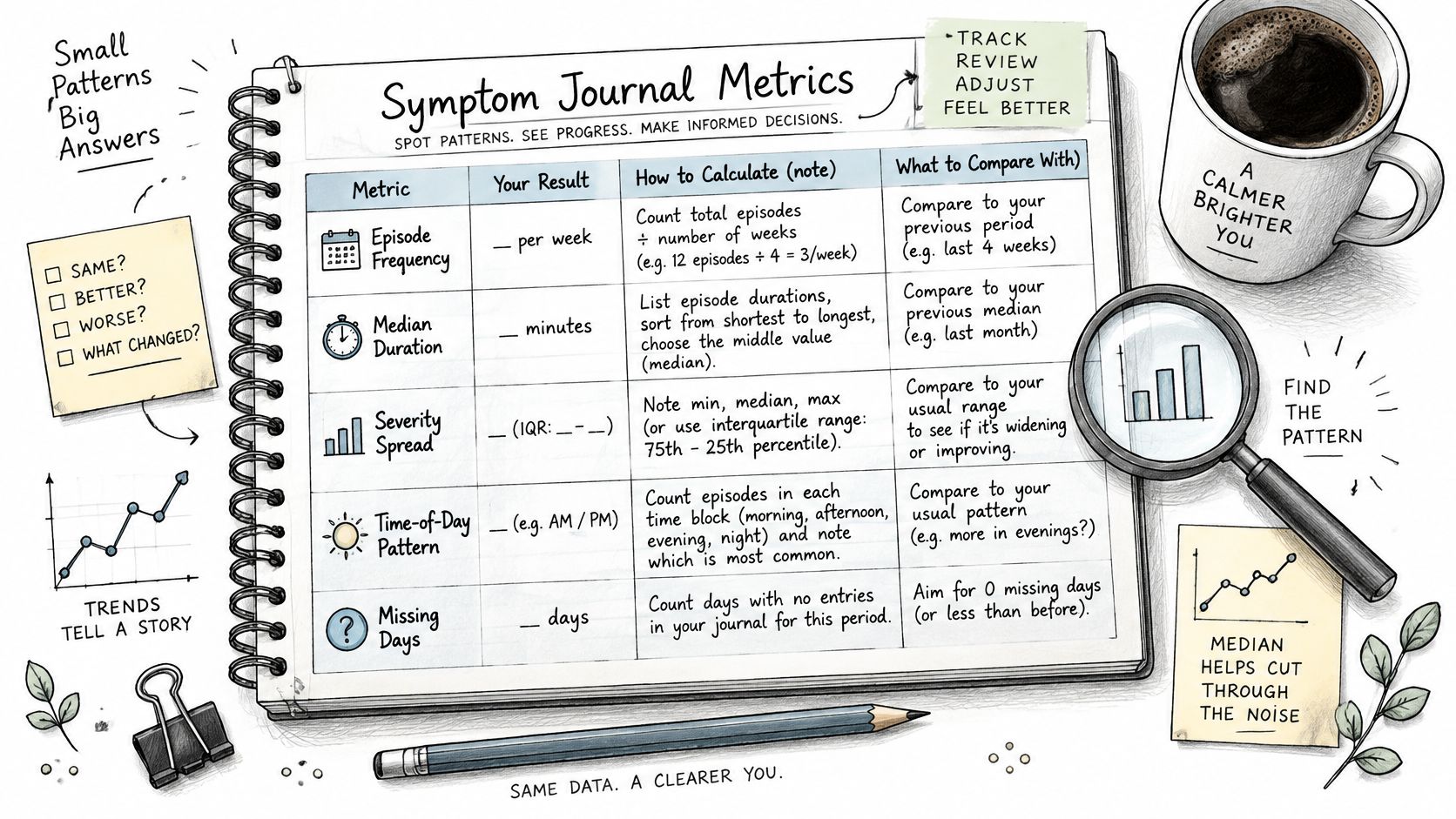
Bring that single page, not the raw pile. If the association is shaky, say so on the page. Exploratory is a respectable word in the visit.
What Your Clinician Can and Cannot Learn From It
A useful symptom journal shows repeated timing, baseline and peak heart rate, how long a spell lasted, posture, other symptoms at the same moment, what you tried, and how long recovery took. That package supports a focused conversation, and it is not a verdict.
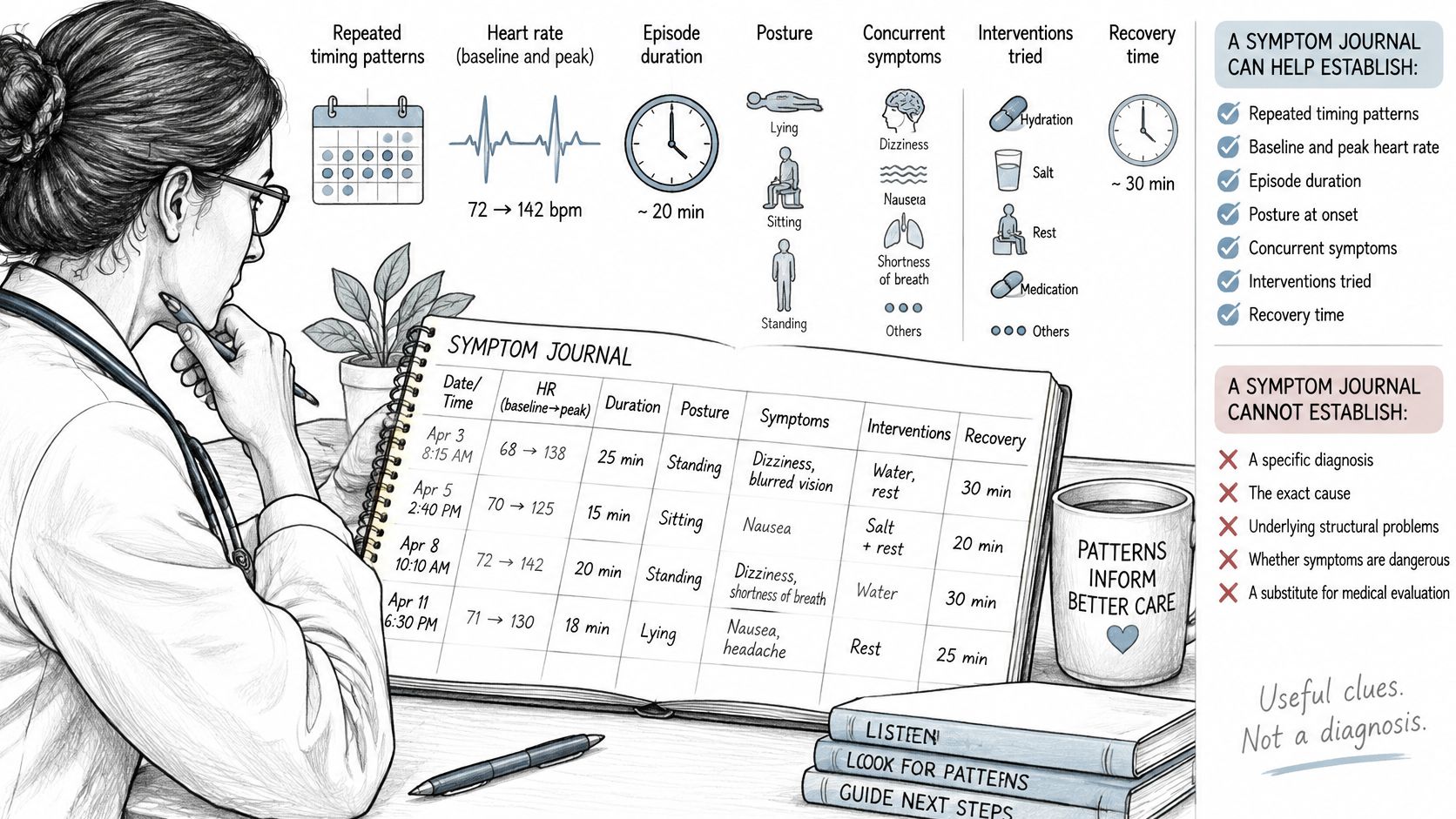
People often treat the notebook as proof that a food, a dose, a hydration plan, or a posture caused the episode. It cannot do that. A 2025 discussion of self-tracking puts the limit plainly: repeated timing can support a clinician conversation, but it cannot independently confirm POTS, name a causal trigger, or justify a medication change. The Long COVID experience points the same way. People use wearable data to notice upright heart-rate patterns and to describe how severe a day felt, and that record still does not settle what caused what, nor does it do much to overcome being disbelieved when the consulting room is unequal.
Real-time alerts and careful symptom logs do help people feel more in control of a fluctuating condition. Whether they change longer-term outcomes is a separate question, and not one a personal journal can answer.
Recall bias and blank days belong in the appointment, not in a footnote you hope nobody sees. If you filled three days from memory on Sunday, say so. Watch readings are also not the same thing as a standardized standing test, and your clinician may still want that test. A visit brings the exam, your history, and the measurement itself, which is the part no notebook replaces. Consumer readings can be a clue and still be the wrong tool for a diagnosis.
What to carry in
Bring the last two to four weeks, not the entire archive. Mark the strongest repeated pattern and the biggest gaps. Write one question per pattern.
A line that says "Days under 1.5 litres had more episodes, so water caused them" overclaims. The same line as a question works: "Episodes seemed more frequent on days under 1.5 litres. Is that worth looking at, or is something else moving with those days?" That framing leaves room for sleep, heat, standing time, and medication timing. It also gives your clinician something to push back on, which is the point of bringing it at all.
For how to shape that visit, patient-provider communication is the skill the page is for.
Fainting, chest pain, or symptoms that don't ease with rest are reasons to contact a clinician or emergency services now. Use the journal to flag them afterward if you're able. Don't use it to decide whether they're serious.
Start Your Symptom Journal This Week
It's Thursday evening, the visit is two weeks away, and the page is still blank. Start within the next 24 hours, and put a review on the calendar 14 days out. Keep it small. Three moves are enough for a minimum journal a busy week will realistically hold, a conversation aid for your clinician rather than proof of a diagnosis or a single trigger.
- Choose the home for entries tonight, a notes app or paper.
- Write one entry today, even if sleep or fluids are all you know.
- Book the review so the pages don't sit unread.
If you already wear an Apple Watch, an app built for people with POTS and dysautonomia can sit beside that notebook. It can log symptoms and triggers against each episode and export a PDF that shows episodes, trends, and symptoms in one place and states the exact criterion used. Cardiogram Pro starts with a 3-day free trial, and no payment is taken at the start, so you can see whether the workflow survives a real week. A notes app or paper journal still works if you don't have a watch.
If you want that PDF beside the template you start tonight, visit Cardiogram and try the workflow on a real week. A partial record still beats a blank memory.