
Choose a digital scale you can recheck against a known load on a hard, level floor, and treat anything finer than that proven error as display, not accuracy. No feature list, app, or extra decimal place crowns a winner on its own.
That's a challenge to the most popular advice you'll find while shopping for the best accurate weight scale. Many lists imply you should chase the prettiest screen, the longest metric list, or the reading with the most decimal places. Don't. A scale can show 0.01 and still give you a different answer every morning because it sits on a bath mat, its zero drifts, or you're standing near the edge of a small platform.
Think like an educator would. Accuracy means how close a reading is to a known true weight. Repeatability, also called precision, means how close repeated readings are to each other. For home trends, repeatability in your bathroom often matters more than a laboratory result from a different floor, a different user, and a different weight.
Error Budget From Real Scale Tests
A scale's accuracy is useful only if it holds up at your weight, on your floor, for the change you want to track. Extra decimal places cannot tell you whether a small change is real or just variation in the reading.
An error budget is the amount of variation you can tolerate for a particular decision. A scale used to follow a gradual trend needs to behave consistently enough that its readings don't obscure that trend. A measurement taken at one load also may not describe how the scale performs at another.
What Real Testing Found
A 2016 peer-reviewed study of home bathroom scales compared scales with calibrated National Institute of Standards and Technology (NIST) Class F weights at six loads, from 10 to 110 kilograms. Accuracy generally worsened at higher loads. Dial scales were significantly less precise than digital scales across the tested weights, and errors of at least 2.7 kilograms were more common among dial scales at loads of at least 99.8 kilograms.
A peer-reviewed study of 61 household bathroom scales also found a difference in their starting readings: digital scales displayed zero before calibration, while dial scales had an average initial error.
Home conditions can add variation. Guidance on calibrating a digital bathroom scale describes consumer-scale errors under real-user conditions. A hard, level surface and a centered stance help make a home reading more comparable with a test on a stable surface.
A 2024 test with a 0.2-pound maximum margin of error offers a useful benchmark, not a promise about every bathroom. Grout, a sloped floor, or repeatedly nudging the scale can change how well it performs at home.
Error Budget by Weighing Goal
| Goal | What the test means for your decision | Prioritize | Do not trust |
|---|---|---|---|
| Day-to-day trend | A stable setup matters more than a fine display increment | Same location and consistent conditions | Extra decimal places as proof of accuracy |
| Checking a known load near mid-range | A result at one load does not establish performance at every load | A reference load near the weight you care about | One showroom reading |
| Weights near the upper part of the scale's range | Accuracy can worsen as load increases | A check near the user's actual weight | A result measured far below that weight |
| Small weekly changes, such as fluid or training | The scale must distinguish the change from its ordinary variation | Consistent timing, clothing, and stance | A single reading |
| Body-fat, muscle, or hydration percentage | These are estimates, not weight measurements | The weight reading itself | Treating a percentage as a diagnosis |
| Soft, sloped, or crowded floors | Laboratory performance may not carry over to an unstable setup | A firm, level surface and centered stance | A reading taken on carpet |
A mid-range result cannot establish how the scale handles a heavier user. A body-composition estimate is a different kind of measurement, so its display does not strengthen the weight reading beside it.
Passing a load check once also cannot show how a scale will perform after it has been moved, dropped, or used for years. Choose capacity above the heaviest user's weight, assess performance near that weight, and check again if readings become inconsistent.
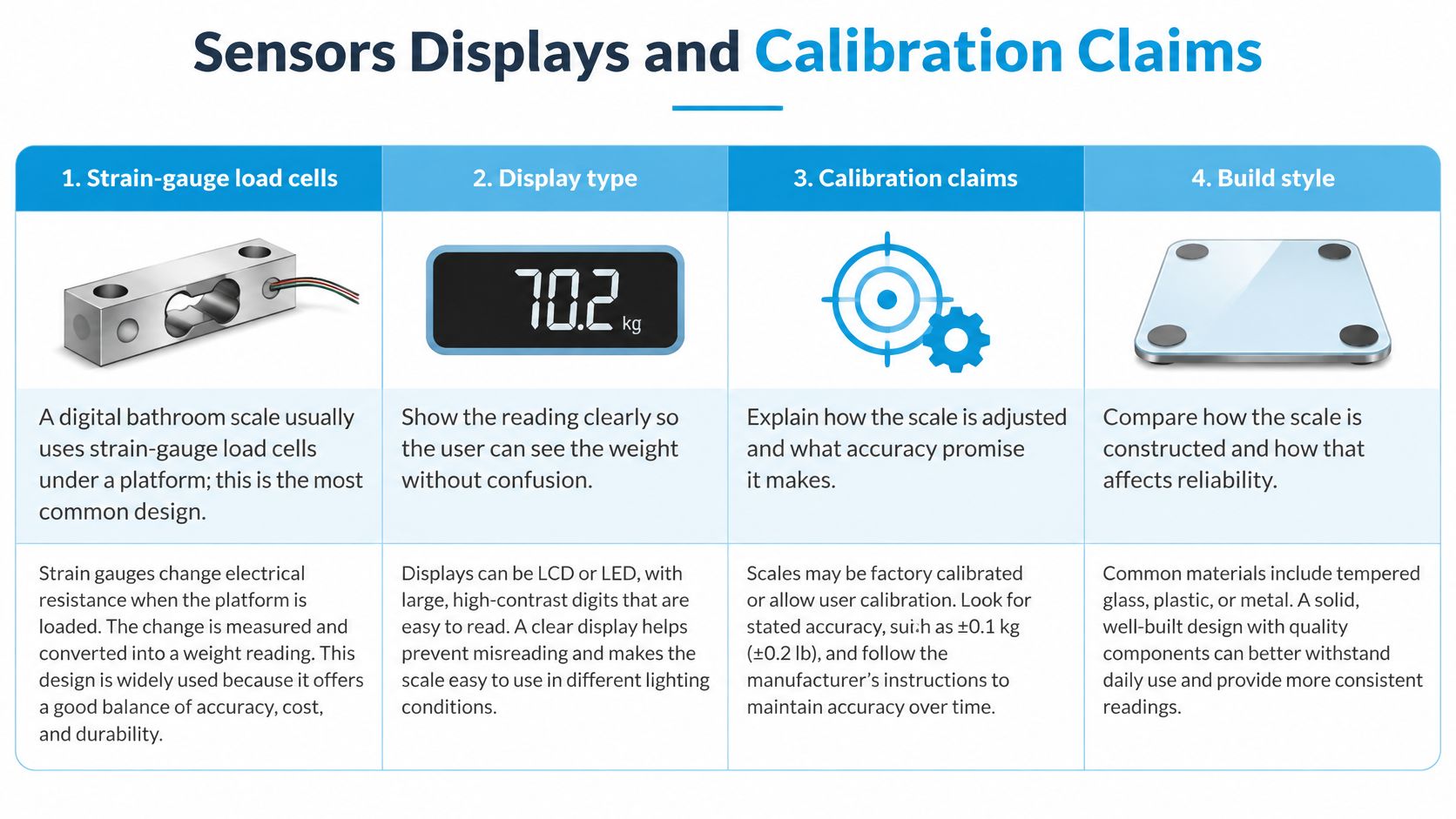
Sensors Displays and Calibration Claims
A scale can measure weight in different ways, and that construction shapes what can go wrong. Compare the mechanism before you compare colors, apps, or font sizes.
What Each Scale Type Can and Cannot Prove
| Type | How it senses weight | Accuracy trait | Main failure | What to verify |
|---|---|---|---|---|
| Digital load-cell | Strain gauges under the platform | Best match to certified loads in home-scale studies, can display true zero | Drift after moves, drops, or age | Zero, capacity, repeat test at your weight |
| Dial or analog | Spring and pointer | No battery, easy to read across the room | Starting offset, less precise at every load | Avoid for small changes |
| Smart scale, weight channel | Load cells plus an app | Weight can be as good as a plain digital scale | App sync and extra metrics distract from a bad floor setup | Same weight test as a basic digital scale |
| Smart scale, body estimate | Foot electrodes and a population formula | Not a second weighing system | Hydration, temperature, food, and foot contact move the percent | Ignore for clinical decisions |
A digital load-cell scale uses strain gauges under the platform that flex under load and convert that change into a number. That's the design you want for routine home monitoring because it can return to a clean zero and repeat a load without you squinting at a pointer.
A dial scale stretches a spring and moves a needle. It's simple and battery-free, but mechanical offset is built into the experience. If the needle doesn't start at zero, every later reading carries that head start with it.
A smart scale isn't a separate kind of weighing machine. It's usually a digital load-cell platform plus connectivity and, often, foot electrodes. Judge its weight channel exactly as you'd judge a plain digital scale. If you want help understanding what an app adds after the weighing is done, our guide to a smart scale app covers that separate layer.
Why a Finer Display Can Mislead You
The NIST weighing and scales FAQ distinguishes the displayed scale division, called d, from the verification scale division, called e, which determines applicable tolerances and accuracy classification. NIST warns that a scale displaying finer increments than its verified accuracy can create a false sense of precision.
For example, a commercial Class III scale used for loads of 0.25 pounds or more should have a verification scale interval no greater than 0.01 pounds, according to that same NIST guidance. NIST also states that the maximum acceptable starting error at zero balance is 0.25e before weighing begins.
You don't need a commercial scale in your bathroom. You need the label-reading habit. A 0.1-pound or 0.01-kilogram display doesn't automatically mean the measurement itself is accurate to that level.
Differentiator: A 0.01 reading is a promise about the screen, not about the load cell.
Hunt for four facts instead of adjectives:
- Capacity: Pick a maximum comfortably above the heaviest expected user, because accuracy near the top still needs testing.
- Zero behavior: Look for a clear zero or auto-zero you can see before stepping on.
- Units: Choose kilograms or pounds you will record without converting in your head.
- Calibration language: Note any stated reset or calibration steps, and be skeptical of vague accuracy promises with no test method.
Capacity, minimum operating load, calibration status, and accuracy class tell you more than display resolution alone. If the packaging shouts about decimals but stays quiet about those basics, you're looking at marketing, not measurement.
How to Test a Scale on Your Floor
Run this procedure in the room where the scale will live. A home check can't copy a metrology lab, but it can catch a bad unit while you can still return it.
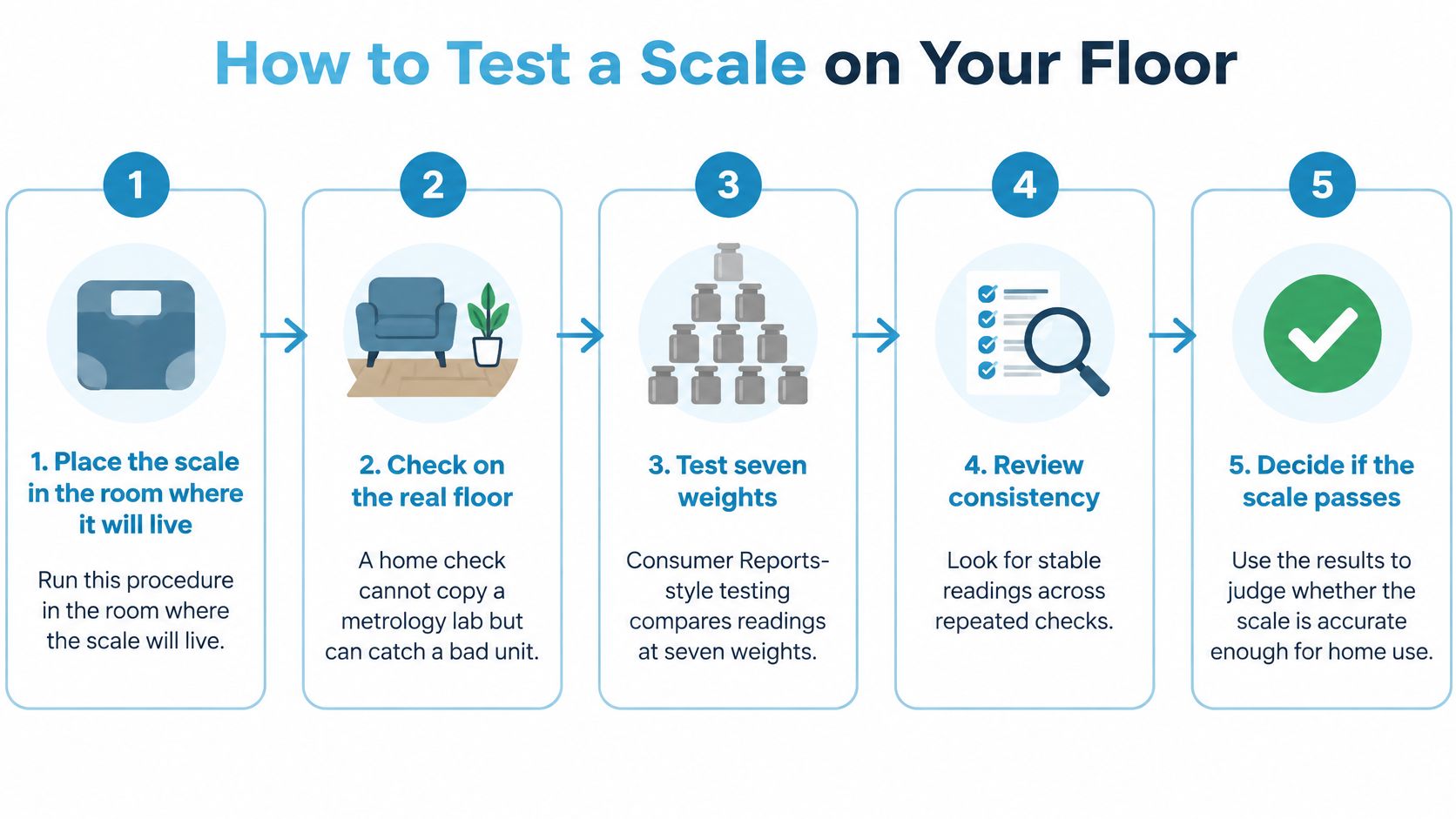
The logic mirrors professional comparison testing. The Consumer Reports bathroom scale buying guide describes testing scales at seven reference weights ranging from 25 to 200 pounds, comparing each reading with a calibrated lab scale that resolves weight to 0.01 pound. Its evaluation emphasizes accuracy, consistency, and performance when weight is unevenly distributed.
Your Eight-Part Home Check
- Place it on a hard, level floor, never carpet, because soft flooring lets the platform flex and the feet sink unevenly.
- Wake it, let it settle, and confirm zero with nothing on it, because a broken starting point makes every later number suspect.
- Weigh one known object, such as a stamped gym plate or dumbbell, because a marked load gives you a difference you can write down and recheck later.
- Lift the load off completely, let the scale re-zero, and repeat three times, because the spread across repeats is your real repeatability.
- Test near the light, typical, and heavy ends of your household, because a flattering mid-range result can hide poor performance where you'll use it.
- Stand centered, then shift slightly toward heels and toes, because uneven loading shows whether normal stance changes can overwhelm your trend.
- Mark the floor position with tape, because moving the scale a few inches can put one foot on a grout line or slope.
- Recheck after a battery change, move, or drop, and every few months, because drift is easier to spot against a dated note than from memory.
Don't overstate what step 3 proves. A bag of pet food or gym plate is only as trustworthy as its printed or stamped mass. It's a consistency check, not a NIST certificate. Still, if that same object reads differently every time, you've learned something important before you blame your body for the variation.
Keep or Replace Rule
Keep the scale when repeats cluster inside your error budget. Return, recalibrate, or replace it when zero fails, when the same load walks by more than the change you're trying to see, or when heel-to-toe shifts produce swings you'd otherwise record as real.
Decision line: You're not testing whether the scale once got lucky. You're testing whether it behaves the same way three times in a row.
Write down the object, its marked mass, the three readings, and the date. That small log turns a surprising morning into a question you can answer. Is your weight moving, or is the instrument moving?
Match the Scale to the Decision You Make
Different situations need different discipline, not different gadgets. Organize your choice by the decision you'll make from the number.
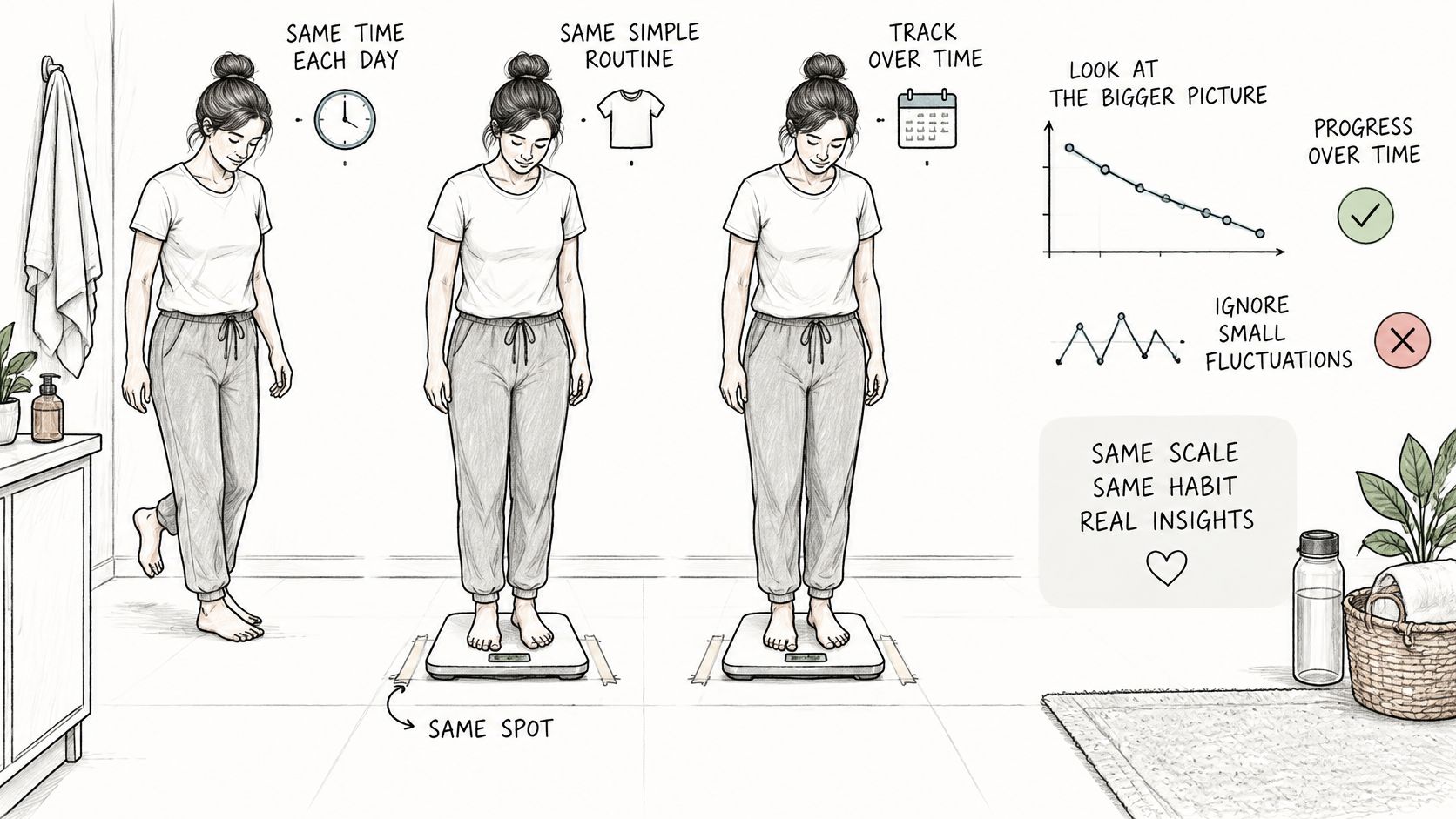
For ordinary trends, keep it simple. Use a plain digital scale in one taped spot, at the same time of day, in similar clothing. Ignore tiny changes that sit inside your repeat spread. If you're also curious about composition context, our explainer on percentage of muscle separates that question from plain body weight.
Near the top of a scale's capacity, be stricter. Skip any platform whose stated maximum is only slightly above the user, and test at that heavy load before trusting week-to-week comparisons. A stable stance also matters more when the platform feels small, so choose enough surface for a natural, centered stand.
When the Stakes Feel Higher
During pregnancy, athletic training, or medication changes, ask one question before reacting. Is the movement larger than your scale's repeat spread? If it isn't, don't treat the wiggle as biology. Repeat under your normal routine and look at the pattern across days.
For people with POTS or dysautonomia, morning weight can add context about fluid alongside other notes, but it can't diagnose orthostatic tachycardia. We let users log hydration, salt, sleep, medications and how they feel, to compare them with their heart rate. That pairing can make a weight trend more useful at an appointment, because your clinician sees context instead of isolated numbers.
Keep the same humility with wearables. Heart-rate data from consumer hardware can be incomplete, delayed or inaccurate, particularly during movement or poor sensor contact. A watch graph and a bathroom scale are both trend tools, not diagnoses.
- For caregivers: One shared scale and one written routine beat two apps that never get zeroed.
- For athletes: Weigh under repeatable conditions and don't grade a training block from one dehydrated morning.
- For fluid tracking: Pair stable weight notes with symptom and salt notes, then take both trends to a clinician rather than self-adjusting treatment.
- For shared households: Record who weighed, in which units, and whether the scale had been moved.
The recommendation stays plain. If the decision is casual, a repeatable digital scale is enough. If the decision affects treatment, the scale becomes supporting evidence for a clinical conversation, not the decision-maker.
Body Composition Numbers Versus Weight
For users tracking a training cut, a scale's body-fat or muscle estimate can look as concrete as its weight reading. The two numbers come from different measurements, so decimal places on a composition readout do not make it equally dependable.
The load cells measure force to produce body weight. Body-composition scales add foot electrodes and use an electrical impedance signal with a formula to estimate fat, muscle, or other values. The estimate comes from a signal that shifts with ordinary life, while the weight measurement can remain repeatable.
For a plain-language explanation of the terminology, see this guide to body fat mass. A scale's body-fat percentage is an estimate, not a direct weighing of fat tissue.
What Moves Impedance
These factors can shift the estimate even when the scale's weight reading is stable:
- Hydration level: Water changes how easily the signal travels.
- Recent exercise: Fluid shifts and temperature changes can affect the reading.
- Skin temperature: Cold or warm feet can change contact with the electrodes.
- Food intake: A recent meal changes body weight and the conditions used for the estimate.
- Foot contact: Lotion, calluses, damp skin, or partial contact can alter the signal path.
A body-fat percentage may change after a shower, workout, or salty dinner without a meaningful change in body tissue. Treat composition values as trend signals only when measurement conditions stay consistent, and not as diagnoses.
During eating-disorder recovery, pregnancy, illness monitoring, medication changes, or athletic cuts and gains, a percentage may look precise enough to influence decisions it cannot support. Don't change medication, judge recovery, or assess a training outcome from an impedance estimate.
Choose a scale for the weight reading you can repeat. Treat composition values as optional context, and give them less weight when the routine or stakes vary.
Units, Minimum Loads and Recalibration
The practical details buyers skip are often the ones that corrupt a clean log. Units, light loads, heavy loads, and reset steps deserve attention before the first weigh-in.
Units and Load Limits
Pick one unit for your log and stick with it. A scale that switches between kilograms and pounds invites mixed entries, especially in a shared household. Convert only from a clearly displayed value when you must, and never average records that were captured in different units without converting each one first.
Check the minimum operating load for a child or very light user. Many digital scales are less informative near empty because the signal is small and the platform still has to settle. Confirm the zero holds, place a light known object on the scale, and see whether repeats make sense before you track a small person's trend.
Treat stated capacity as a ceiling, not a promise. A scale can survive a heavy load without measuring it well. Run your heavy-load check on your floor, leave headroom above the heaviest user, and don't use a crowded platform that forces an unnatural stance.
Reference objects need the same skepticism. A marked gym plate is better than a homemade weight because its mass is stamped by the maker. A sealed bag with printed mass can work for consistency checks, but packaging and settling make it a rough reference. Note what you used so future checks compare like with like.
When Recalibration Helps
Most home scales don't offer true user calibration. Some have a reset or zeroing routine in the manual. Use it if zero fails or a known load shifts after a drop, battery change, or move.
- Reset first: Follow the manual, put the scale back on hard flooring, and repeat your known-load test.
- Replace if it still wanders: A reset that doesn't restore the reading hasn't fixed the instrument.
- Use professional calibration for formal needs: Clinical or trade settings may require a certificate, which is different from home trend tracking.
Keep a dated log of each check, including the floor spot and reference object. Drift then shows up as a pattern, not a single surprising morning that sends you shopping or worrying.
Prove the Scale Before You Trust a Trend
A trend is only as useful as the routine behind it. Once the scale has passed its checks, record the time, floor spot, clothing, and any unusual conditions alongside readings. That context helps distinguish a lasting change from a one-off result.
If a reading looks out of place, repeat it under the same conditions before changing your routine or drawing conclusions. If the recheck still differs, consult the dated checks you have kept. A move or battery change may explain the shift; if the scale continues to vary, stop treating its readings as a reliable trend until it is reset or replaced.
For readers also tracking heart-rate patterns, Cardiogram can automatically detect rises of 30+ bpm within 5 minutes from Apple Health data. It can log hydration, salt, sleep, medications, and how you feel, then provide weekly summaries and a clinician-ready PDF report.
Use weight readings only for the decisions their repeatability supports. A stable trend can show direction; it cannot explain the cause of a change.
If you're pairing a weight trend with Apple Watch heart-rate patterns, Cardiogram can automatically log rises of 30+ bpm within 5 minutes alongside hydration, salt, sleep, medications, and how you feel. Weekly summaries and a clinician-ready PDF report help organize those patterns for an appointment.