You stand up from bed, your heart starts pounding, and your vision turns gray around the edges. Before you've even poured your coffee, you need to sit down. Later, the dizziness eases, but the exhaustion and trouble concentrating don't quite disappear.
If you're looking up POTS syndrome symptoms in adults, you may be trying to connect experiences that seem unrelated. A racing pulse is part of the picture, but the most useful question isn't how high it went. It's what happened when you became upright, how you felt, and what helped you recover.
Adult POTS Symptoms Beyond a Fast Pulse
POTS stands for postural orthostatic tachycardia syndrome. In plain language, it describes a chronic pattern in which becoming upright brings an excessive heart-rate response alongside difficulty tolerating that position.
A clinical overview indexed in PubMed estimates that POTS affects 0.2% to 1% of the U.S. population, while emphasizing that precise prevalence remains uncertain. Its symptoms extend beyond palpitations to fatigue, headache, cognitive difficulty, digestive complaints, sleep disturbance, and temperature-regulation problems.
That breadth can make your own experience difficult to describe. You might call the morning problem dizziness, the afternoon problem exhaustion, and the evening problem nausea, without realizing that posture and daily context could help a clinician connect them.
Recognizing symptom clusters
Say you get out of bed and walk toward the kitchen. Your pulse pounds, your legs feel weak, and you lose track of what you meant to do. These sensations belong to different symptom groups, even though they can happen during the same episode.
Adult POTS symptom clusters
| Cluster | Common symptoms | Typical pattern |
|---|---|---|
| Orthostatic | Lightheadedness, weakness, blurred vision, presyncope or syncope | Worse standing or sitting upright; improves lying down |
| Heart and adrenergic | Palpitations, tremor, chest discomfort, anxiety-like sensations | Often accompanies the upright heart-rate rise |
| Energy and thinking | Profound fatigue, brain fog, headache, exercise intolerance, sleep disturbance | Can linger beyond a single standing spell and limit daily activity |
| Gut, skin, and temperature | Nausea, bloating, abdominal discomfort, constipation or diarrhea, heat intolerance, bluish-red legs | Frequently missed when the visit focuses only on pulse |
Presyncope means feeling as though you're about to faint. Syncope means losing consciousness. You don't need to faint for upright symptoms to deserve medical attention.
Palpitations describe the sensation of your heartbeat, such as pounding or racing. They don't, by themselves, tell you which rhythm your heart is producing or why it's fast.
What these symptoms can look like in daily life
The orthostatic cluster might mean abandoning a standing shower because you feel weak and your vision blurs. Sitting upright at a desk can also be uncomfortable, so the pattern isn't always limited to getting out of bed.
Energy and thinking symptoms can be less visible. You might finish getting dressed but need to rest before leaving, or find that following a conversation takes more effort than usual. Brain fog isn't a precise diagnosis, but it's a useful starting description when you explain the specific tasks that became difficult.
Digestive and temperature symptoms deserve space in that history too. For example, nausea after breakfast, difficulty tolerating a warm room, or a bluish-red change in your legs while standing may seem separate from your pulse.
Describe the whole episode: What stopped you from continuing your activity can matter as much as what appeared on your watch.
This multisystem pattern helps explain why adults may seek help through primary care, cardiology, neurology, or gastroenterology. None of these symptoms is unique to POTS, and having several doesn't establish the diagnosis. A clinician needs both the symptom history and an appropriately measured cardiovascular response.
Heart Rate Criteria Used in Adults
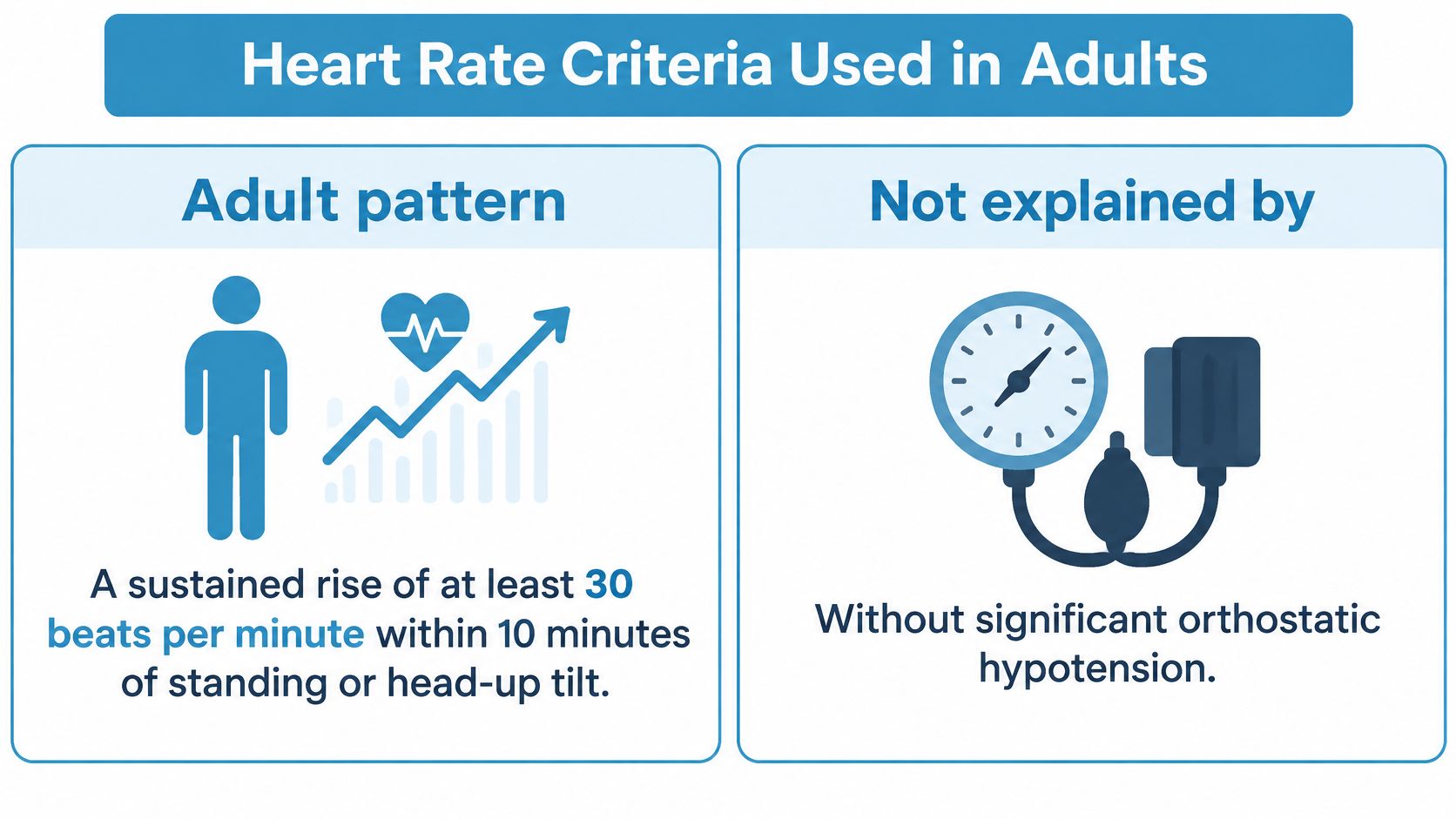
The adult heart-rate pattern is a sustained increase of at least 30 beats per minute within 10 minutes of standing or head-up tilt, without significant orthostatic hypotension, according to this clinical review of POTS diagnosis and physiology.
The important word is sustained. A momentary jump while you get up, move around, or adjust your watch isn't equivalent to a persistent upright response.
Reading the numbers together
Think of gravity as a tilt challenge your body encounters whenever you stand. The assessment asks how your circulation responds over time, not whether one beat looks unusually fast.
Blood pressure matters alongside pulse. Clinicians distinguish POTS from orthostatic hypotension, in which the defining problem is a meaningful blood-pressure fall after becoming upright.
Adult reference points for a POTS pattern
| Feature | Adult reference | What it does not mean |
|---|---|---|
| Heart-rate rise | Sustained increase of at least 30 bpm within 10 minutes of standing or head-up tilt | A brief spike or an exercise rise is not the same pattern |
| Often-cited peak | Frequently 120 bpm or higher | Hitting that peak by itself is not a diagnosis |
| Blood pressure | No significant orthostatic hypotension, generally assessed against a 20 mm Hg systolic or 10 mm Hg diastolic fall | A significant drop requires assessment for orthostatic hypotension |
| Symptom duration | Chronic orthostatic intolerance; older consensus often used 6 months, while an NHLBI summary uses 3 months | Duration language has evolved; the heart-rate-rise threshold has not |
| Symptom link | Lightheadedness, palpitations, weakness, or cognitive difficulty that improve lying down | Tachycardia without orthostatic symptoms is not sufficient |
| Exclusions | Dehydration, anemia, hyperthyroidism, medications, illness, pain, panic, caffeine, alcohol, arrhythmia, exercise | Another explanation can produce a similar rate rise |
The duration distinction reflects evolving diagnostic guidance, not separate versions of the heart-rate threshold. You also don't need to postpone seeking care until you've personally decided that your symptoms meet a duration requirement.
Why a threshold isn't a diagnosis
A clinician will ask whether the rise occurred during quiet standing or while you were walking, whether symptoms accompanied it, and whether the pattern persists outside an acute illness. Medication timing and recent fluid loss can change the interpretation substantially.
A high absolute pulse and a large change from baseline answer different questions. That's why a screenshot of the maximum rate can leave out the information needed to understand the event.
The heart-rate threshold identifies an orthostatic pattern. A clinician still needs to interpret posture, symptoms, blood pressure, duration, and other possible causes.
For a practical explanation of the assessment process, our guide to POTS diagnosis and testing describes what to discuss at an appointment. The purpose of testing is to explain your symptoms, not just to determine whether you crossed a numerical line.
Why Symptoms and Heart Rate Can Diverge
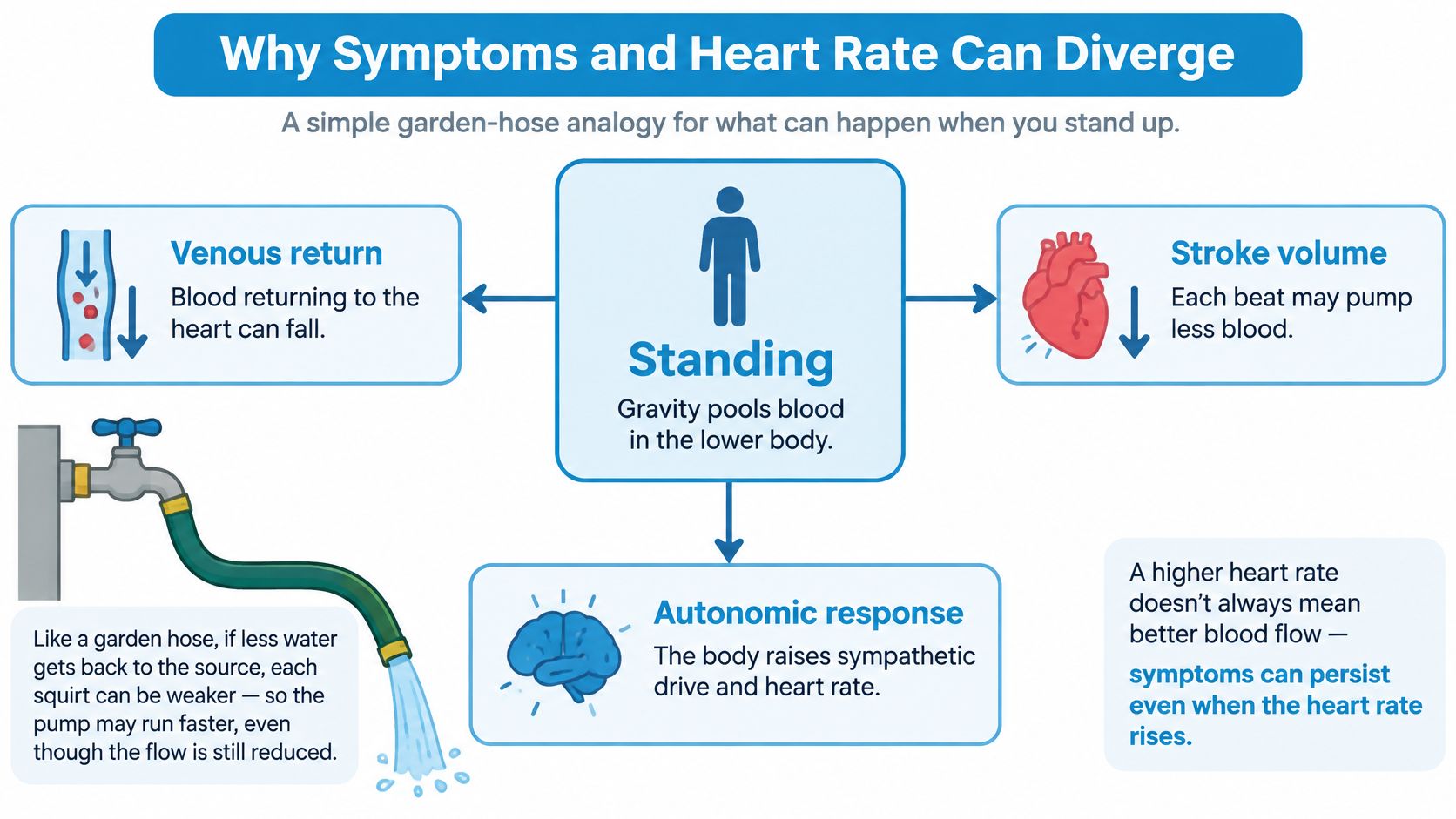
Think about a garden hose supplied by a pump. If less water reaches the pump, making it work faster doesn't automatically tell you how much water reaches the far end. Your circulation is more complex, but the analogy helps separate heart rate from effective blood delivery.
When you stand, gravity encourages blood to collect in the lower body. Less blood may return to the heart, and each beat may pump a smaller amount, called stroke volume. The autonomic nervous system can respond by increasing sympathetic activity and heart rate to help maintain circulation, as described in this review of POTS mechanisms.
Different mechanisms can produce different sensations
Some people also have low circulating blood volume, insufficient blood-vessel tightening, or an exaggerated sympathetic response. These mechanisms can overlap rather than fitting neatly into separate boxes.
That can produce different sensations at the same time. Dizziness, visual blurring, cognitive slowing, and weakness can accompany impaired blood delivery to the brain. Palpitations, tremor, chest discomfort, and anxiety-like physical sensations can accompany sympathetic activation.
These physical sensations don't prove that anxiety caused the episode. They also don't rule anxiety out. The relationship to posture and the broader clinical history help distinguish overlapping explanations.
Comparing days without ranking their peaks
Consider these hypothetical days:
- A difficult day with a modest rise: You slept poorly, the room is warm, and standing to prepare breakfast leaves you foggy and weak.
- A less disruptive day with a larger rise: Your recorded pulse increases more, yet your vision stays clear and you can complete the same task.
- A similar reading with different recovery: Your pulse looks familiar, but fatigue keeps you from returning to work after the pounding settles.
Hydration, salt intake, sleep, temperature, meals, medications, conditioning, and recent exertion can alter blood volume and autonomic demand. A pulse reading captures only part of that changing situation.
A smaller rise doesn't invalidate a harder day. A larger rise doesn't automatically mean greater impairment.
Repeated observations are therefore more useful than choosing the most dramatic reading. They allow a clinician to compare like situations and see whether symptoms track with posture, environmental conditions, or recovery.
Consumer heart-rate trends can support that discussion, but they can't replace an in-person assessment of orthostatic vital signs or a tilt-table evaluation when indicated. The useful endpoint is understanding the pattern, not collecting progressively higher peaks.
Triggers and Conditions That Mimic POTS
Heat, waiting in a long queue, disrupted sleep, illness, and changes in fluid intake can make upright activity harder. Meals, alcohol, and the early part of the day may also be relevant to the history.
A trigger and an alternative diagnosis aren't the same thing. A trigger can worsen an existing pattern; an alternative diagnosis may explain the symptoms instead.
- Heat and prolonged standing: Note whether symptoms begin in a warm shower, while cooking, or during a stationary task.
- Illness and fluid loss: Explain whether the change followed fever, vomiting, diarrhea, or difficulty drinking.
- Meals and sleep: Record whether you felt different after eating or after a disrupted night.
- Substances and medicines: Include caffeine, alcohol, new prescriptions, and dose changes without assuming they're harmless or automatically responsible.
Comparing look-alikes
The comparison belongs in a clinical conversation, not in a self-diagnosis checklist. Several conditions can cause a racing pulse and dizziness, and more than one problem can occur together.
Look-alikes compared with a POTS pattern
| Condition | Main clue | How it differs |
|---|---|---|
| Orthostatic hypotension | A significant blood-pressure fall on standing | The pressure drop defines the problem; pulse alone cannot distinguish it |
| Inappropriate sinus tachycardia | Fast rate much of the day, including at rest | Less tied to standing and to relief when lying down |
| Dehydration or low volume | Similar upright rise during fluid loss | May improve when the volume problem is corrected |
| Anemia or hyperthyroidism | Ongoing tachycardia plus systemic signs | Targeted laboratory tests help identify the cause |
| Medicines, caffeine, alcohol, panic, pain, or acute illness | Rate rise follows a dose, drink, stress, or sickness | Timing and history may explain the episode |
| Arrhythmia | Sudden start, possible irregular rhythm | May require ECG review rather than a standing heart-rate count alone |
A helpful distinction is whether your rate becomes fast mainly with upright posture or remains fast while you're resting comfortably. Another is whether the heartbeat gradually accelerates or suddenly changes in a way that feels unlike your familiar episodes.
Neither distinction is definitive at home. A sensation of irregularity needs assessment rather than interpretation from a symptom label, and medication-related symptoms shouldn't lead you to stop a prescription without medical advice.
What to bring to the comparison
Tell the clinician what changed before the symptoms began. For example, an episode during a gastrointestinal illness carries different context from a recurring pattern that continues when you're otherwise well.
Mention sleep disruption, digestive complaints, headaches, and reduced exercise tolerance even if your appointment was booked for palpitations. Those details can help the clinician avoid treating the pulse as an isolated problem.
Our explanation of unexplained tachycardia can help you organize that history. If the fast rate is mainly situational, feels irregular, or accompanies a clear pressure drop, don't label it POTS before alternatives are checked.
Signs That Need Medical Care Soon
Seek emergency care for new or severe chest pain, severe shortness of breath, fainting with injury or without prompt recovery, one-sided weakness, trouble speaking, or new confusion. A sudden, unfamiliar irregular pounding accompanied by faintness or other severe symptoms also needs urgent assessment. Don't delay care to capture a better recording.
An established POTS diagnosis doesn't make every new symptom a familiar flare. Treat a substantial change from your usual pattern as new information.
When to arrange prompt assessment
- Increasing near-fainting: Seek care when episodes become more frequent, more intense, or interfere with moving safely.
- Persistent resting tachycardia: A rate that stays unusually high while resting deserves evaluation.
- Uncorrected fluid loss: Get help if you can't keep fluids down or remain dizzy and weak despite trying to drink.
- A changed medical context: Contact your clinician promptly if symptoms change during pregnancy or after starting or adjusting medicine.
A clinical review of orthostatic intolerance explains why heart-rate information alone can't establish POTS: it doesn't reliably capture blood pressure, posture, chronicity, or competing diagnoses. A reassuring-looking watch graph can't clear you to stay home when warning symptoms are present.
What to request at a planned visit
Ask for heart rate and blood pressure assessed with position changes, along with a review of medications, hydration, and the symptom timeline. Depending on the history, the clinician may recommend targeted blood tests, an ECG, or additional monitoring.
A tilt-table test can help when the bedside assessment leaves questions; it isn't a prerequisite for taking symptoms seriously. Troublesome upright symptoms deserve evaluation even when the reading taken during an appointment looks ordinary.
Logging Episodes and Preparing for Your Visit
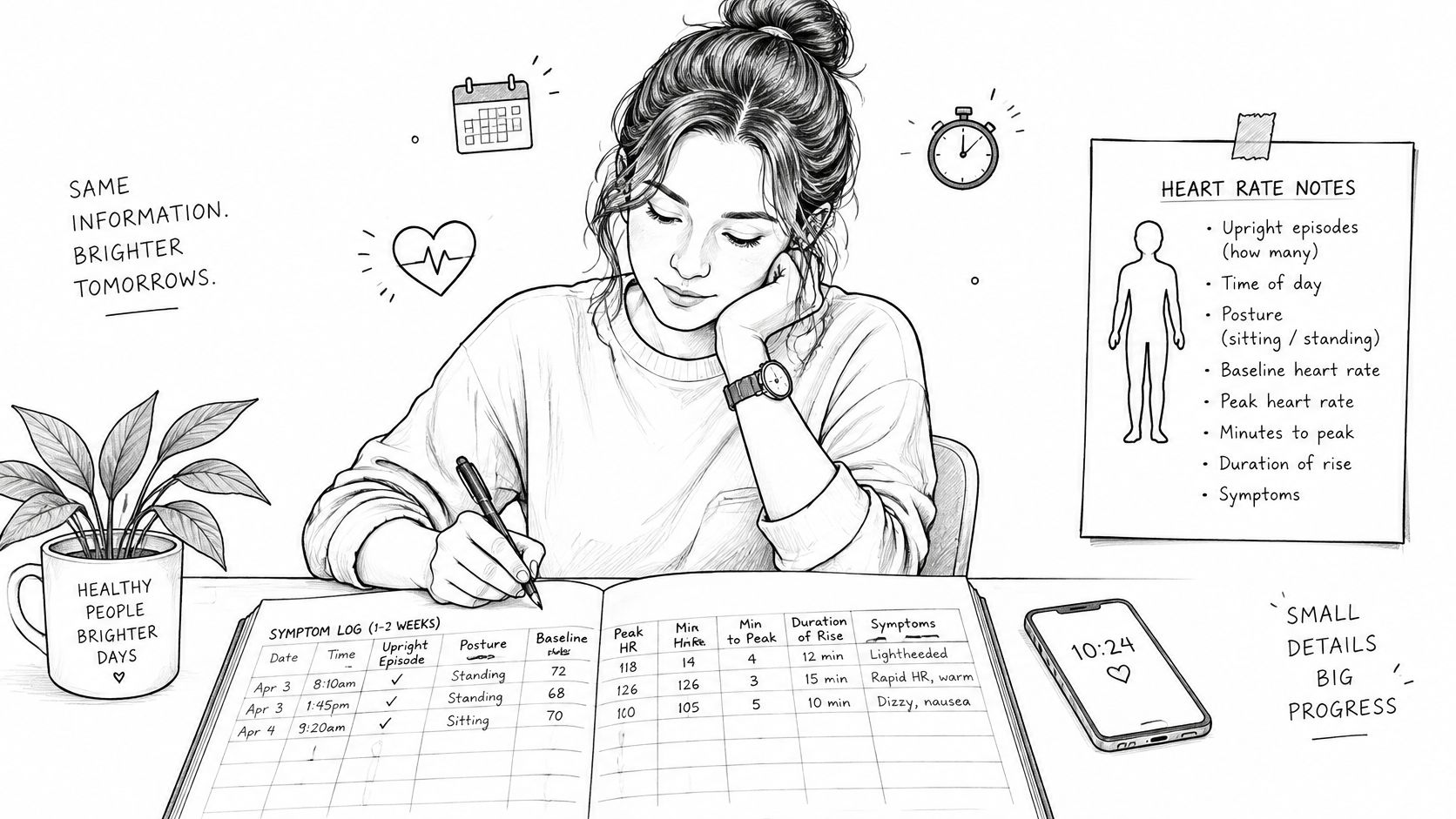
Start a log while you arrange your appointment, rather than waiting until you've collected enough evidence to feel certain. The aim is a readable account of ordinary episodes, not an exhausting monitoring project.
A practical episode checklist
Describe the position and activity. Write whether you were lying down, sitting, standing still, walking, or recovering from activity. Include what you were trying to do, such as brushing your teeth or preparing lunch.
Preserve the heart-rate sequence. If available, record the baseline, peak, elapsed time to peak, and how long the elevation lasted. Mark missing information as unknown rather than estimating it from memory.
Name the symptoms and their impact. Include dizziness, palpitations, fatigue, brain fog, blurred vision, weakness, or nausea. Explain whether you paused, sat down, abandoned the task, or needed help.
Add relevant context. Note time of day, meals, fluids, salt intake, sleep, medication timing, heat, and recent exertion. Record your usual intake and routine rather than deliberately changing them to test a theory.
Describe recovery. Explain whether sitting or lying down helped, which symptoms improved, and what lingered afterward. That can be more informative than recording only when the pulse returned toward baseline.
Keep workouts separate. Label exercise and the recovery afterward so those recordings aren't mistaken for quiet-standing episodes. Look for recurring circumstances across days rather than selecting only your highest peak.
Include the day that doesn't look dramatic
The American Family Physician review of orthostatic hypotension helps frame why position-related symptoms require attention to blood pressure and alternative explanations, not just a fast pulse. Morning patterns and symptoms outside a single standing spell are also worth explaining during your history.
Don't discard a difficult episode because its graph looks unimpressive. A note that you couldn't finish getting ready for work communicates something a pulse maximum cannot.
A concise entry might read:
After getting dressed, I stood at the bathroom sink. My heart pounded and my vision blurred, so I lay down. The visual symptoms settled, but I remained too foggy to start work. I'd slept poorly and hadn't eaten.
This example separates activity, symptoms, response, and context without claiming a diagnosis. If your main problem is nausea or fatigue rather than dizziness, give it the same attention.
Using watch information without confusing detection with diagnosis
If you use an Apple Watch, our Cardiogram app can organize Apple Health heart-rate information alongside logged dizziness, palpitations, fatigue, and brain fog. We log rises of 30 or more bpm within 5 minutes, with baseline, peak, and duration; our reference thresholds also include 40 bpm for ages 12 to 19. These are reference points, not diagnostic criteria, and our PDF brings episodes, trends, and symptoms together while stating the exact criterion used.
An app's detection window isn't interchangeable with a clinical standing assessment. An automatically identified event is something to review in context, not confirmation that posture caused it.
For help keeping notes manageable, use our chronic illness symptom-tracking guide. Before the appointment, summarize your main concern, when the pattern began, what activities it limits, and any recent medication or health changes. Bring the record and let the clinician interpret it alongside blood pressure, examination findings, and appropriate tests.
Cardiogram helps you connect heart-rate episodes with the dizziness, fatigue, palpitations, and brain fog you experience, then bring that history to an appointment in a readable PDF. Visit Cardiogram to organize your patterns and symptoms for a more informed conversation with your clinician, without treating a watch reading as a diagnosis.