Dysautonomia symptoms are involuntary function problems, often worse upright, spanning heart rate, blood pressure, gut, sweating, temperature, sleep, and thinking, and a fast pulse alone is not the diagnosis. That's why the experience can feel confusing in real life. You stand in the shower and your vision grays at the edges, you eat breakfast and feel nauseated for two hours, and by afternoon a simple email takes three tries because you can't hold the thought.
Each complaint looks like it belongs to a different clinic. A racing heart sends you to cardiology, bloating sends you to gastroenterology, and exhaustion gets filed under stress. The useful question isn't whether one symptom sounds dramatic enough. It's whether several symptoms move together with posture, heat, meals, exertion, and recovery, and whether they keep repeating over weeks and months.
Start sorting now with three labels: upright only, all day, or both. A symptom that reliably fades when you lie down tells a different story than one that's present in bed. That distinction turns a scattered list into something a clinician can test.
What Dysautonomia Symptoms Are and How They Appear
You're standing at the kitchen counter when your heart starts pounding. Your hands tremble, your vision blurs, and sitting down helps. Later, after a meal, nausea and bloating linger whether you're sitting or lying down. These experiences can share an autonomic cause while following different patterns.
Dysautonomia is an umbrella term for disorders of the autonomic nervous system, which regulates functions such as heart rate, blood pressure, digestion, sweating, bladder function, and temperature without conscious control. The American Heart Association clinical review on POTS describes POTS as one condition involving chronic difficulty tolerating an upright posture. A rapid pulse can also occur with fever, dehydration, pain, or exercise, so heart rate alone cannot identify its cause. POTS criteria are covered in the section on where POTS fits on the spectrum.
Reading symptoms by body system
The chart is a reference, not a diagnostic checklist. For each symptom, record what it feels like, when it occurs, and whether it eases with rest or a change in posture. A clinician can use those details to see which complaints tend to occur together.
| Body system | Common symptoms | Usual pattern | Not this by itself |
|---|---|---|---|
| Cardiovascular and orthostatic | Lightheadedness, palpitations, weakness, exercise intolerance, fainting or near fainting | May worsen upright and ease when lying down | A heart rate rise only during exercise |
| Neurologic | Blurred vision, tremulousness, headache, brain fog | May occur with standing or deep fatigue | Sudden one-sided weakness, which needs emergency care |
| Gastrointestinal | Nausea, bloating, abdominal pain, diarrhea, delayed stomach emptying | May persist regardless of posture | A one-off stomach illness |
| Temperature and sweating | Reduced or excess sweating, heat or cold intolerance | May shift with environment and exertion | Fever from an infection |
| Bladder, sleep, and energy | Urinary urgency or incontinence, sleep disruption, fatigue | May continue over time and occur with other systems | One poor night of sleep |
For example, two minutes of standing at the counter might bring palpitations, shaky hands, and blurred vision, with all three easing after you sit with your feet up. Record those symptoms together and note the posture and relief. If bloating and early fullness follow meals whether you are seated, standing, or reclined, record that pattern separately. A symptom log is useful when it captures the differences, not just the number of complaints.
A single dizzy morning after poor sleep or too little fluid may have a different explanation from recurring symptoms. The pattern, duration, and context help a clinician decide what to assess.
Practical rule: A repeated cluster of symptoms in a similar context is more useful to discuss with a clinician than one isolated symptom.
What scale doesn't tell you
Population patterns cannot diagnose an individual. Belonging to a group more commonly affected does not confirm dysautonomia, and falling outside that group does not rule it out. A wearable can record pulse patterns, but it does not measure blood pressure alongside the pulse or exclude other causes that may resemble an autonomic problem.
Some symptoms call for urgent assessment rather than routine logging. Sudden one-sided weakness, chest pain, severe breathlessness, or fainting with an injury needs urgent care. Seek prompt assessment for a first faint with chest symptoms or a collapse during exertion. Once urgent concerns have been addressed, a symptom log can help make recurring patterns clearer.
How Standing Disrupts Automatic Control
Think of the autonomic nervous system as a dimmer and pump crew working behind a wall. You don't issue instructions. The crew watches what your body is doing and adjusts, tightening blood vessels a little, nudging heart rate up or down, moving gut contents along, and switching sweat glands on or off so you stay in range.
Standing is their busiest moment. Gravity pulls blood toward your legs and abdomen as soon as you rise. A well run crew notices within seconds, squeezes vessels in the lower body, returns blood toward the heart, and keeps enough flow reaching your brain. You feel nothing. You make coffee, you answer the door, you forget the adjustment happened.
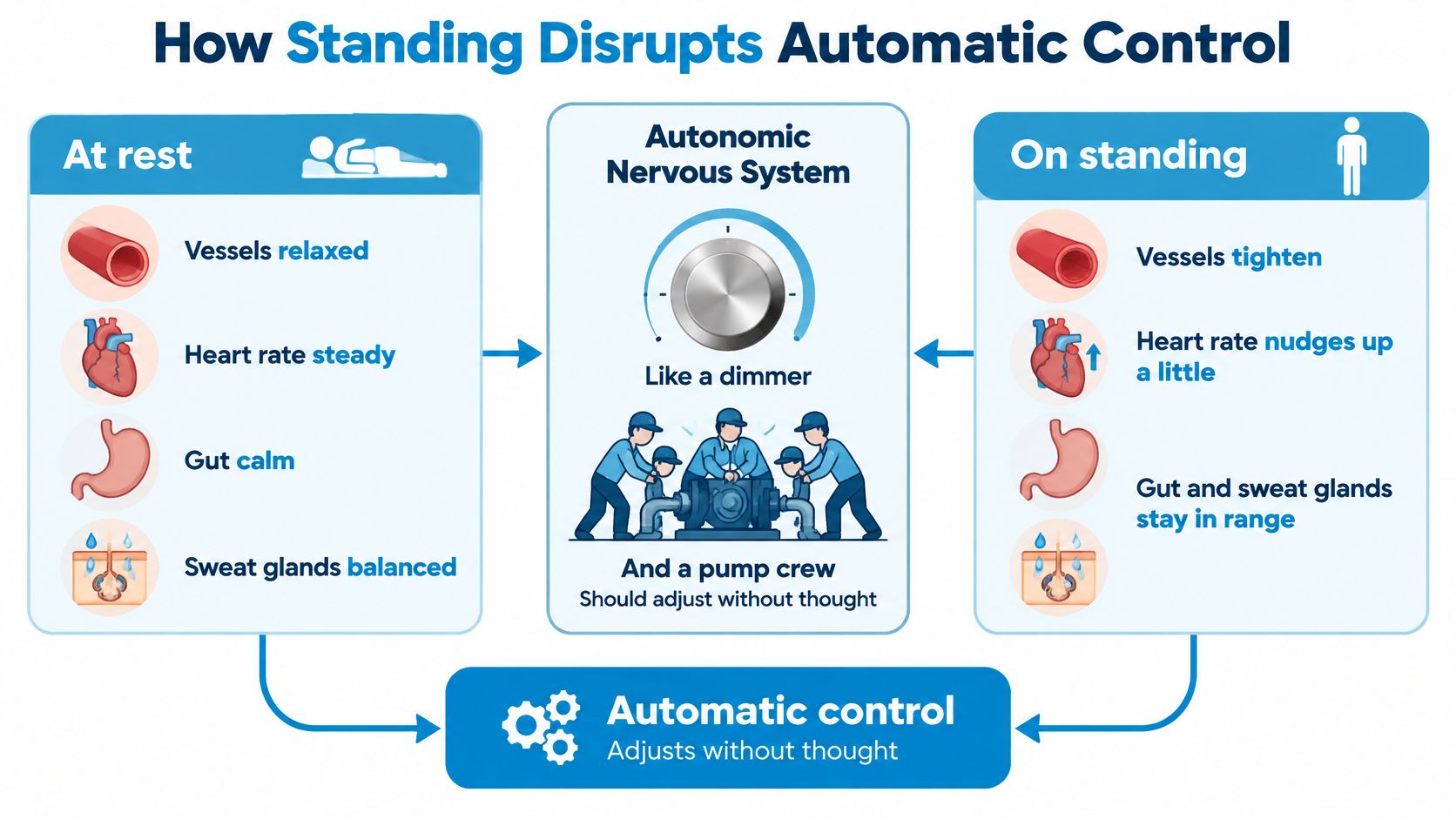
In dysautonomia, that squeeze can be too weak or too late. The clinical overview of dysautonomia mechanisms explains that reduced venous return while upright can trigger inadequate vasoconstriction, cerebral hypoperfusion, and compensatory sympathetic activation, producing dizziness, visual disturbance, tremulousness, and a rapid heartbeat. Cerebral hypoperfusion means not enough blood reaching the brain for those seconds. It's the gray out, the narrowing vision, the sudden need to grab the counter. It isn't a stroke, and it eases when lying flat restores flow without the crew having to fight gravity.
Why the surge feels so unpleasant
When the vessel squeeze underperforms, the crew compensates with the tool it has left. It sends an adrenaline style signal that drives heart rate up hard. That's the pounding pulse, the tremor in your hands, the feeling of being wired while you're only standing in a bathroom. The compensation can keep you conscious, but it feels awful, and it doesn't fully fix the underlying pooling.
Contrast helps here. A healthy person may see a brief, modest heart rate rise on standing that settles quickly and brings no symptoms. A posture linked problem keeps the surge going minute after minute, and symptoms ride along with it. Duration and symptoms together, not a single peak number, are what separate a normal adjustment from a pattern worth testing.
The same crew runs other rooms
Because one crew manages many systems, the failure doesn't stop at vessels. Gut motility can slow until meals sit heavily, or speed up unpredictably. Sweat glands can flood on a mild day or fail to switch on in heat, so temperature control swings. The bladder can mis time its signals, producing urgency at inconvenient moments.
Sleep and thinking suffer downstream. If blood flow regulation falters and adrenaline style activation runs high, concentration narrows and rest feels unrefreshing. These complaints often sound vague in isolation. Placed beside a clear upright pattern, they stop sounding random.
That's the diary implication of the physiology. A lone heart rate number has no mechanism attached, so record posture, time, heart rate, hydration, meals, sleep, medications, temperature, and exertion beside each symptom. You're not collecting trivia. You're showing whether the crew failed at the exact moment gravity, heat, or a meal asked it to work.
Where POTS Fits on the Spectrum
A racing heart can appear during a run, a fever, or a spell of anxiety. POTS describes a narrower pattern: symptoms that repeatedly worsen upright, alongside a sustained heart-rate rise that meets specific criteria. Sorting posture-linked symptoms from all-day complaints helps make a symptom log useful, while keeping a high heart rate alone from being mistaken for POTS.
The consensus-based POTS criteria specify a sustained rise of at least 30 beats per minute within 10 minutes of standing in adults, or at least 40 beats per minute in adolescents aged 12 to 19, without sustained orthostatic hypotension. Symptoms must also be frequent, worse upright, improve when lying down, persist for at least 3 months, and not be better explained by another condition, such as dehydration, medication effects, anemia, or endocrine disease.
POTS heart rate rules versus look-alikes
| Check | Adults | Adolescents 12 to 19 | If it fails |
|---|---|---|---|
| Heart-rate rise on standing | At least 30 bpm, sustained, within 10 minutes | At least 40 bpm, sustained, within 10 minutes | A brief exercise spike does not meet the rule |
| Blood pressure | No orthostatic hypotension | No orthostatic hypotension | A sustained drop of 20 mm Hg systolic or 10 mm Hg diastolic points toward orthostatic hypotension |
| Symptom timing | Frequent, worse upright, better lying down, at least 3 months | Same duration and posture pattern | Symptoms without a recurring upright pattern do not fit the full picture |
| Other causes | Not better explained by dehydration, medication effects, anemia, or endocrine disease | Same exclusions | Other possible causes need consideration |
| Supportive clue only | Standing heart rate above 120 bpm is sometimes cited | Same supportive clue | A rate above 120 without the required rise is not enough |
The rows work together. The rise must be sustained, not a momentary spike as you stand. Blood pressure must also be considered, and symptoms should recur in the upright position. A description of POTS symptoms in adults can help you recognize the kinds of complaints to discuss, but a symptom list or watch alert cannot establish the diagnosis.
What confirmation looks like
An active stand test measures heart rate and blood pressure while you are lying down and at intervals after standing. A tilt-table test records the same measures as a table moves you toward an upright position. In either test, the clinician can compare your symptoms with the changes in pulse and pressure.
A standing rate above 120 without the sustained rise, stable blood pressure, and matching symptoms is a clue, not a diagnosis.
Wearable records can show whether heart-rate rises recur at similar times and provide timestamps to discuss at an appointment. They cannot measure blood pressure or rule out other causes, such as anemia. Repeated upright symptoms and a pattern resembling the criteria are reasons to discuss formal testing with a clinician.
Other Forms on the Autonomic Spectrum
Dysautonomia is a spectrum, and POTS occupies only one part of it. Other forms can produce dizziness, fainting, fatigue, and gut or bladder trouble while following completely different rules. Naming them helps you understand why a clinician doesn't stop at your pulse.
Orthostatic hypotension is a sustained blood pressure drop on standing. Because POTS excludes that drop, finding it changes both the label and the treatment direction. Neurally mediated syncope is a reflex in which heart rate or blood pressure falls and causes fainting, often after prolonged standing, heat, pain, or emotional distress. If faints are your main event, a plain language explainer on the vasovagal response and syncope can help you describe the warning sensations before an episode.
Some forms sit inside wider neurologic disease. Pure autonomic failure and multiple system atrophy are progressive neurodegenerative disorders where autonomic failure appears alongside other neurologic features. Secondary dysautonomia can follow diabetes, certain medications, or endocrine disease, which means fixing or adjusting the underlying driver becomes part of the plan.
A clinician separates these forms with a sorting sequence like this:
- Check blood pressure on standing. A sustained fall points away from POTS.
- Check the heart rate rise. A sustained rise meeting threshold, with pressure holding, fits the POTS pattern.
- Look for neurologic signs. Weakness, gait change, or new bladder failure widens the search beyond a posture problem.
- Review background causes. Medications, diabetes, thyroid or other endocrine history, and how long the pattern has lasted all shape the decision.
No single symptom separates these forms. Fainting appears in several, and so does fatigue. The sequence works because it combines numbers, timing, examination findings, and history rather than betting everything on one complaint.
How Testing Turns a Pattern Into a Diagnosis
A pounding pulse after standing is a clue, not a diagnosis. A clinician looks at how heart rate and blood pressure change together, whether the pattern can be reproduced during standing or tilt-table testing, and whether another condition could explain it. POTS diagnosis generally requires symptoms during standing or tilt testing without a blood pressure fall of at least 20 mm Hg systolic or 10 mm Hg diastolic, according to the 2024 review indexed on PubMed.
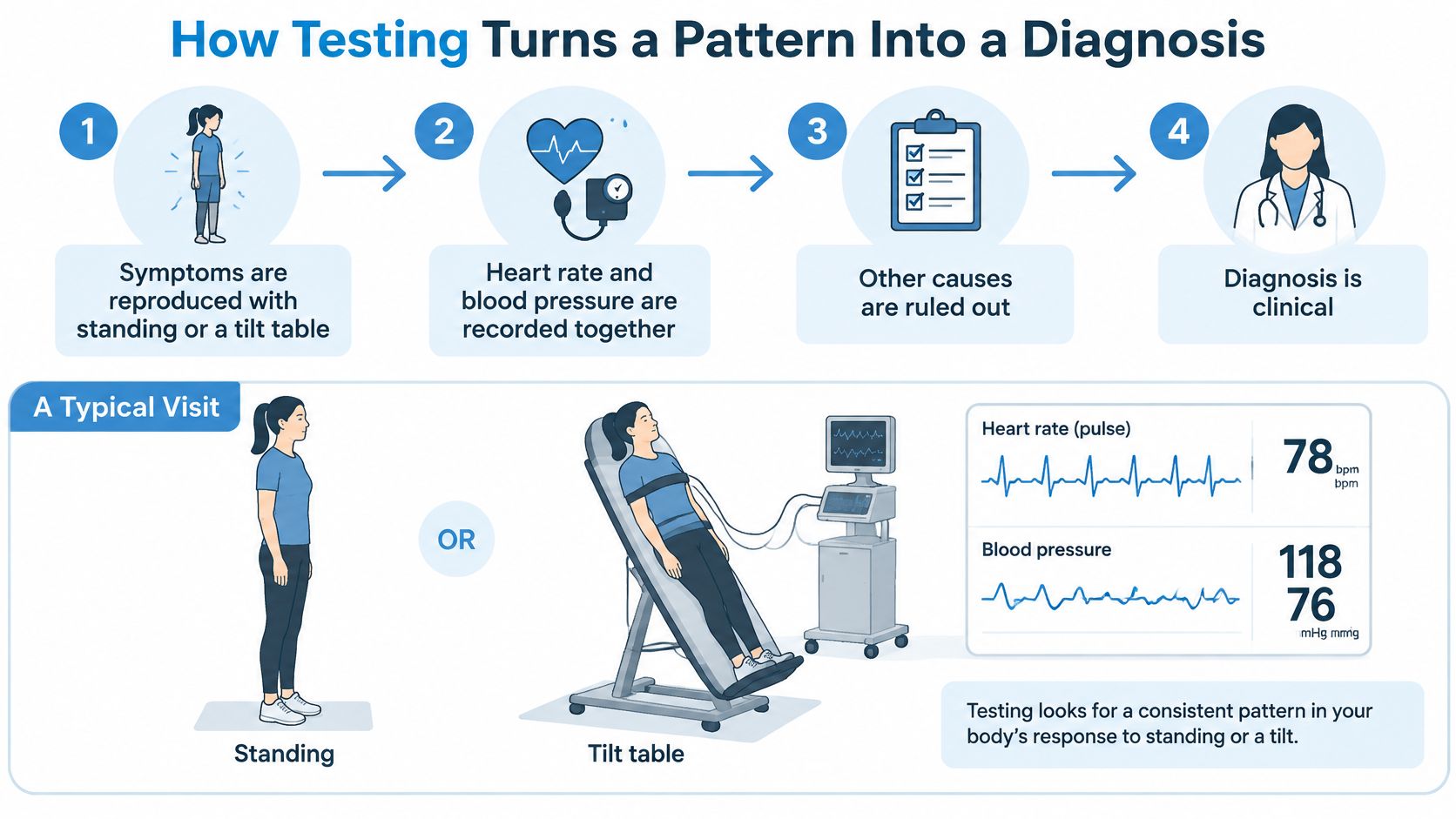
The visit path in order
- History first. The clinician asks which symptoms change with posture, heat, meals, or effort, how long they have lasted, and whether they began after an infection. This timeline helps distinguish a recurring pattern from a brief episode.
- Lying and standing measurements. Heart rate and blood pressure are recorded while lying down and after standing, or during a tilt-table test. The clinician checks whether the heart-rate rise is sustained and whether blood pressure also falls. The dysautonomia diagnosis criteria explain why both measurements matter.
- Labs and medication review. Anemia, thyroid or other endocrine disease, dehydration, and medication effects can produce a similar pulse pattern. The clinician may check for these causes and address them where possible.
- Targeted referrals. If gut, bladder, or neurologic symptoms are prominent, further evaluation can focus on those systems rather than attributing every complaint to heart rate.
The aim is to match the measurements to the history. A normal seated pulse may miss a repeatable upright pattern, while a fast pulse alone may have another cause.
What home data is for, and what it isn't
A home record can show when a heart-rate rise occurs, how often it repeats, and whether symptoms happen at the same time. Repeated episodes of pounding and gray vision after standing, for example, give the clinician a specific pattern to assess during testing. A home record cannot measure blood pressure alongside the change or rule out other causes, so bring it as context for the visit.
For a practical format, see the one-week log. Add questions for the appointment, such as whether active standing or tilt testing is appropriate and what results would affect the next steps.
One Mixed Day and a One-Week Log
At 7 a.m., standing in a warm shower brings gray vision and a pounding pulse. Sitting on the bath edge helps. A useful entry records the time, posture, shower, symptoms, heart-rate reading, and when they eased. The shower detail matters: a clinician can ask whether similar symptoms occur with other warm showers or only when you have been standing for a while.
Breakfast brings bloating and nausea that continue while lying down, so record them separately from the upright episode. During a warm commute, flushing and overheating follow the heat. Later, brain fog and a headache make a short email difficult even while seated. A brief walk brings heavy legs, and the evening adds urinary urgency and unrefreshing sleep. One day can include several kinds of symptoms, with different timing and possible triggers.
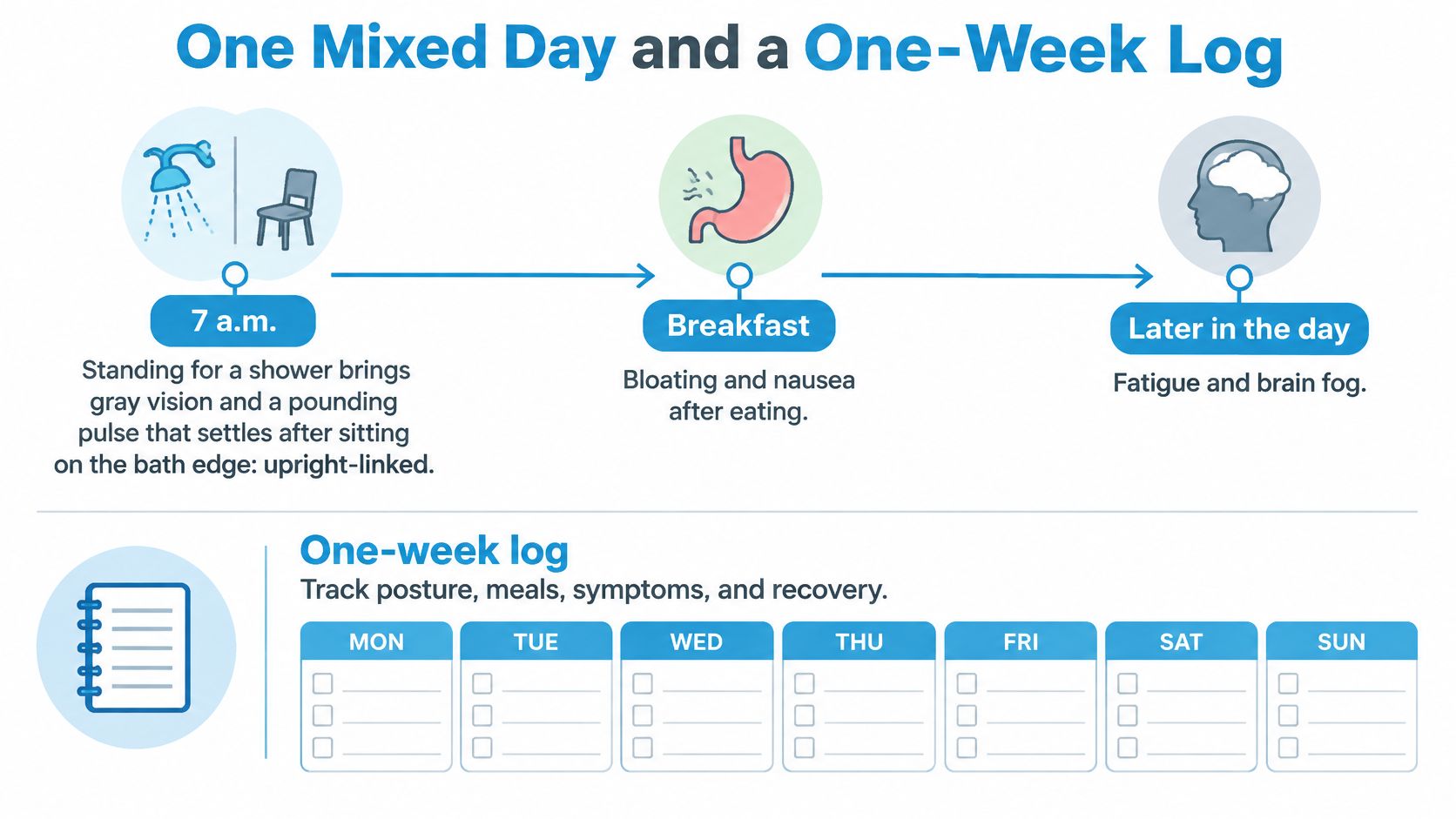
A log helps show which complaints occur with standing and which continue regardless of posture. The patient education guidance on symptom tracking describes this distinction and explains why a symptom pattern alone does not establish POTS. The criteria discussed in the POTS section can help frame the clinical assessment, but a fast pulse by itself does not settle the cause.
Your one-week plan
- Timestamp symptoms and posture. Note when each starts and whether you were lying, sitting, or standing.
- Add a fitting context. Record details such as a shower, meal, heat, exertion, sleep, medication, fluids, or salt when they help explain the timing.
- Keep heart-rate readings tied to the moment. Record them alongside the symptom and what you were doing.
- Bring the log to your appointment. Ask whether blood pressure and heart rate should be measured together while standing.
Short entries are easier to keep up with. If you use Cardiogram, you can log dizziness, palpitations, fatigue, and brain fog, as well as hydration, salt, sleep, medications, and how you feel, then compare those entries with your heart rate. Cardiogram Pro's PDF report shows episodes, trends, and symptoms together and states the exact criterion used.
The goal is a timeline a clinician can interpret: what happened, in what setting, and how it changed. If your log shows recurring upright episodes, Cardiogram can turn heart-rate episodes, logged symptoms, and context such as hydration, salt, sleep, and medications into trends and a PDF report. Bring it to your visit and ask whether the pattern should be assessed with blood pressure measured alongside heart rate while standing.