The cuff tightens, the screen flashes a high result, and suddenly you're worrying about your heart. Yet your readings at home look reassuring. It's frustrating when the numbers don't agree, especially if you're being asked to consider medication.
White coat syndrome with hypertension needs confirmation, not guesswork. The useful question isn't just whether you feel nervous at appointments. It's whether your blood pressure rises mainly in the clinic, stays high during everyday life, or includes spikes that a reassuring average might hide.
What White Coat Syndrome With Hypertension Is and Why It Happens
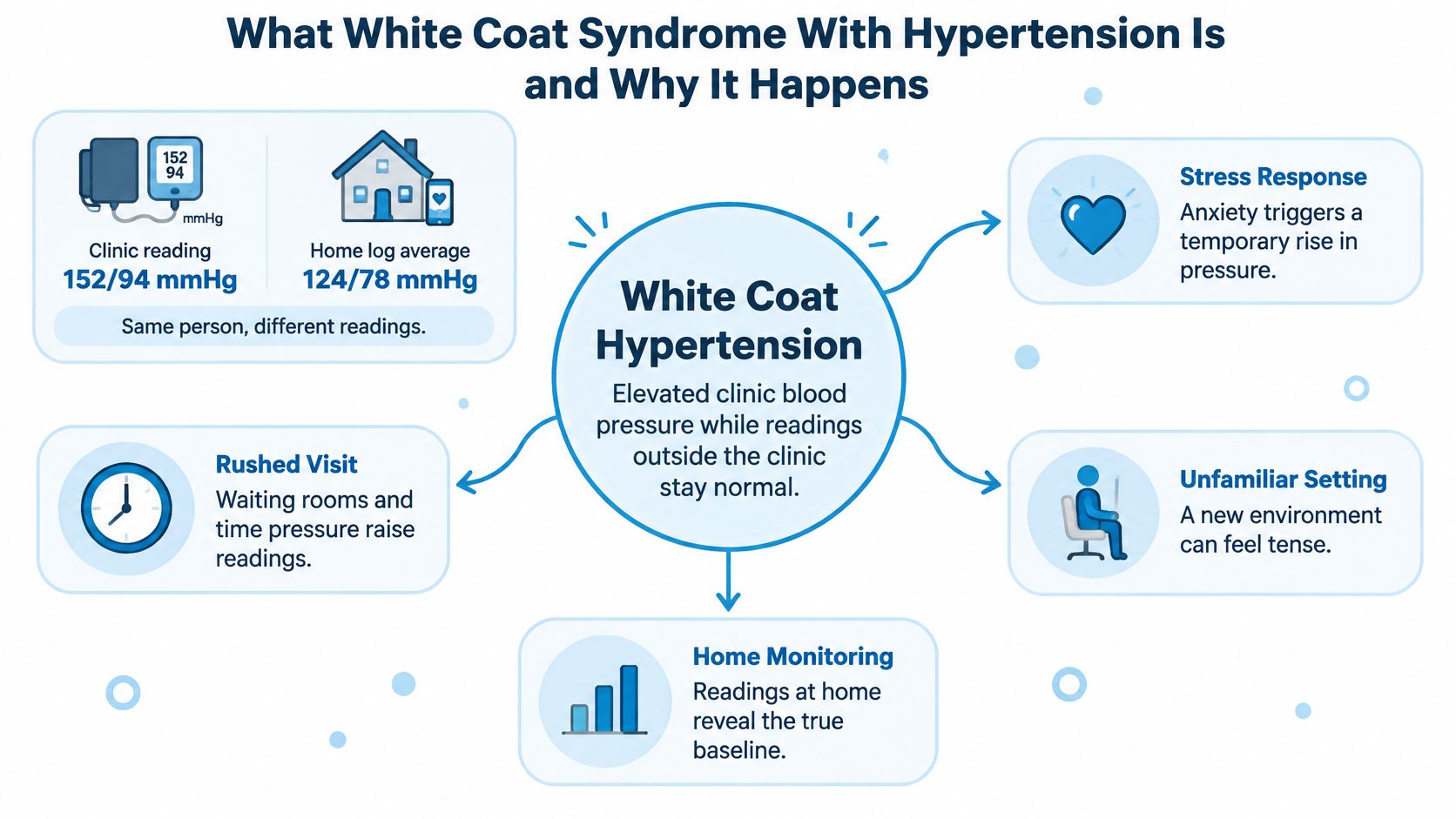
A reading taken two minutes after you climbed the stairs to the exam room can look very different from one taken in your kitchen an hour after breakfast. Both numbers are real. They describe your body under different demands.
White coat hypertension means blood pressure is raised in the clinic but normal outside it, confirmed through home or ambulatory monitoring. Anxiety and calm both leave the diagnosis open; only out-of-clinic measurements settle it. What settles it even better is the pattern across those measurements, because a reassuring average can still hide occasional spikes worth a closer look.
Why the setting can change the result
An unfamiliar room, waiting for the clinician, walking quickly down the hall, or anticipating the cuff's squeeze can put you on alert. Worry about the result can then make the next measurement feel even more important.
Your sympathetic nervous system, the part involved in the fight-or-flight response, sends signals that can speed your heart and tighten blood vessels. Recent activity, caffeine, and rushing can complicate the picture further. A high reading taken immediately after arrival may therefore describe that moment better than your usual resting pressure.
This pattern is common. The American College of Cardiology and American Heart Association guideline reported an average white coat hypertension prevalence of approximately 13%, with rates as high as 35% in some populations already identified as hypertensive.
White coat hypertension and white coat effect aren't identical
The terminology can be confusing if you already take blood pressure medication. Clinicians generally use white coat hypertension for the untreated pattern and white coat effect for a clinic-related rise that can also occur in someone with established hypertension.
That distinction matters. A person can have genuine hypertension and an additional appointment-related increase on top of it. A higher office result can reflect the visit itself rather than failing treatment, so any medication change belongs with your clinician, guided by readings from both settings.
Conditions that keep the autonomic nervous system on a shorter fuse, such as POTS, can produce similar in-clinic rises. That is one more reason the shape of your readings, when they climb and how far, carries more information than the average alone.
Tell your clinician if measurements make you tense. Ask for a quiet, properly supported repeat measurement after a few minutes of seated rest, so the second number reflects your resting pressure rather than your arrival.
One high reading raises a question. The answer comes from the pattern around it.
Office, Home and 24-Hour Monitoring Compared
Each method samples a different slice of the same week, so the useful question is what each slice can prove.
Blood pressure measurement methods for white coat hypertension
| Method | What It Captures | Typical Schedule | Main Strength | Main Limitation |
|---|---|---|---|---|
| Office reading | Pressure during a clinic visit | Repeated readings after rest | Quick and standardized when performed correctly | The setting can raise the result |
| Home monitoring | Resting pressure during daily life | Paired morning and evening readings over several days | Repeatable and practical for follow-up | Samples selected resting periods |
| Ambulatory monitoring | Pressure during waking activities and sleep | Automatic cuff measurements throughout the monitoring period | Clarifies the broader daily pattern | Can be uncomfortable or disturb sleep |
| Wearable or cuffless estimate | Estimated pressure derived from sensor signals | Device-dependent sampling | Convenient | Isn't a substitute for validated diagnostic measurements |
A single office reading captures one moment under clinic conditions. Standardized technique gives that moment consistent conditions: rest before measuring, the same supported arm position, and repeatable timing. That makes the result easier to compare with the next office result, while home and ambulatory data fill in what happens between visits. A reassuring average can still sit beside a cluster of readings that deserve follow-up, so look at the pattern as well as the mean.
Home monitoring supplies several comparable moments across ordinary days. You control the setup and can repeat measurements under similar resting conditions, which helps distinguish a persistent pattern from an appointment-related rise.
What ambulatory monitoring adds
Ambulatory blood pressure monitoring, or ABPM, uses an upper-arm cuff connected to a portable recorder. You wear it during ordinary activities and sleep, rather than choosing only comfortable moments to measure.
The U.S. Preventive Services Task Force recommendation supports confirming hypertension outside the clinic before treatment and describes 12–24-hour ambulatory monitoring as providing the strongest evidence about future cardiovascular risk.
ABPM is particularly helpful when home and office results conflict, symptoms occur outside your usual checking times, or nighttime pressure needs assessment. Keep an activity and symptom diary so the clinician can distinguish a resting measurement from one taken during movement, stress, or interrupted sleep.
Home monitoring remains useful, but it can miss what happens while you're working, commuting, or asleep. Don't deliberately choose only the quietest parts of the day if the question is whether unexplained episodes occur elsewhere.
Where wearable information fits
A pulse graph and a blood pressure record answer different questions. Heart rate measures how often the heart beats; blood pressure measures pressure within the arteries. You can't reliably convert one into the other.
Consumer heart-rate data can also be incomplete, delayed, or inaccurate, particularly during movement or poor sensor contact. Cardiogram can watch Apple Health heart rate and log a 30+ bpm rise within 5 minutes with baseline, peak, duration, and symptoms, but that still describes pulse timing rather than arterial pressure. A sharp rise on a watch deserves context, especially when an autonomic pattern can resemble a clinic surge.
A guide to irregular blood pressure readings can help you organize questions about inconsistent results. For practical decision-making, use ambulatory monitoring when the picture remains unclear, home monitoring for ongoing follow-up, and office measurements as a clinical starting point rather than the whole answer.
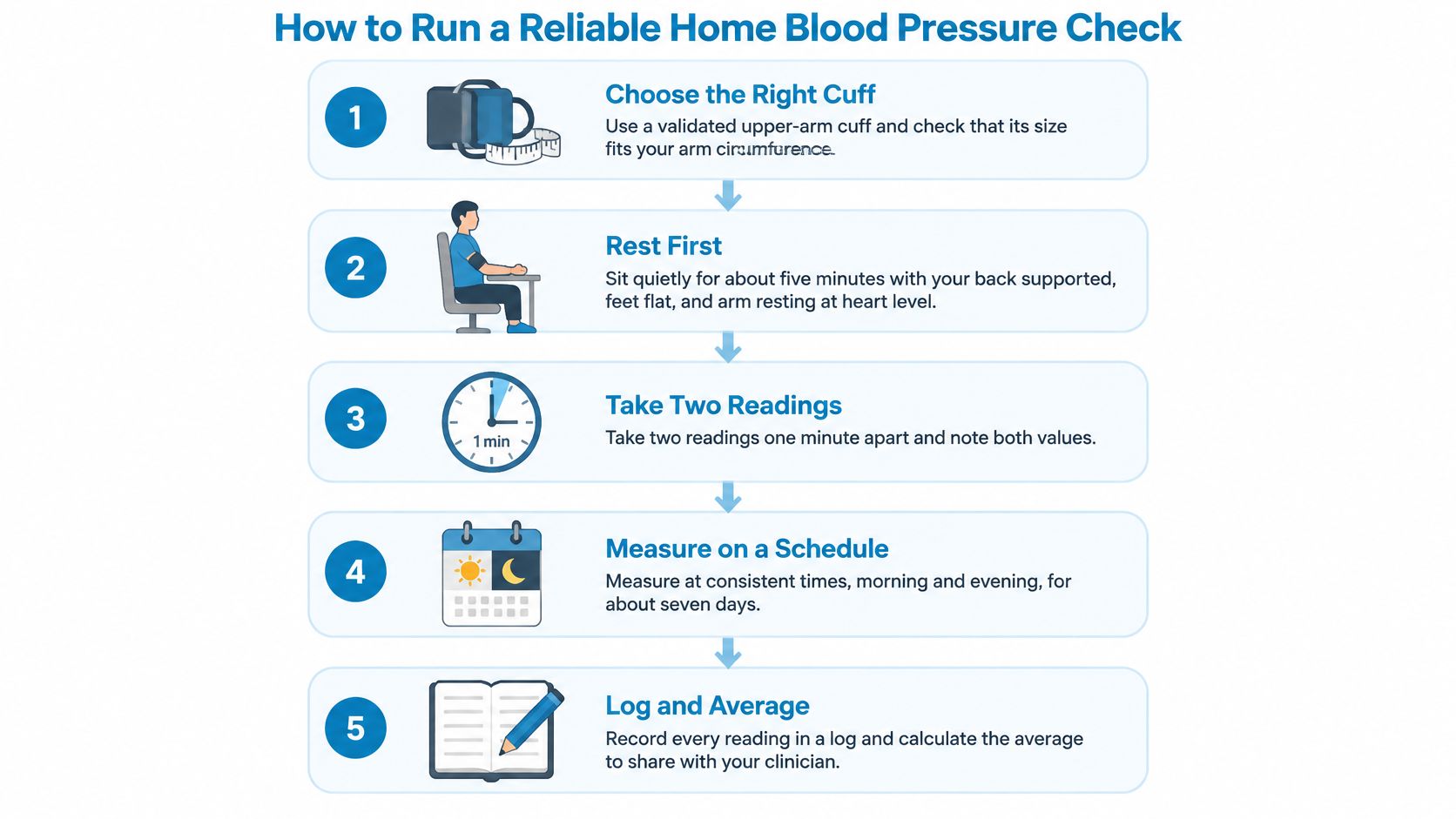
How to Run a Reliable Home Blood Pressure Check
A useful home log isn't a collection of your lowest numbers. It's a consistent record that lets your clinician compare like with like.
The AHA/ACC hypertension guidance recommends out-of-office monitoring to confirm suspected hypertension and supports home or ambulatory monitoring both to exclude white coat hypertension and to detect progression. The technique matters because changing the setup between readings can create apparent swings that are difficult to interpret.
Build a repeatable routine
Choose a validated upper-arm cuff. Match the cuff's stated size range to your arm circumference, because a cuff that's too small can overestimate pressure.
Settle before measuring. Sit with your back supported and feet flat, rather than checking immediately after walking in or climbing stairs.
Position your arm consistently. Place the cuff on bare skin and support the arm at heart level; don't hold it up through muscle effort.
Take paired readings. Pause between measurements according to your clinician's instructions and record both, rather than keeping only the lower result.
Use consistent morning and evening times. Ask how measurements should relate to your medication schedule, and don't delay or skip prescribed medication to improve the log.
Separate the check from stimulants and exertion. Avoid measuring immediately after coffee, smoking, or exercise, and stay silent while the cuff inflates.
Continue across a full monitoring period. Follow the schedule your clinician sets, including ordinary days rather than stopping when you get a reassuring result.
Record the circumstances. Include the time, arm, position, symptoms, medication timing, and anything unusual, such as poor sleep or a rushed morning.
Read the log without editing the story
Keep morning and evening results identifiable, even if your device calculates an overall average. Your clinician may want to compare them separately, particularly when medication timing or symptoms differ.
Mark unexpected spikes rather than deleting them. A measurement taken while talking or over clothing may need an explanatory note, but your clinician should still be able to see why you questioned it.
Practical rule: Bring the complete log, not a screenshot of your best reading or your worst reading.
If a result surprises you, check your position and cuff placement, settle, and repeat according to your agreed plan. Repeatedly checking until the screen gives you an acceptable number can increase anxiety and make the record harder to interpret.
Bring the monitor to an appointment so your team can review the fit and technique. If you're unsure what your wrist device actually measures, our explanation of watch-based blood pressure information helps distinguish sensor estimates from cuff measurements.
Blood Pressure Thresholds That Separate the Patterns
Blood pressure thresholds for white coat hypertension
| Measure | Threshold (mmHg) | What It Signals |
|---|---|---|
| Clinic blood pressure | Above the office threshold your clinician applies | Requires confirmation outside the clinic |
| Home monitoring average | Below the home threshold used in your care plan | Supports a white coat pattern when clinic pressure stays above the office threshold |
| Full-day ambulatory average | Below the applicable full-day threshold | Reassuring average across waking and sleeping periods |
| Daytime ambulatory average | Below the applicable waking threshold | Reassuring pressure during daytime monitoring |
| Nighttime ambulatory average | Below the applicable sleeping threshold | Reassuring pressure during sleep |
| Office minus ambulatory average | A substantial clinic-to-daily-life gap | A clue that must be interpreted alongside absolute readings |
| Guideline screening range | The range specified by the guideline used | Identifies who should have out-of-office confirmation |
The threshold belongs to the measurement method. An office cutoff works like a speed limit posted for one particular road: the same reading, judged against a home or ambulatory limit, is traveling a different road with a different sign. Before you compare results, ask your clinician which framework they are applying.
For the office row, the question is whether clinic pressure is consistently raised under proper measurement conditions. For the home row, the question is whether a representative series stays below the relevant home threshold. One good reading among several higher ones doesn't answer that.
Why the gap alone isn't enough
A Journal of Hypertension study published in 2024 found that an office-to-full-day ambulatory difference cutoff of 20/15 mmHg achieved 76.7% accuracy for identifying white coat hypertension in its validation cohort. The gap is a useful clue that prompts closer review of the absolute readings.
A large gap can exist even when pressure outside the clinic is still too high.
Suppose a clinic reading is markedly raised and the ambulatory average is lower but still above its applicable threshold. The clinic visit may have added a white coat effect, yet the person can still have sustained hypertension. Subtracting one number from the other only describes the size of the clinic reaction. The raised ambulatory result still stands.
The same logic applies inside the ambulatory report itself. A full-day average is built from its waking and sleeping parts, which is why the table gives them separate rows.
Read the whole report
Ask your clinician to walk through:
- The diagnostic framework. Which office, home, and ambulatory thresholds apply to you?
- The recording quality. Were there enough usable measurements, including during sleep?
- The separate periods. Were waking and sleeping averages each reassuring, rather than only the combined result?
- The context of outliers. Did high results coincide with movement, symptoms, medication timing, or disturbed sleep?
Thresholds differ between guidelines and clinical circumstances. The reliable approach is a single coherent framework applied to the whole record and agreed with your clinician. Assembling a diagnosis from the most reassuring cutoff in each system produces a picture no guideline describes.
Is a High Reading Harmless? Risk and Progression
White coat hypertension is generally lower risk than sustained hypertension, but it isn't automatically harmless. The reassuring part is that a clinic spike doesn't necessarily describe your everyday pressure. The reason to keep following it is that the pattern can change.
A systematic review and meta-analysis published in 2019, covering 11 studies, found a 33% higher relative risk of composite cardiovascular outcomes and a relative risk of 2.85 for progression to sustained hypertension compared with participants with normal blood pressure.
These are population comparisons; they do not give your personal probability of a cardiovascular event. For stroke, cardiac outcomes considered separately, and all-cause mortality, the differences in that review did not reach statistical significance, so presenting every outcome as equally increased would be misleading.

A spike's meaning depends on the pattern around it
A single high reading during a stressful appointment carries different weight from several markedly raised readings scattered across ordinary, calm days at home. The useful questions are how high, how often, under what circumstances, and with which symptoms. Brief, isolated increases rarely dictate medication on their own. Repeated spikes away from the clinic, especially with symptoms attached, are the ones worth bringing to your clinician's attention.
| Pattern | What the Record Looks Like | Useful Next Action |
|---|---|---|
| Isolated office elevation | Clinic results are high, while representative home and ambulatory results are normal | Confirm the situational pattern and arrange surveillance |
| Repeated home spikes | The home average is reassuring, but several readings are markedly above it | Bring the full log and discuss ambulatory monitoring |
| Sustained hypertension | Out-of-office averages remain above the applicable threshold | Discuss treatment based on pressure and overall cardiovascular risk |
The middle row is the one people most often miss. A log can look calm overall while a handful of strikingly high readings sit inside it, and those readings are exactly what a full review should surface.
When follow-up needs to move faster
Your clinician should know about factors that can change the urgency or interpretation:
- Symptoms. Chest discomfort, breathlessness, weakness, fainting, or vision changes need attention rather than reassurance from an average.
- Kidney disease or diabetes. These affect the broader cardiovascular assessment.
- Pregnancy. New elevations require pregnancy-specific advice, not an assumption of white coat hypertension.
- Older age or treatment-related dizziness. Both high pressure and excessive lowering deserve careful assessment.
- Very high or escalating readings. Don't file these away for a distant routine visit.
A high reading with chest pain, shortness of breath, new weakness, or vision change warrants emergency care. For a very high result without symptoms, follow your clinician's urgent-action plan or seek prompt medical advice rather than assuming it's anxiety.
Where POTS and Dysautonomia Blur the Picture
POTS and other forms of dysautonomia can complicate an appointment without proving white coat hypertension. These conditions affect automatic regulation of circulation. A person's heart rate may rise substantially around standing, while their blood pressure follows a different pattern.
A rushed journey, standing at reception, and walking to an examination room can all become part of the visit. If the pulse is measured immediately afterward, the result may reflect posture and exertion as well as anxiety. The blood pressure still needs its own measurement and interpretation.
Our explanation of autonomic nervous system dysfunction provides context for symptoms involving this regulation. The important distinction is that a fast pulse doesn't tell you whether pressure went up, went down, or stayed similar.
Posture provides a different clue from setting
Consider someone who feels dizzy while waiting upright but feels better after sitting. Calling the entire episode appointment anxiety could miss a posture-related problem. Conversely, a stressful appointment can occur alongside an autonomic condition rather than instead of it.
Some people with dysautonomia experience a blood pressure drop on standing. POTS isn't synonymous with that drop, and a heart-rate rise alone doesn't establish either diagnosis. A clinician may need appropriately supervised measurements in different positions.
Don't deliberately provoke symptoms at home to demonstrate that something is wrong, particularly if you've fainted or feel unsafe standing. Record what happened naturally, including whether you were seated, standing, walking, or lying down.
Use heart-rate records as supporting evidence
Our Cardiogram app watches Apple Health heart-rate data and automatically detects rises of 30+ bpm within 5 minutes, logging the time, baseline, and peak. You can add dizziness, palpitations, hydration, salt, sleep, medication, and how you felt to compare that context with the heart-rate episode.
For an appointment-related event, that record can help answer whether the pulse rise began before arrival, after standing, or during the examination. It can't establish white coat hypertension, because the app's episode record isn't a paired clinic-and-out-of-clinic blood pressure assessment.
An episode timestamp can help explain when something happened. It doesn't, by itself, explain why.
Consumer sensor gaps and movement artifacts also need review before an apparent surge is accepted as genuine. A missing segment isn't proof that nothing happened, and an isolated peak isn't proof of an autonomic episode.
Keep blood pressure measurements alongside the heart-rate timeline when your clinician requests them. Label which information came from a cuff, which came from a wearable, and which came from your symptom notes. That separation makes the history clearer without asking any device to prove more than it can.
Confirm the Pattern Before Changing Treatment
A high reading in the exam room and normal readings at the kitchen table tell two different stories, and only one of them should guide treatment. Don't start, stop, or change blood pressure medication because of a single clinic reading without clinical advice. Urgent symptoms are an exception to routine monitoring, not a reason to wait for a more complete log.
For nonurgent disagreement between readings, the decision path is straightforward. Confirm the out-of-office pattern with a validated home monitor or ambulatory recording. The pattern across days is what matters here, not the average alone, because a normal average can still sit on top of spikes worth a second look. Then decide whether the right response is surveillance, further assessment of unexplained spikes, or treatment for sustained hypertension.
A confirmed white coat pattern usually calls for continued monitoring and cardiovascular risk assessment. Sustained elevation calls for a treatment discussion that weighs your overall health, medication tolerance, and risk, with the clinic result as one input among several.
Bring evidence your clinician can use
Prepare a small appointment packet:
- Device details. Include the monitor model and cuff size.
- The complete record. Bring the full dated log from your home monitoring period.
- Symptom timing. Note what you felt, your position, and when medication was taken.
- Any ambulatory report. Include the full report with waking and sleeping results.
- A separate pulse summary. If you track heart-rate episodes, label them clearly so they aren't mistaken for pressure readings. That distinction matters when a fast pulse in the waiting room comes from an autonomic condition rather than blood pressure.
Ask for a written plan explaining when to measure again, what should trigger a call, and when treatment will be reviewed.
This week, ask about ambulatory monitoring if home and office results conflict. If they agree, ask for a home-monitoring and follow-up plan appropriate to that pattern.
Built for people with POTS and dysautonomia, Cardiogram helps organize heart-rate episodes and symptom context alongside your blood pressure log rather than as a substitute for it. Cardiogram Pro can export a clinician-ready PDF with the detection rule and logged context for your appointment. Visit Cardiogram to explore these records and bring a clearer account of what happens around your symptoms.