You're looking at a home cuff after a reading of 148, then 122 after sitting still. When you stand, you feel lightheaded, and now none of the numbers seems trustworthy. It's a familiar kind of uncertainty: the reading changed, your body feels different, and you're left wondering what the pattern means.
“Blood pressure irregular” usually describes changing readings, not a diagnosis made from one surprising number. The useful questions are whether the measurement was reliable, whether the change fits ordinary circumstances, or whether readings point to a pattern worth discussing with a clinician. A spike after caffeine, pain, exercise, stress, or poor arm position isn't automatically sustained hypertension, and normal home readings don't always rule out masked hypertension.
The goal is to make your log more useful, not to diagnose yourself from it. This guide won't tell you to start, stop, or adjust medication based on one reading. It will help you notice context, record posture and symptoms, and know when to ask about more informative monitoring.
When Blood Pressure Feels Unpredictable
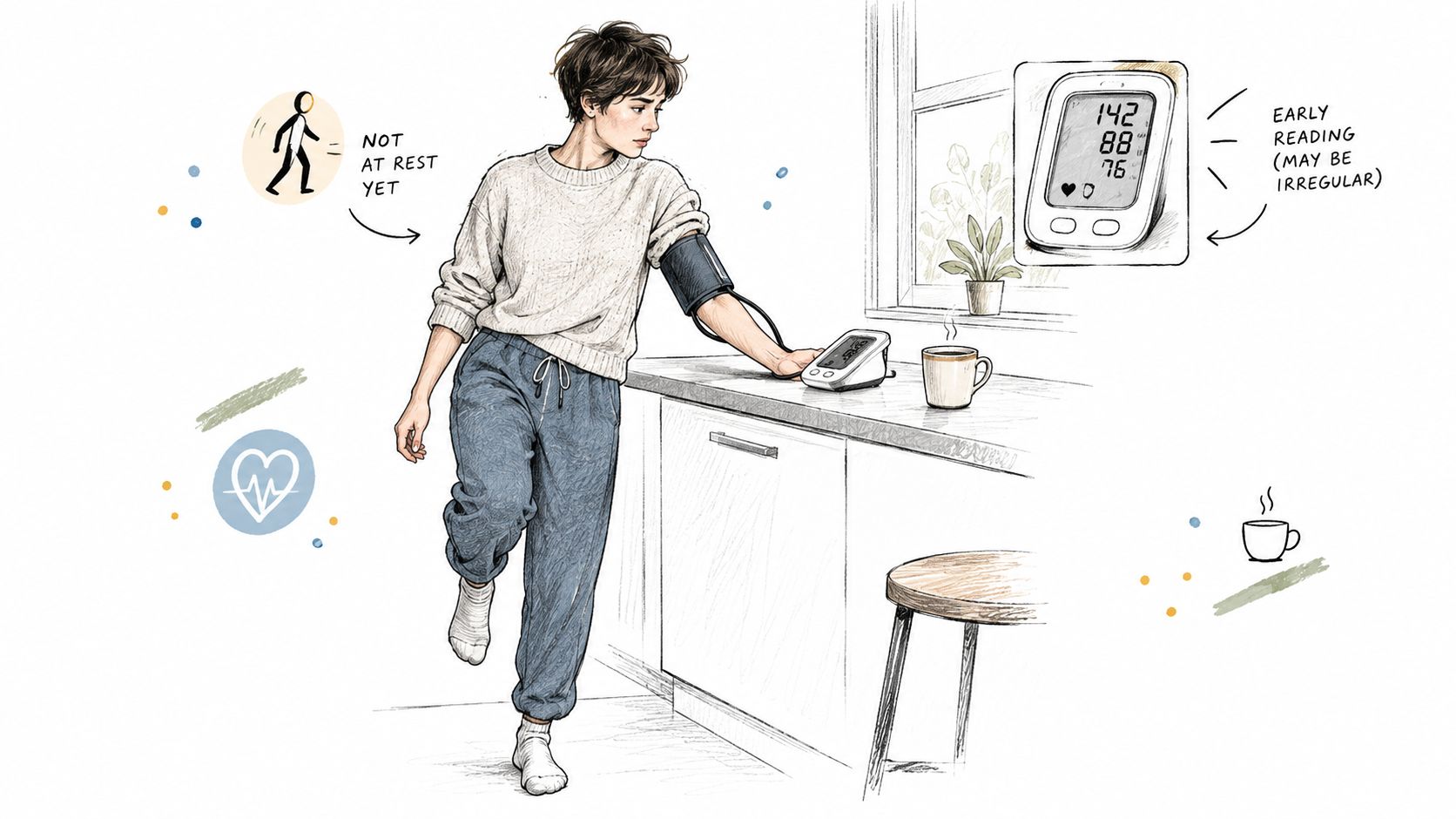
Mara's first cuff reading comes in high. She's just walked in from the kitchen, her arm is unsupported, and she's answering a message while the cuff tightens. She waits, sits still, and tries again. The second result is lower. Later, when she stands from the sofa, a wave of dizziness and a racing heartbeat makes her wonder whether her blood pressure has dropped.
Those readings don't tell the same story, but they don't automatically contradict each other either. A blood-pressure number is a snapshot taken under particular conditions. It can change with movement, posture, stress, medication timing, sleep, and the way the cuff is used. A single reading can't establish which factor mattered most.
Start with three questions
First, could the measurement have been affected by technique? A cuff that doesn't fit, an unsupported arm, talking, or measuring before resting can make a result harder to interpret. Second, could the reading reflect a short-lived change, such as recent activity or stress? Third, does a repeatable pattern emerge across readings taken in different settings or at different times?
That last question matters because clinic readings and readings outside the clinic can tell different stories. Some people have higher readings in a medical setting, while others have readings that look ordinary there but run higher during everyday life. A stack of normal home results doesn't necessarily settle the question if symptoms or clinic readings suggest otherwise.
A useful boundary: Treat a surprising result as a sample to check, not as a reason to change your medication.
If dizziness, palpitations, fatigue, or brain fog occur around changes in posture, note what you were doing and how you felt alongside the cuff result. A watch-based heart-rate trace can add context about pulse patterns, but it isn't a blood-pressure test. The aim is to help your clinician see how the readings, posture, and symptoms line up, not to diagnose a blood-pressure condition from a number or a watch graph.
Three Patterns Behind Irregular Blood Pressure
A log with uneven numbers can look like one problem, but it may represent three different patterns: a flawed measurement, ordinary short-term variation, or a meaningful mismatch between office and out-of-office readings. These patterns need different next questions. One blurry photograph doesn't tell you what the weather is like; a series of well-timed photographs gives a more representative picture.
Three meanings of an irregular log
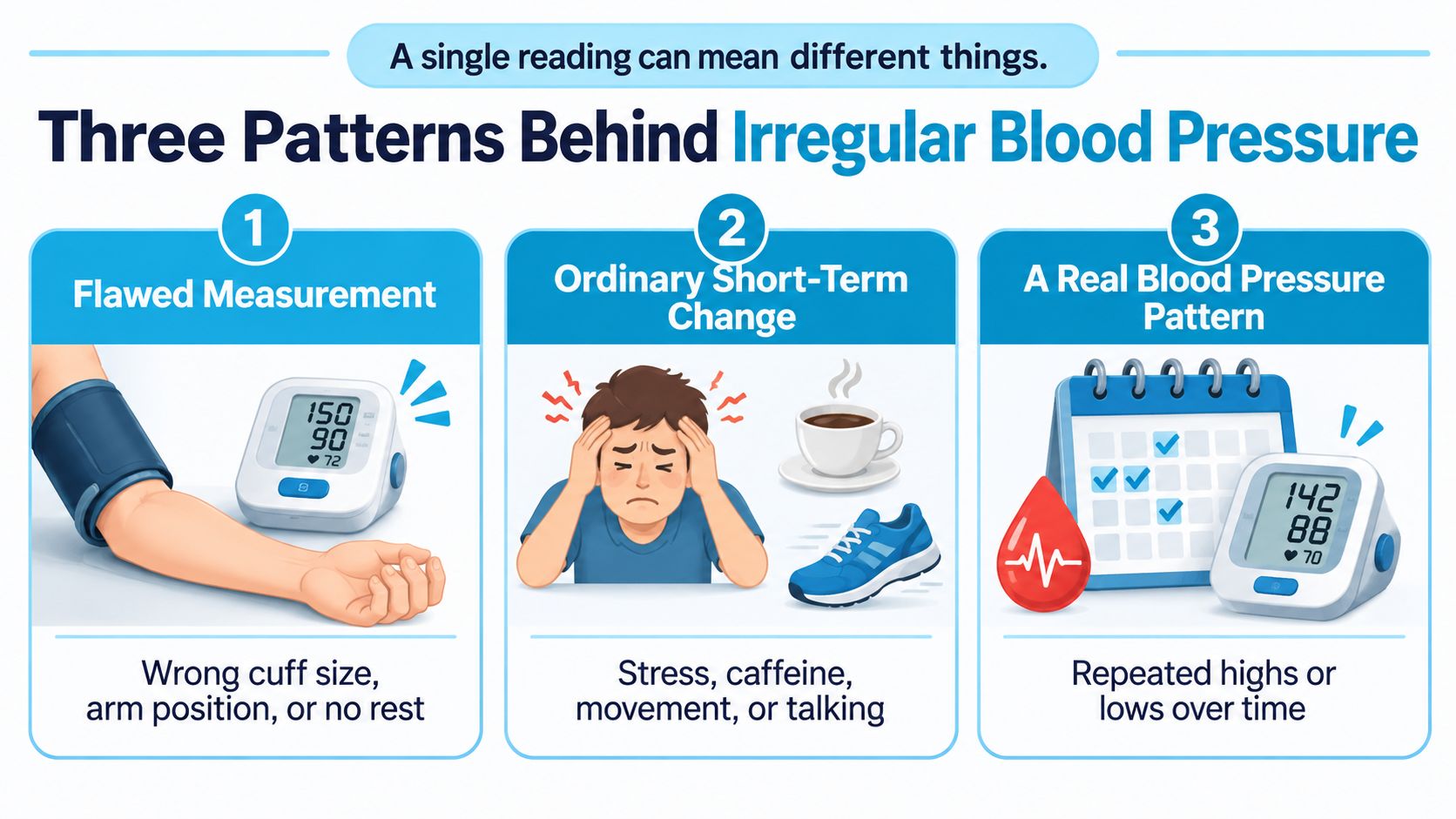
| Pattern | What the log often shows | Helpful next question |
|---|---|---|
| Flawed measurement | A result taken with poor positioning, an unsuitable cuff, or too little rest | Was the cuff the right size, and was I seated quietly with my arm supported? |
| Ordinary short-term change | A temporary rise or fall around movement, stress, caffeine, or another recent event | Does the result settle when I repeat it under calm, consistent conditions? |
| A real blood-pressure pattern | Repeated readings that differ by setting or recur over time | Do I need out-of-office or 24-hour monitoring to clarify what's happening? |
Repeating a reading helps show whether the first result persists under more consistent conditions. Common home-monitoring advice is to take two readings at least one minute apart in the morning and evening, but the first reading may be unstable. A longer rest or an extra repeat can sometimes give a more representative estimate. Don't invent a personal rule to discard the first number; ask your clinician how they want you to record it.
Look for a pattern, not a magic count
There isn't a universally accepted cutoff that cleanly separates pathological blood-pressure variability from ordinary variation. So there's no single number of abnormal readings that proves a problem. A one-off spike doesn't equal sustained hypertension; repeated irregular results after you've checked technique deserve review.
White-coat hypertension describes a pattern where readings are higher in a medical setting than outside it. Masked hypertension is the reverse: readings can appear ordinary in the clinic but run higher away from it. The American Heart Association describes out-of-office measurement as important because clinic and home readings can differ, and ambulatory monitoring is a reference standard for diagnosis and management. If the settings disagree, ask whether ambulatory monitoring could clarify the pattern rather than assuming either set of readings tells the whole story. (AHA guidance on home blood-pressure monitoring)
Causes Symptoms and Risks Worth Sorting
Before deciding that changing numbers point to a health problem, check how the readings were taken. A cuff that doesn't fit well, an unsupported arm, talking during the measurement, or skipping a quiet rest can make readings difficult to compare. Recent caffeine or exercise can also be relevant, as can whether the device has been validated for home use.
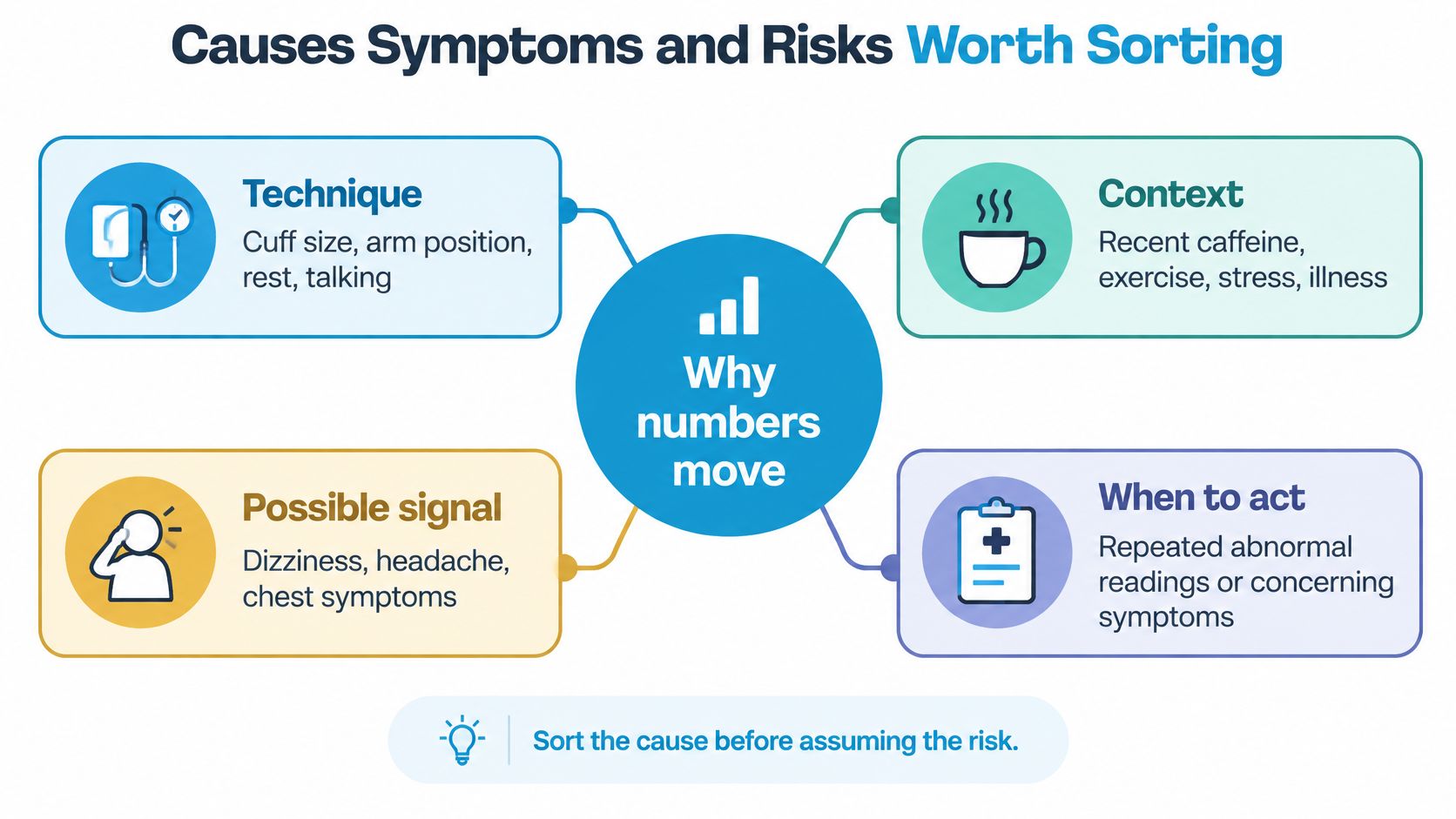
Once technique is consistent, look at the circumstances around the change. Blood pressure can vary with posture and activity, medication timing, and sleep-related physiology. If irregularity persists, a clinician may consider white-coat or masked hypertension, medication-related fluctuations, kidney disease, endocrine causes, or autonomic dysfunction. The point isn't to guess which one applies from a home log; it's to provide enough context for a useful conversation.
Symptoms are part of the record
Dizziness, palpitations, fatigue, or brain fog can occur alongside changing readings, but symptoms and blood pressure don't always rise and fall together. You might feel unwell while the cuff reading looks ordinary, or feel fine despite a raised office result. Note what happened, when it happened, and what your body was doing instead of assuming a symptom proves that blood pressure changed in a particular direction.
If symptoms are most noticeable after standing, keep posture in the record. A clinician can assess whether that pattern warrants further evaluation, including questions about orthostatic blood-pressure changes. You can also read about remedies for orthostatic hypotension, but don't use a list of symptoms or remedies as a substitute for an assessment.
There's no universally accepted threshold that separates concerning variability from normal fluctuation. Sustained high readings and repeated unexplained low readings both deserve a clinician's attention, but a variability score by itself isn't a do-it-yourself diagnosis. Before your next appointment, note the reading, posture, symptoms, recent activity, and medication timing. That combination gives a more useful starting point than circling one “bad” systolic number.
Everyday Episodes That Look Similar
The same uneven log can come from different situations. These short fictional examples show why context matters. They aren't diagnoses, and the comparison is more useful when you record what happened before and after the reading.
Nina takes a morning measurement while rushing to get ready. Her first result is higher than the next one, taken after she sits still and rests. If that happens once, it may be a noisy first sample. If her log repeatedly shows the same pattern despite consistent technique, she can bring the record to her clinician rather than deciding which reading to ignore.
After coffee and a brisk walk, Luis checks his blood pressure and sees a number that worries him. He rests and repeats the measurement later. A result that settles and doesn't recur in similar circumstances looks different from a high reading that keeps appearing under calm, consistent conditions. He records the time, recent caffeine, exercise, and how long he rested.
Similar readings, different settings
Priya's clinic readings tend to be higher than careful home readings. Her clinician may want to understand whether this is a repeated office-only rise, rather than treating one office visit as the full picture. The reverse can happen too: someone's clinic readings look ordinary, while readings during daily life are repeatedly higher. That's a reason to discuss out-of-office confirmation, not to conclude from a handful of numbers alone.
Sam feels dizzy when standing, with a racing pulse. In that moment, a cuff reading may be difficult to take consistently, and the pulse doesn't reveal what the blood pressure is doing. Sam records posture, symptoms, timing, and any cuff result taken under suitable conditions. If similar episodes recur, that record can help the clinician decide what to assess.
Sleep and medication timing can also make morning and daytime logs look different. Rather than trying to explain each difference on the spot, write down when you slept, when you took medicine, and when you measured.
Useful context includes the time, posture, symptoms, recent caffeine or exercise, pain, sleep, and medication timing. If food, salt, or fluids seem relevant to your own symptoms, note those too. A repeating pattern matters more than a single surprising reading, and a clear log makes it easier to see whether the circumstances repeat.
How to Monitor and Document Episodes
A repeatable routine makes readings easier to compare. Use a validated home cuff with the correct size, sit still before measuring, support your arm at heart level, and stay silent while the cuff takes a reading. If the number looks unexpected, check the setup before treating it as a new trend.
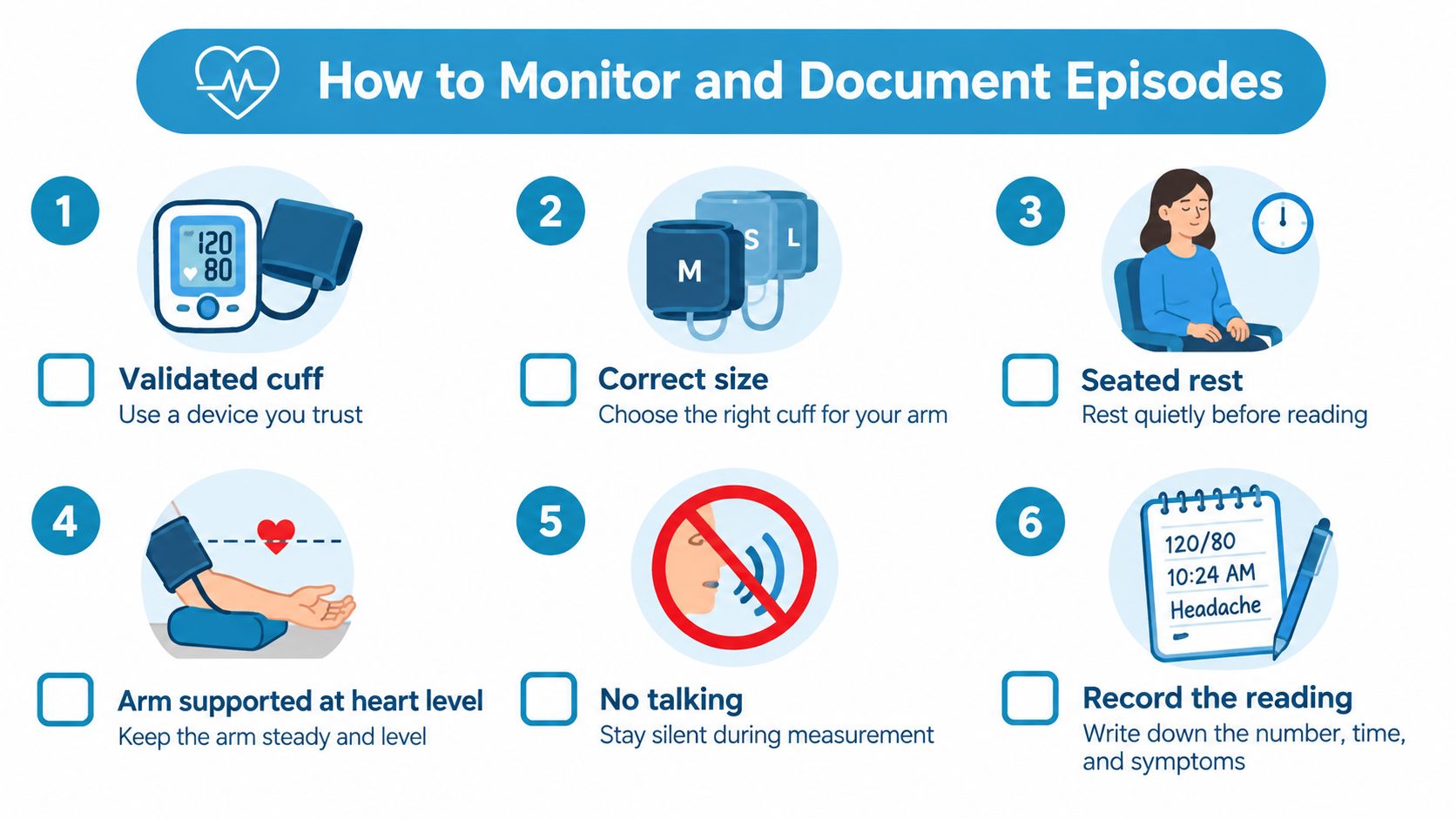
Common home advice is to measure in the morning and evening, taking two readings at least one minute apart. The first result may be less stable than the next, but don't automatically erase it or decide mid-log which readings “count.” Ask your clinician how they want you to handle an unusual first result so your record stays consistent.
Make the log useful to someone else
For each episode, record the systolic and diastolic values, the time, and whether you were sitting, lying down, or standing. Add symptoms and relevant context, such as recent caffeine, exercise, pain, sleep, hydration, salt, and medication timing. A short note like “stood up, dizzy, pulse felt irregular” can be more helpful than a page of numbers without context.
A symptom tracker can help organize what you notice; see this guide to a chronic illness symptom tracker. Keep the goal modest: create a record that lets a clinician compare the reading with the circumstances, not a self-made diagnostic score.
If readings remain inconsistent after you've checked technique, ask whether the difference could reflect white-coat or masked hypertension, medication-related fluctuations, kidney disease, endocrine causes, or autonomic dysfunction. Ambulatory blood-pressure monitoring is more informative than an isolated office reading because it samples blood pressure through waking activity and sleep. A technically useful 24-hour protocol generally records about every 15–30 minutes, with data quality assessed by at least 20 valid daytime readings and 7 nighttime readings. (Research on ambulatory blood-pressure monitoring)
The report should emphasize average 24-hour, daytime, and nighttime systolic and diastolic pressures. Variability indices add context, but they aren't diagnostic on their own. If buying a home cuff isn't feasible, more frequent clinic checks or a pharmacy kiosk may offer ways to obtain readings, though they aren't a substitute for a full ambulatory study. Seek urgent care for severe or rapidly worsening symptoms rather than trying to solve them by repeatedly measuring or adjusting medication yourself.
Heart Rate Posture and Cuff Limits
A home cuff can be less dependable when the heartbeat is irregular. Automated devices calculate blood pressure from the cuff's response to pulses. When the time between beats is uneven, the device may calculate an inaccurate result, so a highly variable log can reflect both real blood-pressure changes and measurement limits. (Mayo Clinic guidance on home monitoring and irregular heartbeats)
If you have an irregular heartbeat, frequent extra beats, or a markedly fast pulse, don't change medication after one anomalous result. Repeat the measurement after quiet rest. If results continue to look inconsistent, tell your clinician about the pulse pattern and ask whether the cuff result should be checked against a manual or clinician measurement.
Keep pulse and pressure distinct
Posture and symptoms help describe what's happening, but heart-rate data can't diagnose a blood-pressure disorder. A faster pulse after standing, especially with dizziness, palpitations, fatigue, or brain fog, is context for a clinician to assess. It doesn't show by itself whether blood pressure rose, fell, or stayed steady.
A paper log can pair cuff readings with posture and symptoms. A generic heart-rate graph may show that the pulse sped up, but it doesn't necessarily explain how long a posture-related episode lasted or what else was happening at the time. Cardiogram is a separate heart-rate context option for people already using Apple Watch data: it can organize detected heart-rate episodes with symptoms and other logged context, then create a report for a clinician. It doesn't measure blood pressure and can't diagnose hypertension, hypotension, or POTS by itself.
For more on the distinction, see blood-pressure readings with Apple Watch. If a home cuff isn't accessible, more frequent clinic readings or a pharmacy kiosk may be alternatives. Tell the person reviewing the results if your heartbeat is irregular, since that can affect how much confidence to place in an automated cuff reading.
What to Do With Your Next Reading
When a number surprises you, treat it as one sample. Sit still, check that the cuff fits and your arm is supported, avoid talking, then repeat the measurement. Record both results and what was happening before you took them.
If the first reading followed caffeine, stress, pain, exercise, or a rushed setup, note that context. Don't decide that the whole day is “high” or “low” from one result; look at whether similar readings return under comparable conditions. If they do, bring the pattern to a clinician.
Bring a paired record to care
Ask about out-of-office confirmation or 24-hour ambulatory monitoring if readings keep varying despite sound technique, or if your clinic and home readings don't tell the same story. Mention dizziness, palpitations, posture changes, and any irregular or markedly fast heartbeat so the clinician can interpret the cuff results in context. The combination of timing, position, symptoms, and readings is more informative than a pulse trace alone.
If you already track standing-related symptoms with an Apple Watch, pair those notes with cuff readings rather than treating heart-rate data as a blood-pressure result. A simple log can do this; a structured episode record may also help you prepare a concise summary for primary care or cardiology.
Don't start, stop, or change blood-pressure medication because one reading looked irregular. Seek urgent help for severe or rapidly worsening symptoms rather than waiting to complete a log or get another measurement.
If standing-related symptoms or palpitations make your readings hard to interpret, Cardiogram can organize Apple Watch heart-rate episodes alongside symptoms and context for a clinician-ready report. Visit Cardiogram to see whether that kind of heart-rate record could help you prepare for your next appointment.