Stand up, watch your wrist, and if the number climbs 30 beats, you've got POTS. That advice travels fast through support groups and short videos. It's also wrong in one specific way that matters, because it treats a pulse reading as a diagnosis.
The feeling of standing up and knowing something is off is real, and so is the heart-rate spike. What that spike means depends on what your blood pressure is doing in the same moment. Orthostatic hypotension can produce the same dizziness and the same urgent need to sit down, and it leaves no signature on a heart-rate graph at all.
A jump in heart rate can also come from a missed breakfast, a hot afternoon, a virus, a new prescription, or a bad night's sleep. The distinction is settled by two measurements taken in the same few minutes, plus the work of ruling out everything else that speeds a heart up. That work follows a logic you can learn.
Why Heart Rate Alone Cannot Tell Them Apart
Two assumptions cause most of the confusion. The first is that a fast standing heart rate equals POTS. The second is that feeling faint equals low blood pressure. Both skip the same step, which is reading heart rate and blood pressure as a pair.
Consensus definitions split the two conditions by what happens to heart rate and blood pressure after standing, not by how fast the heart beats at rest or how unpleasant the symptom is. A review of orthostatic disorders hosted by the National Library of Medicine lays out the logic: POTS requires symptoms of orthostatic intolerance plus a qualifying sustained heart-rate rise, and it specifically requires the absence of sustained orthostatic hypotension. Orthostatic hypotension is defined by a sustained blood-pressure fall. So a person can have a large postural heart-rate rise without meeting the blood-pressure definition, while a person with orthostatic hypotension shows a clinically significant pressure drop that a heart-rate trace cannot see.
The practical consequence: heart-rate episode data can show a POTS-like response. It cannot establish or exclude orthostatic hypotension, because that diagnosis needs a blood-pressure measurement.
The same review notes that evaluation has to exclude other causes of tachycardia, including dehydration, anemia, medication effects, hyperthyroidism, acute illness, and exercise. That list explains why the same person can look like POTS on Monday and like neither condition on Friday. Low fluid volume can add a pressure fall to an existing POTS pattern, and a fever, a new drug, or a stretch of deconditioning can copy either picture. One standing check is a snapshot, not a permanent label.
POTS and Orthostatic Hypotension Side by Side
This is the lookup to bring to an appointment. As you read, note which row matches your own readings. That row is the pattern worth discussing, not the label you arrived with.
| Criterion | POTS | Orthostatic hypotension |
|---|---|---|
| Heart-rate rise after standing | At least 30 bpm within 10 minutes, or at least 40 bpm for ages 12 to 19 | No required heart-rate rise |
| Blood-pressure drop | No sustained fall of 20 mmHg systolic or 10 mmHg diastolic | Fall of at least 20 mmHg systolic or 10 mmHg diastolic within 3 minutes of standing |
| Symptoms required | Yes: light-headedness, palpitations, weakness, blurred vision, fatigue, exercise intolerance | Dizziness is common but not required by the definition |
| Estimated prevalence | About 0.1% to 1.0% of the U.S. population, potentially up to about 3 million people | About 6% of the general population |
| Prevalence in older adults | Not concentrated in older adults | About 15% to 20% at age 65 or older, and above 50% among older adults in nursing homes |
| Typical driver | Excessive compensatory heart-rate rise without a qualifying pressure fall | Inadequate blood-pressure maintenance when upright |
Read the first two rows together, never separately. A rise without a fall and a fall without a required rise are two different physiological events, and the table keeps them apart on purpose.
Who tends to be sitting in which clinic
POTS was first described by Philip Low and colleagues at Mayo Clinic in 1993, although related forms of orthostatic intolerance had been recognized as early as 1940, as a JAMA clinical review recounts. Modern estimates place POTS prevalence at approximately 0.1% to 1.0% of the U.S. population, and other clinical reviews commonly cite 0.2% to 1.0%, potentially representing up to 3 million people in the United States. The same review puts orthostatic hypotension at about 6% of the general population overall, rising to approximately 15% to 20% among adults aged 65 or older and exceeding 50% among older adults living in nursing homes.
Those figures describe different populations, which is why the two conditions turn up in different rooms. Orthostatic hypotension is especially prominent in aging, frailty, neurodegenerative disease, medication use, and institutionalized older populations. POTS is not concentrated in that group at all, and it often affects younger people whose circulation compensates hard and loudly.
When both patterns show up at once
The conditions can coexist or overlap clinically. Under standard criteria, a blood-pressure drop of at least 20/10 mmHg takes precedence over labeling the response as isolated POTS. That rule exists for safety, because a pressure fall changes what needs checking and what needs treating. Mark the row that fits your readings, then read the next section before you decide it's final.
Diagnostic Criteria and Which Pattern Fits
Five patterns cover most of what a standing test produces. Read down the rows in order. Each one tells you what the readings support before any exclusion work is done, and the last two rows explain why a first test so often comes back inconclusive.
| Case | Heart rate after standing | Blood pressure after standing | Likely classification |
|---|---|---|---|
| Tachycardia without a pressure fall | At least 30 bpm rise within 10 minutes, with symptoms | No fall of 20/10 mmHg | POTS pattern, once other causes are excluded |
| Pressure fall within 3 minutes | No required rise | Fall of at least 20 mmHg systolic or 10 mmHg diastolic | Orthostatic hypotension |
| Both criteria met | At least 30 bpm rise | Pressure fall present | Classed as orthostatic hypotension; overlap evaluated |
| Rise with exercise, dehydration or medication | Rise present | Usually no fall | Not diagnostic until causes are excluded |
| Symptoms with normal readings | No rise | No fall | Neither label confirmed; repeat measurements |
Tachycardia without a pressure fall is the row many people are hoping for, and it's also the row with the biggest caveat attached. It fits a POTS pattern only after the mimics are ruled out, which is why a watch trace alone never gets you there.
Why the clock decides as much as the number
POTS uses a 10-minute window after standing or head-up tilt, while orthostatic hypotension is assessed in the first 3 minutes, as a review in the Canadian Journal of Cardiology31550-8/fulltext) sets out. Those two clocks measure different things. A reading captured at minute 1 can miss a rise that arrives at minute 8, and a reading taken at minute 8 can miss a fall that already happened and partially recovered.
There's a second complication. People with POTS can develop a pressure fall during periods of low fluid volume, and dehydration, medication effects, anemia, thyroid disease, arrhythmia, infection, or deconditioning can mimic either pattern, as the JAMA review of POTS and orthostatic hypotension overlap explains. That's the answer to the question people rarely get: yes, you can have both, and yes, your classification can shift from one day to the next.
A single stand is a photograph. A week of stands is a pattern.
Why one clean reading proves very little
Hydration, time of day, room temperature, recent meals, sleep debt and medication timing all move both numbers. Repeated measurements on different days carry more information than one perfect session ever will. If the first pass looks normal, the next step is a repeat, not a conclusion.
Bring the filled-in table to your appointment and ask which row matches your readings. That question gives a clinician the specific numbers the visit needs, which is more useful than asking for a verdict on the label.
Why Heart Rate and Blood Pressure Respond Differently
Standing pulls blood down into the legs and the splanchnic circulation. A healthy body answers by tightening arterioles and speeding the heart slightly, so pressure holds and the brain keeps its supply. Both conditions break that response, but they break different parts of it.
A head-up tilt test is where the two signatures separate most clearly, because it holds you upright while heart rate and blood pressure are recorded continuously.
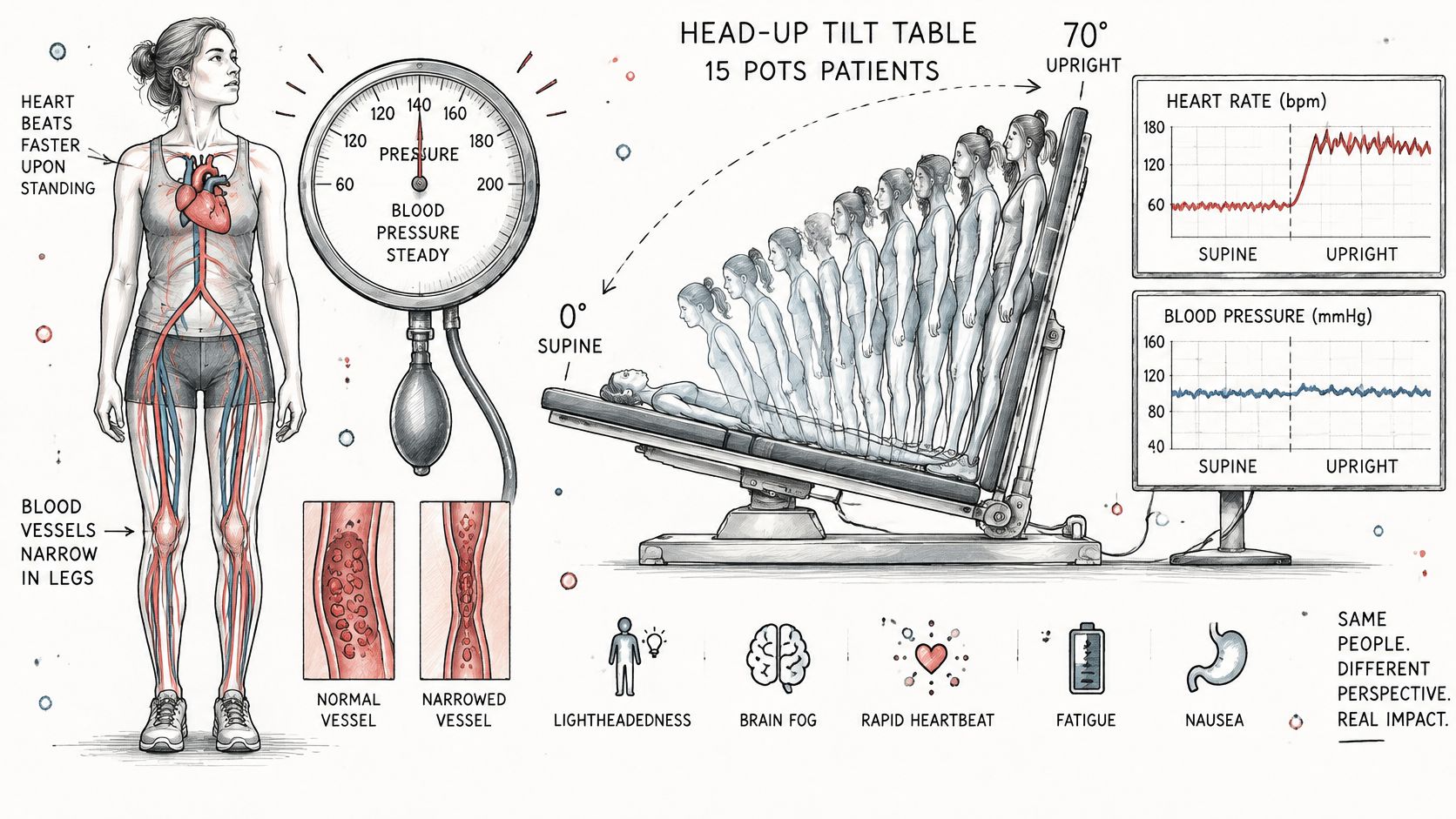
A head-up tilt study comparing 15 patients with POTS and 11 with orthostatic hypotension found that POTS produced significantly greater tachycardia and significantly larger reductions in stroke volume and end-diastolic volume, while total peripheral resistance increased normally or excessively, as the Mayo Clinic research group reported. That combination points to relatively preserved sympathetic arteriolar vasoconstriction alongside impaired venous or splanchnic blood-pooling compensation. The vessels that squeeze are doing their job. The problem sits upstream of them, in how much blood returns.
Autonomic-failure orthostatic hypotension looks different again. Blood pressure isn't maintained when upright, and the compensatory tachycardia you'd expect in POTS may never arrive. That's why a quiet heart rate during a symptomatic stand is not reassuring. It can be the more serious picture.
What this means for the numbers you record
Capture baseline heart rate, peak heart rate, how long the rise took, how long it lasted, what posture you were in, what you felt, and whether you'd been exercising. Then label the result a screening pattern, not a diagnosis, unless you also have a blood-pressure response and a clinician has excluded the mimics.
A high standing heart rate is often the compensation, not the disease. And a missing heart-rate rise does not rule out a meaningful pressure drop.
Both halves of that sentence matter. The first keeps you from over-reading a spike. The second keeps you from dismissing a normal-looking trace when your body is telling you otherwise.
Symptoms That Overlap and What They Tell You
Ask two people with different diagnoses to describe a bad morning and the words often match: light-headedness, dizziness, near-fainting, palpitations, fatigue, brain fog, weakness, blurred vision, exercise intolerance. The overlap is real, and it's why symptom lists alone can't sort the two conditions.
Where the emphasis tends to fall
Palpitations and exercise intolerance are more prominent in POTS, where the heart is compensating visibly. Near-fainting and pressure-related dizziness on standing are more typical of orthostatic hypotension. The word "tends" is doing real work in both sentences, so treat these as leanings rather than tests.
Timing and triggers carry more information than the symptom name
Whether symptoms ease within minutes of sitting or lying down matters more than whether you'd call the feeling dizziness or light-headedness. So does whether episodes track meals, heat, fluid intake, sleep, or a medication dose. Dizziness that appears only on standing and clears when you lie down is worth describing in exactly that detail, and this guide to positional dizziness causes covers the wider set of explanations behind that pattern.
Build a diary that connects feelings to readings
- Time and posture. Note when it started and whether you were standing, sitting, or just off the couch.
- What you'd just done. A hot shower, a large meal, a flight of stairs, a long drive.
- What helped. Sitting, lying down, crossing your legs, cold water, salt, a compression garment.
- What you'd taken. Every prescription, supplement and caffeine dose, with the time.
Signs that need urgent care regardless of the label
Fainting, chest pain, shortness of breath, confusion, or a sudden change in vision should be assessed right away and shouldn't wait for a diagnostic label. Those symptoms sit outside the POTS vs orthostatic hypotension sorting exercise entirely.
A diary only earns its keep when it sits next to numbers. Words describe the episode; measurements describe the physiology.
How Doctors Evaluate Each Condition Step by Step
The evaluation runs in a set order, and each step closes off one specific way of being wrong. Jumping to a standing test before the first two steps is the usual reason someone gets an unhelpful "normal" and leaves without an explanation.
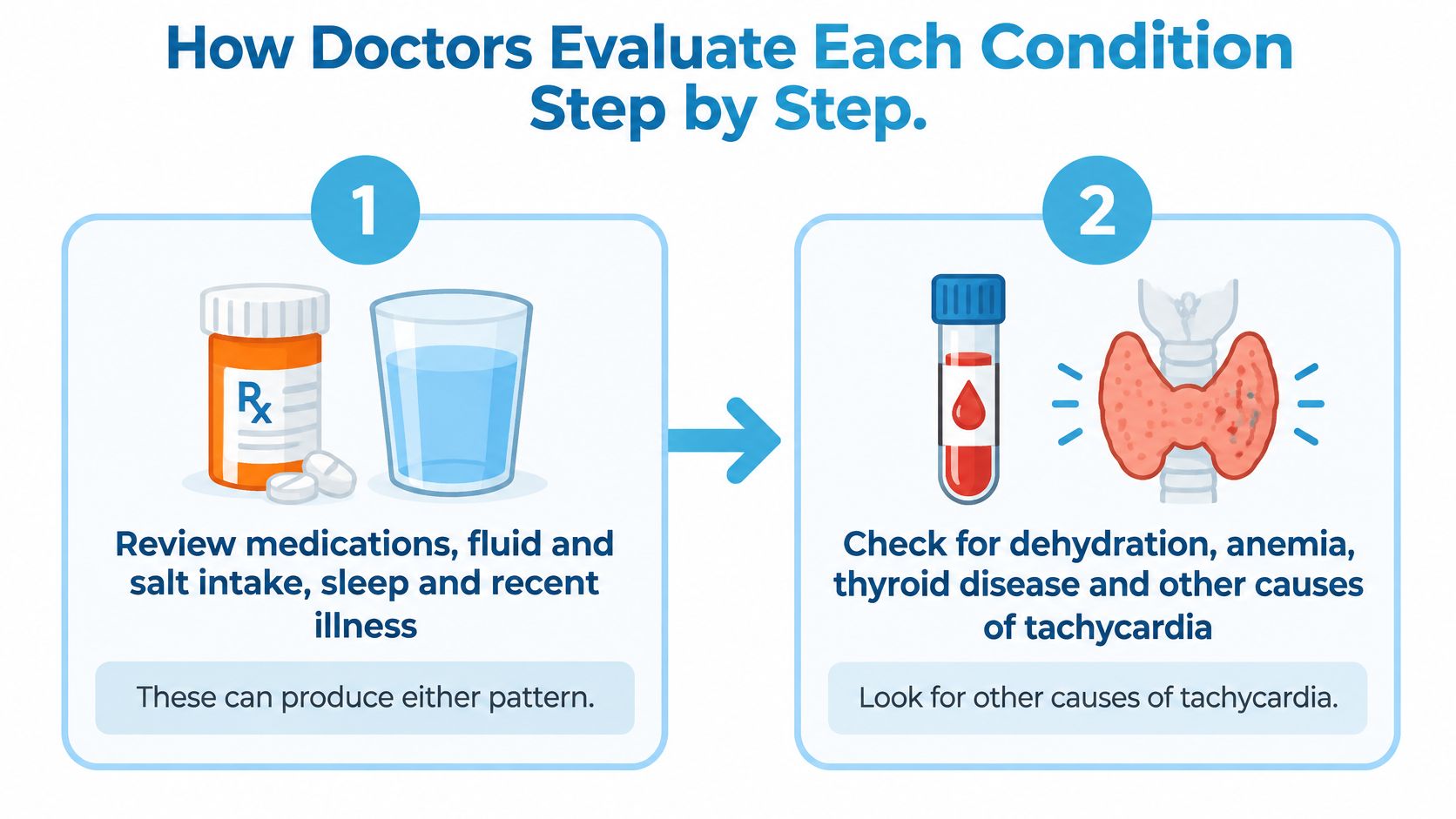
1. Take the history properly. Medications, fluid and salt intake, sleep, alcohol, recent illness, and how long symptoms have been building. Beta blockers, decongestants, stimulants, diuretics and several antidepressants move heart rate and blood pressure, and a recent viral illness can produce a POTS-like pattern by itself. The common slip is treating the medication list as paperwork rather than as evidence.
2. Run the routine labs. A blood count, thyroid function and a basic metabolic panel look for anemia, thyroid disease, dehydration and electrolyte problems. The slip here is assuming a normal panel rules out POTS. It rules out some mimics, not the pattern.
3. Do a proper stand. Rest supine for several minutes, then record heart rate and blood pressure while standing, at 1 minute and at 3 minutes. The 3-minute mark matters because a 2025 review of active-standing testing defines orthostatic hypotension as a fall of at least 20 mmHg systolic or at least 10 mmHg diastolic within 3 minutes of standing. One reading grabbed the instant you're upright catches neither a fast fall nor a slow one.
4. Keep recording heart rate for the full 10 minutes. The POTS window runs that long, and plenty of people cross the threshold at minute 6 or 8. Stopping at 3 minutes because the blood-pressure part is finished is the most common miss.
5. Confirm the pressure side with a validated cuff. A cuff at the arm answers the question a watch can't, and it's the only way to see whether a pressure fall is present during the same stand that produced the tachycardia.
6. Repeat everything on another day. Readings shift with hydration, sleep and time of day, so a second session tells you whether the pattern is stable or situational. One abnormal day and one normal day is itself useful information.
7. Escalate to a formal protocol if the picture stays muddy. When the office readings don't explain the symptoms, the next step is a tilt table test, which holds you upright under continuous monitoring so nothing is missed between cuff readings.
Heart-rate data from consumer hardware can be incomplete, delayed or inaccurate, particularly during movement or poor sensor contact, so treat gaps in a recording as gaps, not as evidence. Cardiogram watches your Apple Health heart rate and automatically detects rises of 30+ bpm within 5 minutes, logging the time, baseline and peak for you. That's the timing and persistence half of the puzzle, produced consistently enough to compare across weeks. The cuff still answers the pressure half on the day.
How Each Condition Is Managed Day to Day
Treatment follows the confirmed pattern, and the two plans share more than they don't. The differences are in emphasis, and they matter most when a pressure fall is part of the picture.
| Lever | POTS | Orthostatic hypotension |
|---|---|---|
| Fluids | Higher daily intake, as directed by a clinician | Adequate hydration, with attention to pressure rising while lying down |
| Salt | Often increased when advised | Often increased when advised, with lying blood pressure checked |
| Compression | Waist-high or leg compression garments | Abdominal binder or compression stockings |
| Positional changes | Slow standing and counter-maneuvers such as leg crossing | Slow standing and head-of-bed elevation overnight |
| Exercise | Graded reconditioning, often starting lying or seated | Activity as tolerated, avoiding long periods of standing |
| Medication review | Review of drugs that raise heart rate | Review of drugs that lower blood pressure |
| Drug options | Clinician may consider specific agents | Clinician-directed options such as midodrine or fludrocortisone |
Where the two plans part company
For POTS, the work is usually about expanding volume and retraining the circulation without triggering a flare. Graded exercise that starts recumbent, on a bike or a rower, lets the body rebuild tolerance before it has to fight gravity. Counter-maneuvers such as leg crossing and tensing the thighs buy time in a checkout line.
For orthostatic hypotension, the balance is trickier, because the same fluid and salt that help you upright can raise pressure too far when you're lying flat. That's why head-of-bed elevation shows up in this plan and not usually in the POTS plan, and why a medication review is central rather than optional. These orthostatic hypotension remedies go deeper on the morning routine, which is when most pressure falls happen.
Use a log to find which lever moves your numbers
Change one thing at a time and give it a week. If you add salt on Monday and feel better by Friday, you've learned something. If you add salt, start compression socks and change your sleep schedule in the same 48 hours, you've learned nothing. In Cardiogram, you can log hydration, salt, sleep, medications and how you feel, then compare them against your heart rate to see which lever moved the number.
One rule holds across both conditions. Don't stop, start or adjust a prescription on your own, including a blood-pressure drug that seems to be causing the problem. Bring the log to the prescriber instead, because the timing in your record is exactly what they need to make a safe change.
Which Situation Fits and What to Do Next
The POTS vs orthostatic hypotension question rarely gets settled in one appointment. Three situations cover most readers, and each points somewhere different.
A teenager, heat, and a heart rate past 40
A teenager stands, the heart rate rises past the age 12 to 19 threshold of 40 bpm, blood pressure doesn't fall by 20/10 mmHg, and heat brings near-fainting. Treat that as a POTS-pattern screen, not a diagnosis. Write down the size of the rise, the minute it appeared, and the trigger, then book a clinician. Self-labeling at this stage tends to close off the exclusion work that matters.
An adult near 70 who just started a blood-pressure drug
An adult around 70 starts a new blood-pressure medication and then drops at least 20 mmHg systolic or 10 mmHg diastolic within 3 minutes of standing. That fits orthostatic hypotension. Bring the cuff log to the prescriber and don't stop the drug alone, because the dose may need adjusting rather than abandoning.
A racing heart with clean readings
An adult has a racing heart and fatigue on standing, but repeated cuff checks stay inside both thresholds. Neither label is confirmed. Repeat the measurements on another day and ask for a longer active stand or a tilt protocol, since the 10-minute window catches rises that a 3-minute check misses.
What to bring: two weeks of stands, each paired with heart rate, a cuff pressure, the symptom you felt, and that day's fluids, salt, sleep and medicines.
Cardiogram is built for people with POTS and dysautonomia, and the Pro membership starts with a 3-day free trial with no payment taken at the start. A heart-rate log organizes episodes beautifully. It still doesn't replace the blood-pressure reading, so keep both.
Cardiogram turns the heart-rate side of this into something you can hand to a clinician, with automatic detection of 30+ bpm rises within 5 minutes, the baseline, peak, timing and duration recorded, symptoms and hydration and salt and sleep and medications logged alongside, and a doctor-ready PDF report that states the detection rule it used. It won't measure your blood pressure, and it doesn't pretend to decide between POTS and orthostatic hypotension. What it does is make the heart-rate half of the pattern impossible to lose, week after week, so your next appointment starts with evidence instead of recollection. Start the 3-day free trial with no payment taken at the start and visit Cardiogram to see how it fits your routine.