A tilt table test is a monitored exam in which a motorized table moves you from lying flat to nearly upright, about 70 degrees, while your heart rate and blood pressure are recorded to see how your body responds to standing. The printout isn't a simple pass or fail, because the angle, the clock, and the condition being hunted all change what that printout can mean.
If a "normal" tracing meant your fainting was nothing, why do two careful labs sometimes leave the same person with different next steps? The gap is the protocol. A short passive tilt and a longer, medicine-assisted tilt are not the same exam, even when both use a motorized table.
What a Tilt Table Test Shows About Your Body
When you stand, your autonomic nervous system helps tighten blood vessels and steady your heart so blood continues reaching your brain. A tilt table test checks how your body responds as gravity shifts blood toward your legs. The Cleveland Clinic's overview of tilt table testing describes its use for unexplained fainting, lightheadedness, abnormal blood-pressure regulation, or suspected postural orthostatic tachycardia syndrome (POTS).
During the test, an electrocardiogram records your heart's electrical activity while staff monitor your heart rate and blood pressure. A typical protocol described by the Cleveland Clinic includes resting flat for about 10 to 15 minutes, then tilting to around 70 degrees, usually within about 10 seconds. Upright monitoring may last as long as 45 minutes. Some protocols raise the table in stages, holding at about 30 degrees and then 45 degrees for 2 to 3 minutes at each angle. Straps and a footrest help keep you in place, and staff can lower the table quickly if you faint or feel severely unwell.
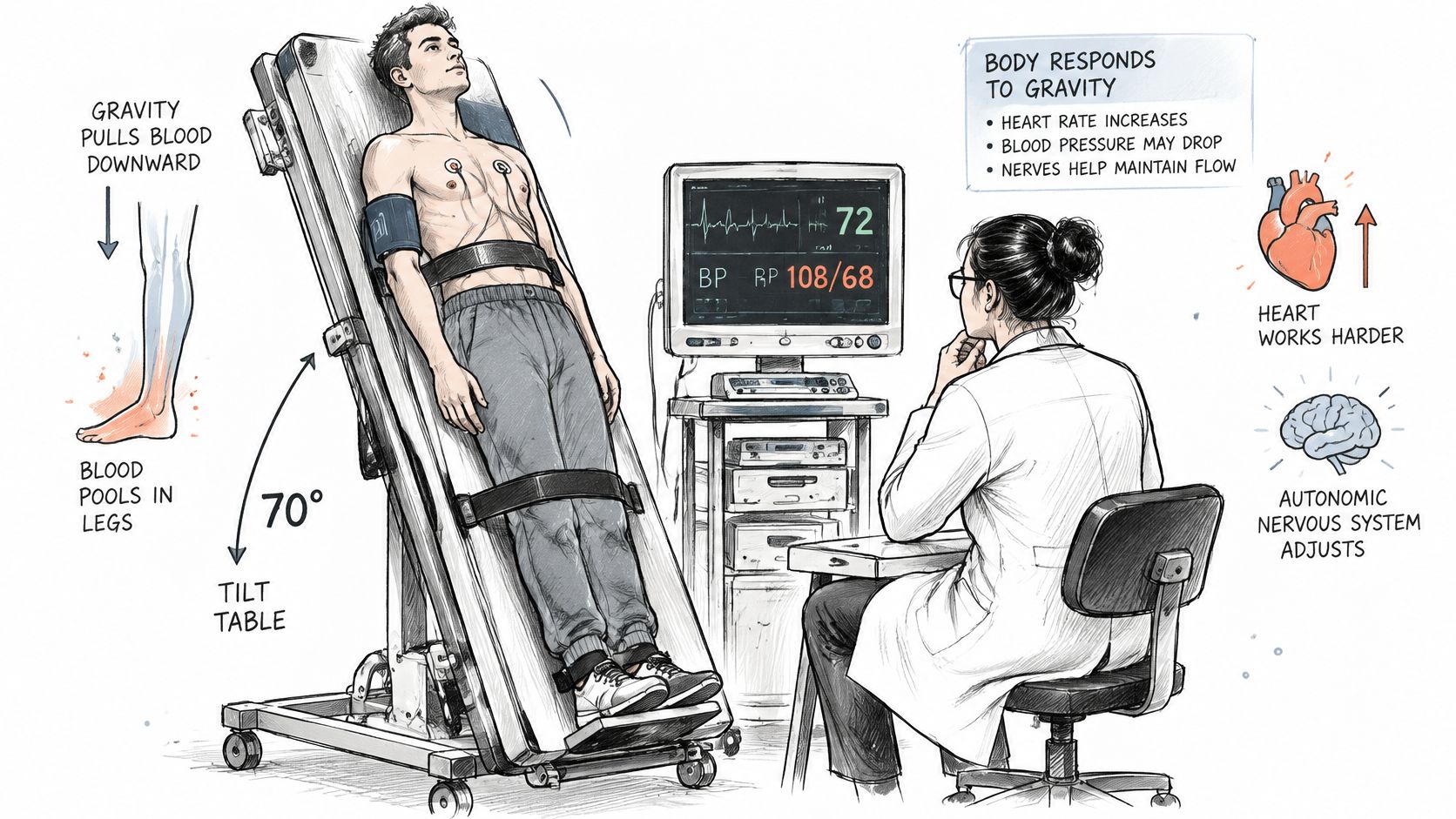
The table does the posture change, so you can stay still and talk while staff watch the monitors. It is a little like a stage lift: the position changes, while the sound engineer watches the levels. Here, the recorded heart-rate and blood-pressure changes provide a clearer picture than appearance alone.
If the passive phase does not bring on your usual symptoms, a second phase may involve a medicine to provoke a response. Nitroglycerin is one medicine clinics describe for this step. A medicine-assisted response may be interpreted differently from one that occurs without medication, because the drug can increase sensitivity while reducing specificity.
The useful result is a physiologic response under standard conditions, not a single resting pulse taken while you sit in a chair.
The timing and pattern of changes can help distinguish a racing upright heart from a vasovagal response that can cause fainting. The meaning of a result depends on the protocol and the condition being assessed.
Getting Ready Before and Getting Home After
Prep isn't a universal script. Food, fluids, caffeine, alcohol, and medicines can all change autonomic responses, so the instructions from your testing site are part of the test, not paperwork around it.
Before you arrive, confirm these points with the lab:
- Fasting window: Ask for the site's own rule. One center may want at least two hours without food, another four hours, and the Mayo Clinic patient guidance sits inside that kind of variation rather than one national timetable.
- Medicines that morning: Ask by name which pills to take and which to hold. Instructions are individualized, not a single list you can copy from a friend.
- Pregnancy and implants: Tell staff if you might be pregnant and about any pacemaker, defibrillator, or other implanted device.
- Fluids, caffeine, and alcohol: Ask whether to keep your usual fluid intake, and limit caffeine and alcohol beforehand so they don't muddy the tracing or how you feel afterward.
- Your own notes: Bring a short list of symptoms, when dizziness usually hits, and any home heart-rate readings you already trust.
The ride home is part of the plan
Arrange a driver before the appointment. Driving yourself may be unsafe after testing. Weakness or dizziness can linger for hours, even though serious complications are rare. You may also feel nausea, headache, blood-pressure swings, palpitations, or, less often, fainting that the team induced on purpose. Plan rest for the rest of the day, and don't stack a workout, a long shift, or a solo errand on top of the visit.
Build the clock around rest, the upright phase, and recovery time before anyone gets behind a wheel. Ask whether you should bring an escort before you leave home, not in the parking lot.
Get urgent help for persistent chest pain, severe breathlessness, prolonged confusion, or an injury from a fall. Those signs are different from the expected wooziness that fades while you lie flat and sip water.
Confirm every fasting and medicine instruction with the lab that booked you. A rule that fit another hospital may not fit this protocol.
How the Test Is Done, Step by Step
You'll be awake, clothed in a gown or loose clothes, and able to talk the whole time. Say what you feel as it happens. Staff match your words to the tracing, and a symptom you swallow is a symptom they can't time.
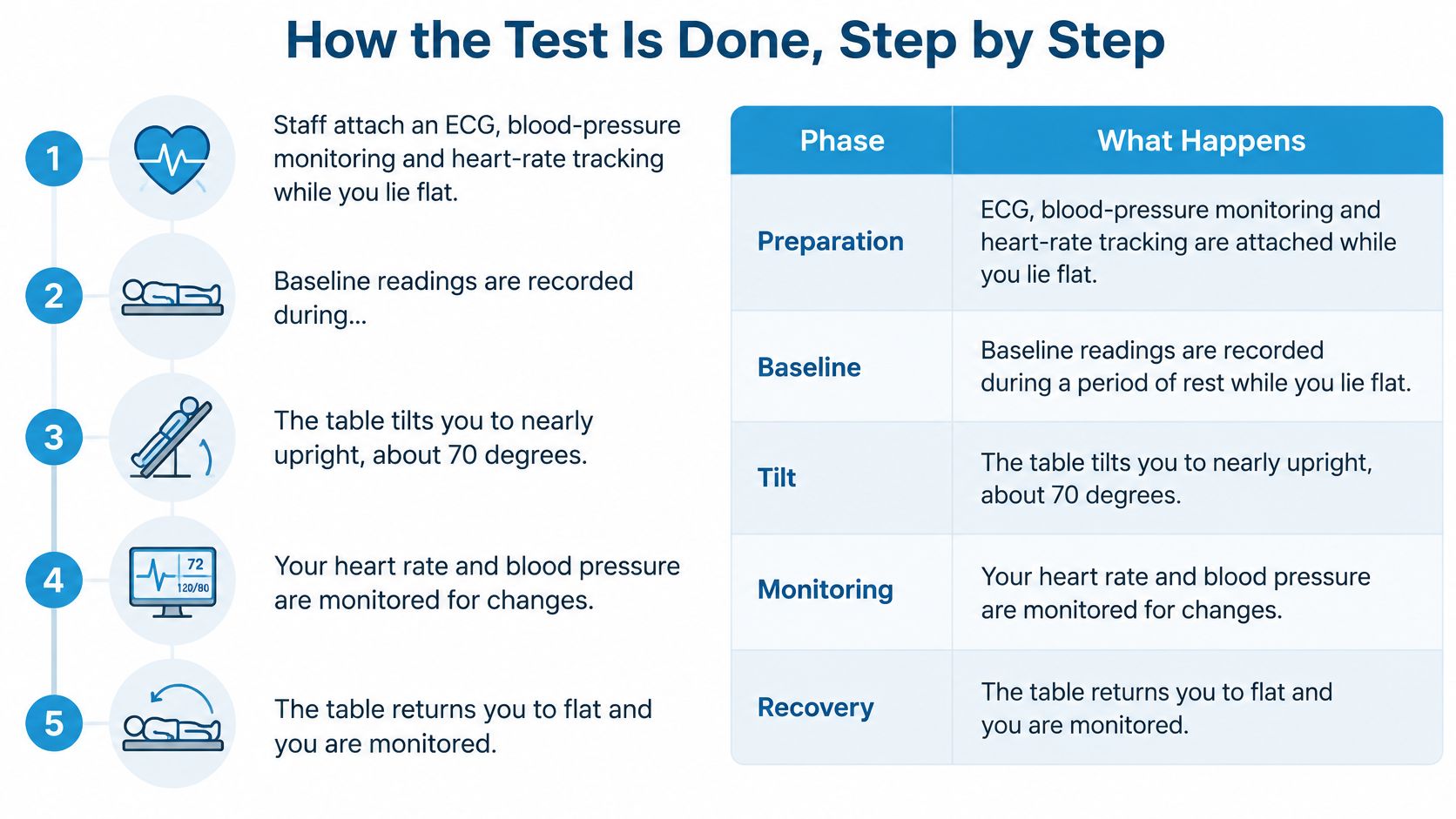
- Leads go on while you are flat. Sticky ECG patches, a blood-pressure cuff or finger sensor, and heart-rate tracking are placed before any movement. You may feel the cuff squeeze and the patches tug a little. Nothing here should hurt.
- Baseline is a quiet lie-down. You rest while the team records your starting numbers. Boredom is normal. Use it to notice your usual "I'm fine" feeling so you can contrast it later.
- The table rises. A motor lifts you toward standing while your feet stay on the board and straps hold your legs and trunk. The motion is steady, not a drop. Warmth, a pounding heart, or a wave of lightheadedness can start here. Tell them the second it starts.
- Upright monitoring is the long part. You stay nearly vertical while readings continue. Nausea, fatigue, visual dimming, sweating, or a heavy head are worth reporting even if you think you can "push through." Expected sensations are still data.
- Some labs climb in stages. Instead of one lift, the table may pause at intermediate angles so the team can see whether trouble starts early. Each pause is still monitored. If you feel worse at a lower angle, say so before the next rise.
- A medicine phase is optional. If the passive upright time doesn't reproduce your symptoms, clinicians may add a provocation drug and watch again. You might feel flushed, headachy, or suddenly faint. That provoked response is recorded separately from anything that happened before the drug.
- Flat is the safety move. Severe symptoms or fainting bring the table back to horizontal quickly. Most of that spun, sick feeling eases once you are down. Staff keep watching until your numbers and your words both settle.
What the room is actually collecting
| Phase | What happens |
|---|---|
| Preparation | Monitors on, you lying flat, straps checked |
| Baseline | Quiet readings before any tilt |
| Tilt | Table raises you, with or without staged pauses |
| Monitoring | Heart rate, blood pressure, and your symptoms timed together |
| Recovery | Table flat, observation until you are steady |
Every phase is stored so the team can line up "I felt sick at that moment" with the heart-rate and blood-pressure trace from the same moment. You don't have to interpret it on the table. Your job is to narrate. Their job is to keep you safe and to write down both the numbers and the story.
Thresholds, POTS and Look-Alike Causes
Tilt results make the most sense when you know which condition the protocol was designed to assess. The angle, length of monitoring, and any medication phase can affect what the test captures, so ask which protocol was used and what it was looking for.
| Finding | Threshold | What it suggests |
|---|---|---|
| Heart-rate rise in adults | At least 30 bpm within 10 minutes of standing or tilt | May support POTS when the clinical picture fits |
| Heart-rate rise in adolescents | At least 40 bpm | Age-adjusted threshold used when assessing POTS |
| Sustained heart-rate rise | Sustained during the upright period | Helps distinguish a continuing pattern from a brief spike |
| Systolic blood-pressure fall | At least 20 mmHg | May indicate orthostatic hypotension |
| Diastolic blood-pressure fall | At least 10 mmHg | May indicate orthostatic hypotension |
| Symptom duration | Frequent and chronic | Part of the overall assessment for POTS |
For suspected POTS, the Cleveland Clinic POTS program describes a sustained heart-rate rise of at least 30 beats per minute within 10 minutes of standing or head-up tilt. For adolescents, it gives a threshold of at least 40 beats per minute. A fleeting jump, such as one that occurs when you cough or feel startled, is different from a rise that continues during upright monitoring.
Blood pressure has its own line
Orthostatic hypotension is generally identified by a fall of at least 20 mmHg in systolic pressure or at least 10 mmHg in diastolic pressure. These thresholds distinguish a blood-pressure drop from a heart-rate rise. Clinicians may compare readings taken while you are lying down with readings during the upright phase.
POTS is assessed alongside the symptoms and history described in this guide to POTS symptoms. Dehydration, medicines, anxiety, deconditioning, and other illnesses can also cause a faster heart rate when upright.
Look-alikes that borrow the same symptoms
- Vasovagal syncope: A reflex change in heart rate and blood pressure may lead to fainting, sometimes preceded by nausea or warmth.
- Orthostatic hypotension: Blood pressure falls on standing, with or without a marked heart-rate rise.
- Dehydration or deconditioning: Either can contribute to a faster pulse while upright.
- Medicines or anxiety: Some medicines and a surge of nerves can raise heart rate.
How long the table is held upright also matters. A short protocol may capture a different pattern from a longer one, and a medication-assisted phase can produce a different response from passive monitoring. A small 2024 study of selected post-COVID patients reported positive tilt tests in all 16 participants in Frontiers in Neurology. That finding describes this specific group, not everyone with dizziness.
Ask which protocol was used, what the test was intended to assess, and when the recorded changes occurred.
What a Result Can and Cannot Tell You
A patient who hears “negative” may stop asking questions, even when symptoms continue. A tilt test records one session, under a particular laboratory protocol. Its result is one part of the clinical picture.
| Result pattern | What it may suggest | What to ask or check next |
|---|---|---|
| Heart rate rises 30 bpm or more, with no blood-pressure drop and symptoms reproduced | Pattern consistent with POTS | Review the result alongside your history, fluid intake, and medications |
| Systolic blood pressure falls 20 mmHg or more | Orthostatic hypotension | Ask how blood-pressure medicines and fluid intake may relate to the finding |
| Normal response but symptoms continue | The protocol may not have captured your pattern | Ask which protocol, angle, and duration were used |
| Fainting during the upright phase | Reflex or vasovagal-type response | Ask how the rhythm and blood-pressure trace were interpreted |
| Response only after the medication-assisted phase | The response occurred after a provocation drug | Ask how the medication-assisted result was weighed against the passive phase |
Why the same body can test differently
Tilt angle, passive versus medication-assisted phases, fasting, medication withdrawal, test duration, hydration, and the condition being investigated can all affect the result. An Aetna clinical policy bulletin reports sensitivity for tilt-table testing in syncope ranging from 13% to 87%, specificity from 55% to above 90%, and reproducibility from 71% to 88%. These ranges show why a negative result may not rule out dysautonomia, particularly when symptoms are intermittent.
The most useful question is specific: “Which protocol was used, what diagnosis was it testing for, and could that protocol have missed my pattern?” If spells continue outside the lab, ambulatory cardiac monitoring can record heart activity over a longer period than a single upright session.
Take the result to your clinician and ask how the protocol shaped what it could detect.
Plan Your Next Step After Your Result
What should you bring to the follow-up? Write down whether the clinician recommends repeating the test, changing its length, or using another kind of recording. The protocol and the condition being investigated shape what a tilt result can show, so ask how those details affect the interpretation.
Keep a symptom diary over several weeks. Note dizziness, palpitations, fatigue, fluid intake, salt, sleep, and medication timing. Mark whether symptoms followed standing, meals, exercise, heat, or a medication change, and record which symptom came first. Your clinician can compare this pattern with the test, your history, and other findings.
A free heart-rate rise calculator and guided NASA lean test are available from Cardiogram, and neither requires the app. Cardiogram's PDF report brings episodes, trends, and symptoms together and states the exact criterion used.
Do these three things:
- Book the follow-up while the tracing is fresh, and bring your questions and diary.
- Highlight matches between symptoms and standing, heat, meals, or medication changes.
- Seek urgent care if you faint, have chest pain, severe breathlessness, prolonged confusion, or an injury from a fall.
If you want help organizing upright heart-rate changes for your appointment, Cardiogram lets users log how they feel alongside heart-rate data and create a criterion-based summary. You can start with the free calculator or guided lean test, then decide whether a fuller report would help at your next visit.