Which is more likely to leave you dizzy: a loose crystal in your inner ear, or a drop in blood pressure the moment you stand? The first one is often answered without hesitating. Dizziness that arrives with movement feels like an ear problem, and that's the explanation repeated in waiting rooms and search results.
The gap is that these two problems feel different in ways nobody teaches you to notice. One follows your head. The other follows gravity. Learning to tell them apart is the fastest way to sort positional dizziness causes, and it changes what you should do next.
Positional Dizziness Causes at a Glance
Start with the pattern, not the diagnosis. The table below sorts the most common positional dizziness causes by what sets an episode off and how long it lasts. Find the row that matches your morning, then read the rest of this guide to understand the mechanism behind it.
Positional dizziness patterns and likely causes
| Pattern You Notice | Most Likely Cause | Timing Clue |
|---|---|---|
| Brief spinning when rolling over, sitting up or looking up | BPPV (inner-ear crystals) | Seconds to under 1 minute, reproducible with head position |
| Lightheadedness within seconds of standing | Orthostatic hypotension | Begins on standing, blood pressure drop within 3 minutes |
| Racing pulse on standing with little blood pressure change | Orthostatic tachycardia | Heart rate rises on standing, often with fatigue |
| Constant dizziness unrelated to position | Central or other serious causes | Continuous, with neurological or cardiac signs |
| Dizziness after a new medication, heat or fluid loss | Medication or volume effect | Upright, linked to dose timing or heat exposure |
Read the third column first. Timing does more diagnostic work than the quality of the sensation, because "dizzy" covers spinning, swaying, lightheadedness and that foggy, about-to-faint feeling. Two people describing the same word can be describing two entirely different systems.
A quick note on words. Vertigo means false motion, the sense that you or the room is spinning when nothing moves. Lightheadedness is closer to feeling you might pass out. Keeping those separate in your own notes makes your description far more useful to a clinician.
Why more than one row can fit
Causes overlap more often than the tidy table suggests. Someone with an ear problem can also be dehydrated. An older adult can have both a vestibular issue and a sluggish blood-pressure response, and each makes the other feel worse. A new blood pressure pill can unmask postural dizziness that was always there in the background.
That's why a single dramatic episode tells you very little on its own. A week of notes tells you a lot.
The two details worth writing down: the trigger (head movement or standing up) and the duration (seconds, or minutes). Those two answers narrow the list faster than any symptom checklist.
Two things to keep in mind as you read on. First, the row you match is a starting point for a conversation, not a label to carry around. Second, if your symptoms are constant rather than positional, or arrive with new weakness, speech trouble or vision change, the table isn't your tool. That's a same-day call, and the final section covers it.
Two Systems Behind Positional Dizziness
Why can turning your head bring on spinning, while standing up makes you feel faint? The trigger and timing help distinguish two systems that guide balance: the inner ear, which tracks head movement, and circulation, which helps maintain blood flow to the brain when you stand.
The inner ear works like a spirit level. Fluid and tiny hair cells help register the direction and speed of head movement. Otoconia, calcium carbonate crystals that normally rest in a gel-filled chamber, help you sense gravity. If some break loose and drift into the semicircular canals, the fluid-filled loops that register rotation, a change in head position can make them move the fluid and send a false signal of spinning.
The map below shows how the balance systems contribute to positional dizziness.
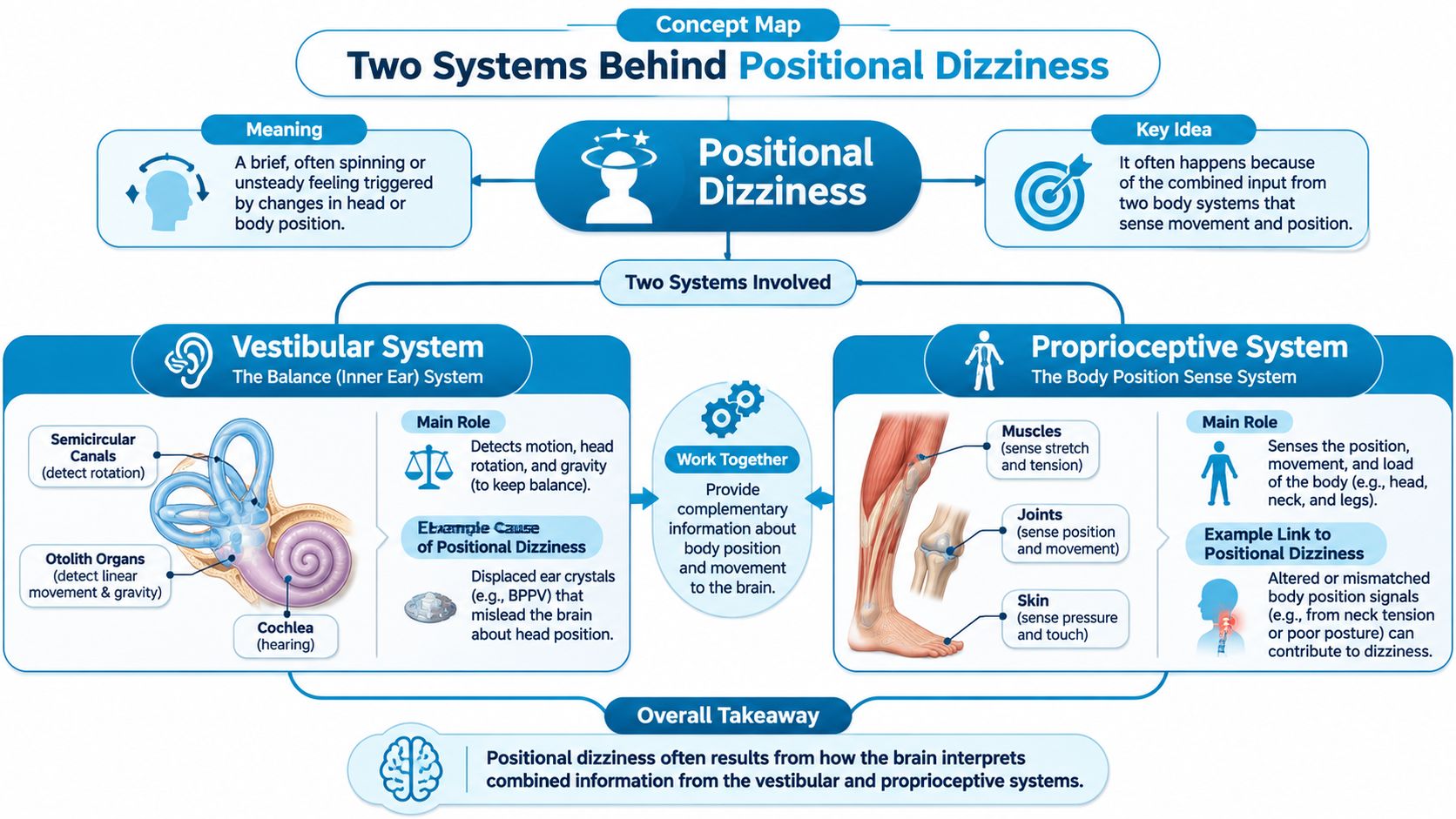
This inner-ear problem is benign paroxysmal positional vertigo, usually shortened to BPPV. A 2006 population-based study of BPPV found a lifetime prevalence of 2.4%, with prevalence about twice as high in women (3.2%) as in men (1.6%). BPPV can be underrecognized, and its brief episodes often follow a repeatable head movement, such as rolling over or tilting your head.
Circulation works differently. When you stand, gravity draws blood toward your legs and abdomen. Your body responds by tightening blood vessels and increasing heart rate to help keep blood pressure steady at the brain. If that response lags, blood pressure can dip briefly. You may feel lightheaded, weak, or notice dim vision. The sensation is more like faintness than spinning.
The trigger offers a practical clue. A brief, repeatable spin linked to a particular head position points toward the inner ear. Faintness that starts after standing and eases when you lie down points toward a circulation response. These patterns are clues, not diagnoses, but they help separate head-movement symptoms from those tied to being upright.
Two questions to ask yourself: Does the sensation start with a head movement, even while you are lying down? Or does it begin when you stand and ease when you lie back down?
The timing is useful because these systems respond to different events. A head turn changes the inner ear's motion signal; standing challenges the body's ability to maintain blood pressure. Note which event comes first, and whether the feeling is spinning or faintness.
How Clinicians Confirm Inner-Ear Positional Vertigo
The exam is low-tech and strangely reassuring. A clinician moves your head into set positions and watches your eyes. If the inner ear is sending a false spin signal, your eyes show it as nystagmus, a rhythmic flicking that you can't consciously control and often can't feel.
The core test is the Dix-Hallpike maneuver, and it involves:
- You sit on the exam table with your head turned about 45 degrees toward one side.
- The clinician guides you back quickly until you're lying with your head extended roughly 20 degrees past the edge, supported the whole way.
- Your eyes are watched for torsional, upward-beating nystagmus, the signature of the posterior canal.
- The timing is recorded, because symptoms typically start after a 2 to 5 second latency and settle within about 1 minute, according to the American Academy of Ophthalmology's summary of canalith repositioning.
Expect a short, unpleasant spin. It's brief by design, and the clinician is watching for it rather than waiting for you to describe it later.
When the first test doesn't explain it
Sometimes the eyes beat horizontally instead of up and down, or nothing obvious happens even though your history sounds textbook. That's the point to run a supine roll test: lie flat, turn the head 90 degrees to each side, and compare the response. Horizontal nystagmus on rolling points to the lateral canal, which needs a different repositioning sequence.
A quiet Dix-Hallpike is not a clean bill of health. It means the posterior canal on that side didn't respond in that position, nothing more.
The answer changes the treatment. Posterior-canal BPPV is generally managed with a canalith-repositioning maneuver, usually the Epley maneuver, a guided sequence that walks the crystal out of the canal. Atypical, persistent, nonparoxysmal or neurological findings send you down a different path entirely, toward imaging, vestibular testing or a neurology review. Repositioning a crystal won't fix a blood-pressure problem.
When you book the appointment, bring three things: what triggers an episode, how long it lasts, and whether lying still stops it. Those three answers often decide which test gets done first.
Standing Dizziness and Home Blood Pressure Checks
Does dizziness start when you move your head, or when you stand? That timing is a useful first clue. Symptoms that follow standing may reflect a change in blood pressure or heart rate, while positional vertigo is linked to head movement. A home check can help record the pattern for a clinician.
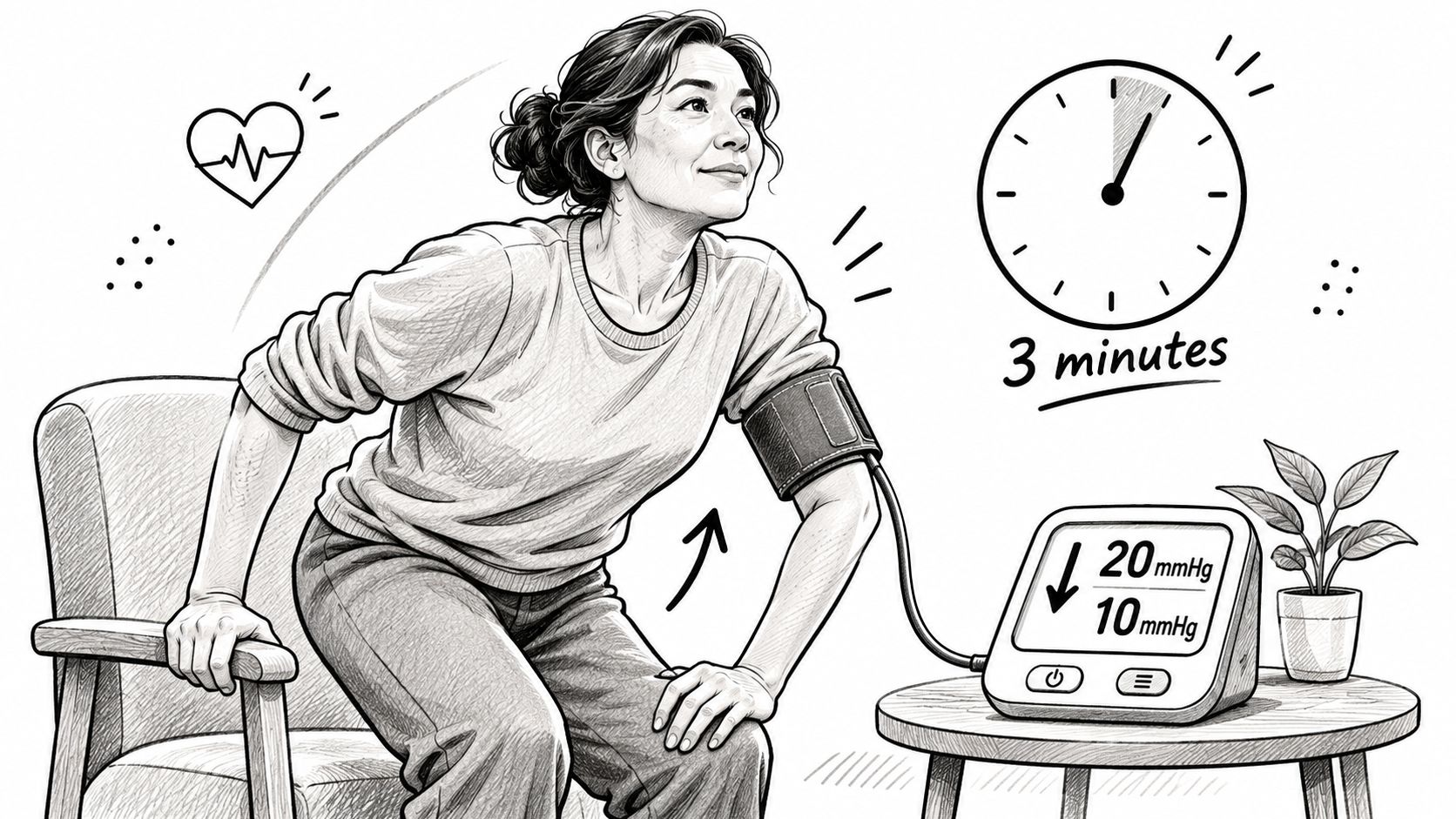
Orthostatic hypotension is a sustained fall in systolic blood pressure of at least 20 mmHg, or diastolic pressure of at least 10 mmHg, within 3 minutes of standing or head-up tilt, according to the American Heart Association hypertension guidance. Reduced blood returning to the heart, impaired autonomic blood-vessel tightening, dehydration, blood loss, or a medication effect can contribute.
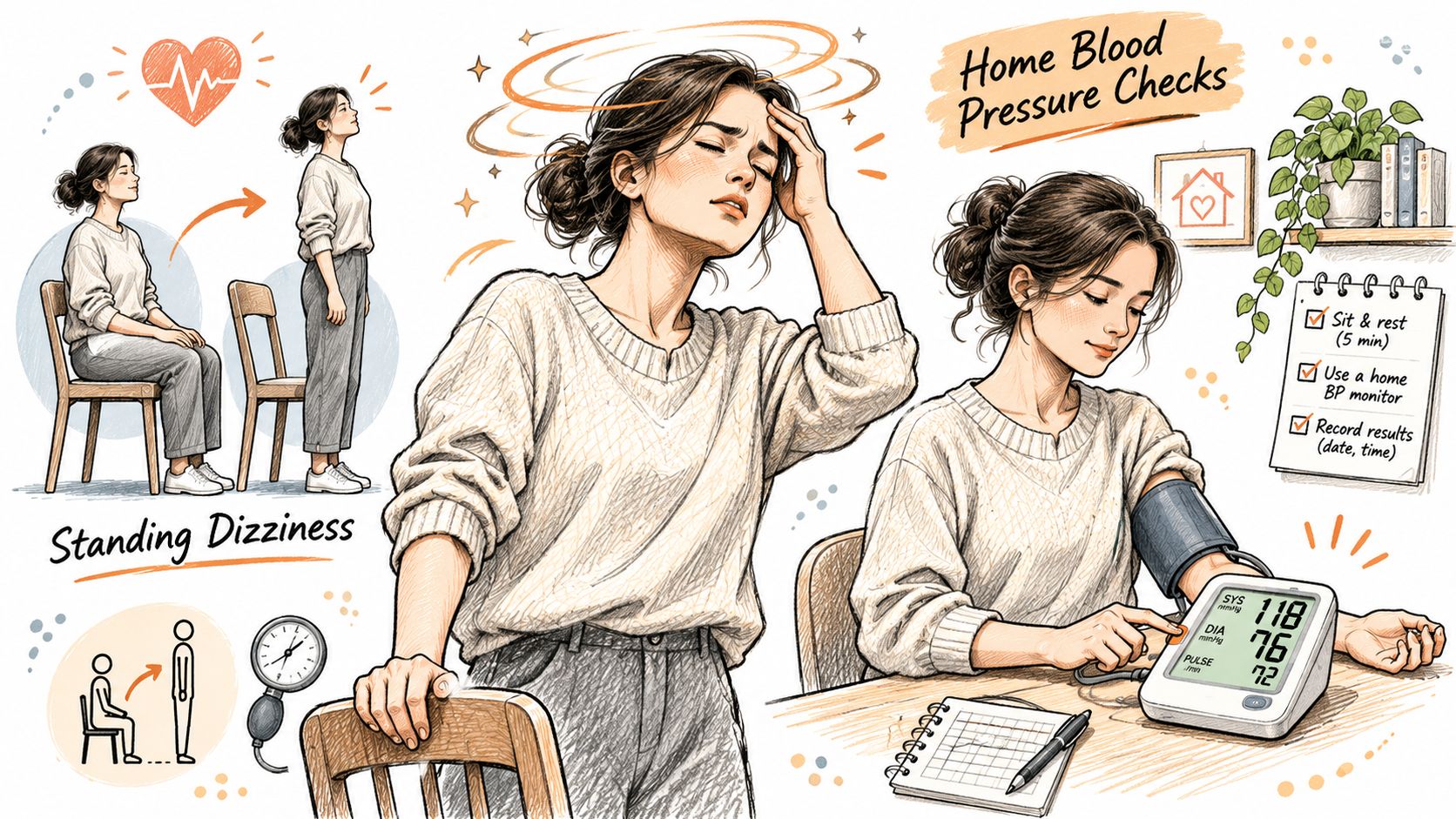
For example, someone stands from the sofa, feels their vision dim, grips the doorframe, then sits down. The symptoms ease shortly afterward. That sequence points toward a standing-related blood-flow change, rather than an inner-ear problem triggered by a particular head position.
Three patterns a standing test separates
- Classic orthostatic hypotension: The defined blood-pressure fall is sustained. Blurred vision, weakness, or feeling close to fainting may accompany it.
- Initial orthostatic hypotension: A brief, larger fall can occur within 15 seconds of standing: more than 40 mmHg systolic or 20 mmHg diastolic, with recovery within 30 seconds, as described in the American Heart Association hypertension guidance. This can feel like a quick head-rush after rising.
- Orthostatic tachycardia: Heart rate rises sharply without the defining blood-pressure fall. Clinicians may consider this pattern when assessing POTS; fatigue or a pounding chest may occur alongside dizziness.
The common clue is becoming upright. BPPV, by contrast, is associated with head position and movement, whether a person is standing, sitting, or lying down.
Why the numbers climb with age
Blood-pressure regulation can become less reliable with age. The National Institutes of Health summary of population studies reports orthostatic hypotension prevalence below 5% among adults aged 45 to 49, around 15% at 65 to 69, and above 25% at 85 or older. It also reports a pooled prevalence of 22.2% among community-dwelling older people. Medication effects, dehydration, diabetes, neurodegenerative disease, and prolonged bed rest can contribute.
The standing check you can do at home
Use a properly fitting home blood-pressure cuff. Have a chair or wall within reach, and allow yourself a quiet rest before starting.
- Rest first. Lie or sit still for five minutes, then record blood pressure and pulse.
- Stand with support nearby. Record readings at about 1 minute and 3 minutes.
- Note symptom timing. Write down when dizziness begins and whether it eases after sitting or lying down.
- Log the context. Record medication timing, fluid intake, heat, recent meals, exercise, and sleep.
Home readings by timepoint
| Timepoint | What to Record | What It Can Show |
|---|---|---|
| Lying or sitting baseline | Blood pressure and pulse after 5 minutes of rest | Reference values for comparison |
| 1 minute standing | Systolic and diastolic values, pulse, symptoms | Early pressure drop or pulse rise |
| 3 minutes standing | Systolic and diastolic values, pulse, symptoms | A fall of 20 mmHg systolic or 10 mmHg diastolic suggests orthostatic hypotension |
| Return to sitting or lying | Time until symptoms ease | Timing pattern to discuss with a clinician |
Use the log to show a clinician how readings and symptoms change over time. A fall of 20 systolic or 10 diastolic within three minutes may point toward orthostatic hypotension; a marked pulse rise without that pressure fall suggests a different pattern. One reading can be difficult to interpret, while readings taken consistently can show whether the same pattern recurs. For practical changes to discuss with a clinician, see these orthostatic hypotension remedies.
Fainting or a very large blood-pressure drop warrants prompt clinical attention, since it may indicate that blood flow to the brain fell enough to cause a brief loss of consciousness.
Staying Safe During an Episode
The injury risk outranks the diagnosis question. A fall on stairs or in a bathroom causes more lasting harm than the dizziness that preceded it, so the first job is to stay upright and unhurt while the cause gets sorted out.
- Sit or lie down at the first warning. Do it before the room starts to spin or fade, not after. Most spinning episodes settle within about a minute if you stay still, so sitting is faster than testing your balance.
- Rise in stages. Sit on the edge of the bed for a moment, flex your ankles a few times, then stand with something solid within arm's reach.
- Skip the risky tasks. No driving, ladders, cycling or baths alone during an active stretch of symptoms.
- Don't self-treat suspected BPPV. Repositioning maneuvers need the right canal identified first, and the wrong sequence can move the crystal into a harder spot. A clinician-led Epley maneuver is the usual treatment for posterior-canal disease.
- Keep fluids and meals steady. Follow whatever your clinician has advised, and never stop or change a blood pressure medication on your own.
If you've fainted or come close, the vasovagal response and syncope guide explains what happens in that moment and how to reduce the next one.
When to Get Care and What to Bring
The timing and trigger help clinicians distinguish an inner-ear problem from dizziness linked to standing, blood pressure, or heart rate. Some symptoms need urgent attention regardless of the trigger.
Call emergency services now for
- A sudden severe headache, especially one that peaks in seconds
- Vision loss or double vision
- Slurred speech, one-sided weakness or numbness
- Trouble walking or a sudden inability to stand
- Confusion or a seizure
Get same-day care for
Seek care today for fainting that caused an injury, chest pain, a racing heart with breathlessness, or dizziness after a head injury.
Book a routine appointment for
Arrange an appointment if spinning repeatedly follows position changes, lightheadedness keeps returning when you stand, dizziness improves and then comes back, or vertigo lasts several days without improving. Dizziness without a clear positional trigger also deserves evaluation, though the assessment may follow a different path.
If you're unsure whether it's urgent, treat it as urgent. A wasted afternoon in a clinic is a much better outcome than a missed stroke.
For a routine visit, use the home-check approach described earlier to record blood pressure and pulse, along with when symptoms occur. A symptom journal can help you organize episodes and notice whether they follow head movement or standing. That pattern gives the clinician a clearer starting point than trying to recall each episode from memory.
Bring your record and ask whether positional testing and a standing blood pressure check fit your symptoms. These checks address different possibilities: head-position-triggered spinning can point toward an inner-ear cause, while symptoms after standing can relate to blood pressure or heart rate. If the pattern keeps recurring, book the visit rather than waiting for another episode to clarify it.
Cardiogram is built for people with POTS and dysautonomia. It logs dizziness, palpitations, fatigue and brain fog as symptoms. Every 30+ bpm rise within 5 minutes is logged with its baseline, peak and duration, and symptoms can be added as they happen. For dizziness paired with a racing heart on standing, these records can help show the timing of episodes for discussion at an appointment.