When your heart runs too fast, it may not get enough time to fill back up, so each beat can push out less blood. That can show up as pounding, dizziness, or feeling winded, though a quicker pulse during exercise or stress is not automatically dangerous.
What Happens When Your Heart Beats Too Fast
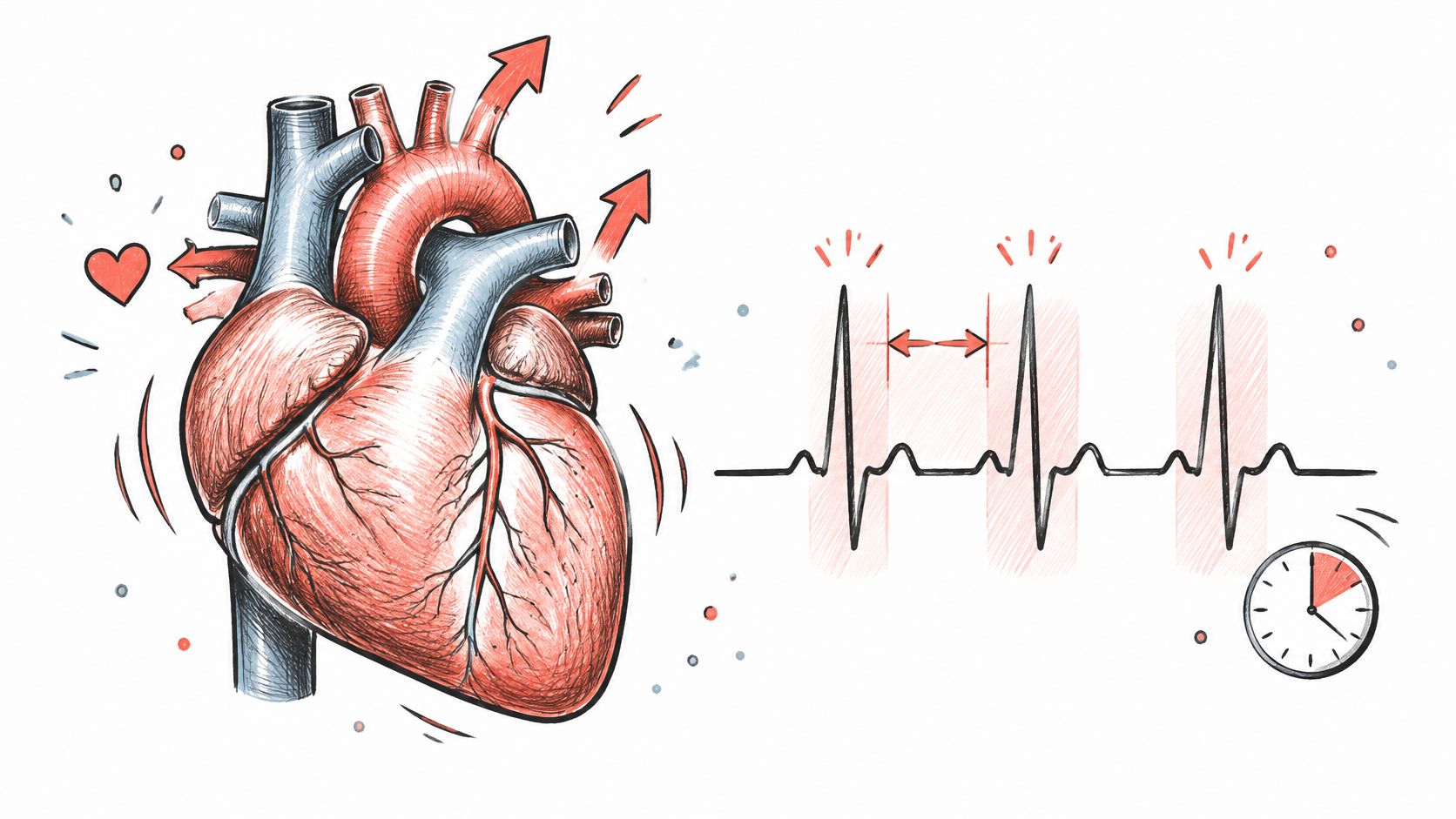
Picture the heart as a pump that needs a brief rest between squeezes. That pause is when the chambers refill, a bit like letting a squeeze bottle expand before you press it again.
If the rhythm gets too quick, that refill window can shrink. Less blood moving through the body may lead to palpitations, dizziness, weakness, shortness of breath, chest discomfort, fatigue, or fainting, while short-lived triggers can include exercise, stress, fever, dehydration, pain, and stimulants. Episodes that keep returning deserve a closer look for issues such as anemia, thyroid problems, medication effects, heart disease, or fluid loss.
A faster heartbeat does not always mean better circulation. Filling time matters, and so does the reason the heart sped up.
Context changes the meaning. A racing pulse after stairs is different from one that begins while you are sitting quietly with a book.
- Notice the trigger. Were you active, resting, stressed, or already unwell?
- Notice the duration. When did it start, and did it settle on its own?
- Notice the company it keeps. Symptoms matter as much as the number on a monitor.
Fast Heart Rate Symptoms and What They Usually Signal
Symptoms are clues, not verdicts. This table helps match common sensations with the situations that often explain them and the patterns that merit review.
| Symptom | Common Temporary Context | Pattern That Deserves Medical Review |
|---|---|---|
| Palpitations | Exercise, stress, caffeine or other stimulants | Repeated episodes without a clear trigger |
| Dizziness or light-headedness | Dehydration, standing quickly, fever | New, worsening, or paired with chest symptoms |
| Weakness and fatigue | Poor sleep, illness, overexertion | Persistent fatigue with recurrent racing |
| Shortness of breath | Hard effort, anxiety, heat | Breathlessness at rest or out of proportion to activity |
| Chest discomfort | Muscle strain, stress, indigestion can mimic it | Pressure, pain, or discomfort with racing or faintness |
| Fainting | Standing long, dehydration, pain or fear | Any blackout, near-blackout, or injury from a fall |
The pattern matters more than a single moment. One brief episode after effort may simply be worth watching, while clusters of unexplained symptoms should move you toward care.
Recognize When a Racing Heart Needs Attention
Notes can sharpen the story, but they are not a home diagnosis. Let them guide the conversation, not postpone it.
| What You Notice | What to Do |
|---|---|
| Pounding after activity | Note the activity and how recovery went |
| Repeated unexplained episodes | Arrange medical review |
| Chest pain, severe breathlessness, or fainting | Seek emergency medical help |
You do not need a perfect diary before asking for advice. A short description of a recurring problem is enough to start the conversation.
If you feel well enough to record an episode safely, keep it simple:
- Note the time and what you were doing.
- Record your pulse reading, if available.
- Add symptoms and how long they lasted.
The useful basics are posture, warning signs, and a few clear details from the episode. Start with your symptoms today: book a review for recurring unexplained racing, and get emergency help for the warning signs above.
Standing up can turn an ordinary moment into a dizzy spell. Your pulse might feel perfectly calm on the sofa, then pound while you're standing in a queue, even though you haven't exercised at all.
Normally, your body adjusts heart rate and blood pressure within seconds of standing, like an automatic balancing act running quietly in the background. When that adjustment stumbles, posture becomes an important clue, not just background noise.
Why Standing Up Can Trigger a Racing Heart
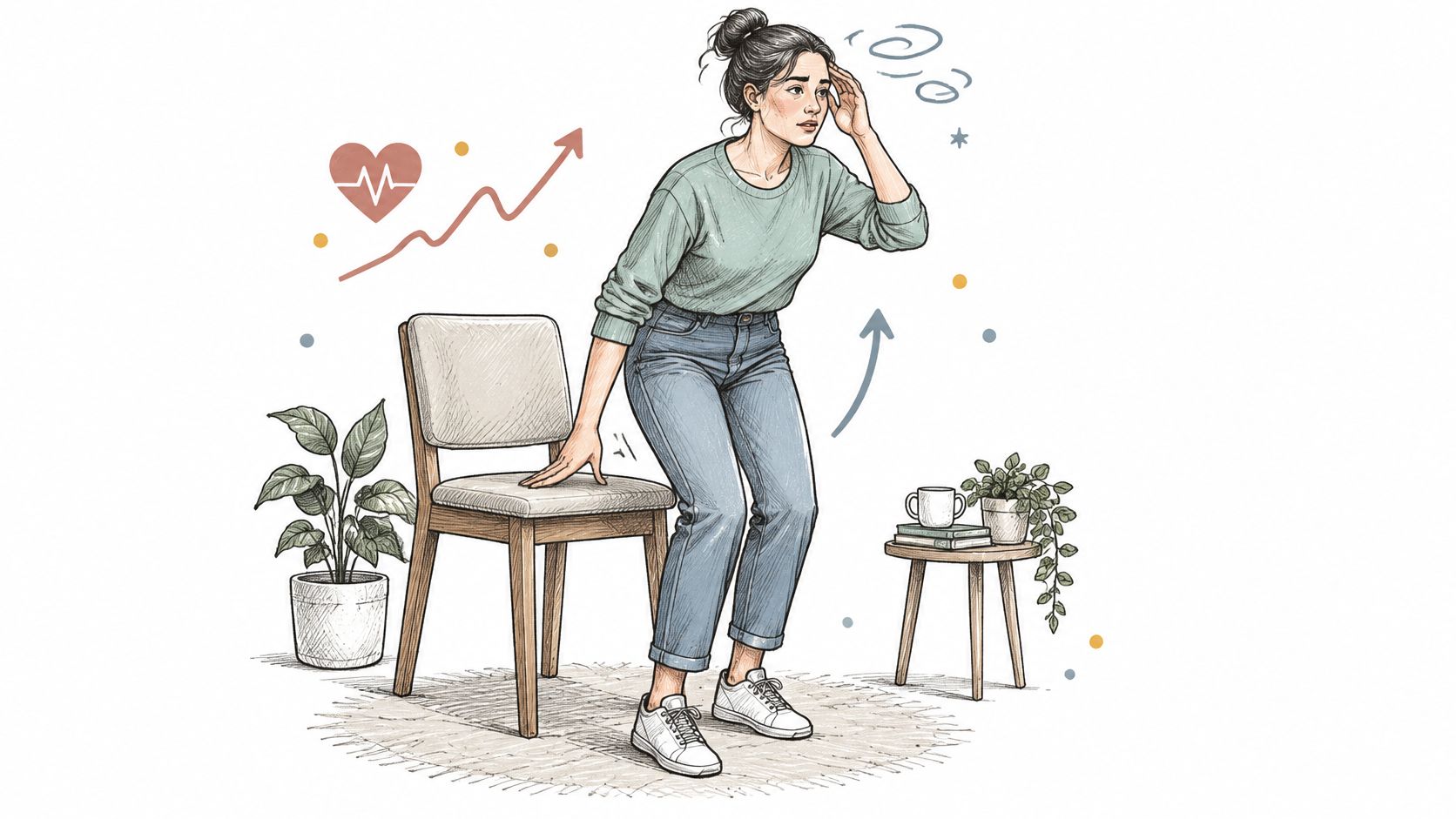
Picture carrying a full cup of tea while you move from sitting to standing. Your hand makes constant small corrections to keep it steady, and your circulation has to do something similar every time your position changes.
So the useful question isn't just "What happens if my heart beats too fast?" It's also worth asking: "Does this mainly happen when I'm upright, and what changes when I lie down?"
The same pulse reading can tell different stories depending on posture, symptoms, and timing.
A few everyday comparisons make this clearer:
- After walking upstairs, a fast pulse simply reflects recent effort.
- While standing still, a climbing pulse paired with dizziness calls for a different kind of conversation.
- During illness or hot weather, note that context instead of assuming posture explains everything.
Recognize the Pattern Without Diagnosing Yourself
Orthostatic intolerance is the term for symptoms that appear when you're upright. Postural orthostatic tachycardia syndrome, or POTS, fits this pattern, bringing light-headedness, palpitations, weakness, blurred vision, exercise intolerance, fatigue, or brain fog that often ease when you lie down.
Clinical descriptions generally look for symptoms alongside a sustained rise of at least 30 bpm within 10 minutes of standing in adults, or 40 bpm for ages 12 to 19, without a significant drop in blood pressure. One large review found that roughly 70% of 4,835 surveyed patients reported major functional impairment or reduced participation in school or work, and the median delay before diagnosis was 24 months.
Worth repeating: these are clinical guideposts, not a home diagnosis. A brief spike on its own doesn't establish the condition, and a pulse reading can't tell you whether your blood pressure fell.
| Observation | Useful Context |
|---|---|
| Pulse rises upright | Record when standing began |
| Symptoms change lying down | Describe what improves |
| Episodes recur | Note their effect on daily activities |
Bring the Posture Pattern to Your Appointment
Instead of repeatedly standing up to recreate the dizziness, capture what happens during normal activities whenever it feels safe to do so.
- Record your position, including whether you were sitting, standing, or lying down.
- Describe the symptoms, when they started, and how long they lasted.
- Add relevant context, such as heat, hydration, recent activity, illness, or medications.
For more detail, read our guide to tachycardia when standing.
Arrange a medical review if this pattern keeps returning. Bring your notes along and ask whether blood-pressure measurements and further assessment could help explain what's going on.
A heart that pounds after a hard sprint is doing its job. The same pounding while you’re stretched out on the couch calls for a different read: the situation around the number matters as much as the number itself.
Telling Normal Heart Rate Spikes From Warning Signs
If you’re asking what happens when your heart beats too fast, begin with a simpler question: does the rise match what your body was doing? Picture a car engine. Higher revs while accelerating are expected; loud revving in a parked car is a reason to lift the hood.
Context Checklist for a Fast Heart Rate
Use this as a way to sort the moment and decide what to do next, not as a self-diagnosis.
| Situation | Typical Trigger or Timing | Accompanying Symptoms | Suggested Next Step |
|---|---|---|---|
| Expected spike | During exercise, stress, fear, or excitement | Feels consistent with the effort and settles afterward | Rest, hydrate, and watch how quickly it recovers |
| Unexplained episode | Starts at rest or lasts longer than expected | Racing, fluttering, pounding, or irregular beats | Arrange prompt medical advice |
| Standing-linked pattern | Recurs after standing over weeks | Dizziness, fatigue, weakness, or a fast pulse on rising | Book a clinician visit and bring notes |
| Emergency warning | Can happen at any time | Chest pain, severe breathlessness, fainting, confusion, or marked weakness | Call emergency services now |
The main dividing line is fit. A fast rate that follows effort and fades with rest is different from one that appears at rest, keeps returning, or arrives with symptoms that feel dangerous.
If you feel seriously unwell, act on those symptoms first. Do not wait for a device, app, or trend line to agree with you.
Separate Urgent Symptoms From Long-Term Outlook
A rapid or irregular rhythm at rest, an episode that goes on unexpectedly, or racing paired with the emergency signs above deserves prompt medical attention. When severe symptoms show up, emergency help matters more than tracking one more reading.
That urgency is separate from the longer view for diagnosed POTS. Clinical reviews report no deaths directly attributed to POTS, even though day-to-day effects can be substantial. One summary found that more than half no longer met diagnostic criteria within five years, while another survey described symptoms persisting years after diagnosis.
- Improvement is not a deadline. Someone else’s timeline does not set yours.
- Persistent symptoms still deserve support. A reassuring mortality outlook does not make the symptoms minor.
- Statistics are context, not prophecy. Different patient groups, definitions, treatments, and follow-up methods can produce different results.
Use Monitoring Without Letting It Delay Care
Think of monitoring as a notebook, not a siren. It is most useful when it helps you tell a one-off event from a pattern that keeps showing up and deserves a real conversation.
When you are safe and symptoms are not urgent:
- Note the setting, such as sitting quietly versus cooling down after activity.
- Describe the pattern, including whether episodes keep returning and what they feel like.
- Bring the details to a medical appointment rather than trying to solve it alone.
For help understanding misleading alerts, read our guide to false positives in heart-rate tracking.
Recurring unexplained episodes merit a review. If chest pain, severe breathlessness, fainting, confusion, or marked weakness appears, call emergency services immediately instead of collecting more readings.
A watch reading is a snapshot, not the whole story. 120 beats per minute after a flight of stairs means something different from 120 while you are sitting still, so an episode record needs more than a screenshot.
Turning Watch Readings Into a Useful Episode Record
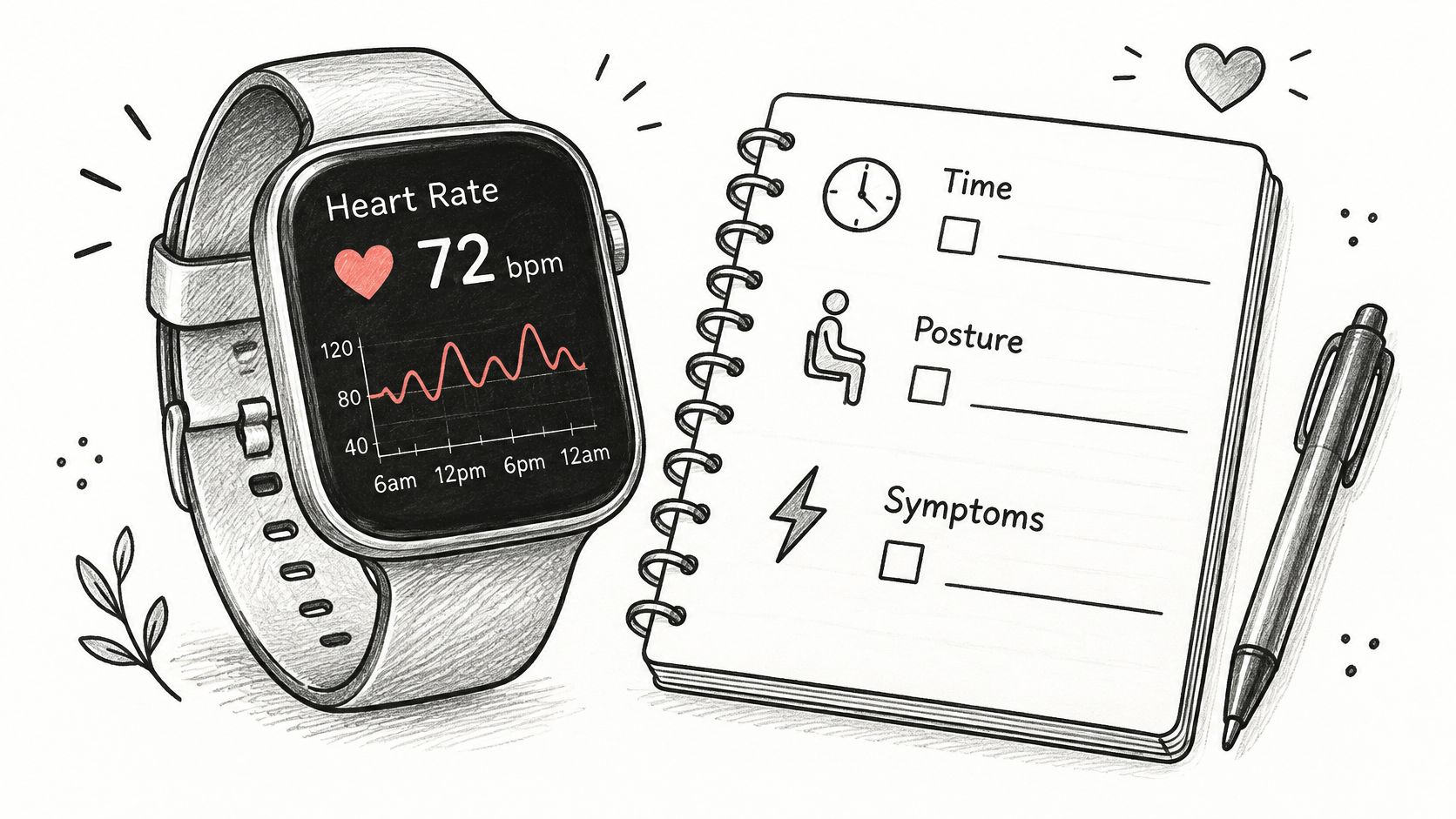
A good log works like captions on those snapshots. You are not trying to save every heartbeat; you are keeping enough context for you and your clinician to see what was going on.
- Baseline and peak show where your pulse began and how high it climbed.
- Timing and duration show when the rise started and how long it stayed up.
- Posture and symptoms tie the numbers to what you were doing and feeling.
“Pulse jumped after I stood up from a hot shower, and I felt dizzy” carries more useful detail than “high pulse today.” Write down what you noticed, and leave the cause open until a clinician reviews it.
A useful record describes an episode. It does not turn a watch reading into a diagnosis.
Let Automatic Tracking Capture the Numbers
Cardiogram can read existing smartwatch heart-rate data through read-only health permissions. It flags rises of 30 bpm or more within five minutes, then stores the time, baseline, peak, and duration.
Its reference thresholds include 30 bpm, or 40 bpm for ages 12 to 19. Those are screening guides, not diagnostic criteria, and automatic capture needs no new hardware or manual logging.
That matters when you feel wiped out or lightheaded and do not want to rebuild a graph from memory. For a practical way to structure notes, read our guide to keeping a useful heart-rate log.
| Captured Automatically | Context You Can Add |
|---|---|
| Baseline, peak, and duration | Standing, sitting, or lying down |
| Episode timing | Symptoms and recent activities |
Workouts and recovery periods are filtered out automatically, which helps keep ordinary exercise from swelling the episode count. Automatic capture still depends on what your watch records, though, so gaps in wear time can leave gaps in the feed.
Treat that feed as a clean starting point. It is not a complete minute-by-minute account of your heart.
Add Context Without Turning Tracking Into Homework
Keep optional notes short enough that you will actually write them. A few specific words can preserve details a pulse graph cannot show.
- Describe symptoms such as dizziness, palpitations, fatigue, or brain fog.
- Note relevant context, including fluids, salt intake, sleep, and medicines.
- Record posture, especially if symptoms began after standing or eased when you lay down.
Wrist sensors can give incomplete, delayed, or inaccurate readings, especially during movement or loose contact. Cardiogram is an information tool, not a medical device; it does not diagnose conditions or replace a doctor.
Start with your next safely observed episode: check the captured numbers, add one brief note, and bring recurring unexplained patterns to your clinician. Never put off urgent care just to finish logging.
Weeks of readings start to matter once they point to a repeatable rhythm. Treat your log like a calendar, not a stack of screenshots: you want it to show when episodes happen, how often they return, and what was going on around them.
Reading Trends and Preparing for Your Appointment

A weekly summary helps you spot frequency, while resting heart-rate trends reveal slower shifts that single episodes can hide. Episode heatmaps add timing by showing clusters across certain days or hours, so read them together instead of letting one busy patch tell the whole story.
- Compare similar weeks, and mark gaps when the watch was off.
- Watch for repeated context, such as short sleep, low fluids, stressful commutes, or symptoms after caffeine.
- Keep the cause open, since two things happening together still fall short of proof.
A note like “dizzy on three mornings after poor sleep” gives a clinician a concrete trail to follow. It carries more weight than “I feel off sometimes,” and it still leaves room for other explanations.
Bring a pattern and a question, not a diagnosis. Careful notes help the visit start in the right place.
Turn Your Trends Into an Appointment Summary
Many heart-rate apps can package episode detection, alerts, history, trends, and heatmaps into a shareable report, and some can export a doctor-ready PDF. If yours offers weekly summaries or resting heart-rate trends, use them as background rather than proof, and remember that pause or cancellation terms matter less than whether the export is clear.
Before the visit, pull together a small set of items so the conversation does not rely on memory:
- Export the report, with episodes, detection settings, trends, and any context you logged.
- List medications and supplements, including doses and anything changed recently.
- Write a short timeline, covering when symptoms began and how they affect work, sleep, exercise, or driving.
- Pick two or three questions, such as what could explain the pattern and which tests would be useful next.
| Bring | Purpose |
|---|---|
| Episode summary | Shows timing and recurrence |
| Medication list | Helps review possible contributors |
| Symptom timeline | Connects readings with daily life |
Skip the urge to print every chart. Choose a few representative episodes, then say whether those days were typical or unusual.
Reports can support clinical review, though they cannot replace blood-pressure checks, an exam, or professional judgment. They also should not become a reason to delay care while you chase one more week of data.
Build your appointment folder today: export the report, add your medication list, and write your three most important questions before booking a review for recurring unexplained episodes.
Even people who track carefully can fall into habits that blur the story their heart-rate data is trying to tell. The encouraging part: most of these are easy to correct, and none call for special gear.
The biggest trap is treating one high reading as proof of a condition. A jump can come from stairs, a hot shower, or a tense email. Before you read meaning into it, note your posture, how long the rise lasted, what you felt, and whether the same pattern shows up again over several days.
- Mistake: comparing a seated number with a standing one without marking where you were. Fix: tag each entry as seated, standing, or lying down so the comparisons mean something.
- Mistake: letting workout and recovery peaks inflate your episode count. Fix: let the tracker exclude exercise automatically, then add a quick note about anything active you did that day.
Fixing Data Quality Problems
Give wrist readings taken mid-movement or through a loose band some healthy doubt. Recheck while still, tighten the strap, and treat jumpy values carefully because consumer sensors can lag or miss beats during motion.
A quieter problem is writing symptoms down days later from memory. Log them in the moment, even as a single line, since small details disappear quickly.
One number proves nothing. Posture, duration, symptoms, and repetition turn readings into evidence.
Another classic appointment mistake: showing up with screenshots but no baseline, peak, or duration. Export a report with those exact figures instead.
Two Misconceptions Worth Correcting
A high resting pulse by itself does not define POTS; what happens when you stand and how you feel matter too. Just as important, repeated standing-related symptoms should not be waved off as anxiety if the pattern keeps returning, since that can slow down useful care.
Every repair comes back to the same routine:
- Record posture with each episode.
- Capture how high the rise goes and how long it lasts.
- Log hydration, salt, sleep, and medications beside how you feel.
Severe or unusual symptoms should never be sorted out from wearable data alone. If chest pain, fainting, or severe breathlessness shows up, get medical care first and clean up the logs later.
When your heart starts racing, what it means really comes down to three things: what caused it, how long it lasts, and what else you're feeling. The questions below can help you sort out what's worth paying attention to, without turning a number on your wrist into a self-diagnosis.
Frequently Asked Questions
Can a Fast Heart Rate Be Harmless?
Often, yes. Your heart is supposed to speed up sometimes. Exercise, a stressful day, a fever, or one too many coffees can all push it higher, and that's a normal response rather than a warning sign.
What deserves a closer look is racing that shows up at rest with no obvious trigger, or episodes that drag on longer than you'd expect. Those are worth bringing to a doctor.
Chest pain, severe breathlessness, or fainting alongside a racing heart means emergency care, not another reading.
Does a 30 bpm Rise on Standing Mean POTS?
Not on its own. For adults, clinicians look at the whole picture: a sustained rise of at least 30 bpm within 10 minutes of standing, symptoms that come with it, no significant drop in blood pressure, and a pattern that persists over time. That's a clinical judgment call, not something a single number can settle.
- A brief spike after standing doesn't establish POTS.
- A pulse graph can't measure blood pressure at all.
- If upright symptoms keep coming back, that's a conversation for your clinician.
Can I Trust Wrist Readings During an Episode?
Treat them as helpful notes rather than a precise record. Wrist sensors can be incomplete, delayed, or inaccurate, especially if you're moving around or the watch isn't sitting snugly against your skin.
If you feel well enough to check safely, here's a reasonable approach:
- Stop moving and make sure the sensor has good contact.
- Jot down your symptoms, posture, and the time.
- Bring any recurring patterns to your clinician.
Do I Need a Manual Diary?
Not necessarily. Cardiogram automatically captures qualifying rises, along with the baseline, peak, and duration of each one. You can add notes whenever you like, things like dizziness, sleep, hydration, or medications, to give the data some context.
It's an information tool, not a medical device. Tracking can support a conversation with your doctor, but it doesn't diagnose anything or replace medical care.
Use Cardiogram to organize your heart-rate episodes, attach symptom notes, and pull together a report before your next appointment. And if symptoms feel urgent, get medical help first. The app can wait.