You're sitting at your desk when your watch shows a heart rate of 160. You haven't been exercising, and you might feel fine, a little lightheaded, or suddenly aware of your heartbeat. It's an unsettling number, especially when you don't know whether to trust the watch.
A heart rate of 160 at rest needs attention, but the number alone doesn't identify the cause. The practical order is to check for emergency symptoms, confirm the reading if it's safe to do so, and get the right assessment. Don't start by guessing whether it's POTS, anxiety, or a faulty sensor.
Triage and Confirm a 160 Reading
Call emergency services now if the fast heartbeat comes with chest pain, fainting or near-fainting, severe breathlessness, confusion, new weakness or numbness, or signs of shock. Don't wait to finish a measurement routine, and don't drive yourself if you feel faint or seriously unwell.
A resting rate near 160 bpm is clinically significant tachycardia. The ACC/AHA/HRS guideline on supraventricular tachycardia supports assessing symptoms and circulation promptly and obtaining an ECG during tachycardia whenever possible, because the rhythm recording helps establish what's happening.
Which urgency tier fits your situation
Symptoms come first. A reassuring-looking watch graph doesn't cancel out severe symptoms, and feeling reasonably well doesn't make a persistent rapid pulse something to ignore.
| Situation | Action now | Why it matters |
|---|---|---|
| Chest pain, fainting or near-fainting, severe breathlessness | Call emergency services now | A rapid rate with these signs can be unstable and needs urgent assessment |
| Confusion, new weakness or numbness, signs of shock | Call emergency services now | Neurological or circulatory symptoms may indicate a serious problem affecting blood flow |
| Rate stays very high after quiet rest, or an irregular pulse, without emergency symptoms | Seek same-day medical review or urgent care, ideally with an ECG | A persistent rate needs a rhythm check, not app-based interpretation |
| Rapid resting rate with fever, vomiting, poor fluid intake, or a new medication | Seek same-day review and bring your medication list | Illness, fluid loss, and medication effects need assessment |
| Brief spike that resolves, you feel normal, and your manual pulse agrees with the settled reading | Recheck and log it; arrange routine review if it repeats | An isolated, unconfirmed peak doesn't establish a diagnosis |
If you can't access same-day care and the rapid rate persists, seek urgent assessment rather than waiting for a routine appointment.
Confirm the reading without delaying care
Consumer heart-rate data can be incomplete, delayed, or inaccurate, particularly during movement or poor sensor contact. That's a reason to corroborate the reading, not dismiss it.
- Stop moving and sit or lie down. Rest rather than walking around to see whether the number changes. If you're lightheaded, lying down is safer than standing.
- Check your wrist pulse manually. Use your index and middle fingers below the thumb side of the wrist. Count over a timed interval, repeat the check, and note whether the beats feel regular. Our guide to taking a radial pulse explains the technique.
- Check sensor contact. Make sure the watch sits securely against your skin. Keep your wrist still and note if your skin is cold or contact is poor.
- Gather other observations if available. Check seated blood pressure and temperature. Record oxygen saturation if you already have an appropriate device, but don't delay care to find one.
- Compare the repeated readings. Save the timestamp, posture, symptoms, and what you were doing before the alert.
A wearable resting-heart-rate methodology study emphasizes clearly defined resting conditions and repeated observations rather than interpreting an isolated value as someone's baseline. That distinction matters when a watch records a postural transition, activity recovery, or a brief sensor error as apparent rest.
Practical rule: Confirming a reading is a short safety check, not a reason to keep testing at home while a rapid pulse persists.
If the watch and manual pulse disagree, preserve that information. If they agree that your pulse remains very fast at rest, act on the appropriate urgency tier.
Causes of Resting Tachycardia and Why 160 Is Not Automatically POTS
One number can't name the cause. A fast resting pulse can reflect the body responding to illness or stress, an effect of medication, or a problem with the heart's rhythm.
The clinical review of POTS diagnosis and physiology describes alternative explanations including dehydration, anemia, hyperthyroidism, infection, pain, stimulant or medication effects, anxiety, inappropriate sinus tachycardia, and arrhythmia. Sorting those possibilities takes the full history: when the episode began, what position you were in, which medicines you take, and whether an ECG captured the rhythm.
Common causes of resting tachycardia by pattern
Treat each pattern as a description you carry into an appointment. A sudden start, an irregular pulse, and symptoms specifically triggered by standing are different clues.
| Possibility | Typical pattern | Check that separates it | First step |
|---|---|---|---|
| Supraventricular tachycardia | Often an abrupt start and stop, with a rapid, regular pulse | Onset and offset documented alongside an ECG | ECG during an episode and appropriate cardiology review |
| Atrial fibrillation | Irregular pulse that can remain fast at rest | ECG capture during a fast, irregular episode | ECG and rhythm assessment |
| POTS-related tachycardia | Sustained rise on standing with orthostatic symptoms | Lying and standing readings, blood pressure, and clinical history | Clinician-directed standing assessment |
| Inappropriate sinus tachycardia | Persistently high sinus rate without a clear explanation | Rhythm documentation and exclusion of other causes | Ambulatory monitoring when appropriate and assessment of underlying causes |
| Medication or stimulant effect | Begins or changes after a drug, dose, or stimulant change | Timing compared with the full medication and supplement list | Pharmacist or prescriber review |
| Thyroid disease | Rapid rate, sometimes with tremor, heat intolerance, or weight change | Thyroid blood tests interpreted with symptoms | Primary care assessment |
| Anemia, fever, infection, or dehydration | Fast pulse alongside fatigue, pallor, fever, thirst, or fluid loss | Examination, temperature, hydration assessment, and selected blood tests | Prompt review and treatment of the underlying cause |
These patterns overlap. An irregular-feeling pulse doesn't prove atrial fibrillation, and a regular pulse doesn't prove the rhythm is harmless. An ECG records electrical activity; a watch's optical heart-rate number doesn't provide the same information.
Look at the timeline before choosing a label
Medication review works best when you bring names, doses, and timing. Include prescribed medicines, over-the-counter cold remedies, inhalers, thyroid medication, supplements, caffeine, and other stimulants. Don't abruptly stop a prescribed medicine or take extra heart-rate medication without clinical advice.
Anxiety often rides alongside a fast pulse without causing it. A persistent episode that stays unexplained deserves a documented rhythm before any single label sticks. Fluids correct dehydration, period. A rhythm problem, an overactive thyroid, or anemia each needs its own assessment.
The JACC review of POTS and inappropriate sinus tachycardia distinguishes posture-related symptoms from a rate that stays high in every position, and it describes other important alternatives including pulmonary embolism and structural heart disease. A resting rate of 160 sits inside that wider differential, which is why clinicians weigh the whole presentation.
A useful description sounds like "it began abruptly while I was lying down and stayed regular." Timed, postural detail like that gives a clinician more to work with than a guess about POTS.
Bring two pieces of clinical history alongside the episode record: pregnancy status where relevant, and whether an ECG captured the rhythm while it was happening. Both shape which tests are justified and which would add little.
Run a Standing Test You Can Bring to a Clinician
A rate of 160 while seated answers one question only: how fast your heart is beating in that position. What a clinician needs next is what happens when you move upright, and which symptoms arrive with that change. POTS is an orthostatic pattern, so a high peak sitting or lying down cannot settle it on its own.
Do not perform a standing test while your resting pulse stays markedly raised, during acute illness, or when you feel faint or otherwise unwell. Get assessed first. A home test produces one observation to discuss with a clinician, and a test you have to stop early still counts as information.
Record posture, blood pressure, and symptoms together
When a clinician agrees home observations are appropriate, start after at least five minutes lying down. Record heart rate, blood pressure if you have a cuff, and symptoms, then repeat at one, three, five, and ten minutes after standing. Have someone within reach if you are prone to dizziness, and stop the moment you feel faint, develop chest discomfort, or become significantly breathless.
A guided NASA lean test walks you through that timing in order, which removes the mental arithmetic while you are symptomatic. Follow whichever protocol your clinician requests rather than assuming one version fits every question, because testing conditions and technique change what the numbers mean.
Thresholds that separate POTS from other causes
The reference numbers below come from the JACC review of POTS and inappropriate sinus tachycardia, which sets out the orthostatic criteria and the sinus-tachycardia reference. They are boundaries a clinician weighs alongside symptoms, blood pressure, and competing causes, so treat them as reference points rather than a self-diagnosis checklist.
| Criterion | Threshold | Condition that must also hold |
|---|---|---|
| Adults, POTS heart-rate criterion | Sustained rise of 30 bpm or more within 10 minutes of standing | Orthostatic symptoms, no significant orthostatic hypotension, and exclusion of alternative causes |
| Adolescents aged 12 to 19, POTS heart-rate criterion | Sustained rise of 40 bpm or more within 10 minutes of standing | Orthostatic symptoms, no significant orthostatic hypotension, and exclusion of alternative causes |
| Rise on standing without orthostatic symptoms | No heart-rate rise alone establishes POTS, even if it meets the numerical threshold | Insufficient for a POTS diagnosis |
| Inappropriate sinus tachycardia reference | Resting rate of 100 bpm or more, or a 24-hour mean above 90 bpm | Other causes must be excluded and the sinus rhythm assessed |
Orthostatic symptoms means lightheadedness, palpitations, or similar complaints that appear or worsen while upright. A significant blood-pressure drop on standing points the interpretation toward orthostatic hypotension, which is exactly why a heart-rate-only test leaves out half the picture.
A pulse that stays high while you are lying down deserves assessment on its own merits. Repeating standing tests to force a cleaner number adds risk without adding information.
Keep stopped tests in the record, including why you stopped. A line like "stopped at four minutes after feeling faint" tells a clinician far more than a blank gap in the log.
How to Log Episodes Your Clinician Can Use
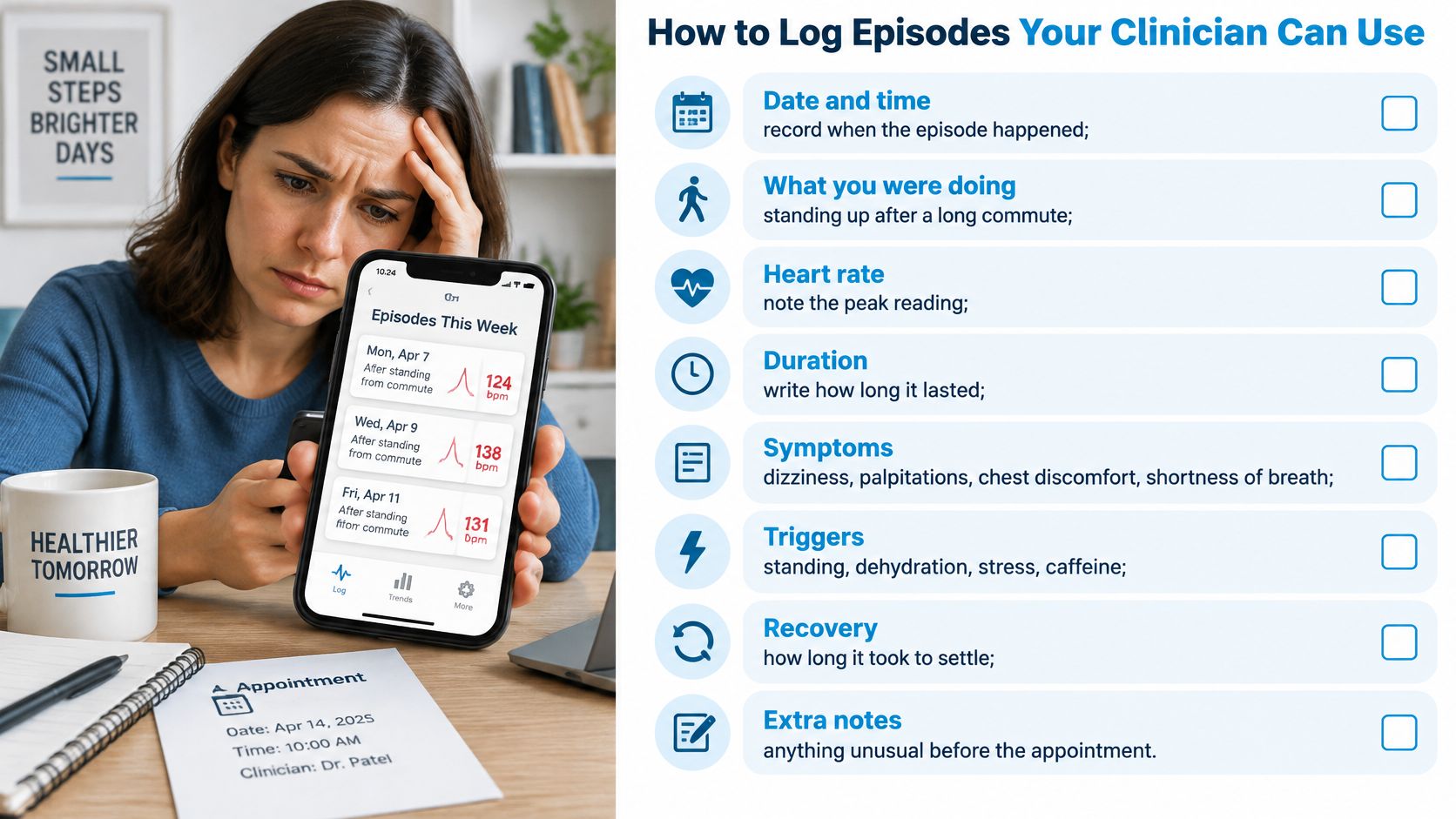
Say you've had several spikes after standing up following a long commute. At your appointment, you remember the pounding heartbeat but can't recall whether the dizziness began before or after you stood, or how long recovery took. A short, timed record answers those questions better than memory can.
Capture the circumstances as well as the peak. A clinician needs to distinguish an abrupt episode at rest from a gradual rise after movement, illness, or a change in medication. The details that separate those two patterns are the ones worth writing down.
Keep a compact episode checklist
- Onset and recovery: Record whether the episode started and ended suddenly or gradually, and what you were doing in the hour before it.
- Manual check: Note whether you felt or counted the pulse yourself. A confirmed racing pulse carries different weight than a watch alert alone.
- Position at the time: A single word such as lying, sitting, or standing is enough. What matters is capturing it while the episode was fresh.
- What ended it: Write down whether rest, lying down, fluid, or nothing at all brought the rate down, and roughly how long that took.
- Changes around the episode: Flag anything new in the days before it, such as a dose change, a new supplement, poor sleep, or an illness.
- How you felt at each stage: Record when symptoms began relative to the fast rate, not only which symptoms you had.
Use automatic records without mistaking them for a diagnosis
With an Apple Watch, heart-rate history in Apple Health can supply timestamps you might otherwise forget. Cardiogram connects Apple Health with one tap using read-only access, logs every detected rise of 30+ bpm within five minutes with its baseline, peak, and duration, and lets you add symptoms as they happen. It also excludes workouts and recovery periods automatically, so exercise doesn't inflate the episode count. Those thresholds flag events worth reviewing; they carry no diagnostic weight on their own, and no app-based detector replaces an emergency assessment when a resting rate stays high.
Analysis happens on your device. Cardiogram operates no servers and doesn't receive your health data.
For the appointment: Bring a concise printed or exported summary, while keeping the underlying readings available if your clinician wants them.
- Log mild episodes too: They may help show whether the circumstances repeat.
- Separate symptoms from alerts: Write down when you felt unwell, not only when the watch notified you.
- Include uneventful context: Note similar activities that didn't trigger symptoms.
- Keep recording while awaiting review: An appointment your clinician has already indicated matters more than a longer log.
A log might reveal that episodes follow afternoon coffee, or occur only after standing following prolonged sitting. Treat a pattern like that as a lead to raise with your clinician.
Choose Your Next Step and Who to See
The useful question now is who can record the rhythm. For a resting rate this high, primary care or urgent care is the practical entry point: either can begin with a rhythm recording, examination, medication review, and targeted blood tests. Ask specifically whether an ECG can be recorded while an episode is happening. A tracing taken after symptoms stop can still help, but it may not show the rhythm responsible.
Match the referral to the findings
Cardiology or electrophysiology makes sense when an ECG identifies an arrhythmia or pre-excitation, or when episodes stay recurrent and unexplained. If the events are intermittent, ambulatory cardiac monitoring gives your clinician a way to capture the rhythm between appointments rather than hoping it happens in the office.
An autonomic or POTS-experienced specialist is most useful when persistent upright symptoms and a clinically assessed standing pattern point toward an orthostatic disorder. You don't need to settle that diagnosis yourself before asking for the referral; describing the pattern you logged is enough to start the conversation.
Take these questions to the appointment:
- Which rhythm was recorded? Ask how it was confirmed and whether the symptomatic episode was captured.
- What needs checking next? Clarify the purpose of each blood test, monitor, or referral.
- What should change safely? Ask which medicines, supplements, or stimulants need review, and which symptoms should trigger emergency care.
Cardiogram is an information tool that doesn't diagnose or replace a doctor, so it should never delay treatment. Bring the timed log and these questions to the visit; the goal of a first appointment is a captured rhythm and a next-step plan, and a settled label can come later.
Cardiogram helps organize Apple Health heart-rate episodes and symptom context into a summary you can bring to a clinician. If you're medically stable and want a clearer record of unexplained spikes, Cardiogram Pro starts with a 3-day free trial, with no payment taken at the start. Use it to prepare for a clinical conversation, not to decide whether a resting rapid heartbeat is safe.