If your heart rate looks completely normal on a Tuesday afternoon, why do you still feel like you're dragging lead weights behind you? Most advice about postural orthostatic tachycardia syndrome (POTS) focuses almost entirely on catching a single high pulse reading. Yet for millions of people living with orthostatic intolerance, a racing heart isn't the symptom that sidelines their day. POTS fatigue is.
Treating every exhausted day as a heart-rate problem leaves a huge blind spot. Fatigue in POTS rarely comes from one neat source. It can stem from gravity pulling blood away from your brain when you stand, from restless sleep that never resets your nervous system, from an activity crash that arrives a day late, or from separate medical issues like anemia or thyroid disease that overlap with autonomic symptoms.
Chasing one number on a screen won't tell you which of those drivers is running the show. Tracking your patterns over several weeks will. A structured log won't diagnose POTS on its own, and it never replaces a clinician's judgment, but it turns vague exhaustion into clear evidence you can act on together.
Why POTS Fatigue Is Often the Heaviest Symptom
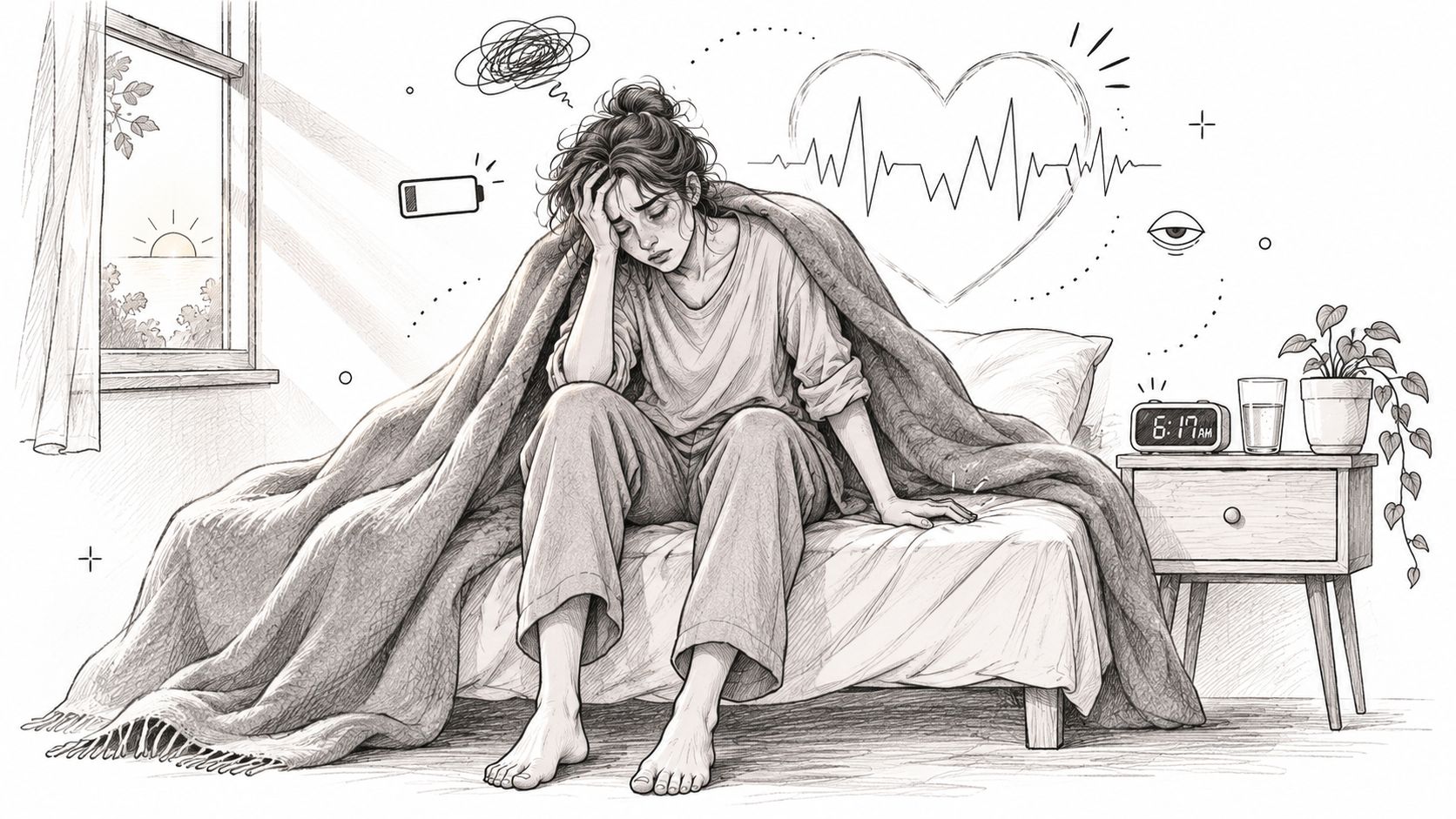
For many people living with POTS, deep exhaustion shapes the entire day rather than acting as a minor side effect of a fast pulse. A pounding heart often settles within minutes of sitting down. The heavy, drained feeling does not. That persistent fatigue is a core feature of the condition, and it deserves the same careful attention as any pulse reading.
POTS is a disorder of autonomic regulation: the automatic system that controls blood flow, heart rate, and blood pressure struggles to adjust when you move upright. A JAMA clinical review of POTS estimates it affects roughly 0.1% to 1.0% of the U.S. population, or about 1 to 3 million people, with women accounting for approximately 87% to 94% of diagnosed cases and symptoms frequently starting in adolescence or young adulthood. Diagnostic coding for the condition lagged for years and population research remains limited, so plenty of patients spent a long stretch hearing they were stressed, tired, or out of shape.
The scale of that exhaustion shows up clearly in patient registries. An Australian POTS Registry observational cohort study that enrolled 500 participants between 2021 and 2024 reported that 87.2% of 477 respondents recorded severe fatigue, defined as a Fatigue Severity Scale score of at least 36. When nearly nine out of ten respondents clear a clinical bar for severe fatigue, exhaustion belongs at the center of the conversation.
The Draining Battery Problem
A phone searching for a weak signal all afternoon can slide from a full charge to red by dinner, even with no video streaming and no games running. The hardware burns power nonstop in the background just to stay connected. A body working overtime to push blood upward against gravity drains the same way: the effort is constant, invisible to anyone watching, and expensive.
Practical frame: Your fatigue often says more about how hard your circulation and nervous system worked to keep you upright than about how much you accomplished today.
Before you change your routine or adjust your intake, pause and name the pattern that shows up most often in your own week. Do you feel heaviest while standing and relieved when you lie flat, wake up unrefreshed before your feet even touch the floor, or crash a full day after a busy afternoon? Each answer points toward a different possible driver, and telling those drivers apart is what turns vague exhaustion into something you and your clinician can work with together.
Heart-Rate Thresholds That Define POTS
POTS is defined by a sustained rise in heart rate after standing, together with chronic upright symptoms and stable blood pressure. The heart-rate change matters, but it has to be read in context. An ordinary workout peak, a fever, or a brief flutter can raise your pulse without representing an orthostatic episode. The useful question is whether a repeatable pattern appears when you stand, and whether symptoms rise with it.
The clinical cutoffs below come from the Current Neurology and Neuroscience Reports review. That review traces consensus criteria to foundational autonomic research by Schondorf and Low in 1993, and it separates adult and adolescent thresholds while excluding orthostatic hypotension. The table also reflects the World Health Organization's ICD-11 description, which frames the symptom pattern as persistent over months rather than a brief illness or rough week.
| Criterion | Threshold | Time Window | Notes |
|---|---|---|---|
| Adults | Sustained rise of at least 30 bpm | Within 10 minutes of standing or tilt | Symptoms worsen when upright |
| Adolescents aged 12 to 19 | Sustained rise of at least 40 bpm | Within 10 minutes of standing or tilt | Same symptom requirement |
| Blood pressure exclusion | Systolic fall of 20 mm Hg or diastolic fall of 10 mm Hg | Within about 3 minutes of standing | Suggests orthostatic hypotension instead |
| Symptom duration | Chronic symptoms | At least 3 months (ICD-11) | Ongoing pattern, not a brief spell |
Each row works with the others, like lanes on a road rather than separate finish lines. A teenager whose heart rate climbs 34 bpm on standing has not automatically met the adolescent criterion, which sits higher at 40 bpm to allow for normal developmental cardiovascular responses. An adult whose pulse jumps 35 bpm while systolic blood pressure drops 20 mm Hg within three minutes points clinicians toward orthostatic hypotension rather than POTS.
A single daily maximum pulse number removes the context that makes the pattern readable. Two flights of stairs, a brisk walk, a fever, or a sudden scare can push heart rate well past 120 bpm without involving autonomic dysfunction. A standing-related rise works differently: it recurs after postural change, holds long enough to matter, and arrives with symptoms such as light-headedness, palpitations, weakness, blurred vision, exercise intolerance, or fatigue. This is why a pattern log is more useful than chasing one striking number.
Cardiogram is built for people with POTS and dysautonomia. Users can log dizziness, palpitations, fatigue and brain fog as symptoms, and they can record hydration, salt, sleep, medications and how they feel. Seeing those entries beside heart-rate patterns helps separate autonomic stress from sleep, intake and medication effects before drawing conclusions.
A wearable can flag a repeatable pattern worth investigating, yet it cannot measure blood-pressure drops or confirm a diagnosis by itself. Formal orthostatic testing, such as an active-standing test or a head-up tilt test in a clinic, remains necessary. Cardiogram provides weekly summaries, resting heart-rate trends and episode heatmaps, which can help you see which upright episodes repeat across days. Section 8 covers the exact readings to line up for an appointment, so the goal here is simpler: notice when heart rate, posture and symptoms travel together.
Fatigue Patterns That Point to POTS or Something Else
The timing and shape of your fatigue tell a clearer story than how tired you feel on a one-to-ten scale. Two people can both rate their exhaustion an eight, yet one feels noticeably lighter after twenty minutes flat on the sofa while the other wakes up wrecked before getting out of bed. Same score, different mechanism, and very different conversations with a doctor.
The table below orders five common fatigue patterns from the one most characteristic of POTS down to patterns that call for broader detective work. Read it as a sorting exercise: match your hardest days to a row first, then think about causes.
| Fatigue Pattern | What It Often Points To | What to Log |
|---|---|---|
| Tired mainly when upright, better lying down | Circulation stress on standing | Heart rate and posture at the time |
| Unrefreshing sleep, worst on waking | Sleep disturbance | Hours slept and how rested you felt |
| Crash one to two days after exertion | Post-exertional worsening or deconditioning | Activity dose and next-day energy |
| Exhausted with a normal heart rate | Sleep, anemia, thyroid disease or medication effects | Symptoms to review with a clinician |
| Fatigue with brain fog and dizziness on standing | Orthostatic stress | Episode time, duration and symptoms |
Upright Patterns Most Linked to Orthostatic Stress
When your energy drains steadily while you stand in a grocery line or cook dinner, then rebounds once you recline, gravity is the prime suspect. Logging your exact posture alongside your pulse turns that suspicion into a pattern: if upright minutes reliably predict the drop and lying down reverses it, the fatigue belongs to the orthostatic family.
Brain fog and dizziness that arrive on standing belong to that same family. The next section traces the circulation mechanics behind them, so here it is enough to note the start time, the duration, and whether spells cluster at predictable moments such as right after waking or following a warm shower.
Delayed Crashes, Bad Mornings, and Normal-Pulse Fatigue
A heavy crash that arrives one to two days after physical or mental effort runs on a different clock entirely. Say you feel fine during a Saturday outing, take it easy on Sunday, and then can barely get off the couch on Monday morning. That delayed drop points toward post-exertional worsening or mismatched conditioning, where your total activity dose matters far more than your peak pulse during the task. Logging what you did on the two days before each crash reveals the dose that keeps tipping you over.
Bad mornings follow their own logic. Waking exhausted before you have even stood up shifts attention toward how well you slept, so record both hours in bed and a quick morning restfulness score to separate a bad night from an orthostatic flare.
Finally, fatigue that hits hard on days when your heart rate stays calm is a signal that tachycardia is unlikely to be the driver. Causes like low iron, thyroid imbalance, fragmented sleep and medication side effects can all imitate a POTS flare, and the section on sleep and medical causes examines each of these look-alikes in depth.
Each row in the table gives you a targeted question rather than a final label. Track your symptoms for two weeks, highlight whichever row matches your toughest days most often, and bring that single observation to your next appointment. A pattern like that supports your clinician's judgement far better than a vague "I'm tired all the time."
How Low Circulation Turns Standing Into Exhaustion
Standing shifts blood toward your legs and abdomen before your nervous system can fully adjust. Gravity pulls blood into the large veins, a process called venous pooling. The heart then has less blood returning to pump upward, so the body has to work harder to keep blood reaching the brain.
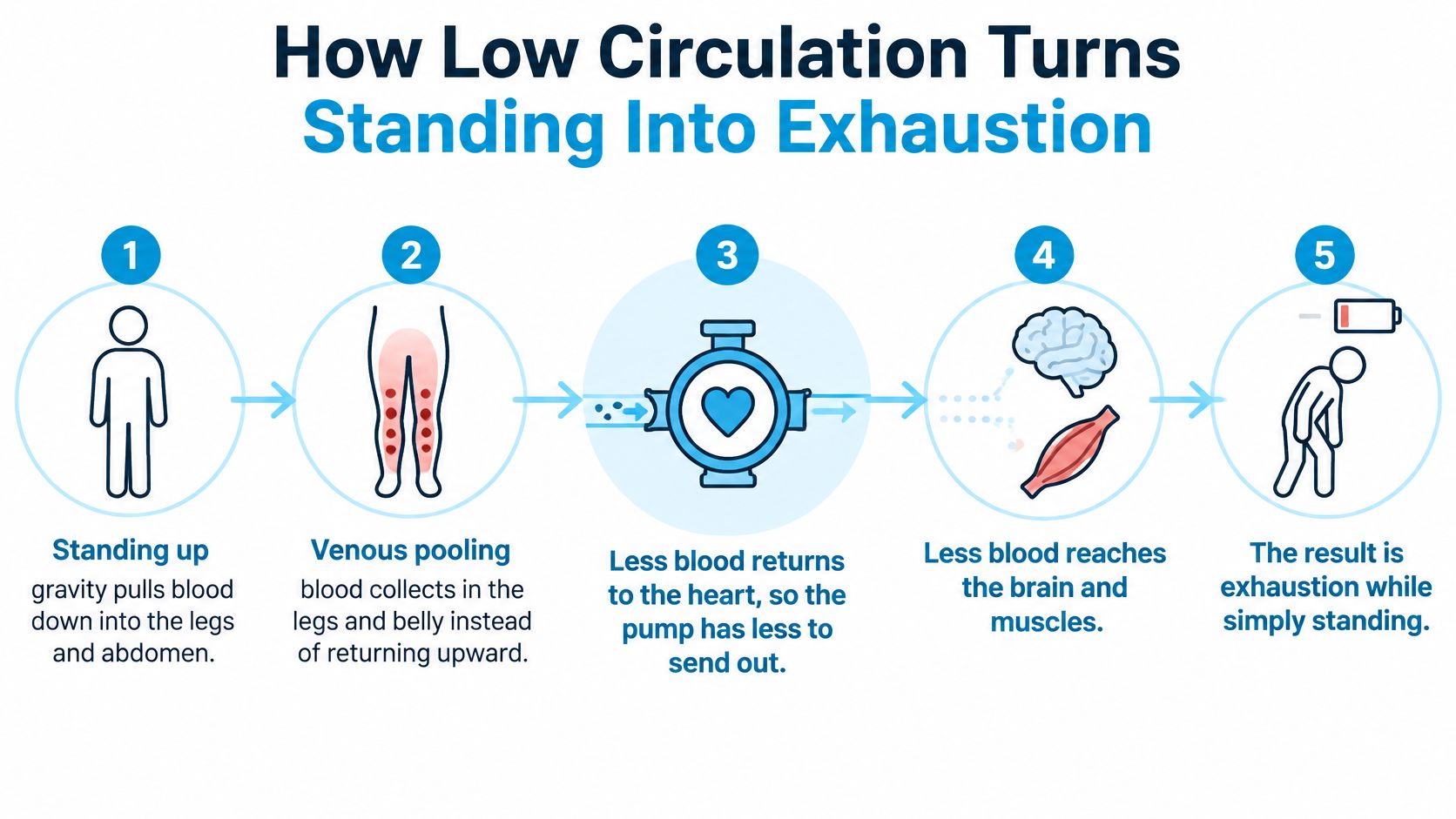
Your circulation works like a pump with a return line. If too little blood comes back, less can go out. In a smoothly regulated system, vessels in the lower body tighten within seconds to push blood back toward the heart. In POTS, that response falls short. Less blood returns to the heart, leaving less volume to send to the brain and working muscles. To keep oxygen moving upward, the nervous system increases sympathetic activation and speeds up the heart rate.
That compensation uses energy even when your body looks still, such as standing at a kitchen counter. A systematic review examining POTS fatigue mechanisms reported severe fatigue in 93% of included POTS patients using a validated fatigue threshold. The same review points to overlapping drivers including hypovolemia, venous pooling, peripheral denervation that weakens vessel tightening, deconditioning, and hyperadrenergic states that keep stress signaling high. These vascular responses are also part of the difference between POTS vs. orthostatic hypotension, since both challenge circulation on standing while differing in blood pressure stability.
The Breathing and Brain Blood-Flow Feedback Loop
Circulation strain also affects breathing and brain blood flow. A systematic review on orthostatic intolerance and ventilation explains how excessive heart-rate and breathing responses while upright can speed up breathing and wash out arterial carbon dioxide. Carbon dioxide helps keep brain blood vessels open, so lower levels can narrow those vessels and reduce cerebral blood flow further.
That creates a stubborn loop. Less blood reaching the brain can intensify dizziness, mental fog, fatigue, palpitations, and early exercise stoppages. Those symptoms can push sympathetic overdrive higher, making upright circulation feel even harder. The same review also highlighted reduced cerebral blood-flow velocity early during standing, before rapid breathing and full postural tachycardia settled in.
Your pulse shows how hard your body is working to keep blood moving to your brain. It does not show every part of the strain, since wearable heart-rate logs cannot directly measure cerebral blood flow or carbon dioxide levels. Pair episode timestamps with symptoms like dizziness, palpitations, fatigue, and brain fog. Cardiogram is built for people with POTS and dysautonomia, letting users log those symptoms alongside hydration, salt, sleep, medications, and how they feel, then compare that context with heart-rate patterns over weeks so a clinician sees a broader pattern rather than a single number.
Sleep and Medical Causes When Heart Rate Looks Normal
Controlled research published in the AHA journal Circulation found substantially worse sleep problems, daytime sleepiness, and fatigue in people with POTS compared with healthy controls. The same research linked sleep-problem variability to approximately half of the variability in health-related quality of life. Poor sleep often drives daytime exhaustion in dysautonomia. A calm pulse can sit inside ordinary waking ranges while the rest of the system is still paying for a short, broken, or unrefreshing night.
That is why normal-pulse fatigue deserves its own kind of pattern log. Heart rate works like one dashboard gauge. It can show that upright strain is quiet, while other gauges, such as sleep quality, medication effects, and medical problems, still explain why the body feels heavy.
A Four-Step Check for Normal-Pulse Fatigue
When exhaustion shows up without a fast heart rate, work through four practical checks before blaming your posture:
- Audit your morning baseline. Track bedtime, nighttime awakenings, total hours slept, and how rested you feel within thirty minutes of waking. Feeling heavy and foggy before you ever stand up points straight toward sleep disruption.
- Review medication timing and side effects. Several prescriptions used to manage heart rate or blood pressure can leave you sluggish, especially right after a dose change. Note when each medication is taken and whether the slump follows a repeatable interval.
- Compare upright days with rested days. Check whether exhaustion stays just as stubborn on quiet days spent mostly reclining or on days when standing feels physically easy. Persistent fatigue that ignores body position often reflects a non-autonomic issue rather than orthostatic strain.
- Ask a clinician for targeted medical screening. Conditions like anemia, thyroid disease, dehydration, cardiac disease, and primary sleep disorders (such as sleep apnea) produce heavy, whole-body tiredness with completely normal resting pulses. Blood work and sleep evaluations can catch treatable problems that extra salt and compression socks will never fix.
A useful example is a week with calm daytime pulses but mornings that start exhausted after six hours of broken sleep. More electrolytes will probably not solve that pattern. A two-week sleep log gives a clinician something concrete to examine, including bedtime, awakenings, hours slept, and morning restedness.
These checks give you a clear differential list, so you and your doctor can test the right possibilities instead of guessing. Cardiogram is built for people with POTS and dysautonomia. Users can log POTS fatigue, dizziness, palpitations, and brain fog as symptoms, then compare those entries with hydration, salt, sleep, medications, and how they feel against heart rate. Weekly summaries, resting heart-rate trends, and episode heatmaps help keep the wider pattern visible over weeks. That pattern log supports a clinician's judgement, it does not replace diagnosis.
Triggers and Daily Factors Worth Logging
Fatigue rarely bows to a single trigger. One morning you might breeze through errands, while the next day the exact same route wipes you out because a warm room, a short night of sleep, and a skipped water bottle stacked on top of one another. Logging daily context alongside your heart rate exposes those hidden combinations.
Focus on a manageable handful of daily factors rather than writing a novel every evening:
- Fluid intake: Note low-fluid days clearly, since even mild dehydration lowers circulating blood volume and makes standing noticeably harder.
- Salt intake: Salt and water work as a pair in many POTS management plans, so jotting down whether you hit your usual sodium target helps explain sudden swings in energy.
- Sleep duration and morning restfulness: Record rough hours plus a quick word on how restored you felt on waking, because poor sleep amplifies next-day orthostatic strain.
- Medications and dose timing: Write down every prescription and over-the-counter drug, especially anything that lowers blood pressure, slows your pulse, or stimulates your heart rate.
- Heat exposure: Hot showers, humid commutes, and overheated offices widen blood vessels and worsen blood pooling, often triggering fatigue hours after you cool down.
- Large or high-carbohydrate meals: Heavy meals pull blood toward your digestive tract, which frequently sparks post-meal palpitations and heavy drowsiness.
- Menstrual cycle phase, stress, and minor illness: Hormonal shifts, high-stress deadlines, and mild viral bugs reliably raise baseline autonomic load for several days at a stretch.
Whenever an orthostatic episode hits, attach quick symptom tags for dizziness, palpitations, fatigue, and brain fog. For a deeper look at how environmental and physical stressors stack up, review this guide on common POTS triggers as you set up your notes.
Spotting Real Patterns Over Two to Four Weeks
Single days are noisy. Wait until you have two to four weeks of entries, then line up your worst fatigue days beside your daily context notes. Look for repeat pairings: do high-episode afternoons consistently follow hot showers, low-water mornings, or restless nights?
Keep intentional workouts and post-exercise recovery windows separate from your orthostatic episode log. A brisk stationary bike ride naturally raises your heart rate and tires your legs; mixing exercise spikes into your daily episode tally blurs the signal and makes it harder to see what's flaring your autonomic symptoms.
Exercise, Crashes and Pacing Without Guesswork
Standard advice often makes exercise sound like a cure-all for POTS, leaving people wondering what went wrong when a twenty-minute jog knocks them flat for three days. Exercise intolerance in POTS isn't just a lack of fitness or willpower. A JAMA review on POTS management highlights that POTS is biologically heterogeneous, involving varied mixes of hypovolemia, venous pooling, neuropathy, excessive sympathetic activity, and possible autoimmune processes, while documenting substantial functional impairment, lost school or work participation, and a median diagnostic delay of about 24 months.
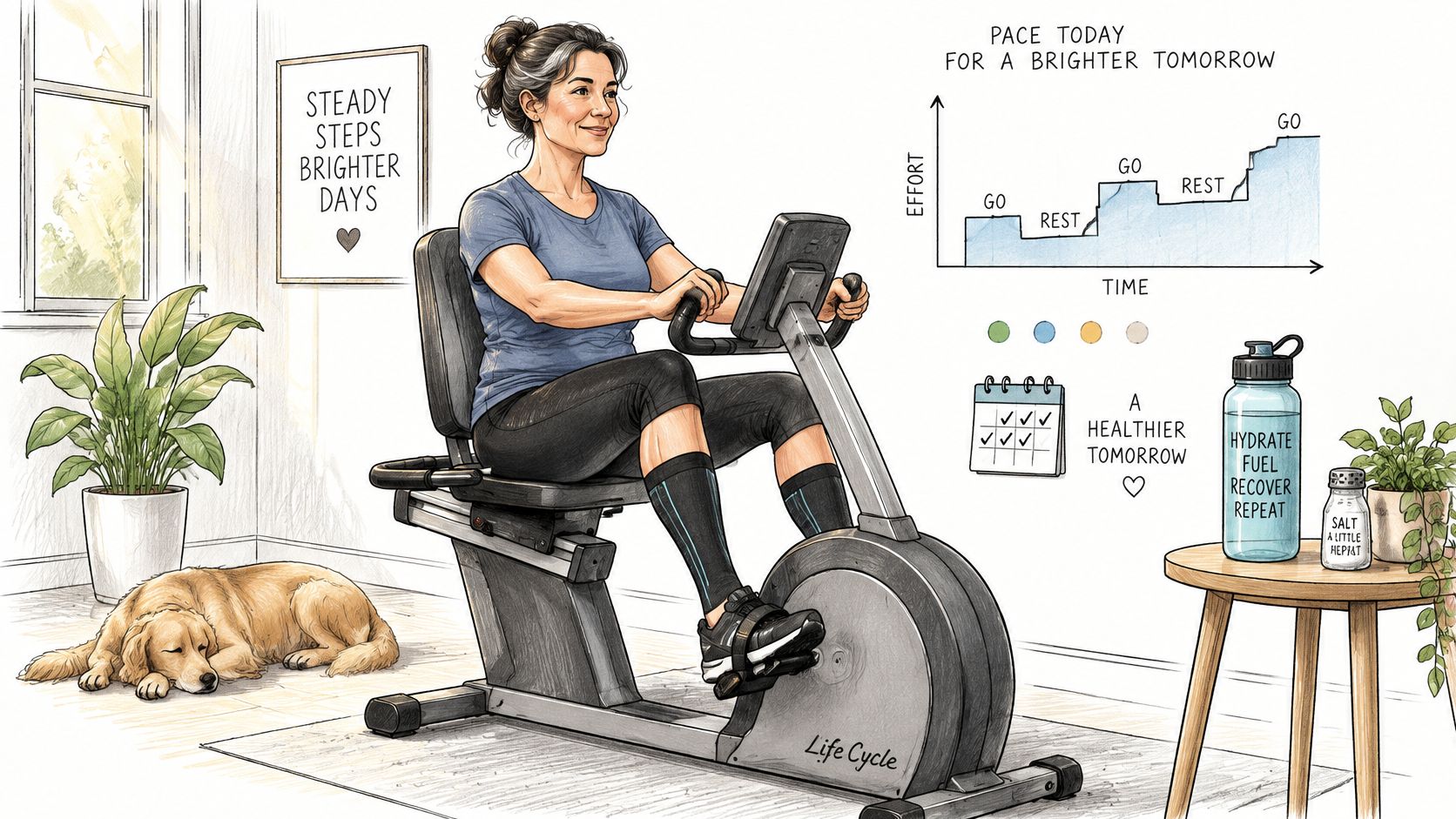
Because that diagnostic wait stretches roughly two years for many patients, people frequently start self-directed workouts long before anyone tailors a plan to their physiology. Clinical guidance generally favors structured, supervised exercise paired with fluids, salt, and compression, beginning in a recumbent (reclining or horizontal) position such as rowing, recumbent cycling, or swimming so gravity doesn't hijack your circulation on day one. Structured conditioning frameworks like the Levine protocol for POTS follow this gradual horizontal-to-upright progression so your heart and muscles adapt without constant orthostatic crashes.
Six Steps to Pace Conditioning Safely
The key skill is telling ordinary muscle fatigue apart from an excessive flare. Mild soreness or temporary tiredness that lifts after a good night's sleep is expected; a crash that drags your baseline down the next morning is a warning sign.
- Start recumbent with short blocks. Begin with brief, seated or horizontal sessions (recumbent bike, rowing machine, or swimming) and record your heart rate, symptoms, and fatigue level right before and after.
- Define your stop rule before you begin. Decide ahead of time to end a session immediately if symptoms climb well beyond your baseline, your heart rate spikes far above your usual target range, or you feel faint, dizzy, or confused.
- Progress only when next-day energy returns to baseline. Hold your current duration and resistance steady until you wake up the following morning feeling back at your normal baseline. If yesterday's workout stole today's function, step the dose down rather than pushing through.
- Move from recumbent to upright one variable at a time. Once horizontal sessions feel stable, transition slowly toward upright activity by changing just one factor per week, such as adding five minutes or shifting to a gentle upright walk, never both duration and intensity at once.
- Schedule recovery days on purpose. Build rest or very light mobility days after harder sessions so cumulative autonomic strain doesn't ambush you forty-eight hours later.
- Rule out medical blockers if fatigue keeps worsening. If gentle conditioning consistently makes you feel worse rather than gradually steadier, pause and ask a clinician to screen for anemia, thyroid disease, dehydration, cardiac disease, or medication effects before assuming you just need to push harder.
Stop-rule reminder: If severe orthostatic intolerance makes upright movement impossible, or if your exhaustion began after a viral illness and triggers delayed multi-day crashes, talk with your doctor about gentle alternatives and pacing instead of forcing standard conditioning.
Interpret your heart-rate episode counts alongside exertion timing and next-day fatigue. A rise during a planned recumbent ride isn't automatically harmful, and a low episode count during a post-exertional crash doesn't mean the activity was safe. The combined trend over weeks gives you the honest answer.
Bring a Pattern Log to Your Next Appointment
Walking into a fifteen-minute medical appointment saying "I'm exhausted all the time" forces both you and your doctor to start from scratch. Walking in with a clean, one-page summary of two to four weeks of structured observations turns that same visit into a focused diagnostic conversation.
Preparation works like packing for a trip: you need less than you think, organized well. Start with the episode details you already gathered while learning your thresholds: timing, resting baseline, peak rise, and sustained duration. Add one line of daily context beside those episodes: a fatigue score, sleep quality, fluids, salt, medications, activity level, and whether a crash arrived the day after exertion. Then distill the strongest patterns onto a single page and write down the questions you want answered before the appointment clock starts.
A fill-in template keeps that page honest:
My appointment summary
Observation window: ___ weeks
Episode pattern: heavy fatigue and brain fog appear ___ minutes after ___
Strongest trigger: ___ ; calm-pulse fatigue linked to: ___
Question 1: Does my pattern fit POTS, or should we rule out something else first?
Question 2: Should I test for anemia, thyroid disease, or sleep disorders?
Question 3: Which treatment or tracking plan fits my specific symptoms?
That single page does two jobs. It gives your clinician objective observations to weigh against formal diagnostic standards, and it protects your best questions from evaporating when the visit runs short.
Keeping Your Log Together Without Busywork
Tracking all of those pieces in scattered notebooks gets tiring fast when you're already low on energy. Cardiogram is built for people with POTS and dysautonomia who want that pattern log in one place, pairing logged symptoms and daily context with heart-rate episodes for clinical review.
A tracking app supports your clinician's review rather than diagnosing POTS on its own. Your clinician still brings the physical exam, lab tests, and medical judgment needed to confirm what is driving your symptoms.
You don't need a perfect spreadsheet to get started. Begin this week with just a daily fatigue rating and one calm baseline-to-standing heart-rate check, then build from there once the habit sticks.
If you want a simpler way to connect daily POTS fatigue patterns with heart-rate shifts, symptoms, and triggers over weeks, explore what we've built at Cardiogram. Our tools organize your heart-rate trends, episode heatmaps, and logged context like sleep, hydration, salt, and medications into clear weekly summaries you can bring straight to your clinician. Visit Cardiogram to see how structured tracking can support your next appointment without turning symptom logging into another chore.