A faster heart rate for a while after a meal is common and usually harmless. The number that changes the picture is a sustained rise of at least 30 beats per minute within 10 minutes of standing in adults, or 40 beats per minute in adolescents aged 12 to 19, without a large fall in blood pressure, because that pattern points to an exaggerated upright blood-flow response of the kind seen in POTS rather than to ordinary digestion.
So if the vagus nerve is the one that slows your heart, why does your pulse climb after dinner? That's the gap in most explanations: they stop at the nerve and never mention the blood. Your heart is responding to where your circulation just went.
Why Your Heart Speeds Up After Eating
Here's the mechanism in a single picture.
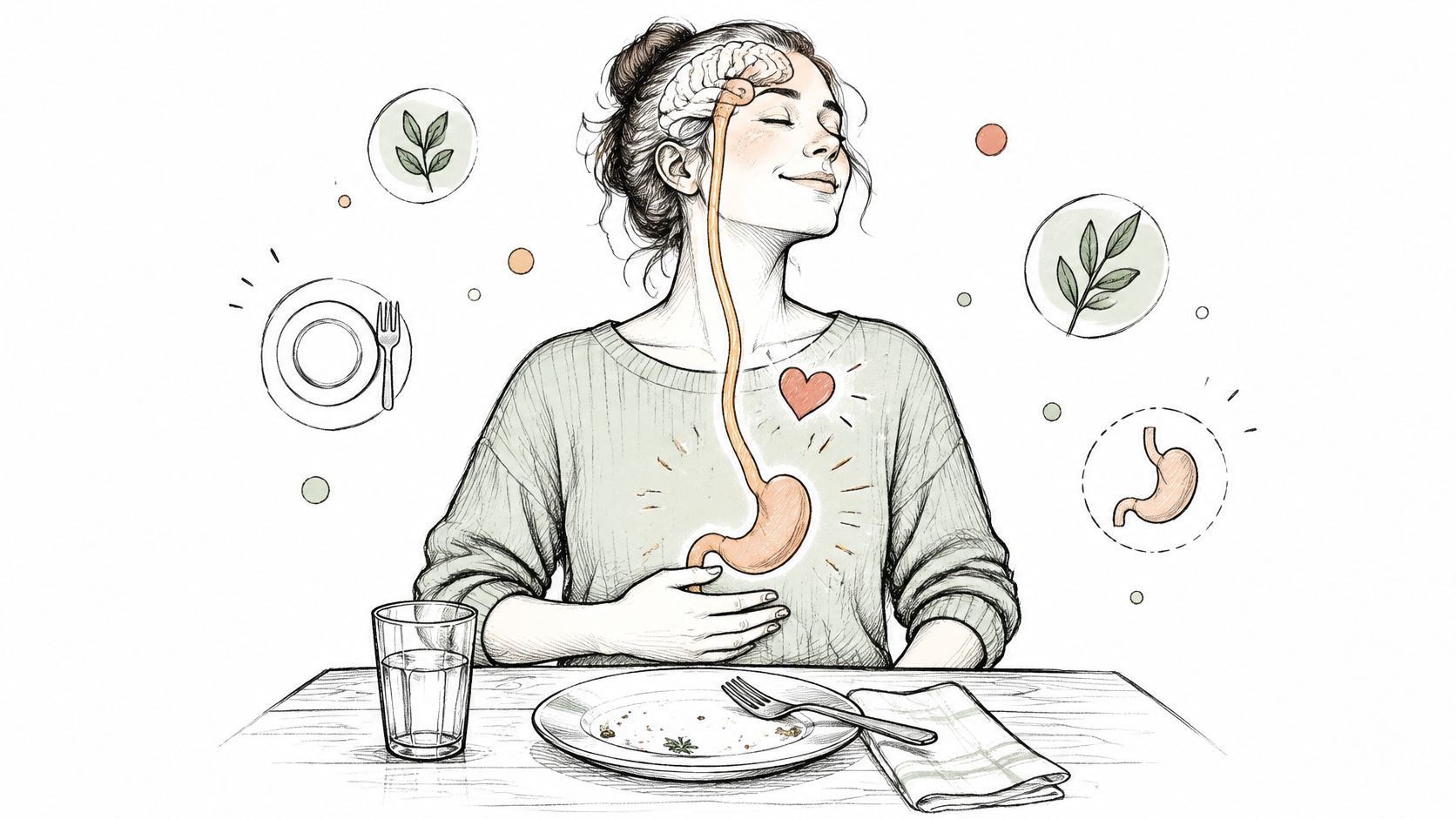
Digestion redirects blood, and the heart compensates. After a meal, blood flow is redirected toward the gastrointestinal tract. Less volume is left to fill the heart and hold pressure steady elsewhere, so the heart beats faster to cover the difference. A bowl of pasta and a glass of water can look harmless on the plate, then show up as a higher pulse on the watch once digestion gets underway.
Three everyday versions of that response look quite different from each other.
- The ordinary shift: a moderate meal lifts your pulse a little, and it settles within about an hour. No dizziness, no change when you stand.
- The heavy meal: a large or rich plate pulls more blood toward the gut and holds it there longer, so the rise is bigger and lasts beyond the hour.
- The poor compensator: in POTS or dysautonomia, blood vessels don't tighten smartly when blood moves to the abdomen. The heart works harder to defend blood pressure, and standing makes it worse.
That third version is where meal size and salt and water intake become genuine symptom triggers. Clinical guidance for POTS notes that reducing meal size may lessen postprandial hypotension by reducing blood flow diverted from the brain to the gastrointestinal system, as set out in this review of autonomic and orthostatic stress. POTS itself was formalised in the 2015 Heart Rhythm Society expert consensus statement as orthostatic symptoms plus a sustained heart-rate increase of at least 30 beats per minute in adults, or at least 40 beats per minute in adolescents aged 12 to 19, without orthostatic hypotension, and later reviews kept that threshold while specifying the rise within 10 minutes of upright posture, as described in this review of autonomic and orthostatic stress.
One racing episode after lunch proves nothing on its own, because the diagnosis also requires chronic orthostatic symptoms, exclusion of alternative causes and a proper blood-pressure assessment.
Three things to notice right now: whether dizziness came with the racing, how long it lasted, and how big the meal was. Those three answers tell you whether you're watching digestion or something worth writing down.
How the Vagus Nerve Fits Into the Picture
A brake inside a larger circulation system
The vagus nerve is a long brake line from your brainstem to your heart, lungs and gut. At rest it helps hold heart rate down; during digestion its influence eases while other signals rise, so your pulse can drift upward. That easing is one event inside a wider shift: the gut draws more blood, vessels elsewhere change tone, and pressure sensors adjust how hard the heart should work.
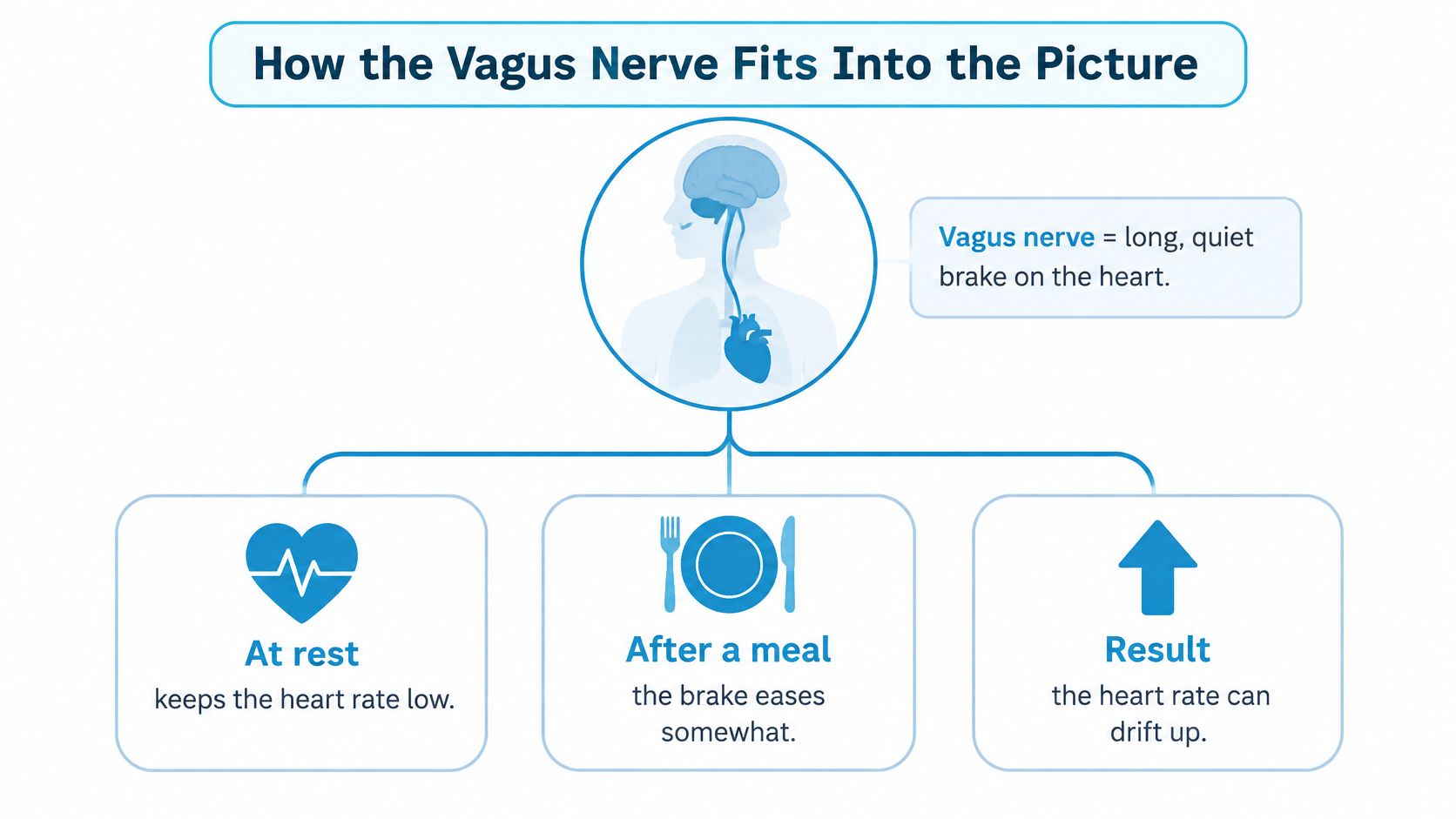
A useful frame is load versus compensation. Meal size, carbohydrate load, fluid and salt intake, posture, sleep and medication timing all change either the load or the response. The vagus nerve sits inside that circuit, so a fast pulse after food reads like a system answer rather than a single faulty wire.
What the meal is doing around the nerve
In this review of postprandial cardiovascular physiology in POTS, eating is described as increasing splanchnic blood flow and pooling blood in the abdomen, with a standard meal reported to raise mesenteric blood volume by approximately 300%. In POTS, compensation often shows up as sympathetic activation and a faster heart rate, instead of the post-meal blood-pressure drop described in healthy physiology.
Carbohydrate-heavy meals are worth watching closely because they often sit in the pattern where presyncope and tachycardia feel stronger. Treat glucose, gut hormones and stroke volume as possible contributors under study, then return to what you can observe: meal size, position, symptoms and timing.
A racing pulse after lunch tells you the balance moved. The sympathetic and parasympathetic branches act as a pair, and the useful question is which part of the circulation asked for speed: gut blood flow, upright posture, low intake, a dose near the meal, or a rhythm that would race without food.
Common Causes of a Fast Heart Rate After Meals
The table below compares the usual reasons a heart races after eating, so you can find the row that matches what you notice. Read the middle column as timing and feel, and the right column as the one thing to log next.
| Possible cause | Typical pattern | What to check |
|---|---|---|
| Normal digestion after a moderate meal | Small rise that settles within about an hour | No dizziness; rate returns to baseline |
| Large or carbohydrate-heavy meal in POTS | Rise with dizziness, worse when standing | Meal size and carbohydrate load |
| Low fluid or salt intake | Rise that builds through the day, worse on standing | Hydration and salt logged before the meal |
| Reactive hypoglycemia | Racing heart with shakiness or sweating, a few hours after a sugary meal | Timing relative to the meal; blood sugar if a clinician checks |
| Medication effects | Rise linked to a dose taken near the meal | Medication name, dose and time |
| Anemia | Fast heart rate with fatigue, pale skin or breathlessness on effort | Blood count ordered by a clinician |
| Arrhythmia | Irregular or sudden racing that may start without food | Rhythm recorded during an episode |
Rows that explain most episodes
Start with ordinary digestion. A moderate meal that nudges your pulse up and lets it settle inside an hour, with no dizziness and no change on standing, is your gut taking its share of blood. Nothing in that pattern needs investigating.
Meal size and carbohydrate load come next. A heavy plate holds more blood in the abdomen for longer, which is why the same person can feel fine after a small lunch and awful after a large pasta dinner. The vascular side of that shift is explained in this walkthrough of postprandial hyperemia.
Low fluid and salt intake make the body compensate harder on standing, because there's less circulating volume to work with. A salty meal after a day of little water is a common recipe for a noticeable rise, and it's one of the easiest rows to test: drink more, log again.
Rows that need a clinician's eye
Reactive hypoglycemia arrives two to five hours after a sugary or starchy meal, often with shakiness, sweating, sudden hunger or irritability, and it eases after you eat something. Timing is the giveaway.
Medication effects cluster around a dose, so log the name, dose and time rather than guessing.
Anemia produces a fast rate with fatigue, pale skin or breathlessness on effort, and a blood count settles it. Arrhythmia is the row that needs a rhythm recording during an episode, not guesswork, especially if the racing feels irregular or starts without food.
Several of these can be true in the same person on the same day. A dehydrated body, a sugary lunch and a new medication isn't one cause. It's three.
Treat the table as a starting point. Which row fits is something a written log answers far better than a guess.
How to Log Meal-Linked Episodes Step by Step
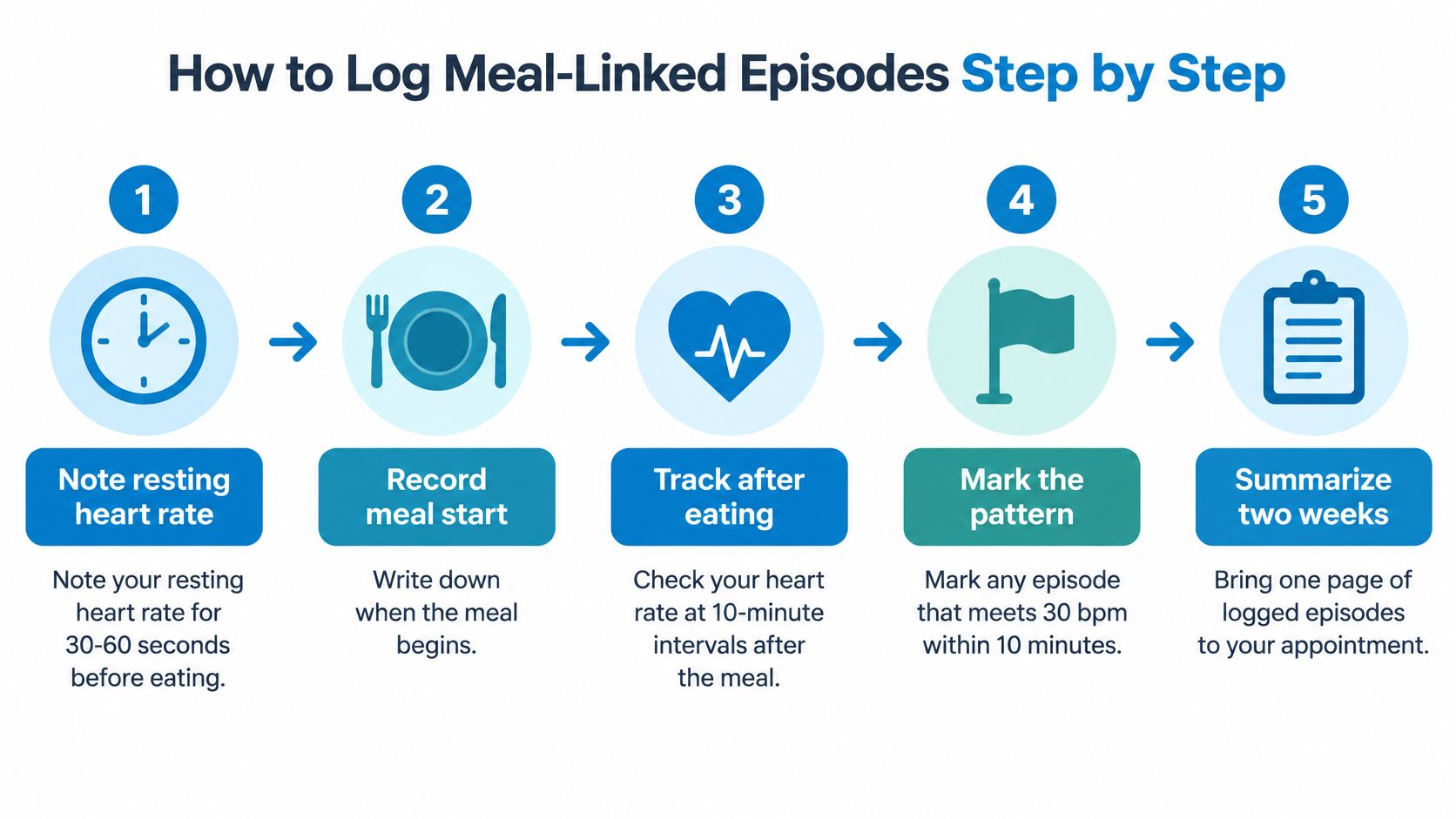
A written log turns "my heart races after lunch" into numbers a clinician can act on. It is also how a meal-linked pattern gets separated from dehydration, standing and medication timing, which can produce the same rise. Six steps produce a log that does that work.
The six steps
- Settle a baseline first. Note your resting heart rate for 30 to 60 minutes before eating, so the rise has something to be measured against.
- Write down the meal. Size and rough carbohydrate content are enough: a small sandwich versus a large plate of pasta tells a clinician more than a calorie count.
- Record your posture at the start and every 30 minutes after. Sitting, reclining and standing produce different numbers from the same meal.
- Keep readings for 2 to 3 hours after eating, and mark any sustained rise of 30 bpm or more within 10 minutes of standing.
- Log the context: hydration, salt intake, sleep, medications with times, and symptoms such as dizziness, palpitations or brain fog.
- Exclude workouts and recovery. Compare only episodes that followed similar meals, otherwise you're comparing a run with a sandwich.
The thresholds you're measuring against
| Group | Rise threshold | Timing and condition |
|---|---|---|
| Adults | Sustained rise of at least 30 bpm | Within 10 minutes of standing, without a large blood-pressure drop |
| Ages 12-19 | Sustained rise of at least 40 bpm | Same timing and blood-pressure condition |
| Absolute upright rate | At least 120 bpm while upright | Used together with the rise and context |
The two rise thresholds and the upright reference of at least 120 bpm come from the consensus work summarised in this review of orthostatic tachycardia criteria, whose final consensus process reported an average agreement of 94% and a minimum of 76%. The same review notes that orthostatic tachycardia varies by time of day, with the percentage of patients meeting the heart-rate criterion generally higher in the morning than in the afternoon or evening. Breakfast and dinner episodes aren't directly comparable unless posture, time of day, meal size, hydration, temperature, medications and activity are all recorded.
What a rise actually proves: that your heart rate changed. It may reflect gastrointestinal blood pooling, dehydration, an upright period or another condition, rather than isolated vagal overactivity.
An app can carry the repetitive parts of this routine. Cardiogram watches your Apple Health heart rate and logs every rise of 30 bpm or more within 5 minutes with its baseline, peak and duration, and you can attach symptoms such as dizziness or brain fog as they happen. Its thresholds are reference points rather than diagnostic criteria, and it is built for people with POTS and dysautonomia.
Heart-rate data from consumer hardware can be incomplete, delayed or inaccurate, particularly during movement or poor sensor contact, which is why step six still matters: compare like with like. Used alongside a written log, the data becomes a pattern finder and a way to walk into an appointment prepared. A symptom journal keeps those notes in one place instead of scattered across phone screenshots.
When a Fast Heart Rate Needs Medical Care
Sort what you're feeling into three tiers and act on the highest one that applies.
Tier one, emergency care now
Call your local emergency number for a racing heart with fainting or near-fainting, chest pain or pressure, severe shortness of breath, confusion, or weakness on one side of the body or slurred speech. These are not watch-and-wait symptoms, and they don't improve by logging them first.
Tier two, medical advice this week
Book a same-week appointment if episodes feel irregular, if they don't settle within 30 minutes of rest, if they happen at rest without a meal, or if your heart rate stays very high while you're seated. Also move this week's call forward if new symptoms appeared after starting or changing a medication, or if the racing comes with fatigue, pale skin or breathlessness on effort, which may point to anemia.
Tier three, a planned visit
For everything else, a routine appointment works. Bring your log and ask whether tests fit your pattern: tilt-table testing for orthostatic symptoms, a glucose check for episodes timed a few hours after sweet food, a blood count for fatigue, or rhythm monitoring if the beat feels irregular. A standard ECG captures seconds, so monitoring worn during symptoms is how a rhythm gets caught.
If an episode starts while you're reading this, work through four steps in order.
- Sit down or recline with your legs raised. Stop standing, because upright posture adds blood pooling on top of the meal response.
- Drink water if you've had none for a few hours. Low fluid and salt intake is one of the rows in the table above, and it's the fastest one to correct.
- Loosen tight clothing, cool the room and slow your breathing, keeping the out-breath longer than the in-breath.
- Time it and note the peak, then check whether it settles within 30 minutes of rest. If it doesn't, or if it feels irregular, move it from the wait-and-see list to the same-week list.
One detail decides which cause a clinician looks at first: whether the episode began within 30 minutes of eating, two to three hours after a sugary meal, or with no meal at all. Write that down before you forget it.
Cardiogram is an information tool and not a medical device. It doesn't diagnose anything or replace a doctor's assessment.
Meal Changes That May Ease Post-Meal Racing
Small changes to meals can shift the response, but test them one at a time, or you'll never know which one worked.
Start with size. Smaller, more frequent meals spread the circulatory load instead of dumping it in one go. A larger plate draws more blood toward the gut and holds it there longer, so a half-size lunch tests whether meal volume is one of your triggers.
Then look at carbohydrate. In a case-control study of 12 women with POTS and 13 matched controls given 75 g of oral glucose, the POTS group developed worsening orthostatic tachycardia alongside declining stroke volume while GIP levels peaked. Survey data from 8,919 people with POTS add real-world weight: 53% of physician-diagnosed respondents reported worse symptoms after high-carbohydrate meals, against 4% reporting improvement, as reported in this study of postprandial worsening in POTS.
The mechanism works like a traffic shift. Carbohydrate absorption widens the gut's blood vessels, venous capacitance rises, less blood returns to the heart, stroke volume drops, and heart rate climbs to compensate, especially when you stand.
Change one lever at a time. Three days of half-size lunches gives you a focused signal. Three simultaneous changes leave you guessing.
Practical moves that cost nothing: drink fluids before or with the meal rather than after, stay seated or reclined for about 30 minutes once you've finished, and stand up slowly rather than pushing back from the table.
Salt is a clinician decision, not a self-service one. Sodium strategies in POTS are individualized, and high blood pressure, kidney disease, heart failure, diabetes and medication interactions all change the risk-benefit calculation. Dietary changes belong in a conversation with a clinician.
Concrete test: try half-size lunches for three days, keep the log running, then compare the same meal-to-episode interval against your full-size baseline. A single meal can be random noise. The pattern becomes clearer when the same change repeats across several entries.
Confirm the Pattern Before Your Next Appointment
Two weeks of entries only become useful once they fit on one page.
- Mark what met the pattern and what didn't. Go through every entry and flag episodes with a sustained 30 bpm rise within 10 minutes of standing. Leave the exceptions visible too, because a pattern that fails half the time is still information.
- Group by circumstance. Sort episodes by meal size, carbohydrate load, posture, time of day and hydration, then count which grouping repeats most often. If large lunches dominate the list and small breakfasts produce nothing, that contrast is the finding.
- Write the one-pager. Typical meal, baseline and peak rate, duration, posture, symptoms, and what made it better or worse. A clinician can scan that in under a minute, and it gives the appointment a concrete starting point.
- Bring the raw log as well, plus a medication list with doses and times.
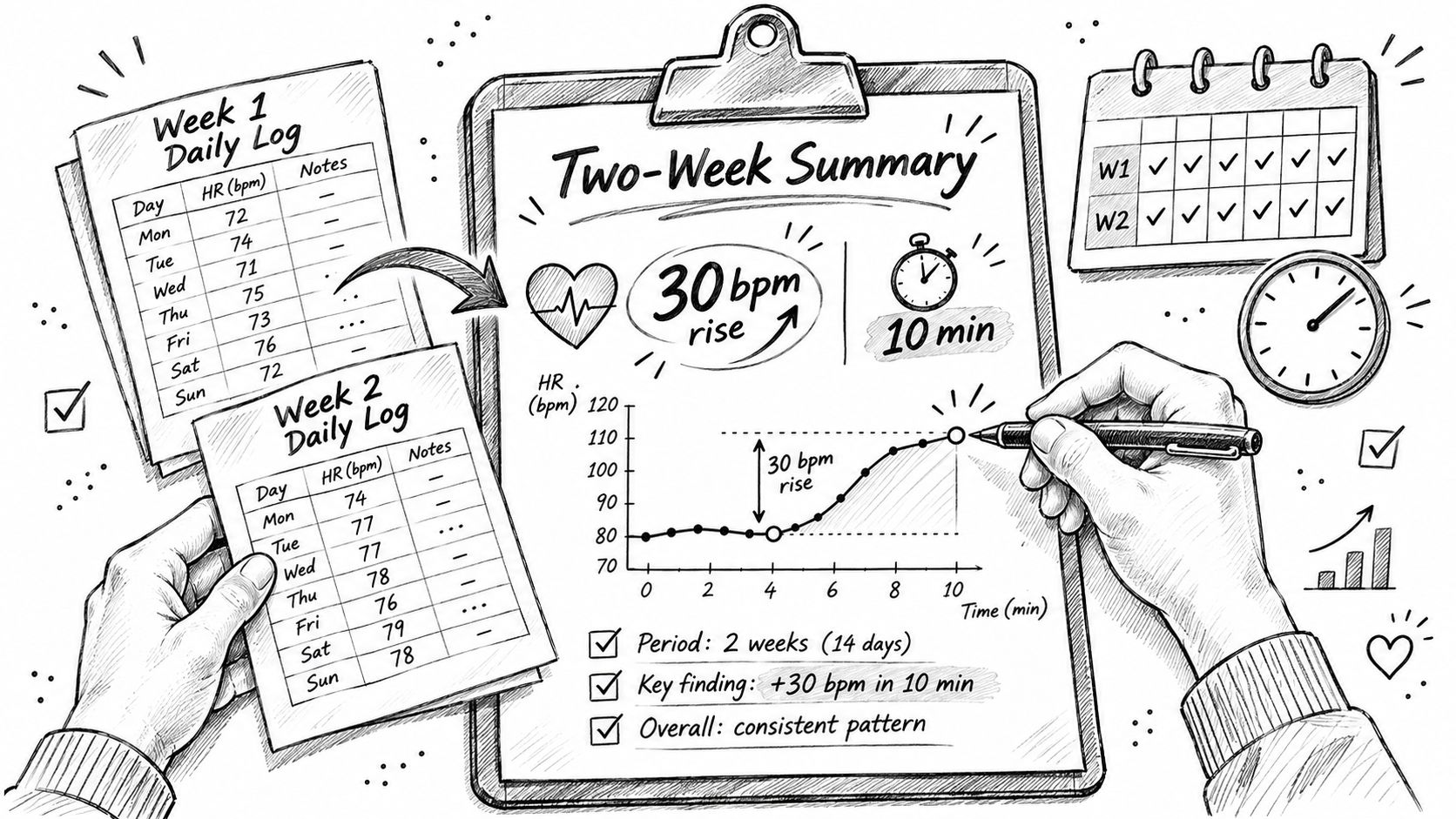
Cardiogram handles the capture side of this by watching your Apple Health heart rate, so the raw entries are already there when you sit down to write the summary.
Start the log tomorrow. If the pattern repeats across two weeks, book the visit rather than waiting for a perfect explanation.
If you're piecing together why your heart races after meals, Cardiogram turns the Apple Watch data you already have into a record you can use: automatic detection of 30+ bpm rises within 5 minutes, baseline and peak for every episode, and symptom notes for dizziness or brain fog, all summarised into a PDF you can hand to your doctor. Visit Cardiogram to see how the episode log and clinician-ready report work together, then start capturing the pattern before your next appointment.