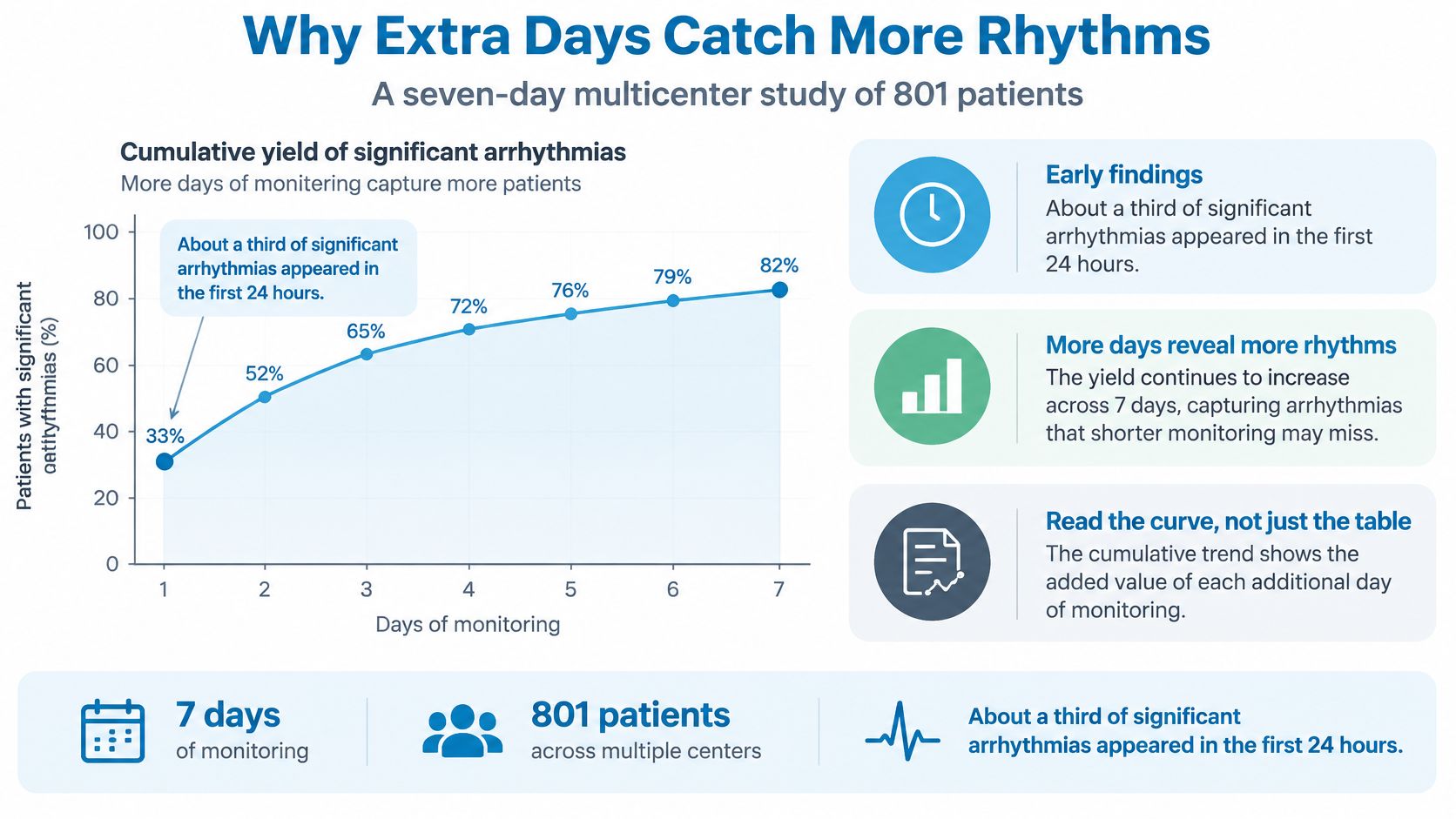
Most of the rhythms a clinician is hunting for do not show up on day one. In a multicenter analysis of 801 patients monitored continuously for seven days, only 278 clinically significant arrhythmias (35%) were first detected during the initial 24 hours, while 523 (65%) appeared after the first day, and 331 cases (41%) were first identified after day three, including paroxysmal atrial fibrillation and ventricular tachycardia, according to a European Heart Journal congress report. A quiet first day is not the same as a clear heart.
An extended Holter monitor is a continuous ambulatory ECG, usually worn about 7 to 14 days, rather than the familiar 24 to 48 hours. It is not a longer version of the same test. Its value depends on how often your symptoms show up, and on whether the file ties what you felt to the rhythm that was happening. Sometimes that rhythm is sinus tachycardia: a normal electrical pattern at a fast rate. That can be real, uncomfortable, and still not an arrhythmia diagnosis.
How Many Days Your Symptoms Need
Before the appointment, you can already narrow the right tool. Match the monitor to how often the spells happen. More days are not automatically better, and a short study is not automatically a shortcut.
| Symptom pattern | Best-fit monitor | Typical duration | Why this length |
|---|---|---|---|
| Daily or nearly daily palpitations, dizziness, or near-fainting | Standard Holter | 24–48 hours | Most efficient when an event is likely during one or two ordinary days |
| Weekly or unpredictable episodes | Extended Holter or adhesive patch | 7–14 days | Gives intermittent rhythms several ordinary days, nights, and recovery periods to appear |
| Less often than weekly, or syncope months apart | Event monitor or implantable loop recorder | Weeks to years | A 14-day recording can still miss rare events |
| Suspected paroxysmal atrial fibrillation or ventricular tachycardia with infrequent spells | Continuous extended recording, then a longer strategy if still negative | At least 7 days | Short studies disproportionately miss low-frequency arrhythmias |
Pick the row that matches a typical month
Daily or nearly daily spells are the setting where a standard Holter is most efficient. If palpitations, dizziness, or near-fainting show up on most ordinary days, one or two days of continuous recording has a fair chance of landing on an episode while you walk, work, and sleep. Stretching that into two weeks adds burden without much extra logic when the event is already likely to appear.
Weekly or unpredictable episodes are the setting for an extended Holter or adhesive patch, about 7 to 14 days. A rhythm that visits once or twice a week can easily skip a Monday-to-Tuesday recording and still be clinically important. Several ordinary days, nights, and recovery periods give that intermittent pattern room to appear, and they give you time to press a symptom marker when it does.
Symptoms rarer than weekly, or collapse months apart, often need a different tool. A patient-triggered event monitor, or an implantable loop recorder, watches for weeks to years. Even a careful 14-day file can miss an event that only happens a few times a year. Longer wear raises the chance of seeing an intermittent rhythm. It can't force the episode to happen while the device is on.
A Polish Heart Journal duration analysis found that 24–48-hour monitoring frequently produced less than half the diagnostic yield achieved with 30 days for atrial fibrillation, premature ventricular complexes, nonsustained ventricular tachycardia, and sustained ventricular tachycardia. Yield rises as recording continues, and it doesn't rise in a straight line. Each extra day adds to the cumulative chance of catching a low-frequency rhythm, while a short study disproportionately misses those same rhythms.
What the matching row can't decide alone
Clinical urgency chooses the strategy, not convenience and not a wish to finish the test before a trip. A normal first day doesn't reliably exclude infrequent disease. A detected rhythm still needs a clinician to judge artifact, how long the episode lasted, ventricular rate, QRS shape, whether a symptom landed on it, and whether the finding needs urgent review.
Practical rule: Write down how often symptoms occur in a typical month, then point to the matching row. "A few times a week," "most days," or "twice last year" is more useful than "sometimes."
If spells are daily, say so and expect a short Holter to be a reasonable start. If they're weekly and erratic, ask whether 7 to 14 days of continuous recording fits. If you've fainted only a couple of times in many months, ask whether an event-capable or implanted recorder is the honest next step rather than another two-week patch.
What an Extended Holter Monitor Records
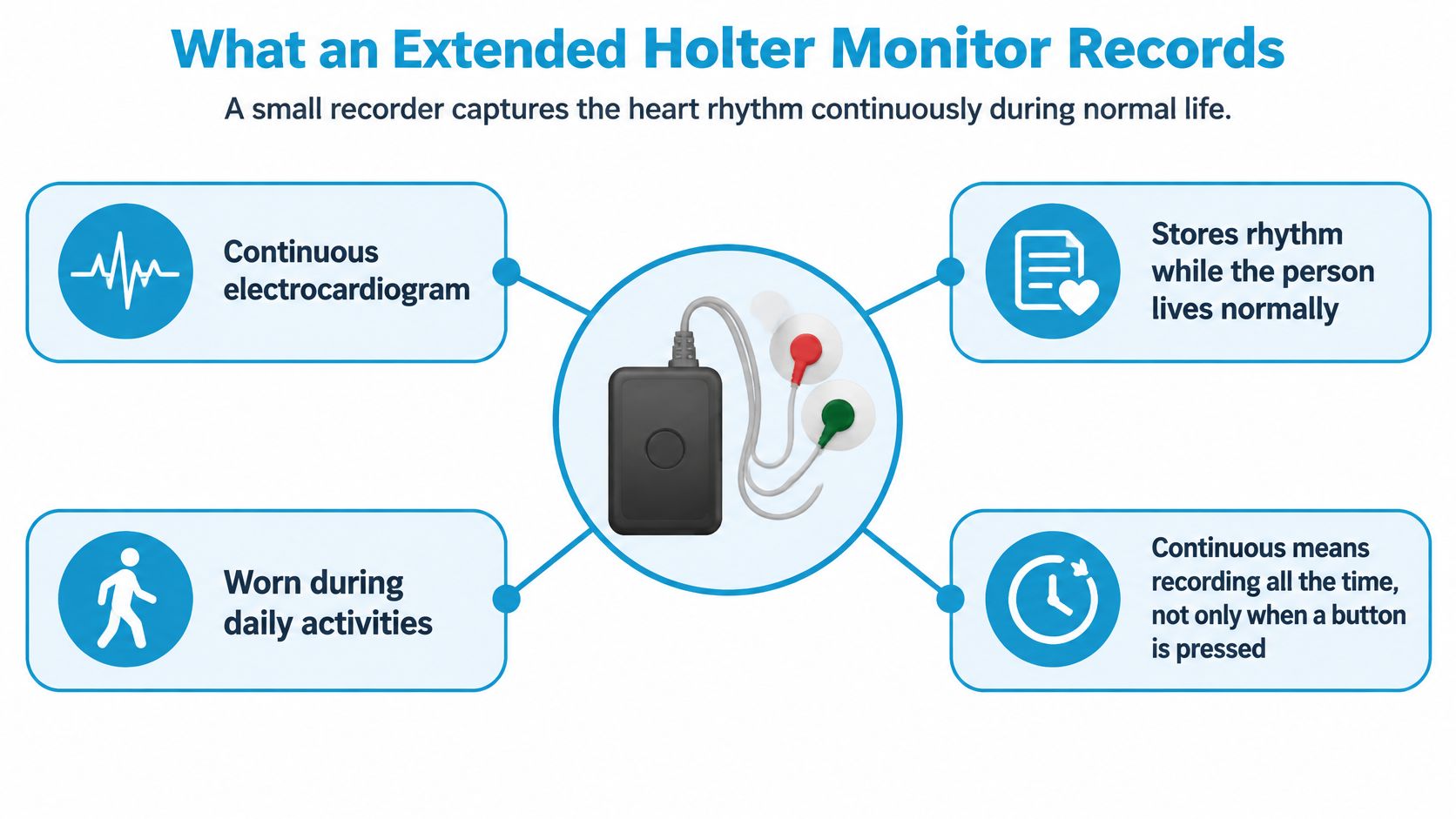
Several stickers on the chest, wires running to a small recorder at the waist, a return visit a day or two later: that is the classic Holter setup. The file it produces is a continuous electrocardiogram, a record of every beat while you live your life rather than a strip saved only when you notice something and press a button.
The newer version is usually a slim adhesive patch worn on the chest for roughly 7 to 14 days. A peer-reviewed comparison in the European Heart Journal of traditional 24-hour Holter monitoring against a 14-day adhesive patch found the patch was worn for a median of 11.1 days. You shower, sleep, climb stairs, and go to work while the recorder keeps a running ECG the whole time.
What the time-stamped tracing can show
The file can show heart rate, pauses, bradycardia, tachycardia, atrial fibrillation, other atrial arrhythmias, ventricular ectopy, and ventricular tachycardia. Every episode carries a time stamp, so the recording can be lined up against your day: what you were doing, when a symptom started, what the heart did next.
Symptom–rhythm correlation is often the most useful part of the file. When a symptom lands on the tracing, the reviewer can see which rhythm was playing at that exact minute. Sometimes that is an arrhythmia. Sometimes it is a fast rhythm that is still electrically normal, which is real but is not an arrhythmia diagnosis. Because the recorder runs whether or not you feel anything, it also captures rhythms that pass unnoticed, the kind a button-only event monitor would miss.
The recording works like a security camera on a doorway: it shows what passed through and when. If you felt faint because you stood up too fast, were dehydrated, or had a normal sinus-rate rise, the tracing can show the rate. It cannot show the reason you stood up.
Where the extra days earn their keep
More days of wear mean more kinds of ordinary days inside the file: workdays and weekends, exertion and rest, waking hours and sleep. Symptoms that only appear now and then get more chances to happen while the recorder is running, and anything that does occur lands in the record with a time stamp instead of a guess from memory.
The limit stays the same on day two and on day twelve. The file observes the rhythm and documents it. It does not treat the rhythm, and it cannot settle why you felt unwell on a day when the tracing looks ordinary.
If you want the wider family of ambulatory tests, including how a short Holter, a patch, and an event recorder differ in clinic practice, our guide to ambulatory cardiac monitoring walks through that choice without treating every device as the same test worn longer.
Wearing the Patch From Day One to Return
The visit itself is mostly logistics. Each step protects either the signal or the story you'll want later.
- Skin is cleaned, and sometimes shaved, so the adhesive sits flat. Oil, lotion, and hair lift the edge. A lifted edge is how a clean ECG turns into noise.
- The patch or electrodes go on the chest and the recorder starts a continuous file. From that moment the clock is the device's clock, not your memory of when a spell "sort of" began.
- You learn the symptom button and a simple diary. Time, activity, and what you felt are enough. A button press without a line in the diary is harder to interpret than both together.
- You go home and keep ordinary routines, including sleep, stairs, and work, unless the clinic names a restriction. The point is your real week, not a quiet day on the couch.
- You press the button and jot a line when palpitations, dizziness, chest discomfort, or near-fainting start. Press at the beginning, not after the feeling has already faded.
- Showers follow the device instructions. Many patches tolerate careful washing and not soaking, scrubbing, or peeling the edge "just to check."
- If the patch lifts, press it back or call the clinic. Don't decide on your own that the study has restarted. A gap you hide looks, on the report, like a heart that paused.
- On the end date you return or mail the recorder so the file can be downloaded. A patch left in a drawer is a test that never got read.
What shortens the usable file
Itch or rash, a detached edge, and a noisy signal from movement or poor contact all cut usable time. A prescribed 14 days may contain fewer clean days than the calendar suggests. Tell the clinic about a day the patch was off or flapping. That honesty keeps a gap from being read as a rhythm.
Diary lines should name posture and activity in a few words: stood up, walking, lying in bed, after lunch. That context is what lets a reviewer connect a symptom to the tracing. "Felt weird" doesn't.
Pack the recorder, the diary, and a list of medicines taken that week. Include anything you started or skipped, not only the usual prescriptions.
Why Extra Days Catch More Rhythms
The value of an extended recording depends on how often symptoms occur. A rhythm that appears every day may show up quickly; an episode that comes only occasionally may require more days of observation. Longer monitoring widens the chance of capturing one, but it cannot guarantee a finding.
| Monitoring window | Typical diagnostic yield compared with 1 day | What the comparison means |
|---|---|---|
| 7 days | About 2 times as high | More time to capture intermittent rhythms |
| 14 days | About 2.5 times as high | A further increase when symptoms are less frequent |
| 1 to 7 days, across referral categories | 1.7–2.8 times as high | The size of the increase varies by reason for referral |
| 1 to 14 days, across referral categories | 1.9–4.2 times as high | Some referral groups gain more than others |
| 1 to 14 days, for intermittent symptoms | At least 3.4 times as high | Includes chest pain, unexplained tachycardia, palpitations, syncope or collapse, and dizziness |
The shape of the curve
A seven-day study found that about a third of significant arrhythmias appeared in the first 24 hours, while 41% were first detected after day three. If a rhythm comes and goes, a normal first day cannot rule it out.
Most of the additional yield arrives during the first week. Days 8 to 14 can still capture less frequent events, so the added value depends on how far apart the symptoms are. A second week may help when episodes are widely spaced; it adds less when a clear rhythm has already been recorded during symptoms.
A 2023 extended Holter analysis in the European Heart Journal reported diagnostic yield approximately twice as high at 7 days and 2.5 times as high at 14 days compared with 1 day. Across referral categories, extending from 1 to 7 days increased yield by 1.7–2.8 times, and extending from 1 to 14 days increased it by 1.9–4.2 times. For intermittent symptoms, the 1-day-to-14-day improvement was at least 3.4-fold. These comparisons describe how often monitoring found a rhythm, not whether every recorded rhythm explains a symptom or establishes a diagnosis.
What a negative file doesn't prove
An extended recording is most useful when it links the time of a symptom to the heart's rhythm. If a person feels a racing heart and the tracing shows sinus tachycardia, the fast rate is real, but that finding alone is not an arrhythmia diagnosis. It may answer whether an abnormal rhythm was present during that episode, while leaving the reason for the symptom unresolved.
A negative file means no relevant rhythm was captured during the usable recording period. It does not prove an episode will never happen. More days increase the opportunity to record an intermittent event, but the result still depends on whether one occurs while the monitor is being worn.
How Clinicians Use the Rhythm Report
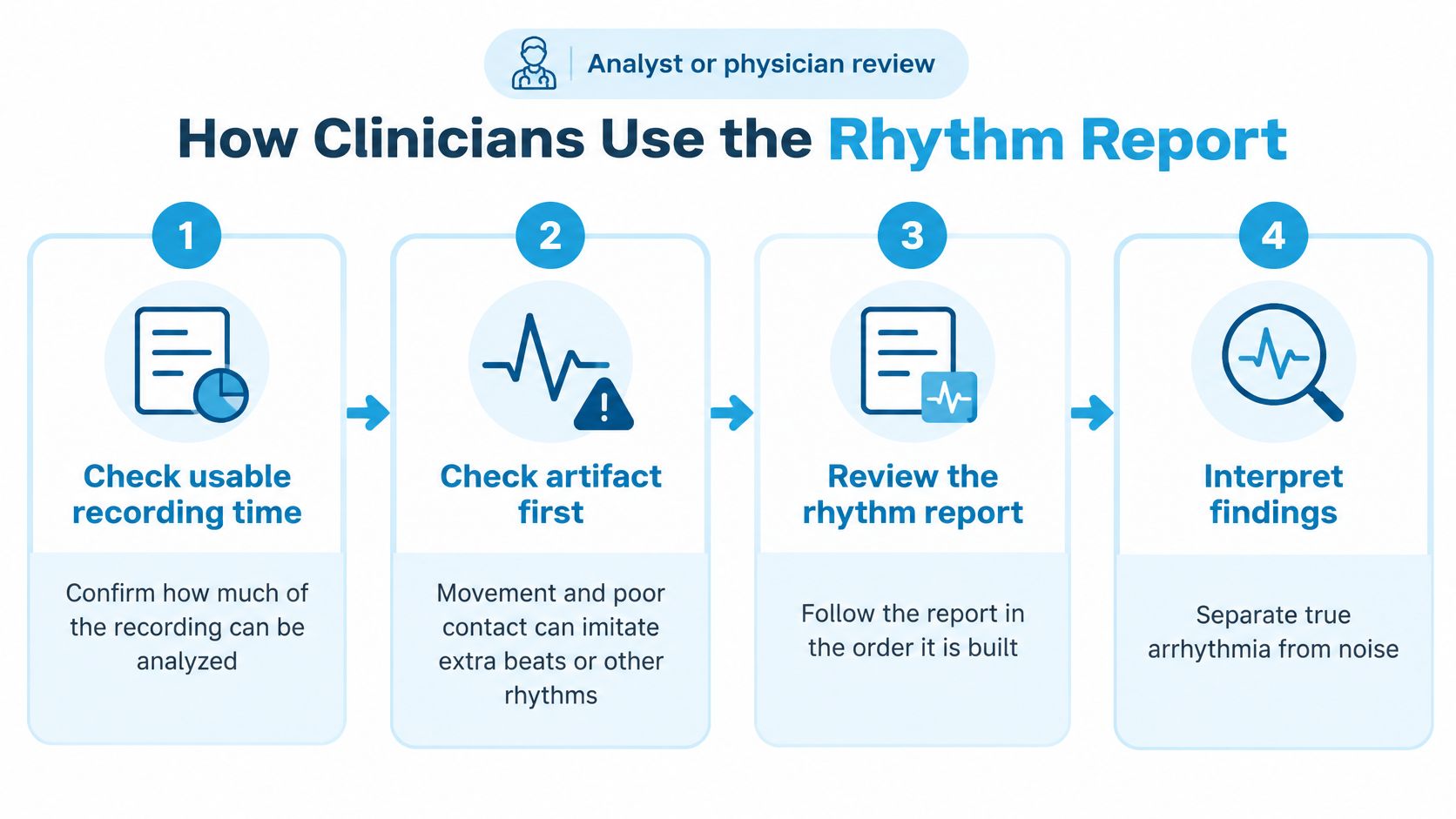
The report is built in a sequence. Skipping ahead to the word "normal" or "atrial fibrillation" misses the checks that decide whether that word is trustworthy.
Signal first, then the strips
The analyst or physician starts with usable recording time and artifact. Movement and poor skin contact can imitate extra beats or pauses. A stretch of flat line from a peeled patch is not a cardiac arrest. A noisy hour on the stair climber is not a run of ventricular tachycardia until someone looks at the shape of the beats.
Next they look for pauses, slow rates, atrial fibrillation or flutter, other atrial runs, and ventricular tachycardia. For each one they note how long it lasted, how fast the ventricles went, and what the QRS shape looked like. A few seconds of atrial fibrillation at a controlled rate is not the same finding as a sustained episode with a very fast ventricular response. Both fast and slow rhythms can be the reason a longer file mattered. A pause you never felt can be as important as the palpitation you circled in the diary.
Match the marker, then sort the decision
Symptom markers get matched to those strips. A button press during sinus rhythm is a different result from a press during atrial fibrillation. Incidental extra beats are separated from rhythms that need a call. Plenty of adults have occasional premature beats that don't explain a collapse and don't need emergency treatment.
These are examples of how findings get sorted, not personal medical advice:
- Urgent review is the path when the file shows a long pause or sustained ventricular tachycardia. Timing of that call comes from the ordering clinician, not from rereading the summary at home.
- An anticoagulation conversation can follow when atrial fibrillation is newly documented. The recording shows that the rhythm occurred. The decision about blood thinners uses your stroke risk, bleeding risk, and history.
- Reassurance, or a different workup, fits when every symptom marker lines up only with normal sinus rhythm and the rest of the file is free of actionable arrhythmia. The symptoms can still be real.
Bring three questions to the review. Did any symptom marker land on an abnormal rhythm? How much of the prescribed time was clean signal? Does a normal file close the question, or does it only reduce concern for arrhythmia?
The recording is evidence for the clinician who knows your history. It isn't a self-read diagnosis. Ask when the full report is expected, and whether you'll receive the raw tracing or only a summary. Results often arrive after the patch is already back in the clinic.
When a Normal Tracing Leaves Symptoms
A normal extended Holter can be useful and still leave you symptomatic. That isn't a contradiction. The test is chosen when an arrhythmia is suspected. Over the days it was worn, a clean file can lower concern for pauses, atrial fibrillation, and ventricular tachycardia. It doesn't certify that your dizziness has a harmless cause.
The Heart Foundation's professional guidance on POTS notes that Holter monitoring is used when an arrhythmia is suspected, while wearable heart-rate data should not be used alone to diagnose POTS. An extended Holter can identify tachyarrhythmias, bradyarrhythmias, pauses, and symptom–rhythm relationships. It generally doesn't establish postural orthostatic tachycardia syndrome, and it doesn't explain every episode of sinus tachycardia.
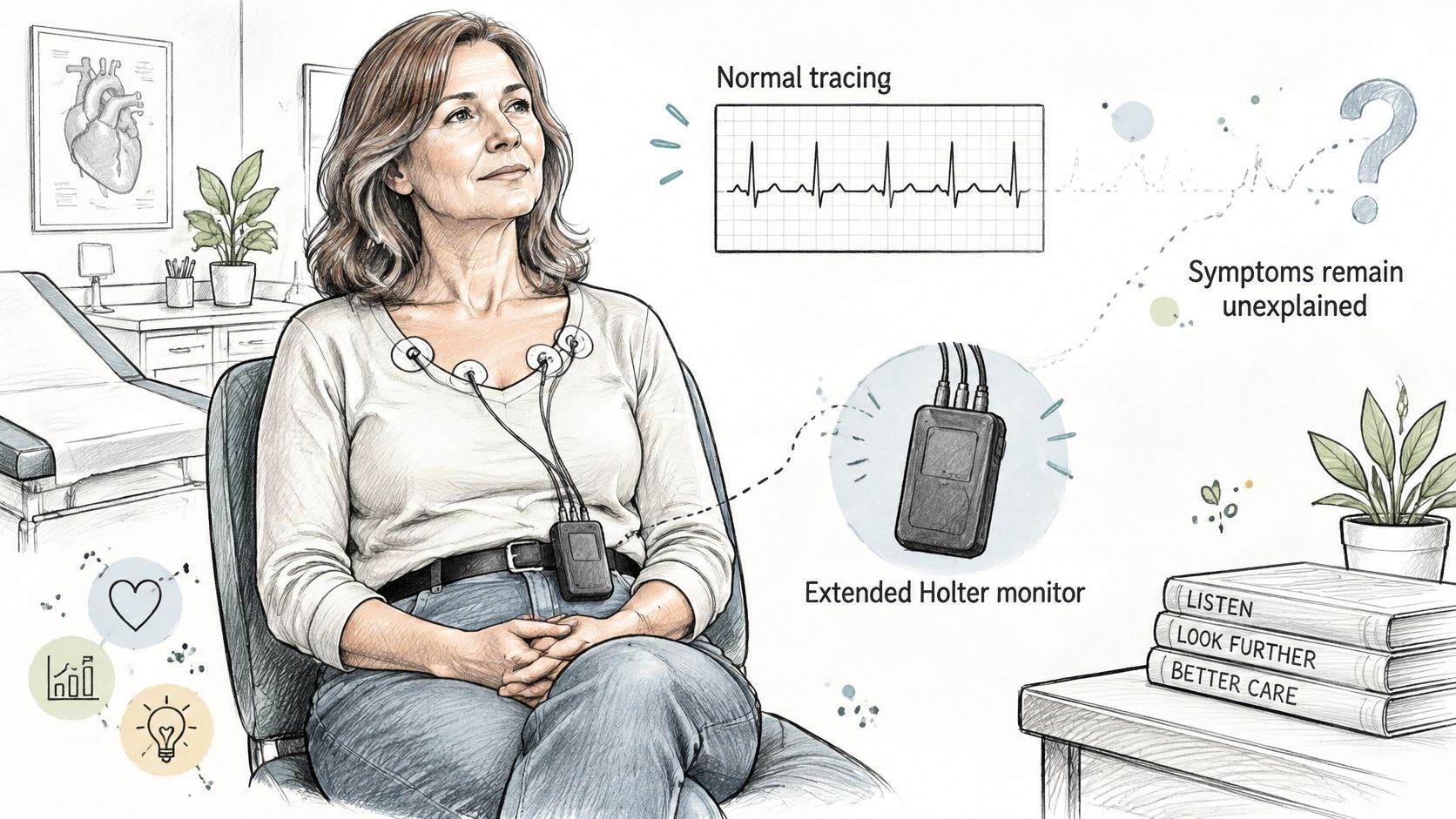
Sinus tachycardia is a rhythm, not a verdict
Picture someone who gets dizzy and fast within a minute of standing. The report may be full of sinus tachycardia, a normal electrical pattern running at a high rate. That is neither proof that nothing is wrong nor proof of a dangerous arrhythmia. The file usually has no standardized standing test. It rarely records posture, hydration, salt intake, sleep, medicines, or whether the rise happened outside exercise.
A "normal" stamp often means "no arrhythmia we treat as a primary electrical problem." It doesn't mean the heart-rate change was imagined. If you want a plain-language look at what an electrical tracing can and can't show, our explainer on whether an EKG shows heart problems separates rhythm findings from the many symptoms a single tracing leaves open.
Gaps that survive a long wear
Three practical limits keep a normal report from closing the chart:
- Symptoms on days the patch was off were never recorded. A spell the morning after removal isn't in the file.
- Episodes rarer than the wear window can hide for the entire study and still be genuine.
- Lost signal from skin irritation, detachment, or movement shortens the clean recording, so "14 days prescribed" may be fewer days analyzed.
Heart-rate numbers from consumer hardware can be incomplete, delayed, or inaccurate, particularly during movement or poor sensor contact. We treat Cardiogram as an information tool, not a medical device. It doesn't diagnose anything or replace a doctor. A 30 bpm rise, and a 40 bpm rise for ages 12 to 19, are reference points we use, not diagnostic criteria.
If your spells track with standing, the next clinical question is whether an autonomic evaluation belongs beside the rhythm result, and whether anyone has looked for the cause of the sinus-rate change. The normal tracing did a job. It didn't finish the visit.
Prepare the Follow-Up With a Clear Record
The days after the recorder comes off are when a vague memory turns into a usable appointment. Bring the diary, the medicine list, and one sentence on how often spells happen in a typical month. That sentence is the same one you used to pick the monitor, and it still matters when the result is negative. A study that recorded no spells may have been worn on the wrong days, and your frequency count is how the clinician sees that gap.
Ask four questions, in this order:
- Did any symptom marker match an arrhythmia? A yes or no here changes the rest of the conversation. It also separates an arrhythmia from a fast but ordinary sinus rhythm, two findings that can feel identical from the inside.
- How many clean days were recorded? Four days of noisy signal reads as a four-day study, whatever the prescription said.
- Does a negative study mean stop, repeat with a longer event monitor, or look for an orthostatic cause? Those are different plans, and convenience shouldn't pick among them.
- When will the full report be available, and will you see a summary or the tracing? Waiting without a date invites you to reread symptoms as if they were a diagnosis.
Keep logging time, posture, and activity while you wait. The habit that made the Holter diary useful still pays off if the next step is an event monitor, a standing evaluation, or another ECG. A symptom journal keeps each line short enough that you'll write it. Three facts per spell are enough: what you were doing, whether you were upright, and what you felt.
Between visits, Cardiogram can serve as an optional companion for people with POTS and dysautonomia, keeping a heart-rate record that sits beside the formal test.
If you faint, have chest pain, or a sudden severe spell, contact urgent care or the ordering clinician. Don't wait for a summary to decide whether that spell can wait.
An extended Holter answers a rhythm question for the days you wear it. The weeks between visits are a different record. If you want a log for those weeks, visit Cardiogram.