You read the same sentence three times. You walk into a room and lose the reason you went there. You know the word you want, but it won't arrive on time. That's the everyday shape of POTS brain fog for many people, and it's not a simple story where a faster pulse always means slower thinking. A cloudy hour can follow standing, linger after you've sat down, or show up on a short night when your pulse looks unremarkable.
How Common POTS Brain Fog Is and What It Costs
Say it's a school morning. A student gets through breakfast standing in the kitchen, rides to class, then opens a textbook and can't hold a paragraph together. She isn't just sleepy. She keeps losing her place, forgetting instructions, and pausing mid sentence because a familiar word feels out of reach. By afternoon she's reread the same assignment twice and still can't summarize it.
That pattern showed up at striking scale in a 2013 symptom survey in Clinical Autonomic Research, where 132 of 138 respondents, 96%, reported experiencing brain fog at least once, and 93 participants, 67%, experienced it daily. The respondents were ages 14 to 29 years, and 88% were female. Those numbers need one caveat in the same breath. This was a symptom survey, not a population based count of every person with POTS, so 96% isn't your lifetime risk. It's a signal from a young surveyed group that foggy thinking was common, frequent, and disruptive.
What People Meant by Fog
The words matter because they separate cognition from plain tiredness. People most often chose "forgetful" and "cloudy", and described difficulty focusing, thinking, or communicating. A tired person may want to rest. A foggy person may rest and still lose the thread of a conversation, switch tasks slowly, or blank on something they knew yesterday.
Brain fog frequency, daily cost, and named triggers
| What people reported | Share | Day-to-day meaning |
|---|---|---|
| Brain fog at least once | 96% (132 of 138) | A thinking complaint, not only tiredness |
| Daily brain fog | 67% (93 of 138) | Most surveyed days include cloudy thinking |
| Words used for it | Most often forgetful, cloudy, hard to focus, think, or communicate | Cognitive, not a vague fatigue label |
| Schoolwork harder | 86% | Classes and assignments take longer |
| Work productivity down | 80% | Tasks and communication slip |
| Social life affected | 67% | Plans and conversations are harder |
| Fatigue as a trigger | 91% | Fog clusters with being worn out |
| Lack of sleep as a trigger | 90% | A short night often precedes a foggy day |
| Prolonged standing | 87% | Time upright is a common spark |
| Dehydration | 86% | Low fluid intake shows up with fog |
| Feeling faint | 85% | Near-fainting and fog often travel together |
Read the table as a mirror, not a test. Circle the rows that match your last foggy week, especially the trigger that sat closest to the start. Was it a short night, a long line, low fluids, feeling faint, or plain exhaustion stacking up over several days? That timing question is more useful than asking whether fog counts as real. For the people surveyed, it already interfered with school, work, and social life.
Try this tonight: Write one line about your last foggy stretch, naming the closest trigger and the task that got harder.
How Autonomic Changes Reach Thinking and Linger
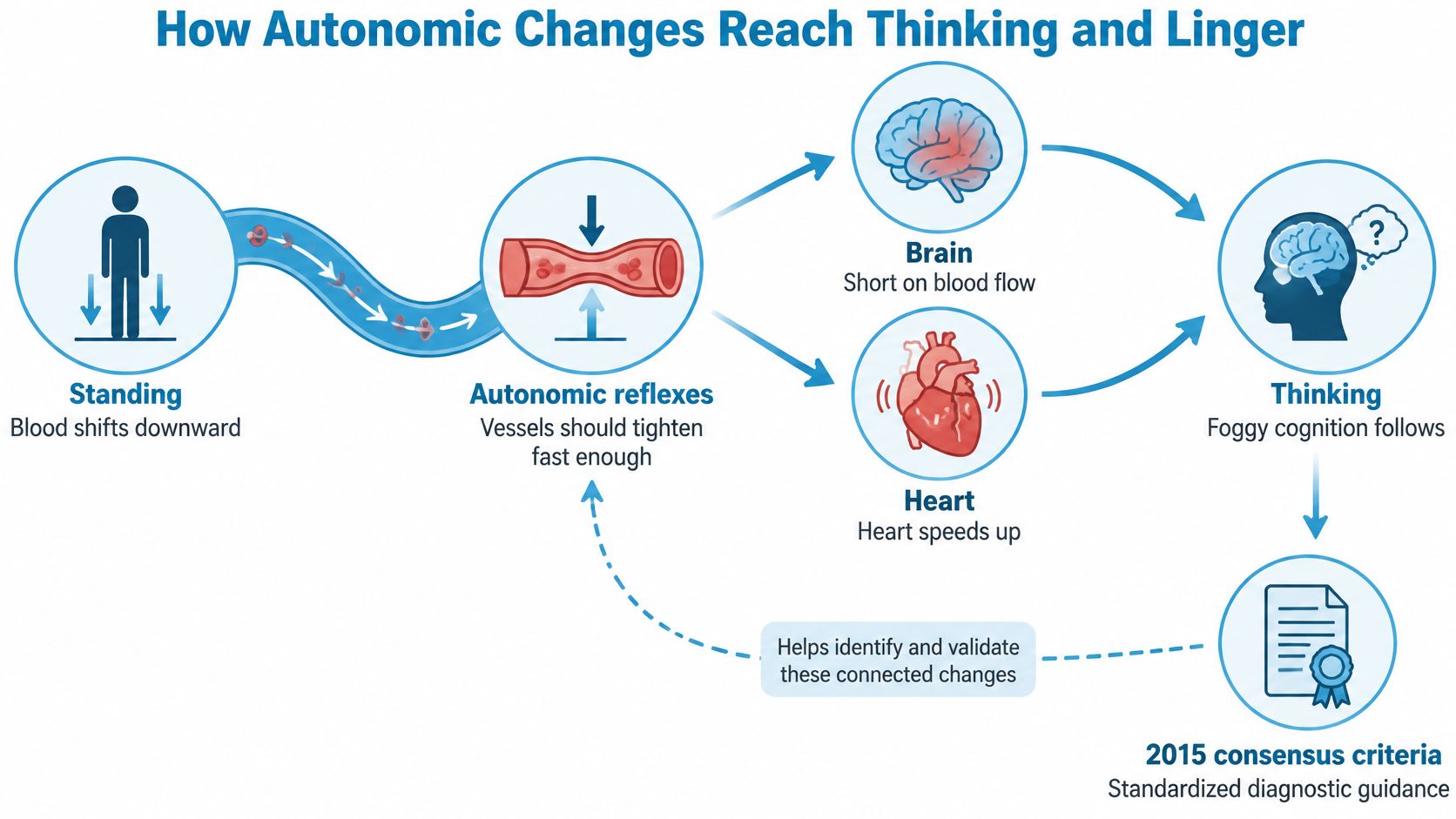
Blood moves through your vessels the way water moves through a garden hose: pressure, gravity, and any pinch points decide how much reaches the far end. When you stand, gravity pulls blood toward your legs and belly, and your autonomic nervous system should answer within seconds by tightening vessels and adjusting heart rate so enough blood keeps reaching the brain. That same background system also runs digestion, sweating, and other automatic jobs. If you are new to the wider category, a plain language overview of what dysautonomia symptoms can include can help place POTS in context.
In POTS, that upright adjustment misfires in a recognizable way. Blood pools lower in the body, the brain can run short, and the heart speeds up to compensate. A review of cognitive dysfunction in POTS summarizes the 2015 consensus criteria, which generally define adult POTS by an orthostatic heart rate increase of at least 30 beats per minute within 10 minutes of standing, without orthostatic hypotension. That definition captures a heart rate and blood pressure pattern. How clearly you think at minute three, minute ten, or an hour later is a separate question the criterion leaves open.
What Objective Tests Add
Fog shows up in lab measurements as well as in daily complaints. The same review describes case-control testing in which 87 people with POTS scored lower than 39 controls on executive function, with mean t scores of 48 ± 11 versus 55 ± 10, p = 0.009, along with blood-flow work in which cerebral blood flow velocity fell by about 7.8% in POTS participants compared with 1.8% in controls during sustained cognitive stress.
Executive function is the mental traffic control you use to plan, prioritize, switch tasks, and hold steps in order. A lower score reflects how the organizing part of thinking performed under test conditions, separate from overall intelligence. That maps onto everyday complaints like losing a train of thought when someone interrupts you, or needing extra time to move from email to a phone call and back.
The blood-flow result adds a second layer. Sustained mental effort itself appears to strain regulation, which helps explain why a long exam, a dense meeting, or an hour of concentrated reading can feel like hitting a wall. Upright posture is one demand on the system. A hard cognitive task is another, and the two can stack.
Why Lying Down Doesn't Always Clear It
Many readers trip on the next point. If standing triggers fog, lying down should switch it off, right? Sometimes it does. Blood no longer has to fight gravity in the same way, the pulse settles, and words come back within minutes. Other times thinking stays slow into the next class, the drive home, or the evening, even while the wearable shows a calmer number. A settled pulse describes your circulation in that moment, not the state of your concentration.
Imaging work gives one reason a calm reading can be misleading. A Medical Xpress report on a SPECT study of 56 POTS patients with severe brain fog described reduced blood flow in key brain regions in 61% of participants, even while lying down. The finding falls short of proving that reduced flow caused every person's fog, and SPECT imaging is a hospital tool rather than a home check or a self-diagnosis route. It does challenge the tidy idea that brain supply is fine whenever you are flat and impaired only while you stand.
Recovery also depends on what stacked up before you sat down. A short night plus a long stand plus low fluids is a heavier load than a brief stand after good sleep, so there is no honest universal recovery clock. One stretch may lift in minutes. Another may need food, fluids, rest, or sleep, with the exact plan set by your clinician. If thinking still feels unsafe or unreliable, let that experience overrule a normal-looking pulse for driving, exams, or detailed work.
Ask yourself which pattern sounds familiar. Does your fog usually rise while you are upright and fade soon after you sit, or does it linger after your pulse settles? That split, posture-triggered versus lingering, is one of the most useful details you can record.
When a Big Pulse and Heavy Fog Split Apart
It's tempting to use your watch as a fog forecast. Big spike, bad thinking. Small rise, clear head. A 2024 study of youth with POTS and chronic pain in the Journal of Child Neurology pushes against that shortcut. It found that self reported autonomic symptom intensity, not the magnitude of the heart rate change, was associated with cognitive performance. Depressive symptoms were also linked to poorer performance across most cognitive measures.
Those are associations in youth who also had chronic pain, not a new diagnostic cutoff for everyone. Still, the practical lesson is broad. Heart rate data alone can't explain brain fog. Your pulse is context for a window of time, not a grade for your brain during that window.
A Paired Example
Say a student stands in a grocery line and sees a 45 beat rise from her seated baseline. She feels shaky and hot, grips the cart, but can still text a coherent list to her roommate. The next evening, after a short night and a painful day, she's seated at her desk. Her pulse is only about 10 beats above her usual baseline, yet she can't follow one paragraph or remember why she opened a document. The second episode is the heavier fog, even though the first had the larger number.
That discordance matters for teens and young adults in particular. A cloudy day can be filed too quickly as anxiety, low effort, or just POTS. Any of those labels may miss sleep loss, pain, mood, medicines, or fatigue sitting in the same day.
What each signal does and does not explain
| Signal to record | What it can show | What it does not prove |
|---|---|---|
| Size of the heart-rate rise | One contextual clue during that window | A bigger spike means worse thinking that day |
| Self-reported autonomic symptom intensity | Linked with cognitive scores in a 2024 youth study | A diagnosis by itself |
| Depressive symptoms | Poorer scores on most cognitive measures in that study | That mood is the whole explanation |
| Sleep loss and fatigue | Fog often clusters with a short night or being worn out | That the autonomic system was quiet |
| Pain and medicines | Other drivers worth naming on the same day | That POTS is irrelevant |
| Upright tachycardia with clearer thinking | Discordance is possible | That either finding should be ignored |
| Heavy fog with a modest pulse change | Cognition can slip without the largest rise | A reason to stop tracking heart rate |
Use the table to widen the frame, not to throw out heart rate. Keep the pulse, posture, and upright duration. Then add symptom intensity, mood, sleep, pain, hydration, and medicines beside them. After two weeks, you should be able to answer one clear question. Were your worst thinking days also your highest pulse days, or did they split apart?
A mismatch between pulse and thinking isn't failed tracking. It's often the most informative pattern in the log.
Strategies to Reduce Fog Episodes
Every option below is a lever to test with your clinician's guidance, and the fairest test changes one thing at a time. Each lever works like a dial on a mixing board: adjust fluids, salt, activity, and sleep in the same week, and you cannot tell which dial improved the sound. Record whether fog episodes grow less frequent, less intense, or quicker to recover from. A settled pulse is not the finish line either. A change can calm your heart rate while thinking stays slow, and that gap is still worth writing down.
Fluids deserve a careful explanation. In a Frontiers in Neuroscience study of neuropathic POTS, water intake reduced norepinephrine and heart rate and was accompanied by improved symptoms and cognitive performance. Norepinephrine is a stress-related chemical messenger, and in that study it was high even independent of body position and rose excessively when upright. The finding supports a link between fluid volume, adrenergic load, and cognition. It does not prove hydration alone clears fog, and it cannot set your personal fluid or salt target, which is why your numbers belong in a clinician conversation.
Match the Lever to Its Limit
Posture is usually the fastest first response when fog builds while you are upright. Sit or lie down, especially if you feel faint, and do not try to prove you can push through a line, a lecture, or a shift. Then plan for the second phase, because the pulse often settles before the thinking does. If you are still cloudy while flat, the better move is a quieter task, a break from rapid switching, or help getting home, rather than an immediate return to demanding work.
Sleep and standing need structure more than willpower. In the survey discussed earlier, short nights, exhaustion, and long stretches upright were among the most frequently named triggers, and both are hard to fix alone. A regular wake time, a wind down that protects your sleep window, sitting for part of a job, or splitting a long stand into shorter blocks may take a written school or workplace plan. Bring that request to your clinician with a concrete example. "I lose the thread after standing through a full lab session" gives them more to work with than "standing is hard."
Mood and medicines belong in the same conversation. Low mood can worsen attention and memory, and some medicines add grogginess or slow processing. Raise mood openly at your visit instead of treating it as a separate problem, and ask for a review that weighs each medicine's benefits, timing, and alternatives. Do not stop or adjust a medicine on your own to test the theory.
Pick one lever for the next two weeks and write it at the top of your log. Judge it by the fog pattern as much as by heart rate: a lever can steady the pulse while fog lingers, and learning that is progress too.
How to Log One Foggy Stretch
Log one stretch at a time, while details are fresh, and keep the entry short enough to finish on a bad day. You're building pattern evidence, not writing a diary. A simple notes app works, and a structured chronic illness symptom tracker can help if loose notes keep scattering across your phone.
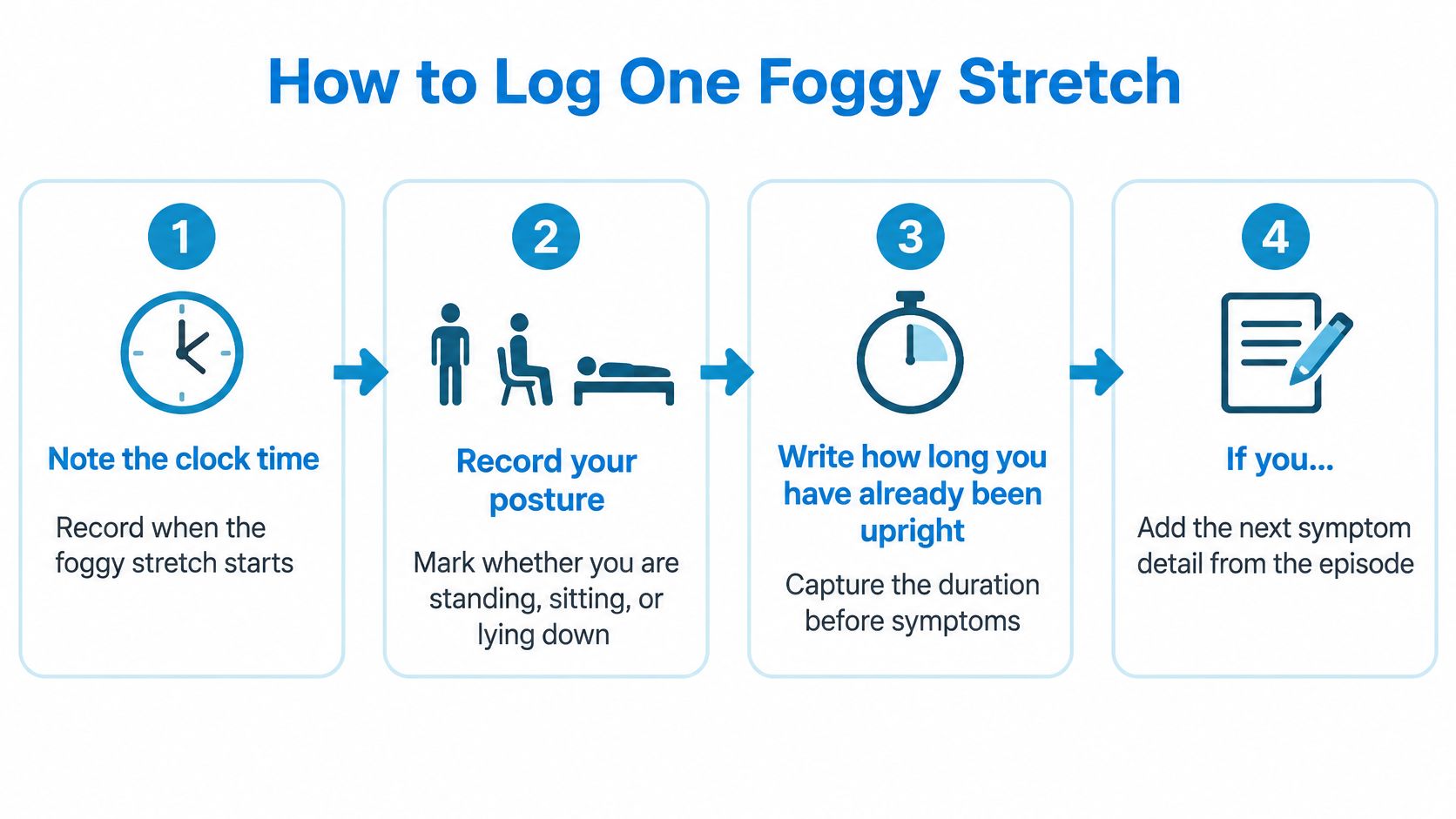
Note time and posture: Write the clock time, whether you're standing, sitting, or lying down, and how long you've already been upright. Posture plus duration is the field people most often skip, yet it separates a brief stand from a long upright load.
Record heart rate context: If you wear a watch, note the rate before the change, the peak, and roughly how long it stayed up. A sustained rise over minutes tells a different story from one odd beat while you adjust your strap. If you don't have a reading, write "not captured" rather than guessing.
Score the fog in one line: Choose the closest words, such as forgetful, cloudy, slow to switch tasks, or hard to speak. Name the task you were doing, for example reading, driving, answering questions, or following a meeting. A task makes the symptom concrete in a way a number from one to ten can't do alone.
Add same day context: Record last night's sleep, fatigue, fluids, salt intake if your clinician has you track it, pain, mood, and medicines taken that day. Keep it brief. "Short night, headache, low fluids, morning medicine taken" is enough to spot clusters later.
Track what happened after you sat or lay down: Note whether thinking improved within minutes, later the same day, or not at all. This recovery note is the step that captures lingering fog. Don't rewrite the entry hours later to make it tidier. Add a second timestamp instead.
Mark exercise separately: Note workouts and the recovery window after them. An exercise pulse shouldn't be filed as an orthostatic episode, and post exercise fatigue may explain a cloudy hour that would otherwise look random.
Do this on clearer days too, for about two weeks. Clear day entries can be one line with sleep, posture demands, fluids, and "thinking steady." Without them, every record looks like a bad day and you can't see what a better day had in common. With them, a mismatch between pulse and thinking can show up plainly.
One line is enough: "2.40 pm, standing 25 minutes in lab, pulse rose and stayed up, cloudy and slow switching, short night, sat down, clearer much later."
Don't invent a personal cutoff from small lab studies. Your log isn't a self diagnosis and it shouldn't be used to change medicines, salt, or fluids alone. It's a readable record of timing, posture, recovery, and context that a clinician can interpret with you.
Bring the Two-Week Log to Your Visit
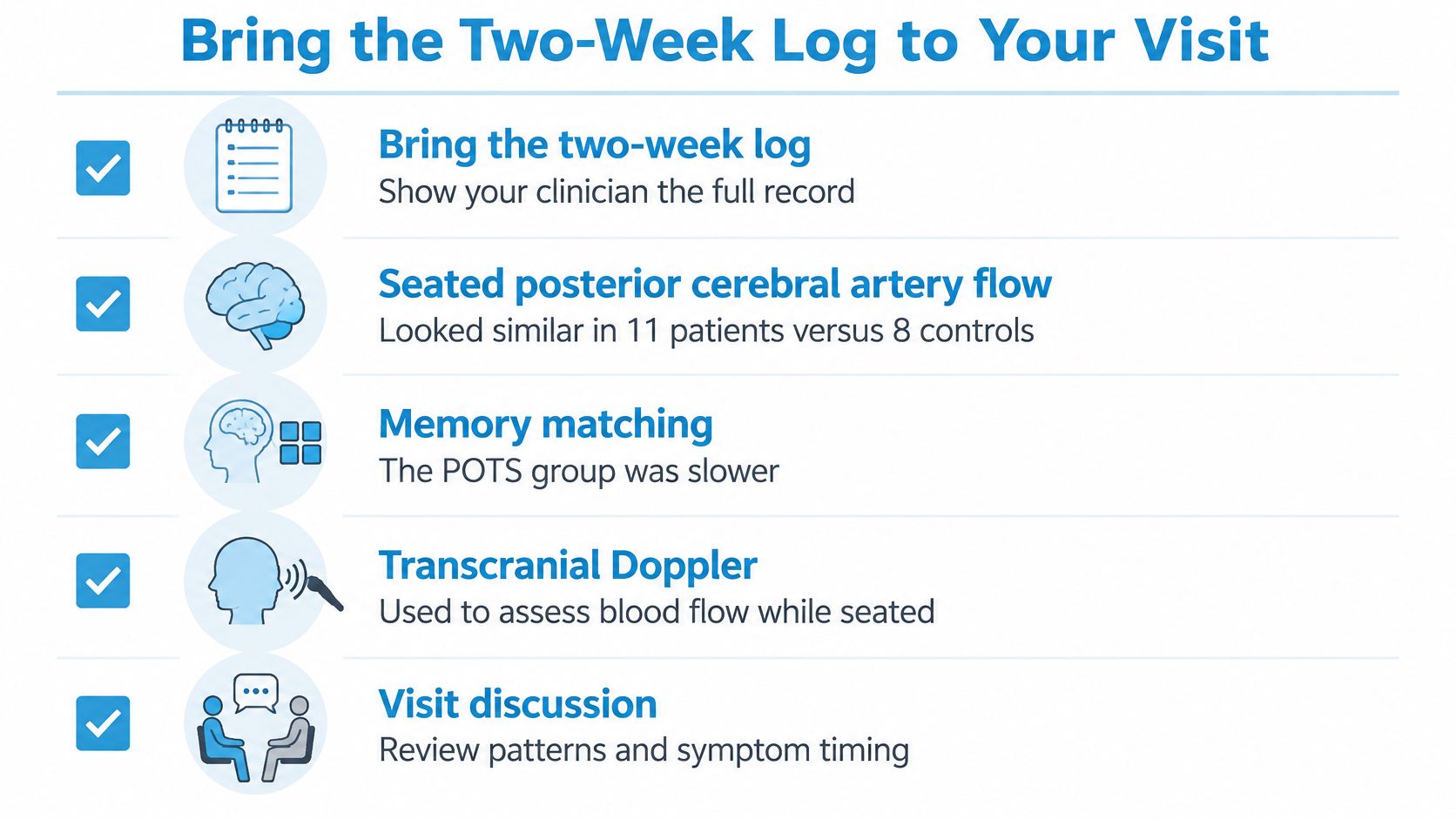
A normal snapshot in the clinic chair can miss the problem. In a controlled study in Frontiers in Neuroscience, transcranial Doppler measurements of posterior cerebral artery blood flow were similar while participants were seated in 11 patients with POTS and 8 healthy controls, yet the POTS group still showed significantly slower delayed match to sample responses and more errors on an attention switching task. If your own seated numbers come back ordinary, open the log to your upright and recovery entries and ask for the cognitive side to be reviewed on its own.
That gap between blood flow and thinking is the reason your log splits episodes by posture. Mark fog during an upright tachycardic episode separately from fog while seated or lying down. Fog that happens upright and clears fast is one pattern. Fog that continues flat, clusters after short nights, or builds during sustained desk work is another. If both occur, bring both, because they point the visit toward different questions.
Turn Fourteen Days Into Five Lines
Before the visit, summarize the log so your clinician doesn't have to mine raw notes under time pressure. Good patient provider communication starts with a short pattern statement, then detail if they ask for it.
- Fog days: How many of the fourteen days included fog, and how many were heavy enough to disrupt school, work, driving decisions, or conversation?
- Usual posture: Did fog start mostly standing, seated, or lying down, and how long had you been upright when it began?
- Recovery lag: After sitting or lying down, did thinking improve within minutes, later that day, or not at all?
- Heart rate context: When known, what were the baseline, peak, and duration, and did the biggest rises match the worst thinking?
- Non pulse cluster: Which factors kept appearing on foggy days, such as short sleep, low fluids, pain, low mood, fatigue, or a medicine timing?
For readers who already use an Apple Watch, Cardiogram is built for people with POTS and dysautonomia. Every 30+ bpm rise within 5 minutes is logged with its baseline, peak, and duration, and you can add dizziness, palpitations, fatigue, and brain fog as symptoms as they happen, plus hydration, salt, sleep, medications, and how you feel, all comparable against your heart rate. A notes template with the same fields produces the same five line summary.
Know When Not to Wait
Seek care sooner, and urgent care when the symptom is sudden or severe, if you have fainting with injury, chest pain, sudden trouble speaking, one sided weakness, sudden vision change, or fog that is rapidly worsening. New confusion that doesn't resemble your usual pattern also deserves prompt medical assessment. Don't drive yourself if you feel faint or can't think clearly enough to track the road, signs, and other drivers.
Bring the summary, the raw log, and one sentence you can say aloud. "My worst thinking is not always my highest heart rate, and here's the two week split." That sentence respects what the pulse can show, names what it can't, and hands your clinician a pattern to work with. Your two weeks supply the record; your clinician supplies the interpretation.
Start your two week split today by pairing each foggy stretch with posture, recovery, sleep, hydration, and heart rate context, then bring the pattern to your clinician. If you use an Apple Watch, Cardiogram can log qualifying heart rate rises with baseline, peak, and duration while you add brain fog and same day context beside them. Visit Cardiogram to set up tracking before your next appointment, so your worst thinking days and highest pulse days can be compared side by side.