Postural orthostatic tachycardia syndrome (POTS) is clinically defined by what happens when you stand up: a sustained heart-rate jump of at least 30 beats per minute within 10 minutes of standing in adults, or at least 40 beats per minute in adolescents aged 12 to 19, according to a clinical review of POTS diagnosis and management that estimates the disorder affects roughly 0.1% to 1% of the population. Because diagnostic criteria focus on standing upright without a conventional drop in blood pressure, many newly diagnosed people expect their symptoms to switch off once they lie flat.
For those dealing with POTS and sleep, bedtime doesn't bring that relief. You might fall asleep quickly and still wake up exhausted, or lie awake for hours while your pulse thuds against the mattress.
Standard sleep advice often falls flat because it treats poor sleep as one generic issue. A far more useful approach separates overnight rest into three distinct variables: how long you sleep, how restored you feel on waking, and what your heart does overnight. Tracking all three in one simple log helps you spot repeatable patterns and walk into your next medical visit with sharp questions and a care plan you can test one change at a time.
How Common Sleep Problems Are With POTS
Yes, sleep trouble is one of the most frequent and draining complaints among people with POTS, and waking up feeling as though you never rested is strikingly common. You aren't imagining it, and you're far from alone.
In a 2016 clinical study and review of sleep disorders in POTS, 63.3% of 30 surveyed patients reported trouble falling asleep, while 62.1% reported difficulty staying asleep through the night. That same paper noted subjective excessive daytime sleepiness in 43.2% of participants in a polysomnography-based study, compared with 51% in earlier work. Across different surveys, the numbers paint a consistent picture of disrupted nights.
| Sleep complaint | Reported share | Source context |
|---|---|---|
| Difficulty falling asleep | 63.3% | 2016 survey of 30 patients with POTS |
| Difficulty staying asleep | 62.1% | 2016 survey of 30 patients with POTS |
| Not feeling rested on waking | 83.3% | Separate survey of people with POTS |
| Poor self-reported sleep quality | 98.4% | Large survey of respondents with POTS |
| Subjective daytime sleepiness | 43.2% (51% in earlier research) | Polysomnography-based study |
Why Reported Sleep Numbers Differ So Much
You might wonder why one group reports a complaint in roughly four out of ten people while another lands close to everyone in the survey. The biggest reason is that these figures come from self-reported questionnaires across very different sample sizes and measurement tools. A small clinic cohort answering a structured intake form won't always match a large community survey asking for an overall sleep rating.
Objective sleep testing adds another twist. In polysomnography research, patients' subjective daytime sleepiness wasn't consistently backed up by lab evidence of major sleep disorders or objectively measured sleepiness. That gap matters clinically because disrupted sleep often coexists with, and can intensify, daytime brain fog, noticeable palpitations, and heavy POTS fatigue.
Sleep trouble is a meaningful symptom clue to track, never a standalone diagnosis of POTS or proof of a specific sleep disorder.
Before moving on, grab a scrap of paper or open a note on your phone. Jot down which complaints in the table above match your typical week. Keep that short list handy, because matching your exact symptoms to a daily log is far more helpful than trying to fix vague "bad sleep."
Why Sleep Goes Wrong in POTS
Think of your body's heart-rate control system as a thermostat stuck on high alert. Your autonomic nervous system regulates heart rate, blood pressure, body temperature, and alertness in the background without conscious effort. In a healthy sleep cycle, that system eases off the gas at bedtime so your pulse slows and your body shifts into deep recovery. In POTS, the thermostat can keep firing as if you're standing upright even when you're lying flat under the covers.
Several overlapping physical triggers can keep your nervous system activated well past bedtime, as shown below.
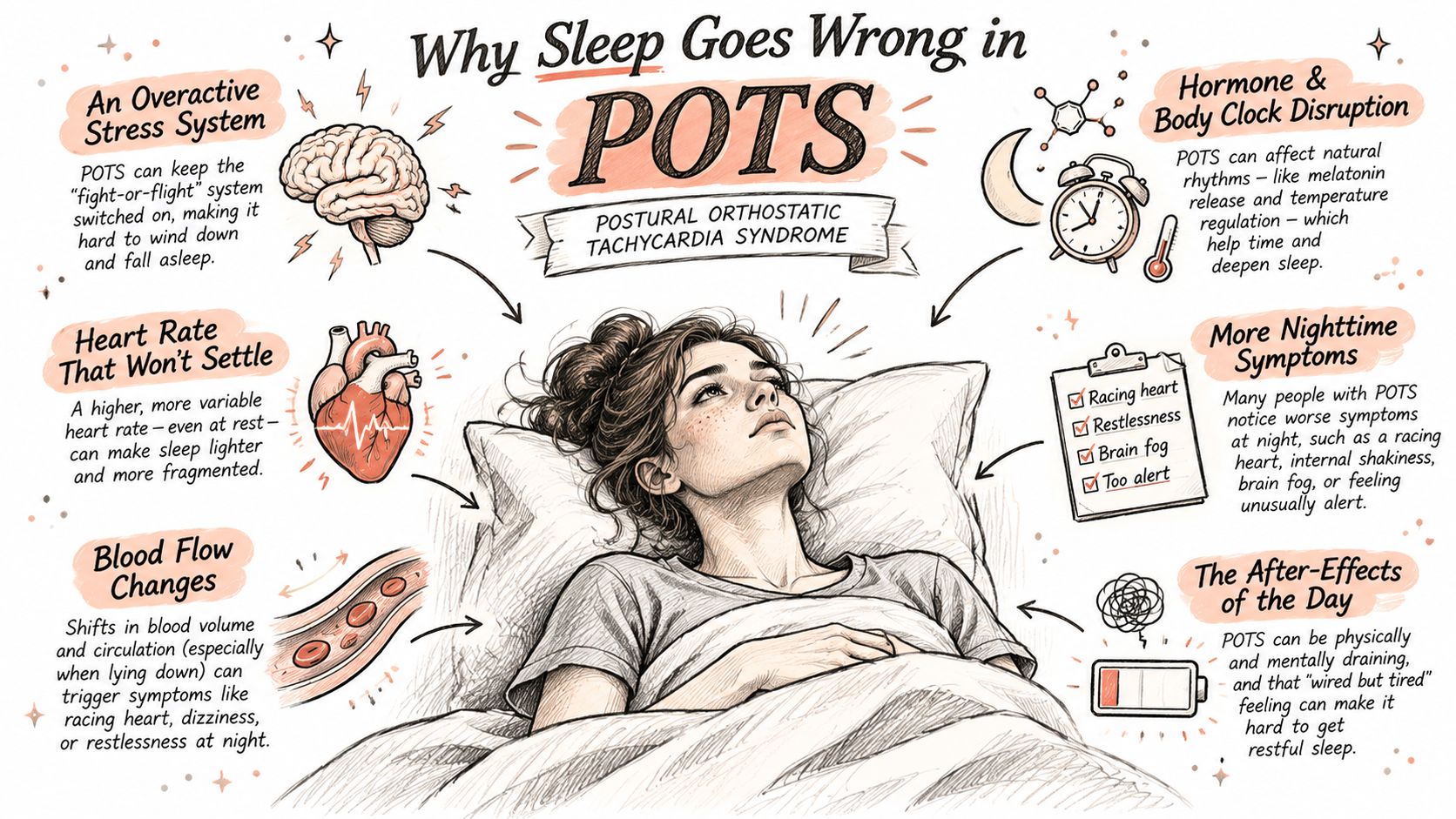
Because most public advice treats poor sleep as a simple habit problem, people with POTS are often handed the same checklist of generic sleep hygiene tips. Dim the lights, put away your phone, and drink herbal tea. Those steps rarely hurt, yet they don't explain why someone can follow every rule in the book and still wake up feeling flattened.
When Standard Sleep Tests Look Normal
One of the most frustrating experiences in POTS care is spending a night wired up in a sleep lab only to hear that everything looks normal. A polysomnography study published in the Journal of Clinical Sleep Medicine found no significant differences between POTS patients and healthy controls across sleep efficiency, sleep-onset latency, wake time after sleep onset, sleep stages, arousal index, apnea-hypopnea index, or periodic leg movements. Yet those very same patients reported heavy fatigue, early awakenings, nighttime awakenings, and insomnia.
Results also vary depending on who is tested. Other work cited in that paper found that 40% of POTS patients had diminished subjective sleep quality alongside altered sleep-stage distribution. A clean sleep lab report rules out classic obstructive sleep apnea or obvious limb-movement disorders, but it doesn't mean your exhaustion is imaginary. Several overlapping factors can leave sleep feeling unrefreshing even when basic sleep architecture appears intact:
- Autonomic symptoms and hypervigilance: Ongoing heart-rate swings, temperature shifts, or a subtle "tired but wired" state can keep your nervous system scanning for discomfort through the night.
- Physical pain: Joint aches, headaches, or muscle soreness frequently interrupt restorative rest without always registering as major arousals on a standard overnight graph.
- Medication effects: Drugs used to manage blood pressure, heart rate, mood, or daytime sluggishness can shift alertness, alter dreaming, or wear off in the middle of the night.
- Post-exertional crashes: Pushing too hard during the day can trigger a delayed recovery crash that leaves you both depleted and strangely unable to settle down after dark.
That is why chasing a single "POTS sleep score" on a smartwatch or app usually leads to confusion. Sleep isn't one metric. Separating how many hours you spent asleep, how restored your body feels on waking, and what your heart rate did overnight gives you and your doctor three clear dials to examine instead of one blurry number.
What to Track Each Night and Morning
A night can look generous on paper and still leave you dragging through breakfast. In an actigraphy and sleep-log study of people with POTS, participants showed reduced sleep efficiency and a trend toward more wake time after sleep onset, matching their reports of restless nights, nocturnal awakenings, and daytime fatigue. Yet their measured sleep-onset latency didn't differ from healthy controls, pointing toward possible sleep-state misperception, where you feel wide awake or poorly rested even though objective tracking shows you fell asleep in a typical window.
That finding explains why perceived sleep and measured sleep belong in separate columns. A consumer wearable's single sleep score can't diagnose a sleep disorder, and persistent loud snoring, witnessed breathing pauses, or overwhelming daytime sleepiness always warrant a formal medical evaluation because POTS and independent sleep disorders can coexist.
To build a clean picture across two weeks, pair a quick evening check-in with a two-minute morning review, outlined in the daily checklist below.
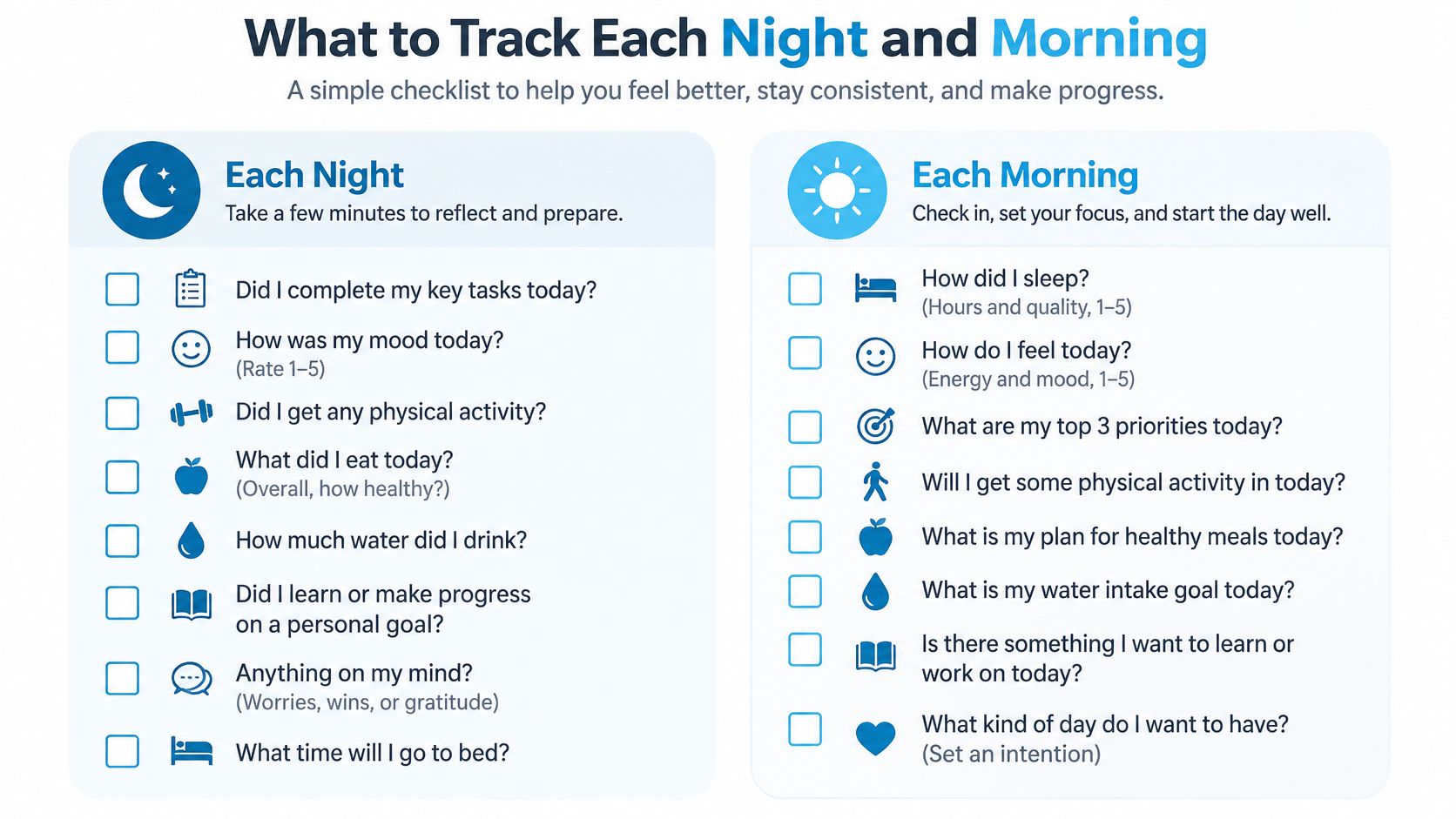
Use the template below to capture the exact variables clinicians find most helpful.
| What to record | Why it matters | Example entry |
|---|---|---|
| Bedtime and time to fall asleep | Separates trouble falling asleep from trouble staying asleep | Lights out at 11 p.m., asleep about 1 hour later |
| Night awakenings | Shows fragmented sleep, which studies link to lower sleep efficiency | 3 awakenings, 2 needing a position change |
| Morning restfulness (1 to 5) | Captures perceived restoration, which can differ from measured sleep | 2 of 5, heavy legs on waking |
| Overnight or morning resting heart rate | Shows whether nights line up with a higher baseline | Overnight low 62 bpm, morning resting 74 bpm before standing |
| Next-day orthostatic symptoms | Links sleep quality to palpitations, dizziness or fatigue | Dizziness and palpitations after 20 minutes standing |
| Hydration, salt, meals and medication timing | Flags factors that research has barely studied for POTS sleep | Two glasses of water before 2 p.m., medication taken at 7 a.m. |
| Exercise and recovery periods | Separates exertion-related tachycardia from overnight patterns | Afternoon walk, marked as exercise |
How to Fill Out Your Log in Two Minutes Each Morning
Keep the routine light so you can stick with it on foggy mornings. Before looking at your watch's sleep graph, give yourself a 1-to-5 restfulness rating. Scoring how you feel first prevents your watch's numbers from swaying your own perception.
Next, jot down roughly when you fell asleep and how many times you woke up, plus your overnight or morning resting heart rate before getting out of bed. Once you've been upright for an hour or two, add any palpitations, light-headedness, or heaviness, along with your daily hydration, salt intake, meals, medication timing, and exercise. Keeping these details inside a dedicated structured symptom journal makes patterns much easier to spot than scattered sticky notes. In our app, Cardiogram, you can log symptoms such as dizziness, palpitations, fatigue, and brain fog, along with hydration, salt, sleep, medications, and how you feel.
Practical rule: Aim for consistency over perfection. Logging the same seven items every day lets you see whether rough nights truly line up with harder mornings, without jumping to the conclusion that one bad night caused a POTS flare.
Your task tonight is simple. Copy these seven rows onto a single sheet of paper or set up your digital log, and commit to recording the exact same items for the next two weeks.
Practical Sleep Care Steps to Discuss With Your Clinician
Before changing your routine, treat the habits below as low-risk tools to discuss with your healthcare provider rather than cures for autonomic dysfunction. Every person with POTS responds differently, and what calms one person's nighttime pulse might do nothing for someone else.
- Keep a steady wake time every day. Waking up at roughly the same hour, including weekends, removes schedule swings from your two-week log so genuine physiological patterns stand out instead of social jet lag.
- Give yourself a slow transition out of bed. Before standing up, sit upright on the edge of the mattress for about a minute, then rise with one hand on a dresser or bedpost. Those first upright minutes are when blood shifts downward and light-headedness or palpitations often hit hardest.
- Keep bedside water within reach and ask about timing. Drinking fluids before getting vertical helps many people feel steadier, though the ideal timing of evening fluids and salt around sleep hasn't been studied closely in POTS. Ask your clinician how much water and sodium make sense for your evenings and mornings.
- Review every medication's timing with your prescriber. Stimulants taken too late can wire your nervous system past midnight, while certain sedating or heart-rate medications can leave you groggy or wear off before dawn. Mark exact dose times in your log so your prescriber can see any pattern.
- Trim late caffeine, evening alcohol, and bedroom heat. Caffeine in the afternoon lingers well into the night, alcohol fragments later sleep cycles, and a warm bedroom can easily trigger autonomic discomfort. Keeping your sleeping space cool and dark removes three avoidable stressors.
- Ask about cognitive behavioural therapy for insomnia (CBT-I). If you routinely lie awake staring at the ceiling for long stretches, CBT-I has strong backing for chronic insomnia in general, even though clinical trials specifically in POTS remain limited.
- Speak up directly if you snore. Don't chalk up loud snoring, morning dry mouth, or witnessed breathing pauses to POTS. Ask your clinician straight out about screening for sleep apnea.
Test One Change at a Time
When you're exhausted, it's tempting to overhaul your bedroom temperature, bedtime, water intake, and supplements all in the same week. Resist that urge if you can. Changing five things at once makes it impossible to tell which habit helped and which one backfired.
Pick one low-risk adjustment after talking with your clinician, keep a short note of the start date, and watch your morning restfulness and standing symptoms across a full week. If it helps, keep it. If nothing budges, cross it off your list and move cleanly to the next option.
Night-Time Racing Heart and When to Get Urgent Care
Waking up at 2 a.m. with a pounding chest feels alarming, and when you already have POTS, it's easy to blame every racing pulse on your diagnosis. Pause before making that assumption. While poor sleep and daytime sleepiness are well documented in POTS, studies haven't established a single universal nighttime heart-rate pattern or proved that nocturnal tachycardia causes insomnia.
In a large survey of sleep disturbance in POTS, estimated subjective sleep efficiency dropped to just 65.4%, yet because those figures were self-reported, investigators couldn't confirm whether disrupted sleep triggered worse autonomic symptoms or resulted from them. That same body of research points out how little evidence exists on evening salt and fluid timing, bedroom heat, and late meals in POTS sleep. Those triggers are worth logging, not treating as proven explanations.
Repeated episodes of tachycardia at rest deserve a broader medical look. Autonomic arousal is only one entry on a longer checklist that includes dehydration, pain, position changes, medication timing, anxiety, infection, anemia, thyroid disease, cardiac arrhythmias, and separate sleep disorders.
| Night pattern | Possible contributors | Next step |
|---|---|---|
| Heart races soon after lying down | Position change, dehydration, medication timing | Log fluids and dose timing, then discuss with a clinician |
| Wakes with palpitations, no clear trigger | Anxiety, arousal, pain, infection | Note symptoms and any fever or illness |
| Racing heart with loud snoring or witnessed breathing pauses | Possible sleep-disordered breathing | Request a sleep evaluation |
| Irregular or pounding beats, or fainting | Possible arrhythmia or other cardiac cause | Seek prompt medical review |
| Racing heart with fatigue and pallor | Anemia or thyroid disease | Ask about blood tests |
How to Sort Nighttime Red Flags by Urgency
When your heart starts racing in the dark, clear triage rules save you from guessing whether to wait until morning or seek immediate help.
- Call emergency services right now: Seek immediate emergency care if you experience chest pain, fainting or near-fainting with an injury, a racing heartbeat paired with shortness of breath or confusion, or a pulse that stays dangerously high while resting calmly.
- Arrange a same-day medical review: Contact urgent care or your clinic the same day for irregular, fluttering, or pounding beats that feel noticeably different from your usual episodes, or new dizziness severe enough to stop you from functioning normally.
- Book a routine clinician appointment: Schedule a standard visit if you've dealt with unrefreshing sleep for several weeks, persistent daytime sleepiness, loud snoring, witnessed pauses in breathing, or recurring nighttime palpitations without emergency signs.
A single wearable reading or one isolated jump in heart rate is never a medical diagnosis on its own. Bringing a calm, written record of episode timing, body position, and symptoms is all you need to start a focused evaluation.
Sorting your nighttime symptoms this way protects you in both directions. It stops you from brushing off a treatable condition like anemia, thyroid disease, or sleep apnea as "just POTS," and it gives you clear boundaries for when an episode needs urgent hands-on care.
Reading Two Weeks of Data and Preparing for Your Visit
Consider a realistic scenario. Maya notices her worst palpitation mornings seem to follow nights with three or four awakenings, yet that pattern only shows up on days when she skipped her afternoon water. No single dramatic night made that connection obvious. Two steady weeks of logging revealed it clearly.
There is a physiological reason poor sleep can echo through your heart-rate readings the next day. A systematic review examining sleep quality and heart rate variability reports that high-quality sleep generally aligns with greater high-frequency heart-rate-variability power and stronger parasympathetic activity, whereas sleep deprivation alters HRV measures used to assess cardiac autonomic regulation. In POTS, where sympathetic activation and hyperarousal may contribute to poor perceived sleep alongside a higher standing heart rate and upright norepinephrine, sleep loss works best as an explanatory context and potential confounder rather than a standalone trigger.
Once you have two to three weeks of notes and heart-rate history, review them in five clear steps, shown in the workflow below.
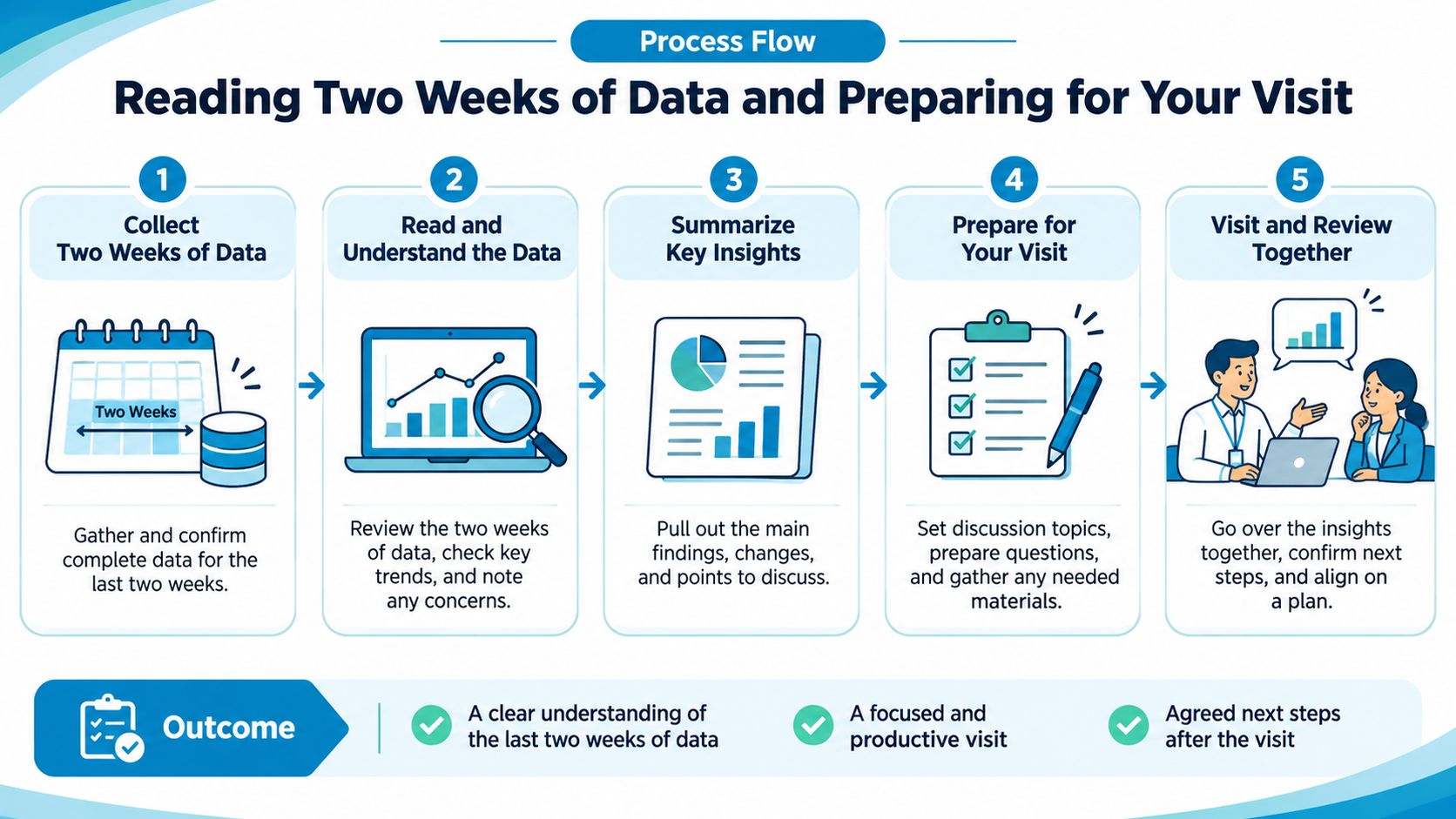
Five Steps to Review Your Own Patterns
- Set your personal baseline week. Scan seven ordinary days first and note your typical resting heart rate and bedtime. Comparing your own rough nights against your own good nights is far more useful than measuring one night against a population average.
- Tag every detected heart-rate rise with prior-night context. Beside each orthostatic episode, link your previous night's sleep duration, awakening count, fluids, salt intake, exercise, medication timing, and any sign of illness.
- Compare poor-sleep mornings with restful ones. After two to three weeks, tally how many standing heart-rate rises happened after fragmented nights compared with restorative ones. A link is worth highlighting to your doctor only when it repeats across multiple nights.
- Track baseline-to-peak shifts and duration, not single spikes. Heart rate and HRV naturally shift with circadian timing, body posture, and optical sensor quality. Looking at how high your pulse climbs from baseline and how long it stays high gives a much steadier picture than zooming in on one isolated minute.
- Label measurement confounders. Flag days when your watch band sat loosely, your schedule shifted for travel, or a mild virus crept in so noisy data don't skew your conclusions.
Walking Into Your Appointment Prepared
Clinic visits move fast, so walking in with organized notes makes every minute count. Bring your two-week log, and if you track on an Apple Watch, export a PDF summary listing detected episodes, weekly trends, and your logged context so your clinician can scan the timeline in seconds.
Tell your doctor plainly if you snore or if anyone has ever seen you stop breathing in your sleep. Then put three specific questions on an index card so brain fog doesn't derail the visit:
- Which nights look hardest in my log, and what might be driving them?
- Based on my unrefreshing sleep and daytime symptoms, should we consider a formal sleep study?
- Could adjusting the timing of any of my current medications improve my overnight rest or morning heart rate?
Wearable data should always support, never replace, clinical judgment. Sleep trouble with POTS is real, you can capture it clearly in your own records, and bringing structured patterns to your care team turns a frustrating mystery into a plan you can work through together.
Tracking overnight heart-rate behavior alongside morning restfulness and daytime orthostatic flares is much simpler when everything lives in one place. Cardiogram analyzes your existing Apple Watch data on device to automatically detect sustained orthostatic heart-rate rises, lets you log sleep, symptoms, hydration, salt, and medications next to each episode, and exports a clinician-ready PDF summary for your next appointment. Explore how it works by visiting Cardiogram.