You're standing in the kitchen, mug in hand, feeling oddly light-headed. You glance at your watch and wonder whether that jump means something serious. It might be useful information, but it's a clue to investigate calmly, not a label to apply to yourself today.
What Happens to Your Heart Rate When You Stand Up
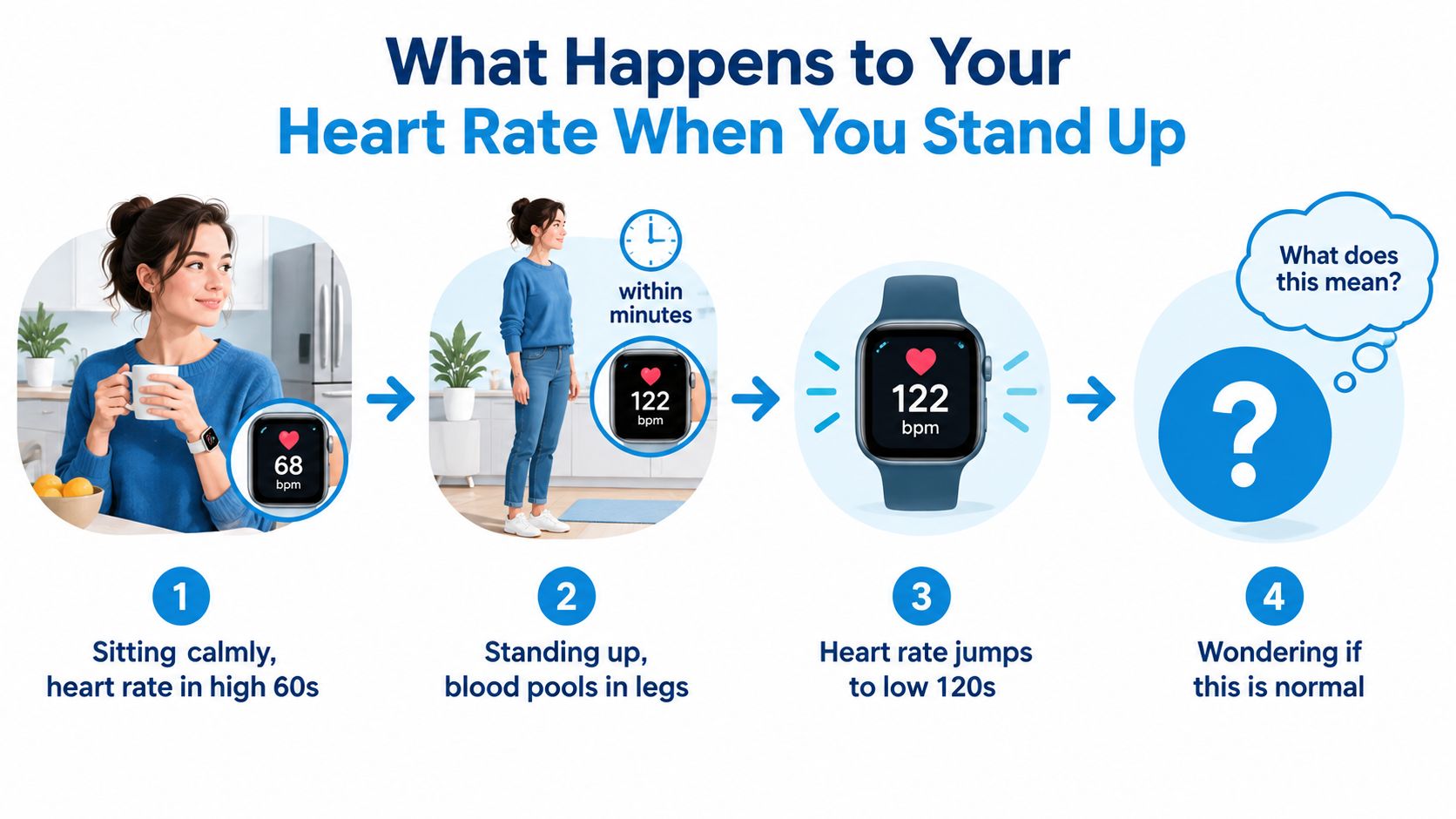
You're sitting calmly and your watch shows a heart rate in the high 60s. You stand, walk a few steps, and within minutes it's in the low 120s. Your chest feels fluttery, your head feels light, and sitting back down slowly helps.
That moment is unsettling because it looks dramatic on a graph. It's also incomplete. A watch can show tachycardia when standing, but it can't tell you why it happened, whether your blood pressure fell at the same time, or whether you'd just climbed stairs, had coffee, or stood up from a hot bath.
Why Some Rise Is Normal
Standing asks your body to work against gravity right away. Blood shifts toward your legs, less blood returns to your heart for a moment, and your nervous system compensates by tightening blood vessels and speeding your pulse a little. For a healthy person, that compensatory rise is approximately 10 to 20 beats per minute, as described in this review of orthostatic heart rate and blood pressure responses.
That's the key distinction to hold onto. A modest rise that settles quickly is your body doing its job. A much larger rise that stays high while you're upright, especially with symptoms, is an exaggerated response worth describing to a clinician.
One high reading tells you your heart raced. It doesn't tell you whether the cause was posture, dehydration, exertion, illness, or something else.
Think in patterns instead. Does this happen most mornings, after meals, in heat, or only on days when you're unwell? Does lying down bring both the number and the symptoms down? Those repeated details turn a scary screenshot into a history a clinician can use.
The Gravity and Baroreflex Mechanism
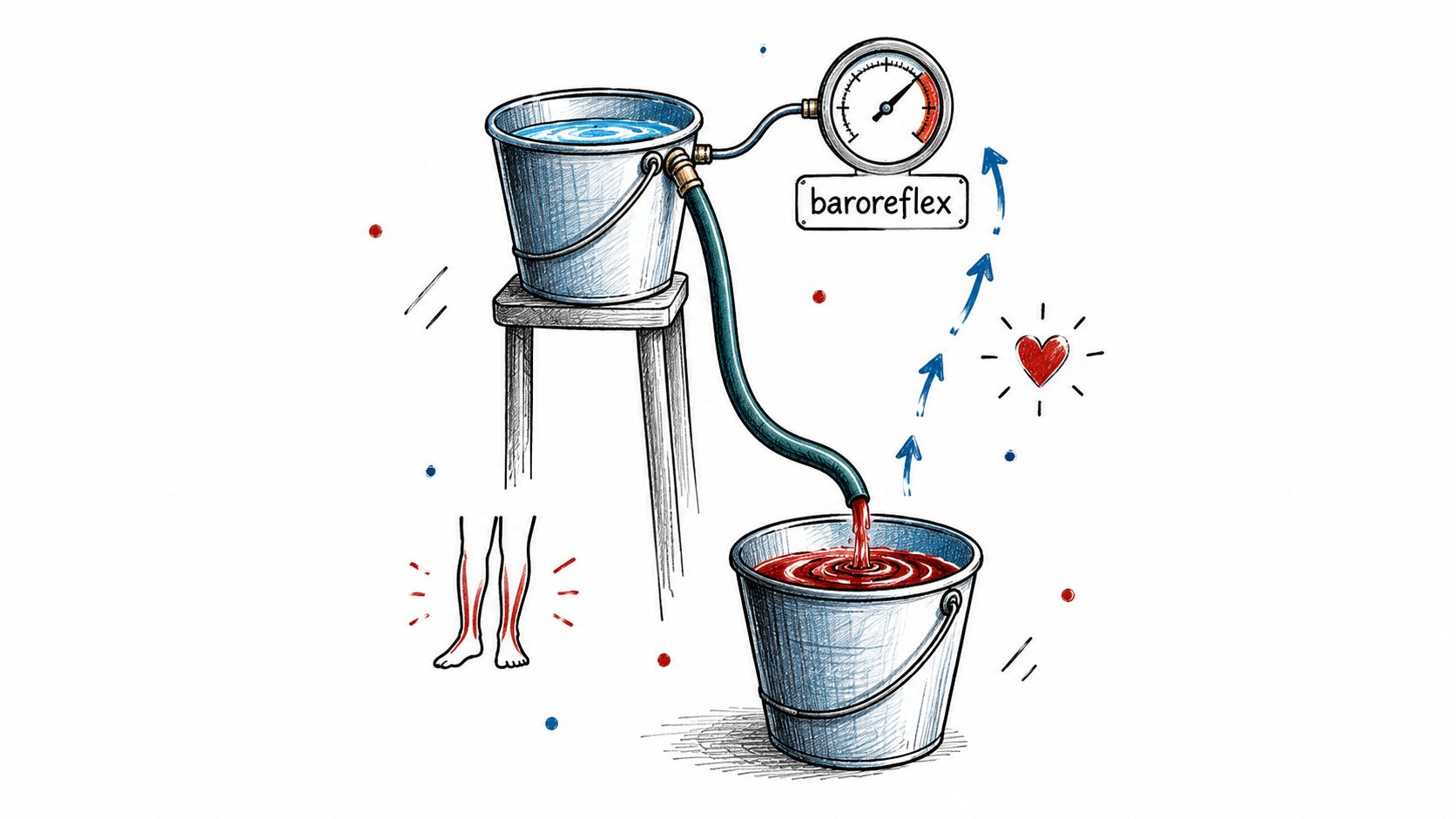
Think of your circulation like water moving between buckets connected by a hose. When you're lying flat, the water is fairly evenly spread. When you stand, gravity pulls more of it into the lower bucket, your legs and the circulation around your abdomen.
With less blood returning, your heart fills less with each beat. It therefore pumps out less blood per beat, a quantity clinicians call stroke volume. If nothing corrected that drop, less blood would reach your brain and you'd feel faint.
The Pressure Sensor That Responds
Your baroreflex works like a pressure gauge attached to that hose. Sensors detect the brief fall in filling and signal your autonomic nervous system to respond. Blood vessels tighten, which pushes blood back toward your heart, and your heart rate rises modestly.
That balancing act involves both the accelerator and brake sides of your autonomic system, which are explained in this overview of the sympathetic and parasympathetic nervous system. You don't need to memorize those terms. It helps to picture one side speeding things up when you stand and the other helping you settle when you're resting.
When Compensation Overshoots
Problems arise when the lower bucket keeps too much blood. Blood vessels may not tighten enough, total blood volume may be low, nerve signaling may be impaired, or the accelerator response may be unusually strong. Deconditioning can also make the system less efficient.
Your heart then compensates the only way it can. If each beat still moves too little blood, it beats faster and faster to maintain circulation. That can produce palpitations, weakness, light-headedness, and difficulty thinking clearly.
A useful analogy for your appointment: gravity moved blood downhill, the pressure sensor noticed, and my heart sped up because the vessels didn't push enough blood back.
Heat, recent exertion, dehydration, medicines, and temperature can all make this response stronger. That's why the number on your watch only makes sense alongside what your body was doing at the time.
Common Causes of Standing Tachycardia
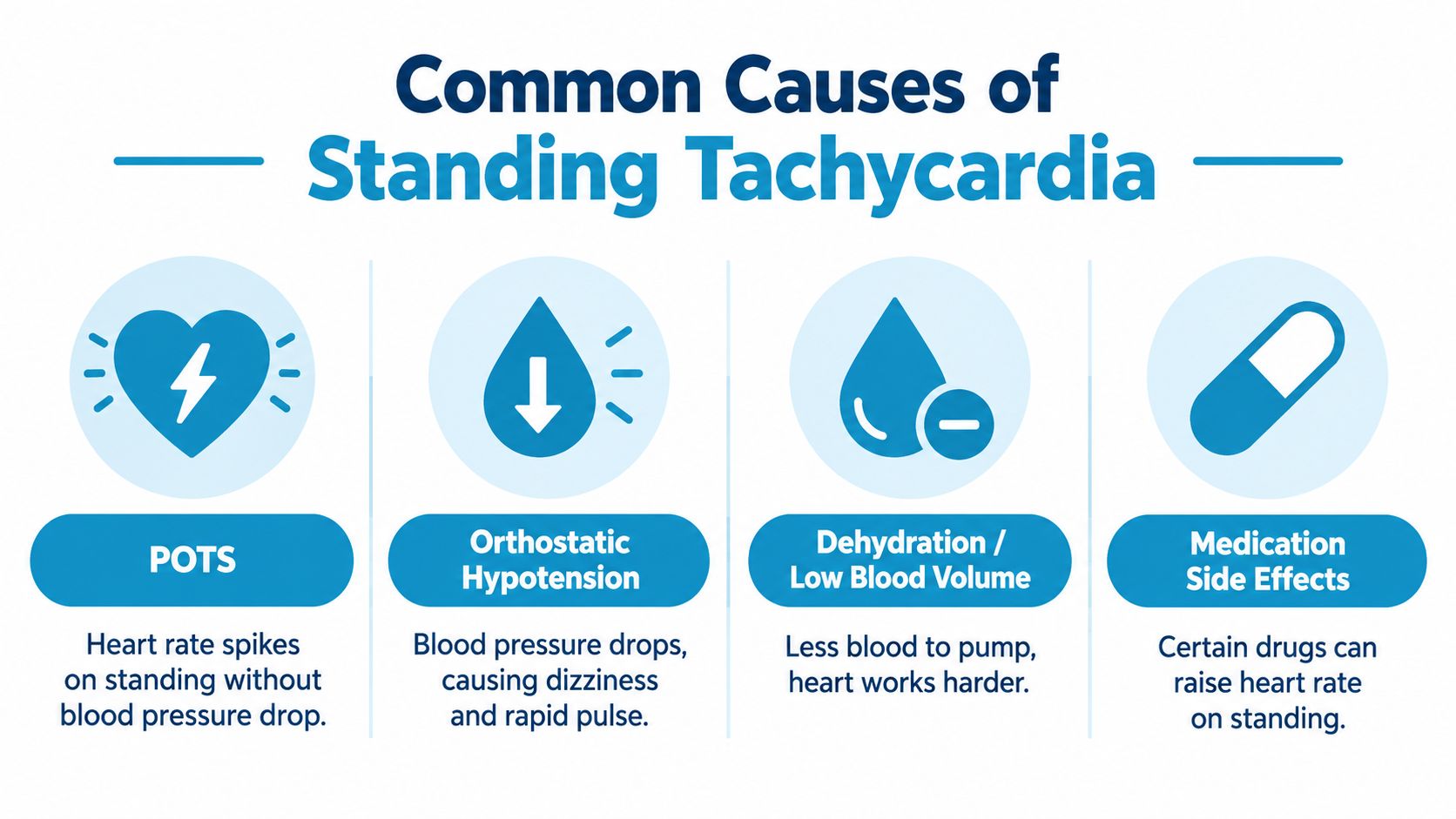
Several conditions can produce a similar watch graph. They differ in what happens to blood pressure, how long symptoms have been present, and what else is going on in your body.
Causes Your Clinician Will Separate
- Postural tachycardia syndrome: In POTS, heart rate rises substantially on standing while blood pressure doesn't show the significant fall that defines orthostatic hypotension, as outlined in the National Institute of Neurological Disorders and Stroke overview of POTS. Symptoms develop or worsen upright and ease when you lie down.
- Orthostatic hypotension: Here, the central clue is a meaningful blood pressure drop after standing. Your heart may race as it tries to compensate, but a watch alone can't reveal that drop because it isn't measuring blood pressure.
- Dehydration or low blood volume: Illness, blood loss, poor fluid intake, vomiting, diarrhea, or heavy sweating leaves less blood to circulate. Standing then becomes harder because there's less volume available to push back toward your heart.
- Medicines and supplements: Stimulants and decongestants can raise heart rate. Some blood pressure medicines can affect vessel tightening or volume, and stopping certain medicines abruptly can also change your response.
- Anemia, thyroid problems, infection, or pain: These can raise heart rate throughout the day and make standing feel much worse. The clue is often that your pulse isn't only high in one posture.
- Deconditioning and broader autonomic dysfunction: After prolonged inactivity or illness, your circulation may tolerate upright posture poorly. Autonomic disorders can also interfere with vessel tightening or nerve signaling.
- Heart rhythm problems: An arrhythmia can start suddenly, feel irregular or unusually forceful, and occur while you're sitting or lying down as well as standing. That pattern needs a different kind of evaluation from a gradual posture related rise.
Notice what separates these possibilities. Timing matters, but so does whether symptoms happen only upright, whether you've recently been ill, what medicines changed, and whether blood pressure fell. Bring those observations rather than trying to choose a diagnosis from the list.
POTS and the Diagnostic Threshold Explained
A common question is whether a 30 bpm rise proves POTS. It doesn't. That number is one part of a stricter clinical picture that also requires upright symptoms, no significant orthostatic hypotension, and a pattern that has generally persisted long enough to show it isn't a temporary illness or a single dehydrated day.
Formal assessment also controls the starting conditions. Recommended testing begins after 5 to 10 minutes lying down, then records heart rate and blood pressure at intervals through 10 minutes of standing, as described in this guide to diagnosing POTS. That's different from catching the highest number while you're cooking, rushing, or recovering from stairs.
POTS Diagnostic Thresholds at a Glance
| Criterion | Adult Threshold | Adolescent (12 to 19) Threshold | What It Means in Practice |
|---|---|---|---|
| Heart rate rise within 10 minutes | At least 30 bpm | At least 40 bpm | Compare a calm lying baseline with sustained upright readings, not one isolated peak |
| Standing heart rate | Above 120 bpm may be an alternative indicator | Interpreted with the adolescent rise threshold | A high absolute number still needs symptoms and blood pressure context |
| Blood pressure change | No fall of 20 mmHg systolic or 10 mmHg diastolic within 3 minutes | Same exclusion principle | A significant early fall points toward orthostatic hypotension rather than POTS |
| Symptoms and duration | Upright symptoms that improve lying down, generally for at least 3 months | Same symptom pattern | Repeated episodes matter more than one difficult morning |
The thresholds in this table reflect the pattern described by the National Institute of Neurological Disorders and Stroke overview cited earlier. Adolescents use a higher rise because larger posture related increases can occur in younger people.
On your graph, look for four things. Note the baseline, the peak, how large the rise was, and whether it stayed high while you remained upright. Then read this explanation of the POTS diagnosis test before assuming a home observation matches a formal test.
Your watch also can't exclude anemia, thyroid disease, infection, medication effects, anxiety, deconditioning, or an arrhythmia. A clinician may need paired blood pressure readings, blood tests, a rhythm tracing, or supervised standing or tilt testing. Your data can start that conversation, but it shouldn't end it.
How Apple Watch and Cardiogram Detect Episodes
Your watch samples heart rate all day, which means it often catches the exact moment you stand and your pulse climbs. The raw graph leaves the detective work to you, though: find the baseline, locate the peak, estimate how long it lasted, recall whether you'd just been moving.
Cardiogram does that arithmetic for you. It scans Apple Health heart rate data for rises of 30 or more bpm within 5 minutes, then stores the baseline, peak, sustained duration, and time of occurrence for each event. A moment that would otherwise be one spike on a chart becomes a saved episode with a shape you can revisit later.
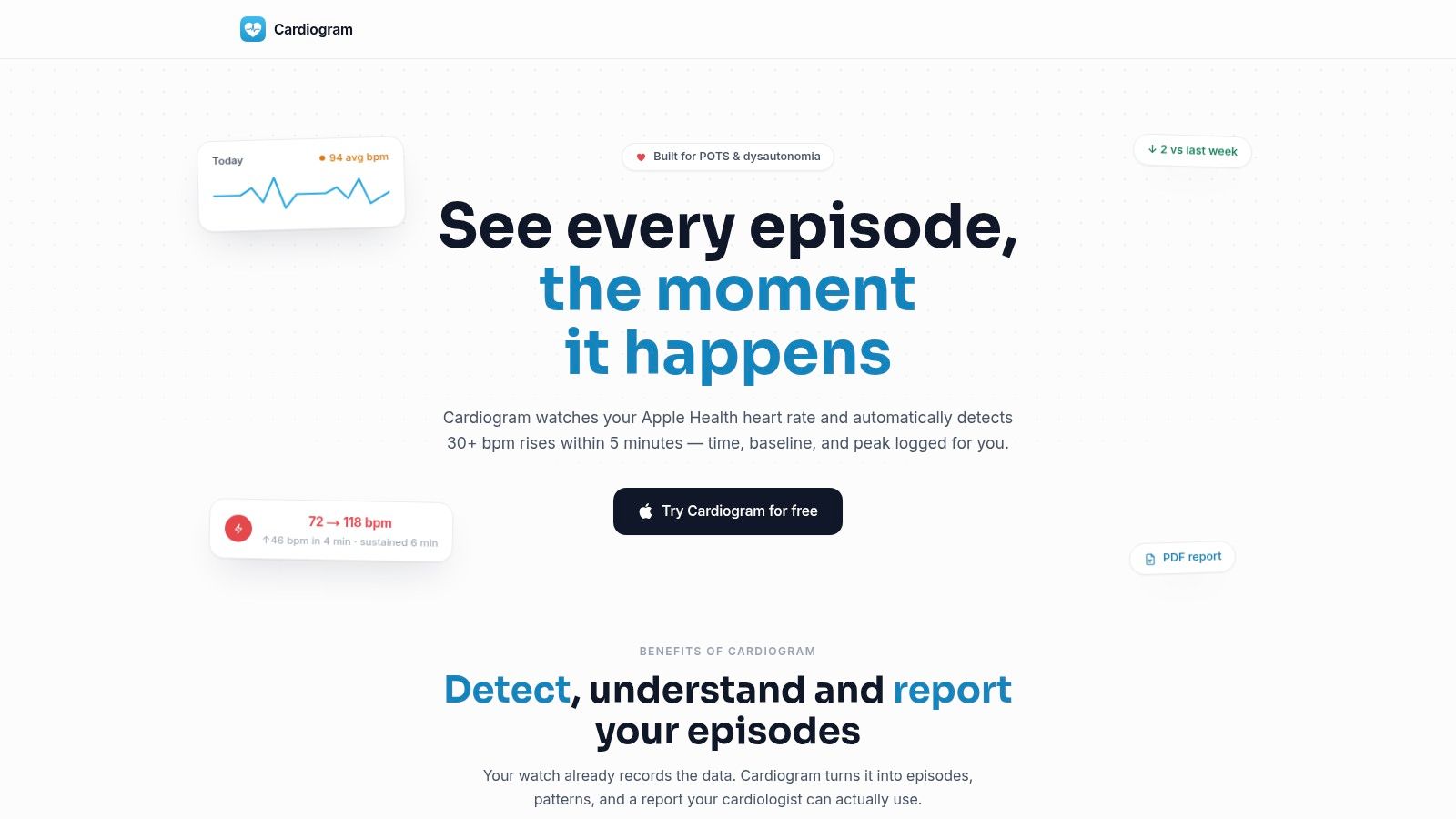
In daily use, this plays out. Each detected event lands in a time stamped feed, so a Tuesday episode can be matched against the shower you took or the meal you'd just finished. When an alert arrives on your phone, you can describe your symptoms while they're happening rather than reconstructing them that evening. Workouts and recovery windows are excluded automatically, which keeps ordinary exercise from being mistaken for an orthostatic episode.
Over weeks, the weekly summary and the resting heart rate trend with heatmap start doing work that memory can't. They show whether episodes cluster on certain mornings, follow a particular routine, or are tapering off. One spike is a curiosity. A dozen documented episodes are a pattern.
All of this runs on device, syncing through your iCloud account with read only access to Apple Health. No extra sensor is needed beyond the watch already on your wrist.
Keep the limitation in view. Detection can flag a rise that looks orthostatic, but it can't capture the paired blood pressure reading a clinician needs. Treat every saved episode as a well documented observation in a growing history, useful precisely because no single one gets treated as a verdict.
What to Log Around Each Episode
Give yourself two weeks of focused logging. Long enough to reveal repetition, short enough that your life doesn't become a research project.
Here's a useful way to think about the task. Your watch already records the spike itself, so your job is to supply the context a sensor can't see. A rise at 8:12 on Tuesday means little on its own. What happened at 8:05 is what gives it meaning.
The details worth capturing fall into six groups:
| Detail | What to note |
|---|---|
| Symptoms | Dizziness, palpitations, fatigue, brain fog, weakness, blurred vision, nausea, feeling close to fainting |
| Posture and activity | Whether you'd just stood from lying or sitting, how long you'd been upright, whether lying down helped |
| Hydration and salt | Whether you'd eaten or drunk normally, been ill, exercised, or spent time in heat |
| Sleep | Unusually poor nights, which may explain a harder morning |
| Medicines and supplements | Recent or missed doses, new products, decongestants, stimulants, caffeine |
| Likely triggers | Hot showers, large meals, prolonged standing, pain, fever, your menstrual period |
Timing matters as much as content. Log symptoms while they're fresh, because people naturally forget whether dizziness began before or after the peak, and that sequence can matter. End of day notes beat nothing. A short note attached to the right timestamp beats a long diary entry written three days later.
Just as important, skip what doesn't change interpretation. You don't need every food ingredient, every step count, or a paragraph about your mood for each event. Record changes and obvious triggers, not your entire day.
When the two weeks are up, look at the episode list alongside the trend view. Do events concentrate after waking, after meals, or after hot showers? Do they cluster on poor sleep or low fluid days? That clustering is the story a clinician can work with, and it carries far more weight than saying your heart sometimes races when you stand.
Preparing a Clinician-Ready Report and Knowing When to Seek Care
A clinician handed ten minutes and a phone full of watch screenshots will guess. A clinician handed a one-page summary will act. Your goal is to arrive with the second version.
A useful export does three jobs. It states the exact detection criterion that triggered each episode, lists every event with its baseline, peak, sustained duration, and time, and places weekly trends next to the symptoms you logged. That turns "my heart races sometimes" into "here is a repeating pattern under these specific conditions," which is the difference between a shrug and a workup.
Before you print anything, review the options for customizing your report so the export matches what the visit calls for. Attach your medication list, recent illnesses, and any home blood pressure readings you have. Primary care is a sensible first stop for many people. Depending on the findings, you may be referred onward to cardiology, electrophysiology, neurology, or an autonomic specialist.
How Urgently to Book
Work out which rung of the ladder your episodes sit on. The lowest rung covers recurrent light-headedness, palpitations, exercise intolerance, or repeated standing-related rises that resolve when you sit down: book a routine appointment. One rung up sits near fainting, episodes that are becoming more frequent, or a heart rate that stays very high while you're upright: ask to be seen sooner.
The top rung needs no log at all. Fainting, chest pain, severe shortness of breath, sudden severe weakness, or a racing heart that won't settle warrants urgent or emergency care now, even if your two weeks of tracking aren't finished.
At the visit itself, ask three things: what paired heart rate and blood pressure testing would add, which alternative causes should be ruled out, and whether any of your medicines could be contributing. Ask what to do during an episode, and which symptoms should send you to urgent care next time.
Your report doesn't need to prove a diagnosis. It needs to make your history specific enough that the clinician can choose the next test efficiently.
A Pattern, Not a Diagnosis
Tachycardia when standing is a signal, not a verdict. A normal system compensates modestly for gravity, while a larger sustained rise with upright symptoms deserves a structured look.
Your next move is straightforward. Watch for repetition, log the context around each episode, separate exercise from posture related rises, and bring a clean summary to a clinician. Even a strong looking pattern still needs paired blood pressure measurements, attention to symptom duration, and exclusion of simpler causes before anyone applies a label.
That approach replaces anxious guessing with evidence you can discuss. The next time your watch lights up after you stand, you'll know what to note, what to ignore, and when to get help.
If standing related spikes keep appearing on your watch, Cardiogram can turn your existing Apple Watch data into time stamped episodes with baseline, peak, and duration, plus symptom logging and an exportable report for your appointment. Visit the site to see how the detection, weekly summaries, and clinician ready PDF work, and start building a clearer pattern from the data you already have.