For most healthy adults, the answer is less than 2,000 mg of sodium a day, the amount in about one teaspoon of salt. In the United States, the reference figure on a Nutrition Facts label is 2,300 mg, and the American Heart Association suggests many adults aim closer to 1,500 mg.
So why does a cardiologist sometimes tell someone with a racing heart to eat more salt, not less?
That question exposes the gap in most sodium advice. A population limit is built to lower blood pressure across millions of people. A personal target is built around one body, its blood volume, kidneys, medications and diagnosis. The two overlap, but they aren't the same instruction, and treating them as identical is where people get stuck.
If you've searched "how much sodium should I have daily" and come away with three different answers, that's why. This guide starts with the headline numbers, translates salt into sodium and back again, shows where the hidden milligrams come from, then walks through the situations, including POTS and orthostatic intolerance, where a clinician may deliberately send you in the opposite direction.
The Daily Sodium Number Most Adults Should Aim For
Which of these numbers is yours? The World Health Organization sets the global ceiling at less than 2,000 mg of sodium a day, under 5 grams of salt (WHO sodium reduction fact sheet). US guidance sits a little higher, and the American Heart Association aims lower: 2,300 mg a day as the upper limit, with an ideal target of no more than 1,500 mg for most adults (American Heart Association sodium guidance).
Three numbers, three jobs. Here they are side by side, each with its salt equivalent, so you can match a label or a recipe without doing arithmetic at the counter.
| Source | Daily sodium limit | Salt equivalent | What it is used for |
|---|---|---|---|
| WHO, most healthy adults | Less than 2,000 mg | Less than 5 g of salt, about 1 teaspoon | Global benchmark for blood pressure and heart risk |
| US FDA and Dietary Guidelines | Less than 2,300 mg | About 1 teaspoon of table salt | Daily Value on Nutrition Facts labels |
| American Heart Association ideal | Less than 1,500 mg | About two-thirds of a teaspoon | Optimal target for most adults, especially with hypertension |
| Average US intake | About 3,400 mg | About 8.5 g of salt, roughly 1.7 teaspoons | Typical intake reported in FDA sodium guidance, well above all three limits |
Each row answers a different question. The 1,500 mg row is a heart-health goal, the figure that best protects blood vessels over decades and the one that deserves the most attention if your blood pressure already runs high. The 2,000 mg and 2,300 mg rows are practical ceilings, set at levels a whole population can realistically reach. Read the table as a ladder: one rung is the ideal, and two rungs mark the upper bounds.
The last row is the reality check. Typical intake in the United States sits well above every rung on that ladder, so the first job for most American eaters is closing a sizable gap between daily habit and guideline, long before fine-tuning comes into play.
Pick one row and start there. Choose the figure that fits your situation today, then compare it with a single ordinary day of eating to see which side of the line you land on. Keep your grip on that line loose, though. These are population defaults, and conditions like POTS can lead a clinician to raise a sodium target on purpose. The standard limit is a baseline, one your own health picture may rewrite.
Salt Versus Sodium and Why the Numbers Look Different
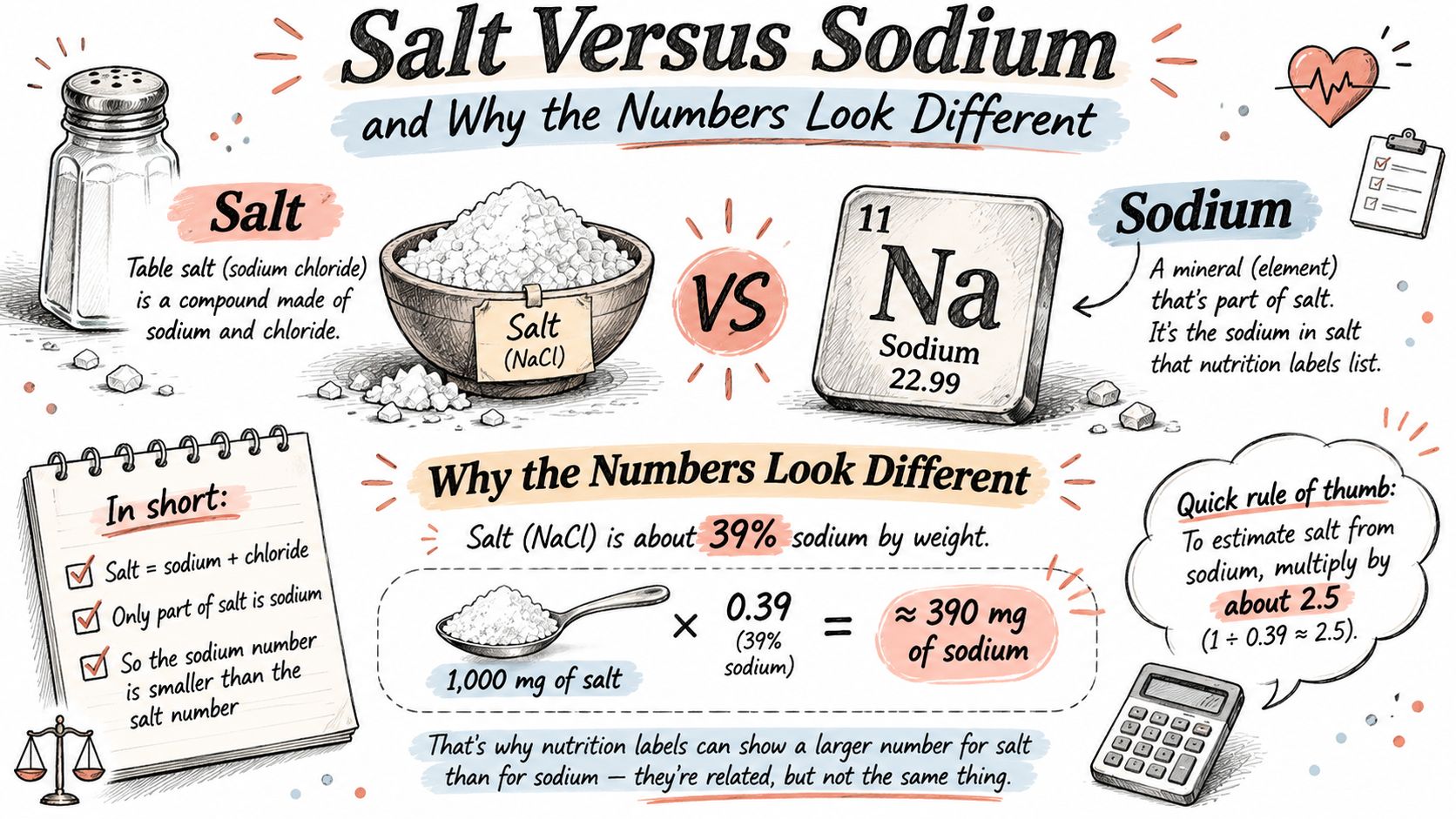
Salt is the crystal in the shaker. Sodium is the mineral inside it, paired with chloride. The two words aren't interchangeable, and the confusion costs people accuracy: a little less than half of salt's weight is sodium, which is why the same limit appears as a milligram figure on a package and a gram figure in a recipe.
The FDA makes the scale concrete: 2,300 mg of sodium is approximately the amount in one teaspoon of table salt, with the exact figure depending on the salt product and how it's measured (FDA guidance on sodium in your diet).
Units are where readers lose the thread. A soup label reads 640 mg per serving. A recipe calls for 1 teaspoon of fine sea salt. A clinical paper reports 66 mmol. All three describe the same mineral wearing different clothes.
Label rule: milligrams on a package means sodium. Grams or teaspoons in a recipe means salt. Convert before you compare, or you're comparing a price per pound against a price per ounce.
The routine that fixes this has three steps, and it takes about twenty seconds once you've done it for your regular products.
- Identify the unit. Check whether the number describes sodium or salt, and whether it's milligrams, grams, teaspoons or millimoles. When a package says "sodium 640 mg," you already have your answer in the unit that matters.
- Convert to milligrams. A gram is 1,000 mg, so a recipe with 2 grams of sodium is 2,000 mg. For salt, multiply the gram figure by roughly 0.4 to get sodium, because that's the share of salt's weight that is sodium.
- Compare with your daily target. Do the comparison in milligrams against the row you picked from the table above, not against a number you half remember.
Run those three steps on the five packaged foods you buy most often, and the arithmetic stops being work. You'll know which two products are supplying most of your day.
Where Sodium Hides in an Ordinary Day
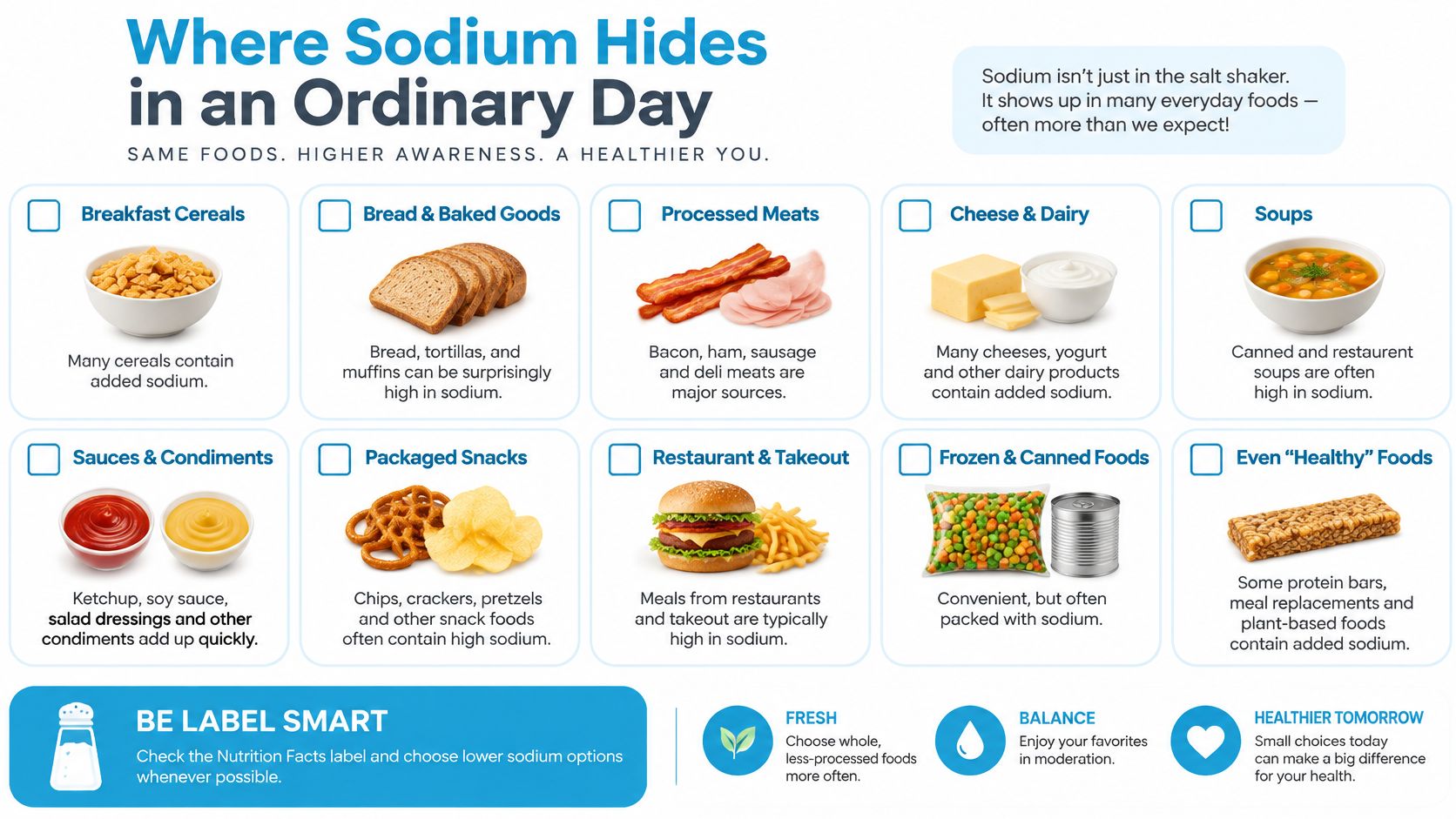
The salt shaker is usually the smallest contributor on the table. Most sodium in a typical day arrives in food someone else seasoned, and it rarely tastes as salty as a bag of chips. That's exactly why it slips past.
- Bread and rolls: a food that tastes of nothing in particular, eaten at breakfast, lunch and dinner, can stack up faster than a snack.
- Cured and deli meats: salt is part of the curing process itself, so turkey and ham carry as much as salami.
- Cheese, sauces and condiments: concentrated flavor in small volumes, which makes portion size easy to underestimate.
- Canned soup, frozen meals and restaurant plates: a single bowl or entree can cover a full day's ceiling.
In 2024, the U.S. Food and Drug Administration reported that average sodium intake in the United States was approximately 3,400 mg per day, compared with a recommended limit of 2,300 mg per day for people aged 14 and older (FDA report on sodium reduction in the food supply).
A label routine that takes twenty seconds
- Find the sodium line, in milligrams per serving, on the back of the pack. Front-of-pack claims are marketing and tell you very little.
- Check the servings per container. A "serving" is often half a bottle or two slices, not the amount you'll eat, so double the number when you'll eat double.
- Read the percent Daily Value. Five percent or less is low per serving. Twenty percent or more is high, and two of those in one meal uses up most of a day.
Here's how a day adds up before anyone reaches for the shaker. Oatmeal with milk, about 100 mg. A deli sandwich, about 1,200 mg. A can of soup, about 800 mg. A restaurant dinner, about 1,500 mg. That lands near 3,600 mg. Treat those as illustrative and check your own labels, but the shape of the problem is real.
Pick one swap this week, not five. No-salt-added canned vegetables instead of the regular can. Canned beans rinsed in a colander. Citrus, vinegar, smoked paprika or black pepper in place of a seasoned salt blend. One change held for a month beats a total overhaul abandoned by Friday.
Why Your Personal Sodium Target Can Shift
A population target is a starting point, not a verdict. Two forces move it further than anything else: sweat and blood pressure.
Sweat carries sodium out of the body, and how much varies widely between people. A summer shift on a roof, a long ride in heat, a hot kitchen, a marathon block, all change what your body loses in a day. Apply a strict low-sodium ceiling mechanically to someone in that situation and it can undershoot what they need.
Blood pressure response is the other big variable, and it isn't uniform. A Cochrane review found that reducing sodium from roughly 4,623 mg to 1,518 mg a day lowered systolic and diastolic pressure by about 5.5/2.9 mmHg in white participants with hypertension, but by only about 1/0 mmHg in white participants with normal pressure (Cochrane review of sodium reduction). In other words, the same cut produced a meaningful shift in one group and almost nothing in the other.
That gap is why the 1,500 mg target earns its place for people whose pressure is already raised, and why it's less urgent for someone with normal pressure and no other risk factors. Neither group is being careless. They're answering different questions.
| Factor | How it changes your needs | Who to ask |
|---|---|---|
| Heat exposure or heavy sweating | Sweat carries sodium out, so needs can rise | Clinician or sports dietitian |
| Long endurance exercise | Extended sessions with heavy sweat losses | Sports dietitian or clinician |
| Diagnosed hypertension | A lower target is usually advised | Clinician |
| Chronic kidney disease | Changes how the body clears sodium and potassium | Nephrologist |
| Heart failure | Fluid retention, so intake is often restricted | Cardiologist |
| Pregnancy | Needs and blood pressure risks change | Obstetrician or midwife |
| POTS or orthostatic intolerance | Clinicians may prescribe more fluid and salt | Cardiologist or autonomic specialist |
| Certain medications | Some drugs raise or lower sodium and potassium | Prescriber or pharmacist |
Sodium and water move together in the bloodstream, and our explainer on how drinking water fits with your salt intake covers the fluid half of that balance.
No single row above decides your number. The useful answer usually comes from stacking two or three of them with a clinician who knows your history, rather than picking the strictest line and hoping it fits.
A target that ignores your medication list, your kidneys and your summer job isn't a target. It's a guess with a number attached.
Sodium Advice for POTS and When to Ask Your Clinician
The reflex on hearing the word sodium is to cut back. For people with POTS and orthostatic intolerance, that reflex often runs the wrong way.
Clinicians who treat orthostatic intolerance may recommend individualized increases in fluids and sodium rather than restriction, because the goal in that room is blood volume and standing blood pressure, not population cardiovascular risk. Mainstream guidance wasn't written for that reader. It assumes the problem is too much sodium, not too little circulating volume.
Why there's no single POTS number
There is no single evidence-based sodium target that fits every person with POTS. The appropriate amount depends on your blood pressure, kidney and heart function, medications, heat exposure, activity and your clinician's direction. Someone with normal pressure and no heart or kidney disease may be advised to take in considerably more salt than a label reference value. Someone managing hypertension alongside POTS may be told to hold steady instead.
Raising salt without monitoring isn't neutral. It can worsen hypertension or fluid retention. Kidney disease, heart failure, pregnancy and potassium-related concerns all call for individualized advice before anything changes. WHO's 2025 salt-substitute guidance excludes people with impaired potassium excretion, a pointed reminder that "lower sodium" interventions aren't universally safe or interchangeable (WHO work on reducing population sodium intake).
The number on a food label and the number a clinician gives you are answering different questions. Don't swap one for the other.
What to bring to the appointment
Bring four things and the conversation gets specific fast.
- Your estimated current intake, roughly how much sodium and fluid you take in on a typical day, even if the estimate is imperfect.
- Any history of high blood pressure, heart disease or kidney disease, including family history your clinician hasn't recorded yet.
- Your medication list, especially anything that affects potassium, such as diuretics, ACE inhibitors or ARBs.
- Your symptom pattern, what happens when you stand, in heat, after a big meal, and how long it lasts.
Never start or stop a salt plan on the strength of a general limit, a forum thread or an article like this one. Those are inputs to a conversation, not a prescription.
How to Track Sodium and Symptoms for Your Appointment
A clinician can only tune a target they can see. Memory smooths over the bad weeks and the hot commutes, which is why a short, boring record beats a confident recollection every time.
Set a two- to four-week window and record approximate daily sodium using labels and a simple food log. A few weeks show a pattern that a single careful day cannot, and it also captures the takeout Friday you'd rather forget.
Note fluid intake in cups or litres on the same days. Sodium and water work together on blood volume, so a salt number without a fluid number is half a picture.
Log symptoms as they happen, including dizziness, palpitations, fatigue and brain fog, with a simple 0-to-10 severity score. Scoring forces a comparison between days that felt similar in memory but weren't.
Record sleep, medications, activity and heat exposure alongside them. These are the variables that explain a spike you'd otherwise blame on lunch.
Mark any heart-rate episodes, ideally from a wearable, then compare those days against your salt and fluid intake. A pattern usually appears in that comparison, and it's rarely the one people expect.
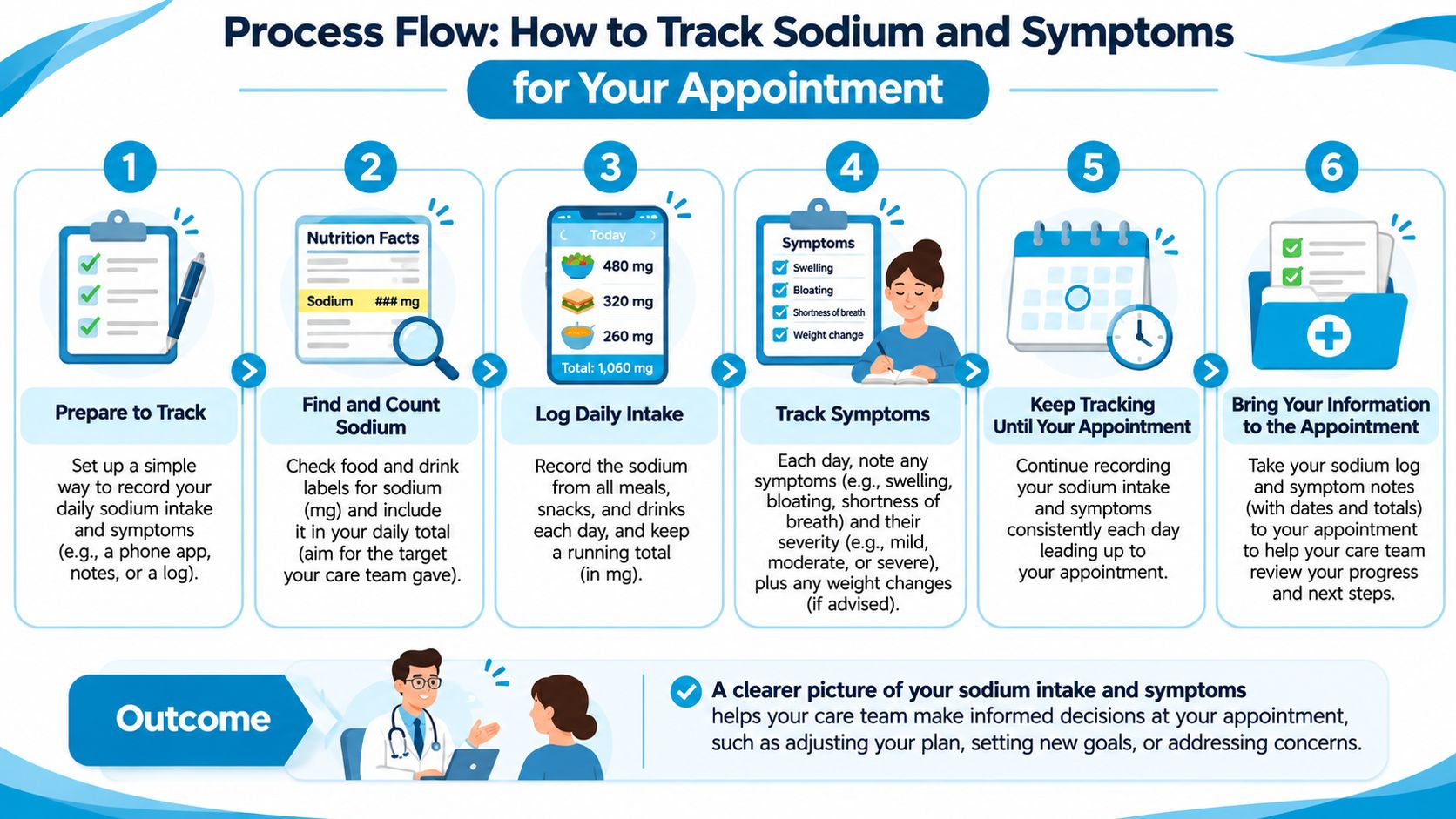
Bring the summary to your appointment and ask one direct question: which of these patterns should change my target? That's a far easier question to answer than "is my salt intake okay?"
If you want a structure to log against, our guide to keeping a symptom journal shows what a useful entry looks like. One habit makes the whole record more valuable: write down anything unusual about the day, a heat wave, a long flight, a workout that wiped you out, a missed dose. Patterns make sense later only if the odd days are labelled.
Confirm Your Sodium Target Before You Change Your Salt
The order that works is simple. Start with the general figure that fits you: 2,000 mg from the WHO, 2,300 mg as the US label reference, or 1,500 mg as the ideal many adults with raised blood pressure aim for. Adjust it for the personal factors in the table above, heat, endurance training, medications, kidney or heart function. Then get individual confirmation before you change anything on your plate.
Three actions turn that sequence into progress.
- Book the conversation. Arrive with the log you built while tracking, because a clinician can move faster with a pattern in front of them than with a vague description of "some dizzy spells."
- Ask for specific numbers. Request a daily sodium target in milligrams and a fluid target in litres, written down, so you're not reconstructing the advice from memory a month later.
- Agree on a recheck. Targets get adjusted together rather than decided once and defended forever. Blood pressure, symptoms and medication lists all change, and your number should be allowed to change with them.
If you're unsure how to frame that appointment, our piece on talking with your clinician about your data walks through it.
If the record itself feels like the hard part, logging hydration, salt, sleep, medications and how you feel alongside your heart rate gives the conversation something concrete to work from.
Your number is yours to confirm, and a clear record plus one good appointment is usually what settles it.
Cardiogram is built for exactly this kind of question. You can log salt, fluids, symptoms, sleep and medications, then see how those days line up against your heart-rate episodes, with an exportable summary you can bring to a cardiologist or autonomic specialist. If you've been trying to work out what your own sodium target should be, visit Cardiogram and start turning daily entries into a pattern your care team can use.