Salt may help some people with postural orthostatic tachycardia syndrome (POTS) by expanding circulating volume and reducing the heart-rate rise on standing, which was 46 beats per minute on high sodium versus 60 beats per minute on low sodium in one small controlled study. It doesn't reliably eliminate symptoms, though, so you shouldn't increase it without an individualized clinical plan.
You may have heard this advice in a clinic room after describing a racing heart in the shower, lightheadedness while queuing, or needing to sit down soon after getting up. The suggestion sounds simple. The decision behind it isn't, because dose, fluid, blood pressure, other conditions, and your actual symptoms all change whether extra salt is sensible.
Why Salt May Help With POTS
You're standing at the kitchen counter after getting out of bed. Your watch shows your heart rate climbing, your vision narrows slightly, and you grip the edge while waiting for the wave to pass. Later, your clinician mentions fluids and sodium, and you search does salt help with POTS because you want to know if something so ordinary could make standing easier.
For selected people, it may. Salt provides sodium, and sodium helps the body retain water. When that extra fluid stays in circulation, the heart may not need to compensate as strongly when gravity shifts blood toward the legs.
Three outcomes people often blur together
It's helpful to separate what salt might change into three distinct outcomes:
- Standing heart-rate rise: The jump from lying or sitting to upright may become smaller.
- Blood-volume measures: Laboratory or clinical markers may suggest improved volume status.
- How you feel: Dizziness, palpitations, fatigue, brain fog, and presyncope may improve, stay the same, or fluctuate for other reasons.
Those outcomes don't always move together. A smaller heart-rate rise on your watch is encouraging information, but it isn't proof that your day feels better. Likewise, a rough morning after poor sleep or heat exposure doesn't prove a clinician-guided salt plan has failed.
Treat salt as a supportive measure to test carefully, not as a diagnostic test, a cure, or a universal prescription.
That's the proportionate answer. Salt has a plausible role, particularly when low circulating volume contributes to symptoms, but neither the amount nor the response is universal. Your blood pressure, kidney health, medications, and other diagnoses matter before you change intake.
How Salt Affects Circulation on Standing
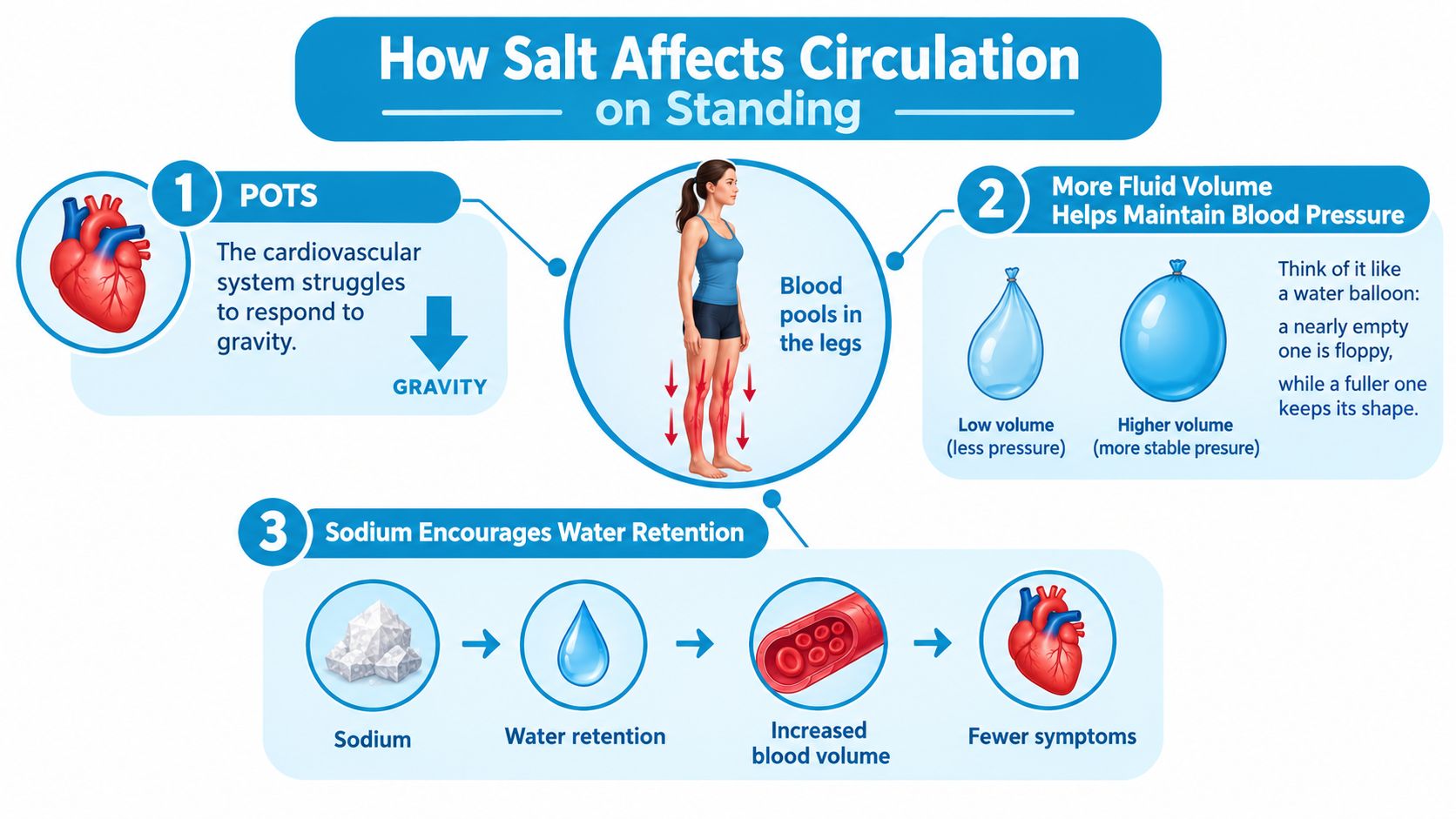
When you stand, gravity pulls blood downward. Your blood vessels and autonomic nervous system normally respond quickly, keeping enough blood returning to the heart and reaching the brain. In POTS, that response can be insufficient or poorly coordinated, so heart rate rises sharply as compensation.
Think of circulation like a partially filled water balloon being lifted upright. With very little fluid inside, pressure is harder to maintain at the top. A fuller balloon distributes pressure more effectively, although the analogy breaks down because real blood vessels actively tighten, relax, and respond to hormones.
Where sodium fits in
Sodium encourages the kidneys to retain water. If you also drink enough fluid, some of that water expands plasma volume, the liquid portion of blood. More circulating volume can mean more blood returns to the heart on standing, so the compensatory heart-rate increase may be less pronounced.
Fluid is not an optional extra in this mechanism. Salt without an appropriate fluid plan may leave you thirsty and uncomfortable without achieving the intended volume effect. If you're reviewing the basics, this explanation of hydration and heart rate can help you connect fluid intake with cardiovascular response.
Why responses differ
People with POTS don't all have the same underlying physiology. Baseline blood volume, blood-vessel tone, kidney function, supine blood pressure, medications, menstrual factors, illness, heat, and deconditioning can all influence standing tolerance. Two people can eat the same salty meal and have very different blood-pressure and symptom responses.
Salt also doesn't repair every mechanism that can produce orthostatic tachycardia. It supports one piece of the physiology, volume. If symptoms are driven mainly by another process, expanding volume may produce little benefit, which is why a monitored trial tells you more than a generic promise.
What the Controlled POTS Study Shows
The clearest dietary evidence comes from a 2021 randomized crossover study in which each participant tried both sodium conditions. That design is useful because people serve as their own comparison, reducing some between-person differences. It's still important to notice how small and short the study was.
The researchers studied 14 adults with POTS aged 23 to 49 and 13 healthy controls, with each diet lasting six days, as described in the randomized crossover study report. The high-sodium diet contained 300 mEq of sodium per day, approximately 6.9 g of sodium, while the low-sodium diet contained 10 mEq per day, approximately 230 mg, according to the same report.
What improved on high sodium
On high sodium, the median heart-rate increase from lying to standing was 46 beats per minute, compared with 60 beats per minute on low sodium in the study's reported outcomes. That is a meaningful physiological signal, but it doesn't mean standing tachycardia disappeared.
Upright norepinephrine, plasma renin activity, and aldosterone were lower during high sodium. In plain language, the body appeared to be activating fewer compensatory systems that respond to low volume and upright stress. Those findings fit the proposed mechanism of better volume status.
What did not clearly improve
Symptom improvement did not reach statistical significance. Statistical significance is not the same as saying nobody felt better. It means the study couldn't establish the symptom difference confidently enough under its design and size.
Key distinction: Measurable hemodynamics can improve while dizziness, palpitations, fatigue, or presyncope remain stubbornly present.
Blood volume in participants with POTS also remained lower than in healthy controls even during high sodium. So the high-sodium period narrowed some gaps without normalizing everything.
The six-day duration leaves major questions unanswered. We don't know from this study alone who benefits most over months, what amount is sustainable, or how benefits balance against long-term blood-pressure and kidney concerns. Read it as support for a careful, clinician-supervised trial, not as proof that more salt always produces proportionate relief.
Choosing Food, Electrolytes, or Salt Tablets
Once a clinician agrees that extra sodium is worth trying, the next question is practical. Should it come from meals, an electrolyte drink, or tablets? These options differ in measurement, fluid pairing, taste, and stomach tolerance.
Food-based salt is often easiest to spread across the day. Salting meals can feel normal and may be gentler than taking a concentrated dose, but restaurant food, packaged food, and home seasoning make exact totals hard to estimate. Labels usually list sodium rather than salt, which creates a conversion problem covered later.
Electrolyte solutions pair sodium with fluid in one step. That pairing matches the volume goal, and a labeled serving can be easier to record. Products vary widely, though, and sugar, potassium, flavorings, cost, and total daily volume may matter for your medical situation.
Why tablets deserve extra caution
Tablets look precise because each unit has a stated amount. Precision doesn't equal tolerability. Some treatment literature warns that concentrated tablets can create a strong osmotic gastrointestinal load, causing nausea, vomiting, and dehydration that could worsen volume depletion, as noted in the autonomic treatment and nutrition review.
Common Salt Options Compared
| Option | Measurement Challenge | Potential Advantage | Important Caution |
|---|---|---|---|
| Salted food | Seasoning and portions vary | Easy to spread through meals | Sodium totals can be underestimated |
| Electrolyte solution | Formulations differ by serving | Combines sodium with fluid | Check potassium, sugar, and fluid limits |
| Salt tablets | Unit may state salt or sodium | Portable and clearly portioned | Concentrated dose may upset the stomach |
Ask your clinician which form fits your blood pressure, kidneys, medications, stomach, and fluid target. If a change is approved, gradual adjustment through meals or a clinician-directed product is generally easier to evaluate than several changes at once. There's no universal routine hidden in this choice.
Understand Sodium and Salt Units
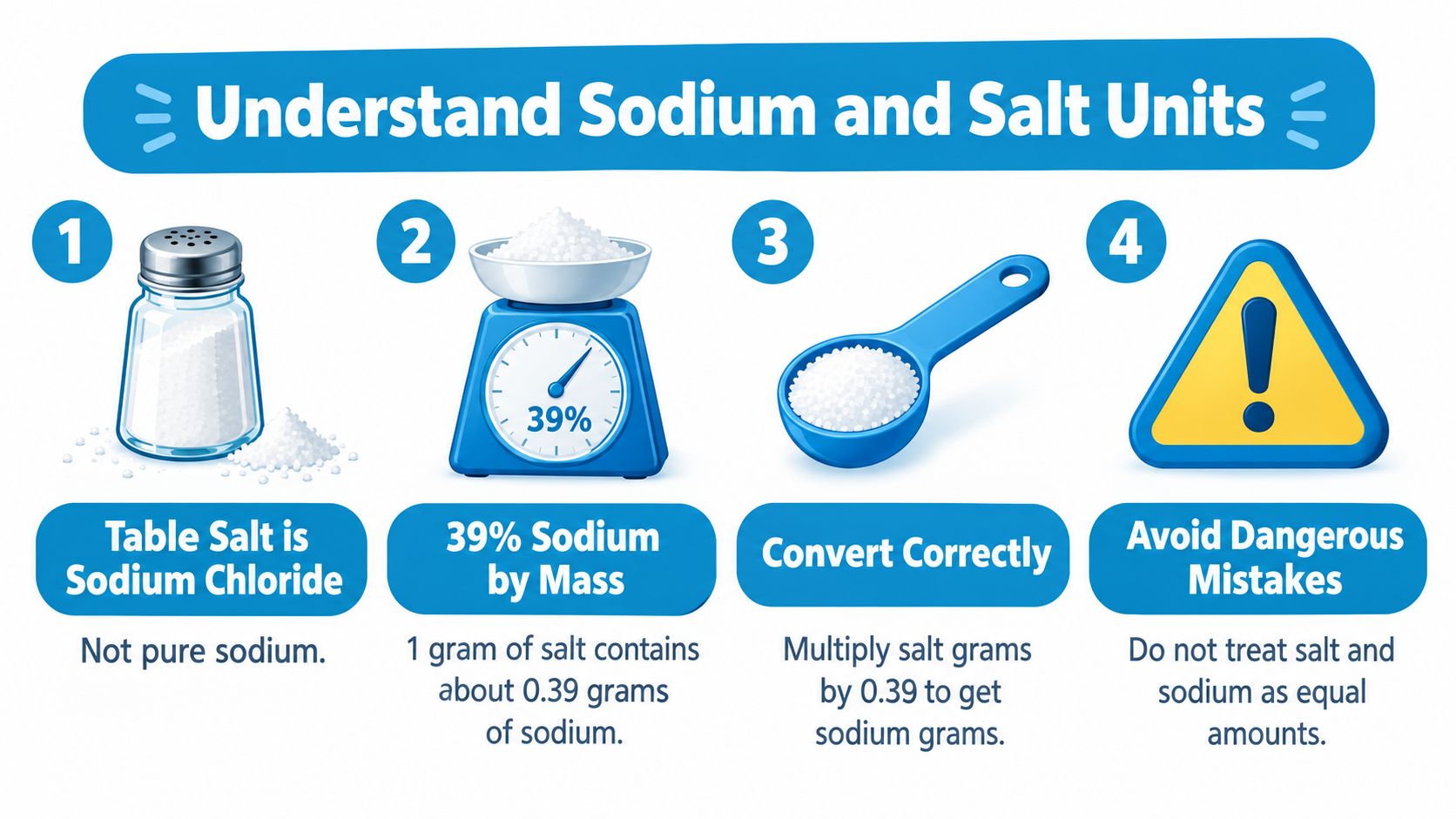
Well-meaning advice can become unsafe here. Salt and sodium are not interchangeable words. Table salt is sodium chloride, meaning sodium is only part of its weight.
Sodium chloride is about 39% sodium by mass, so 10 g of table salt contains roughly 4 g of sodium, a conversion explained alongside historical sodium and salt guidance. Working backward matters too because 10 g of sodium would correspond to approximately 25 g of salt under that same conversion.
A simple label check
Use these steps before you copy any target from a leaflet, appointment note, or package:
- Identify the unit: Look for sodium, salt, sodium chloride, grams, milligrams, mmol, or mEq.
- Convert only once: Multiply grams of salt by about 0.39 to estimate grams of sodium.
- Check the serving: A label amount may describe one packet, one tablet, or only part of a container.
- Confirm the target: Show the exact label to the clinician who set your plan.
Confusion is easy because POTS recommendations have appeared in different units across publications. Earlier literature even described 10 to 15 g of sodium daily, equivalent to about 250 mmol or 250 mEq, which is not the same instruction as 10 to 15 g of salt.
If the unit isn't clear, don't guess. Pause and confirm it before changing intake.
Write the agreed target in both forms if that helps, for example grams of salt and grams of sodium. Then record the same unit every day. Consistent units make your tracking useful and prevent a small labeling mistake from becoming a large dosing mistake.
Balance Potential Benefits With Safety Risks
Clinical guidance has historically suggested sodium and fluid together for selected patients, especially when low volume is suspected. The 2015 Heart Rhythm Society expert consensus is commonly summarized as 2 to 3 liters of water and 10 to 12 g of sodium chloride daily for appropriate patients, as summarized in the salt and fluid loading guidance. Those figures are treatment targets for clinician-selected patients, not instructions for everyone reading about POTS.
A 2020 Canadian position statement similarly cited about 10 g of salt and at least 3 liters of oral fluid. The similarity can make the advice sound settled, but the evidence base remains limited and your safety profile determines whether those targets are reasonable.
Situations that change the calculation
Extra sodium and fluid can raise blood pressure or worsen fluid retention in susceptible people. Kidney disease, heart failure, hypertension, high blood pressure while lying down, edema, pregnancy-related complications, and some medication effects require particular care. Expert reviews also advise considering salt particularly when urinary sodium is low and supine blood pressure isn't high, while monitoring for adverse effects.
When Extra Salt Needs Clinical Review
| Context | Why It Matters | Safest Next Step |
|---|---|---|
| Hypertension | Added sodium may raise blood pressure further | Review home readings before increasing |
| Kidney disease | Sodium and fluid handling may be impaired | Ask for kidney-specific limits |
| Heart failure or edema | Fluid loading may worsen congestion | Do not start without specialist guidance |
| Sodium restriction already prescribed | POTS advice may conflict with another condition | Reconcile both plans with your clinicians |
| Relevant medications | Fluid retention or blood-pressure effects may interact | Review the full medication list |
Both too little and too much can be unhelpful. Salt without enough fluid may not expand volume as intended, while aggressive fluid loading can be dangerous for someone with cardiac or kidney limitations. Blood pressure, kidney function, symptoms, and medications should guide the plan, with review after any change rather than indefinite escalation.
Track Salt Changes Against POTS Episodes
A salt trial becomes useful when you can answer two separate questions. Did my standing heart-rate episodes change? Did my symptoms change independently? Memory usually blends those answers, especially after a particularly good or bad day.
Start with a simple baseline before changing intake, if your clinician agrees. Record your usual salt or sodium amount in one consistent unit, fluid intake, resting and standing heart rate, episode timing, and symptom severity. Add blood pressure when you have a reliable way to measure it.
What to log each day
- Intake: Salt or sodium amount, exact unit, form used, and total fluid.
- Episodes: Time, peak heart rate if available, duration, and what you were doing.
- Symptoms: Dizziness, palpitations, fatigue, brain fog, nausea, and presyncope rated separately.
- Context: Heat, sleep, illness, menstrual timing if relevant, activity, and medication changes.
- Adverse effects: Headache, swelling, stomach upset, unusual thirst, or blood-pressure concerns.
A structured chronic illness symptom tracker can make those fields easier to keep consistent than scattered notes. Consistency matters more than capturing every minor detail.
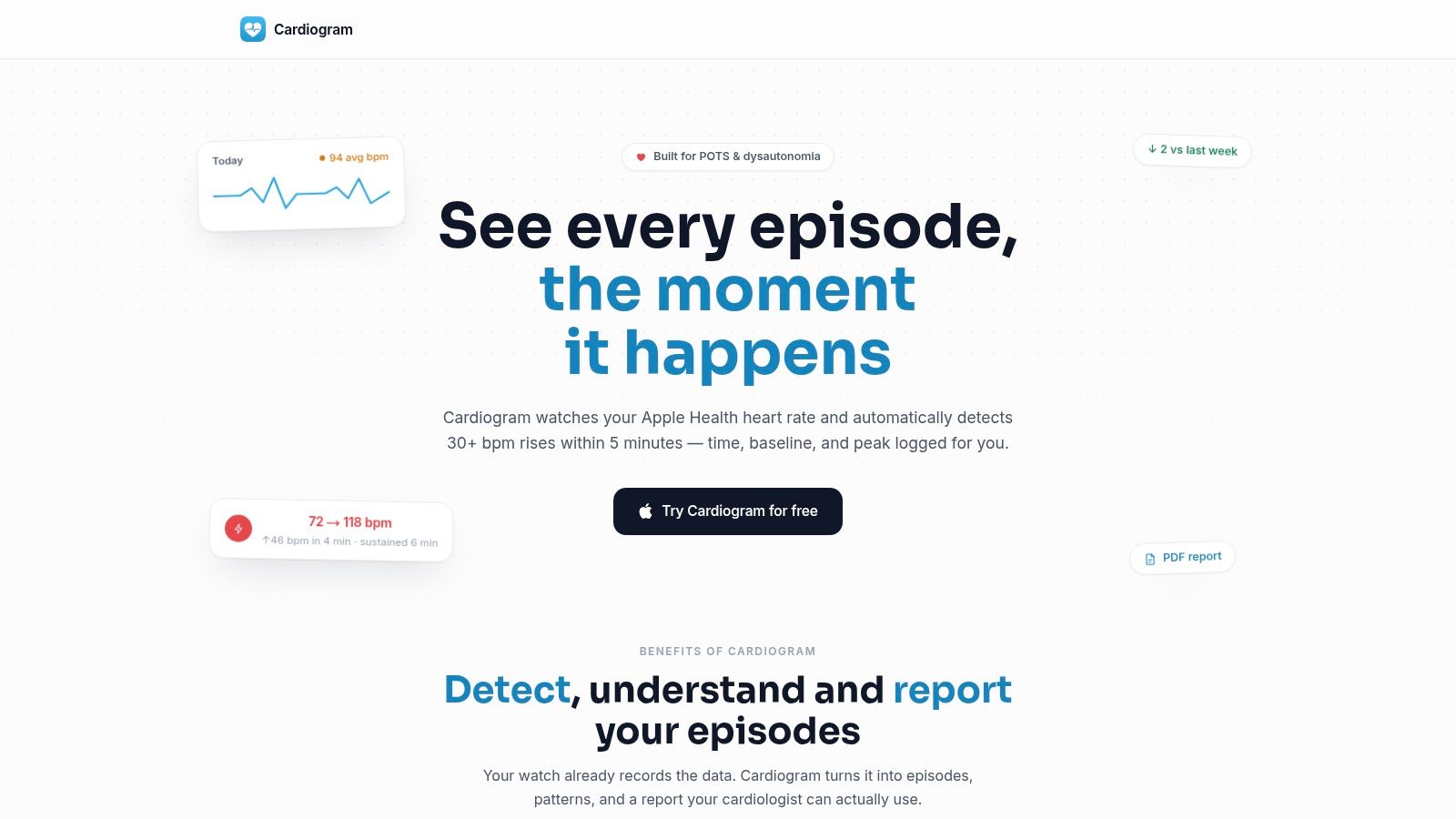
If you use Apple Watch data, Cardiogram can detect rises of more than 30 bpm within five minutes, link episodes with salt and other context logs, exclude workouts and recovery periods, and export trends for clinical review. That helps reduce manual timestamps, but it doesn't interpret the cause of an episode for you.
Review several days together. One calm morning may reflect better sleep, cooler weather, a later wake time, or medication timing rather than salt alone. One difficult afternoon may follow heat, a large meal, dehydration, or prolonged standing.
Look for a repeated pattern across comparable days, not a verdict from a single episode.
Separate the graphs in your mind. Episode frequency, heart-rate rise, and duration are physiological measures. Dizziness, fatigue, brain fog, and presyncope are lived outcomes. A plan is most convincing when the outcome you and your clinician chose in advance improves without unacceptable adverse effects.
Build a Safer Salt Trial With Your Clinician
Turn the evidence into a small, controlled experiment. First, choose the problem you're trying to change. It might be repeated presyncope after standing, a large morning heart-rate rise, palpitations during routine tasks, or an overall symptom burden that limits your day.
Next, confirm the basics before you start. Your clinician can clarify whether the target is written as sodium or salt, how much fluid should accompany it, and whether blood pressure, kidney function, medications, or another diagnosis limits the trial. This is also the time to agree on what would count as benefit, what would count as harm, and when you'll review the result.
A practical sequence
- Record a baseline: Capture episodes, symptoms, intake, and context before the change when feasible.
- Change one variable: Adjust only the agreed salt or electrolyte approach, keeping other routines as steady as you reasonably can.
- Track four outcomes: Episode count, episode duration, symptom severity, and adverse effects.
- Review the trend together: Continue, modify, or stop based on the full pattern and safety measures.
Broader context on postural orthostatic tachycardia treatment can help you prepare questions, but it can't replace that individualized review. Salt is one tool among several possible management strategies, and your response may show that another approach deserves priority.
Stop the experiment and seek medical guidance if symptoms worsen, swelling or breathlessness develops, blood pressure becomes concerning, or stomach effects prevent adequate fluid intake. Do not keep increasing salt because a heart-rate graph looks slightly better while you feel worse.
The goal isn't to win an argument for or against salt. It's to learn, safely and specifically, whether a defined change helps your body tolerate standing with fewer meaningful symptoms.
If you're testing whether a clinician-guided salt change affects your standing episodes, Cardiogram can organize Apple Watch heart-rate rises alongside salt, hydration, symptoms, sleep, and medication logs. Bring the exported multi-day trends to your appointment so you and your clinician can judge heart-rate change, symptom relief, and adverse effects as separate outcomes.