
Postural orthostatic tachycardia treatment is usually multimodal, starting with fluids, salt, compression, and graded exercise before medication. The evidence base is still small and mixed, so the right plan is usually the one that improves symptoms and standing tolerance over time, not the one that chases a single pulse number.
You're often dealing with symptoms that change by the hour. One day your heart rate spikes when you shower, the next day you can sit upright a little longer, then a routine walk wipes you out for the rest of the afternoon. That kind of inconsistency makes a lot of people feel like they're failing treatment when, really, they're trying to manage a condition that rarely behaves in a straight line.
Why Postural Orthostatic Tachycardia Treatment Feels Overwhelming
The hardest part of postural orthostatic tachycardia treatment is that the decisions aren't binary. You're not choosing between “do lifestyle” or “take medicine,” you're usually building a plan in layers, then adjusting it again when your body changes, your energy shifts, or one intervention helps one symptom but not another. That's frustrating, but it's also normal.
A staged plan makes more sense than a perfect plan
The most workable approach is usually to think in three layers. First come foundational habits, like fluids, salt, compression, and symptom-aware pacing. Then comes monitored progression, especially with exercise and medication trials. After that, the plan lives inside a clinical partnership, because blood pressure, volume status, comorbidities, and medication tolerance vary too much for a one-size-fits-all answer.
Practical rule: if a treatment lowers the heart rate but leaves you more exhausted, more dizzy, or less functional, that treatment hasn't really done its job.
That's why good POTS care feels iterative rather than dramatic. You try something, measure what changed, keep what helps, and adjust what doesn't. Patients often think they need a cleaner answer than that, but the condition itself rarely gives one.
The emotional toll matters here too. When you're already limited by fatigue, brain fog, or orthostatic symptoms, every extra instruction can feel like one more task your body refuses to complete. A realistic treatment plan should respect that energy budget instead of pretending consistency is easy.
Starting with Non-Drug Foundations Before Medication
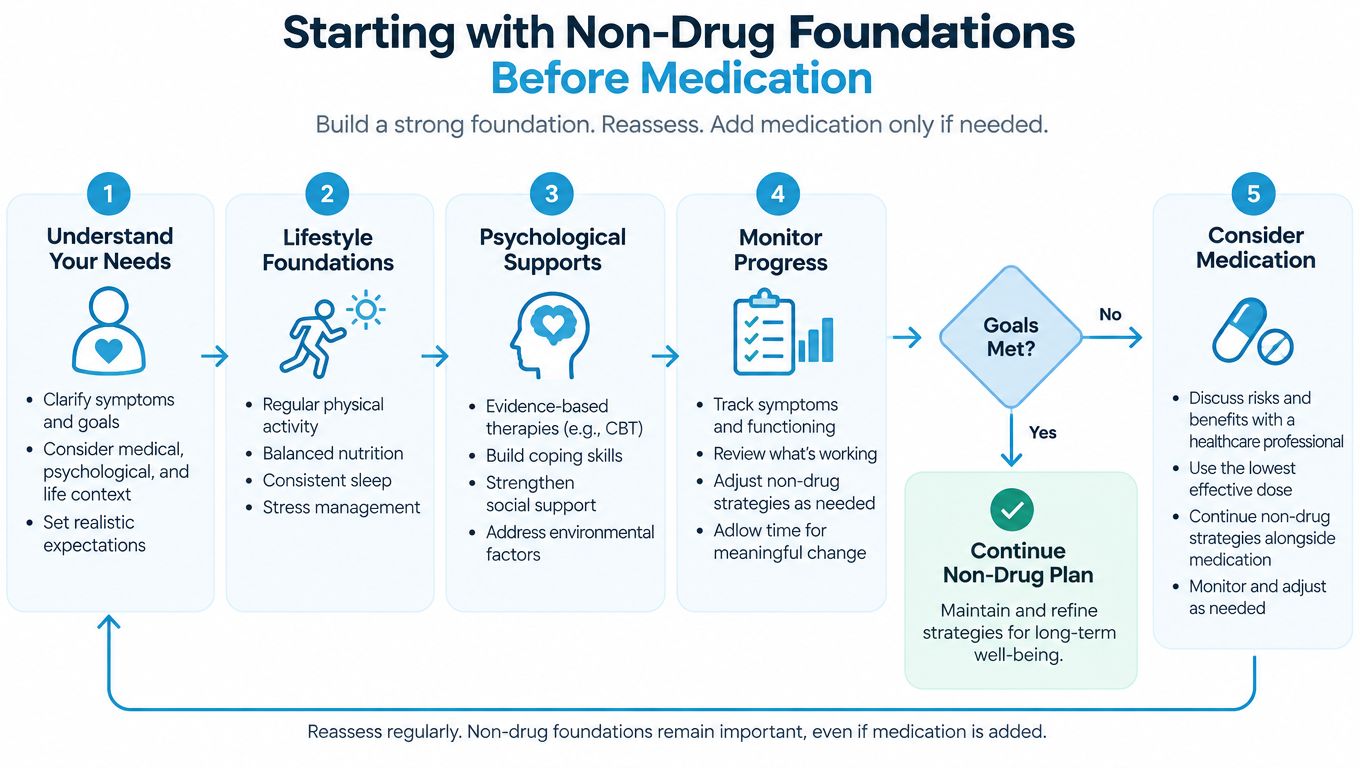
The first step is usually to support circulation, then see what your body can tolerate. A practical starting point is about 2 to 3 L/day of fluid, with sodium increased gradually toward 10 g/day when clinically appropriate and supervised, because volume support can make standing easier for some patients (treatment overview). That does not mean everyone should push salt upward without review. Kidney disease, hypertension, edema, and subtype differences all matter.
Build support before you build intensity
Compression garments and physical counter-maneuvers are often useful because they help push blood upward when standing. Supervised exercise should begin in recumbent or non-upright positions, such as rowing, swimming, or recumbent cycling. The goal is to train without repeatedly triggering the same symptom pattern you are trying to settle.
The common mistake is moving into upright exercise too fast. That can make symptoms flare early, which leads people to conclude exercise does not work when the problem was the starting point, not the idea itself. A better approach is to progress aerobic duration and resistance work over roughly 3 months, while watching orthostatic symptoms, standing heart rate, blood pressure, hydration status, and general tolerance (structured exercise guidance).
Start low enough that the next day is still usable.
That matters more than generic fitness advice. If recumbent training leaves you wiped out for 24 hours, the dose was too high. If you can repeat it and still function, you are more likely to build conditioning instead of creating a cycle of stop-start setbacks.
The evidence supports that cautious approach. In one exercise-training study, orthostatic intolerance remained after treatment in 6 of 16 participants, compared with 10 of 11 controls. In a six-month training comparison, only 23% of treated participants still met the heart-rate criterion for POTS, versus 93% of controls, with P < 0.0001. Those findings are meaningful, but they come from specialized cohorts, so they are not a promise of the same outcome for every patient.
For a practical walkthrough of these foundations, see how to help POTS symptoms.
Understanding Medication Options and Their Limits
Medication makes sense when non-drug measures are not enough, but it should not be treated as an automatic next step. A systematic review of 21 randomized clinical trials involving 750 patients looked at propranolol, midodrine, pyridostigmine, ivabradine, and other therapies, and still concluded that the evidence is too limited to set a universal medication hierarchy. That is the practical problem in POTS pharmacology. These drugs can help, but they do not help every patient in the same way.
Match the drug to the physiology
The best choice depends on what is driving the symptoms. If low blood volume is part of the picture, volume-support approaches may make more sense. If venous pooling is driving the symptoms, a peripheral vasoconstrictor such as midodrine is usually the first candidate. If the main problem is heart-rate acceleration, a rate-modulating drug may help, but only if it does not flatten exercise tolerance or worsen fatigue.
Low-dose propranolol is often used because it can lower standing heart rate and improve symptoms, while higher doses may be less effective. Long-acting propranolol has not consistently improved quality of life, so more medication is not automatically better. Midodrine supports peripheral vasoconstriction, fludrocortisone promotes sodium retention, and pyridostigmine is another specialist-directed option that may reduce tachycardia (clinical overview).
Measured improvements are encouraging, but they are not proof of superiority. One analysis estimated symptomatic improvement rates of 77.76% for midodrine, 74.51% for ivabradine, and 64.45% for beta-blockers, though those figures combine heterogeneous studies and should not be read as direct comparisons (medication review). In a randomized crossover trial, ivabradine reduced peak standing heart rate to about 99 bpm compared with 118 bpm on placebo, and propranolol to about 100 bpm. The standing-minus-supine increase also fell from 36 bpm with placebo to 27 with ivabradine and 28 with propranolol (medication review).
Monitor side effects as closely as symptoms
Medication trials should be judged with more than a pulse reading. Clinicians need to watch supine and standing blood pressure, electrolytes, edema, headache, urinary retention, and medication-related fatigue. If the standing heart rate improves but you cannot think clearly, cannot exercise, or feel worse after dosing, the trade-off may be wrong for you.
Earlier observational data involving 49 patients who took ivabradine found 88.4% reported improved palpitations and 76.1% improved light-headedness (medication review). That is useful, but it still does not replace individualized prescribing. The question is which option best matches the patient's blood pressure, fatigue pattern, subtype, and daily function.
Tracking Episodes That Matter for Clinical Decisions
A generic heart-rate graph tells you something happened. A clinically useful episode report tells you whether it was orthostatic, how long it lasted, what it felt like, and whether it lined up with standing, hydration, medication timing, or exertion. That difference matters because POTS care depends on context, not just peaks.
Why context beats isolated numbers
Simple fitness tracking often collapses everything into a line on a screen. That's not enough for POTS, because workouts, recovery periods, standing episodes, and brief stress spikes can all look similar if you ignore the surrounding circumstances. Cardiogram's heart-rate alert app capability for POTS identifies a rise of 30 or more bpm within five minutes and records the baseline, peak, sustained duration, and time of occurrence, which makes episode review much more actionable than an isolated daily average.
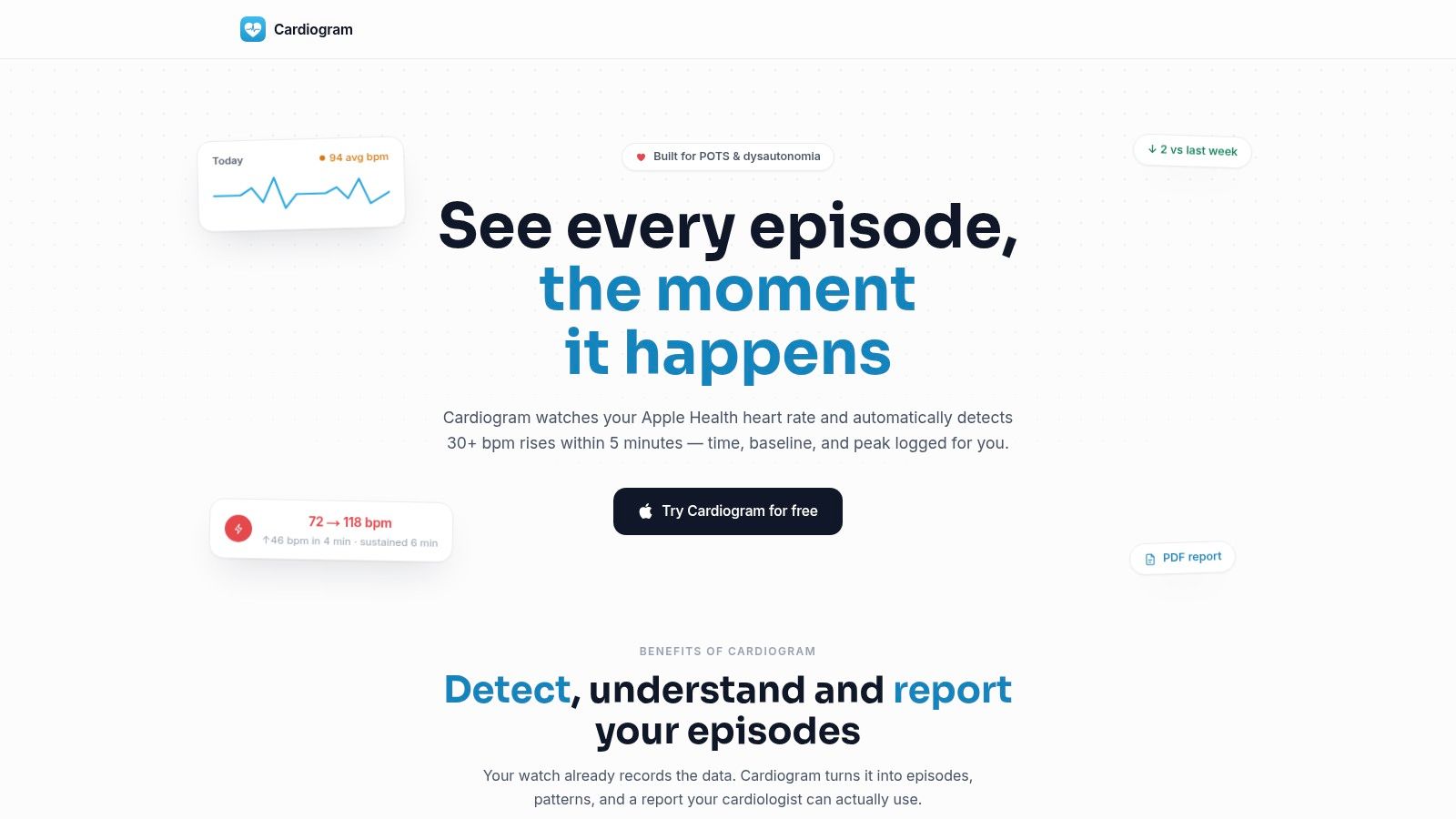
Longitudinal pattern recognition is where the value lies. When you can compare baseline-versus-standing heart rate, symptom burden, syncope, activity tolerance, hydration, salt exposure, and medication timing over weeks instead of hours, appointment conversations become much sharper. That's especially helpful when the question isn't whether tachycardia exists, but whether a treatment is improving function.
A report that shows when the episodes happened is more useful than a memory of how you felt last Tuesday.
That's where context-aware filtering matters too. Exercise-related spikes can muddy the picture if they're counted as orthostatic events, so excluding workouts and recovery periods keeps the episode list clinically cleaner. For readers trying to understand their own data, this guide on POTS heart-rate monitoring helps separate meaningful episodes from noise.
The broader monitoring goal is simple. You want to know whether your treatment plan is reducing true orthostatic burden or just making the numbers look calmer on paper.
Building Clinician-Ready Reports for Better Appointments
POTS appointments are short, and memory gets shaky after weeks of symptoms. By the time you sit down with a clinician, it is easy to forget which days were worse, whether poor sleep came before the flare, or whether a medication change helped palpitations but left you more fatigued. A structured report turns scattered observations into something a clinician can scan quickly.
Organize symptoms around episodes, not just days
Start by linking the symptoms that matter most to each episode. Dizziness, palpitations, fatigue, brain fog, hydration, salt intake, sleep, and medications should sit next to the event they may have influenced. That makes the report clinically useful, because it shows both what happened and the context around it.
Weekly summaries add another layer. Resting heart-rate trends, episode heatmaps, and repeated timing patterns can show whether symptoms cluster around certain hours, activity levels, or medication windows. When those pieces are shown together, you do not have to rebuild your history from scratch at every visit.
A practical report should answer three questions:
- What happened? Show episode timing, baseline, peak, and duration.
- What was going on? Attach symptoms, hydration, sleep, salt, and medication context.
- Did anything change? Compare the current week with earlier patterns so treatment effects are easier to see.
The goal is not a perfect dashboard. It is to narrow the gap between what you felt and what you can explain under pressure. The right report format also makes it easier to match your output to the way you and your clinician talk about symptoms, and report customization gives a useful starting point for that.
Ask better questions at the visit
Once you have that summary, the appointment changes. Instead of saying “my heart rate is all over the place,” you can say, “these episodes still happen when I stand after poor sleep, and the current medication lowers the peak but does not improve function.” That shifts the discussion toward treatment choices instead of symptom frustration.
A good report also makes the detection rule visible. If the PDF notes that an episode is only counted after a sustained rise above baseline, your clinician can judge the pattern with the same filter in mind. That small detail matters, because it keeps a noisy watch trace from looking more convincing than it is.
If you want a clearer way to turn tachycardic episodes into something you can discuss at an appointment, start using Cardiogram. It organizes heart-rate episodes, symptoms, and trends into clinician-ready reports, which can help you and your care team decide whether hydration, exercise, or medication changes are improving real-life function.
Moving From Heart-Rate Numbers to Real-World Function
The best marker of progress is not a lower heart-rate spike by itself, it's whether you can stand longer, recover faster, and live with fewer symptom interruptions. Heart-rate reduction can be useful, but it isn't the same thing as recovery, and it can even be misleading if it comes with more fatigue or lower activity tolerance.
The cleaner way to judge postural orthostatic tachycardia treatment is to track the same few things over time, orthostatic heart rate, blood pressure, symptom burden, activity tolerance, hydration, and adverse effects. When those are reviewed together, you can tell whether a treatment is helping the body function, not just calming a monitor. That's the feedback loop that makes trial-and-error less random.
If you want a clearer way to turn tachycardic episodes into something you can discuss at an appointment, start using Cardiogram. It organizes heart-rate episodes, symptoms, and trends into clinician-ready reports, which can help you and your care team decide whether hydration, exercise, or medication changes are improving real-life function.