
You stand up to make breakfast, your heart races, and you're back in a chair before the kettle finishes. You've heard the advice about water, salt, compression, and exercise, but you still don't know what to try first or whether anything is helping.
Postural tachycardia treatment works better as a measured experiment than a growing checklist. Agree on a safe intervention, document what changes over several weeks, and review heart rate alongside symptoms and daily function. Don't keep adding treatments without deciding what success should look like.
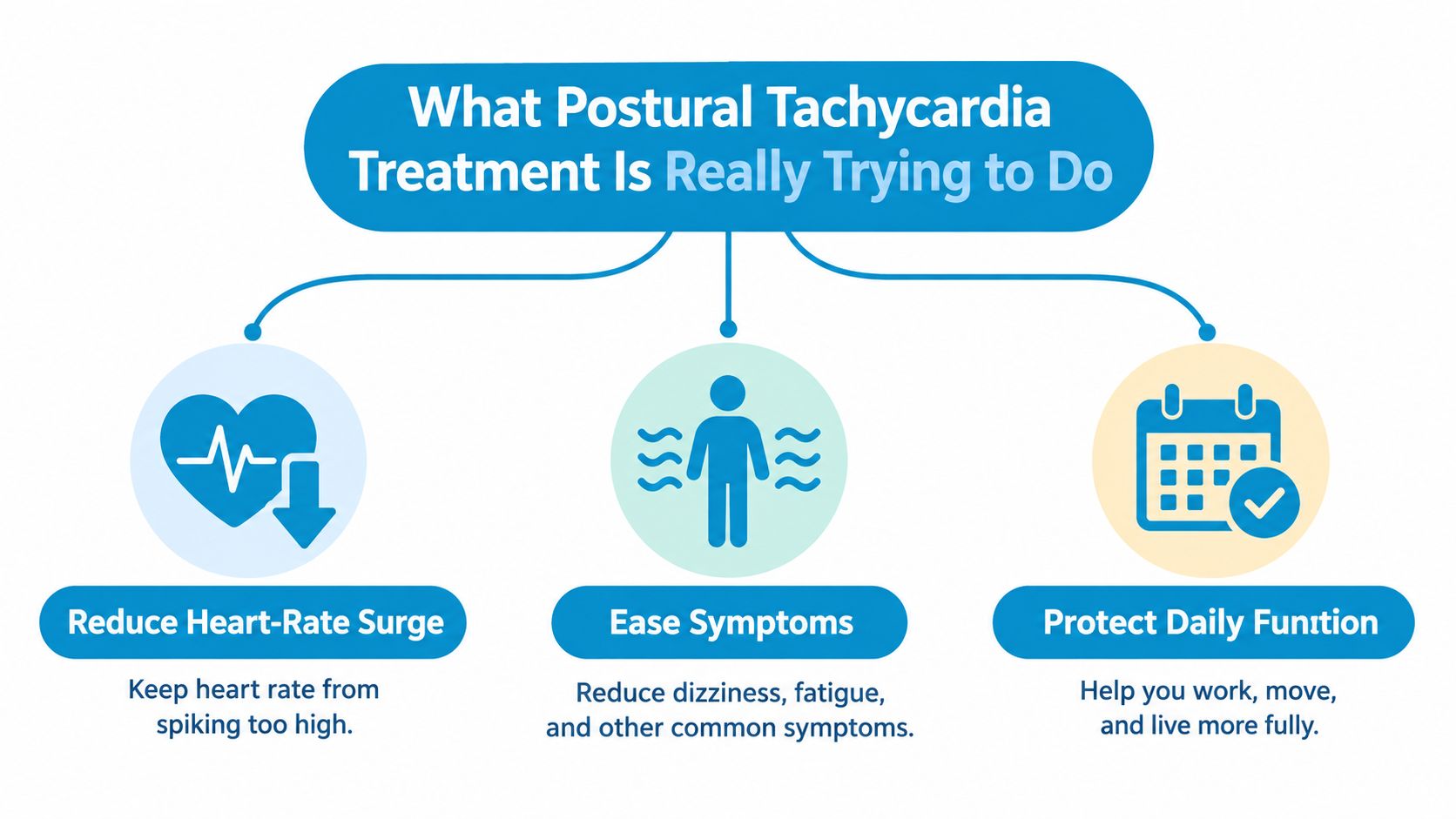
What Postural Tachycardia Treatment Is Really Trying to Do
A lower standing heart rate matters, but it isn't the whole outcome. You also need to know whether you can prepare a meal, concentrate at work, or recover from ordinary activity without losing the rest of your day.
The foundational expert consensus on POTS management recommends a stepwise approach beginning with nonpharmacologic measures rather than medication alone. It also recognizes that treatment needs to address different clinical features, including reduced circulating volume and prominent sympathetic activation.
Choose outcomes you actually care about
Before changing your routine, write down what you want treatment to make possible. Use a combination of physiological measurements and practical outcomes.
| Treatment outcome | What to document |
|---|---|
| Standing response | Heart-rate change with posture under comparable conditions |
| Episode burden | How long episodes last and what you were doing |
| Symptom relief | Dizziness, palpitations, fatigue, and difficulty concentrating |
| Daily function | Whether a specific ordinary task becomes more manageable |
My recommendation is to choose a repeatable daily task as your functional benchmark. Preparing breakfast while taking fewer seated breaks is more useful than a vague goal of feeling better.
Treat the pattern, not an isolated reading
A heart-rate threshold can help clinicians assess an orthostatic pattern, but a watch reading alone doesn't establish POTS. Clinical assessment must consider posture, blood pressure, symptoms, and alternative explanations for tachycardia.
Likewise, a lower peak doesn't automatically mean treatment is working well. If you feel worse or accomplish less, that belongs in the treatment discussion.
Practical rule: Judge an intervention by what happens to your symptoms and usable day, not just the most reassuring number on your screen.
For planned changes, keep the rest of your routine reasonably consistent when possible. If your clinician needs to change several things together, document that clearly rather than pretending you can identify which component helped.
That's the working loop: establish a baseline, try an agreed intervention, observe the response, and decide whether to continue, adjust, or stop.
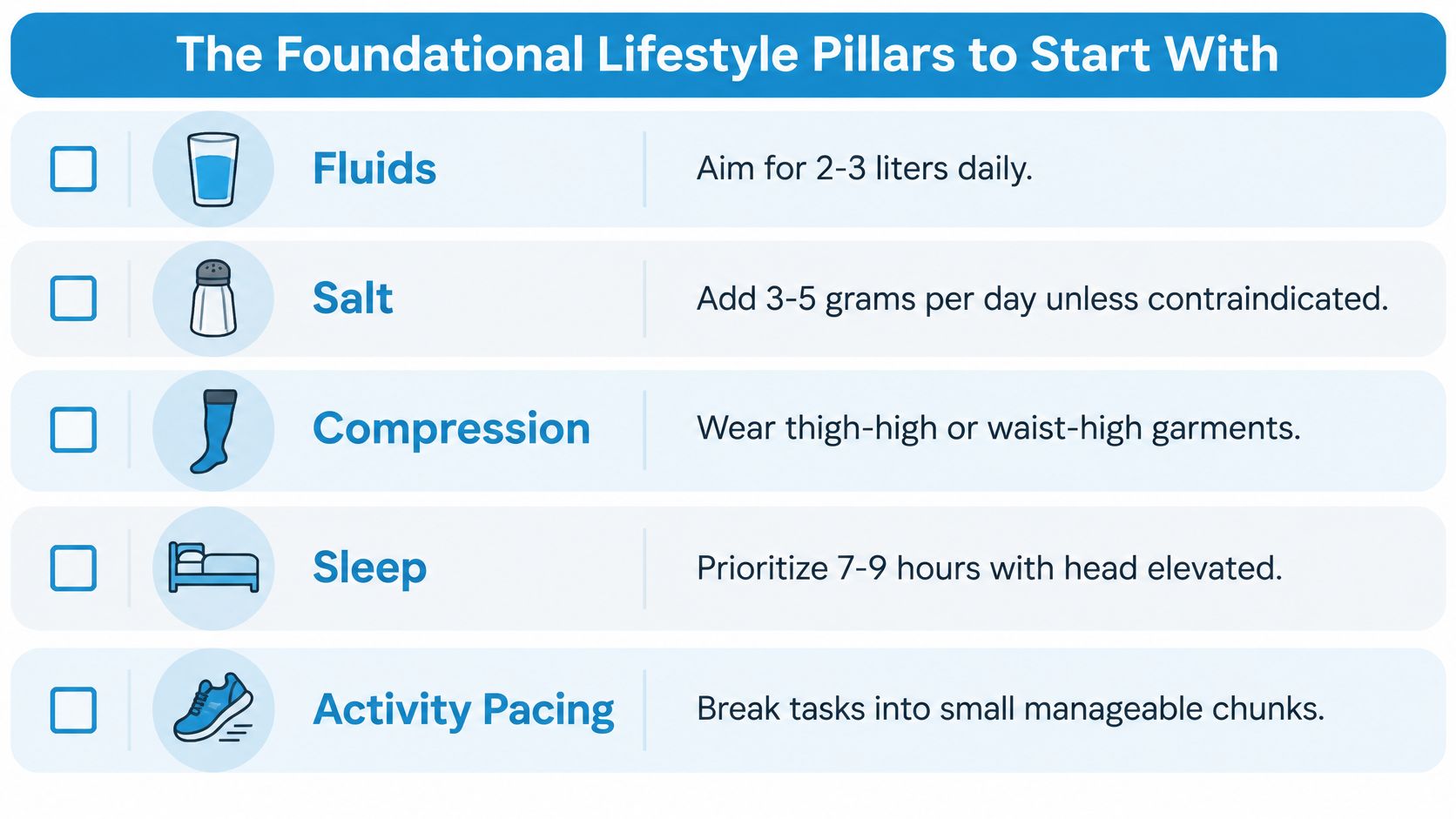
The Foundational Lifestyle Pillars to Start With
Start with a medication review and an individualized foundation, not an aggressive salt target copied from a social post. Ask your clinician or pharmacist whether anything you take could worsen tachycardia or reduce circulating volume, and don't discontinue prescriptions independently.
The clinical consensus protocol for conservative treatment describes approximately 2–3 liters of water and 10–12 grams of sodium chloride daily, when medically appropriate, alongside compression and progressive conditioning. Sodium chloride means salt, not elemental sodium. Ask which quantity your clinician means before interpreting food labels or buying supplements.
Make the foundation medically safe
Hypertension, kidney disease, heart failure, and other volume-sensitive conditions require clinician oversight before fluid or salt loading. Don't interpret the guideline quantities, or a simplified infographic, as a personal prescription.
Set your target with the clinician managing those conditions. The practical guide to salt and POTS can help you prepare questions about intake and monitoring, but your medical history determines whether an increase is appropriate.
- Fluids: Spread your agreed intake through your waking day. Record what you drink rather than assuming a bottle on your desk means you've met the plan.
- Salt: Document the amount and form you use. If you're unsure whether a label lists sodium or salt, resolve that before increasing it.
- Compression: Ask which garment targets your pattern of venous pooling. Comfort and the ability to wear it consistently should be part of the choice.
Don't treat maximal garment coverage as the only acceptable approach. If a garment is intolerable, ask about alternatives, including abdominal compression, rather than abandoning the discussion.
Make the routine livable
I recommend a consistent sleep routine and planned seated breaks because they make your experiment easier to interpret and sustain. Record poor sleep rather than changing your treatment every time you have a difficult morning.
For predictable post-meal difficulties, document the meal, timing, and symptoms before making broad dietary restrictions. Discuss whether smaller meals or a different activity schedule would be reasonable to test.
Pacing means planning activity before you're overwhelmed. Put a chair near a task you struggle with, prepare supplies while seated, and separate demanding activities instead of stacking them together.
Don't introduce every possible lifestyle adjustment at once unless your clinician recommends it. A manageable routine you can describe accurately is more useful than an elaborate plan you can't follow.
How to Start and Progress an Exercise Program Safely
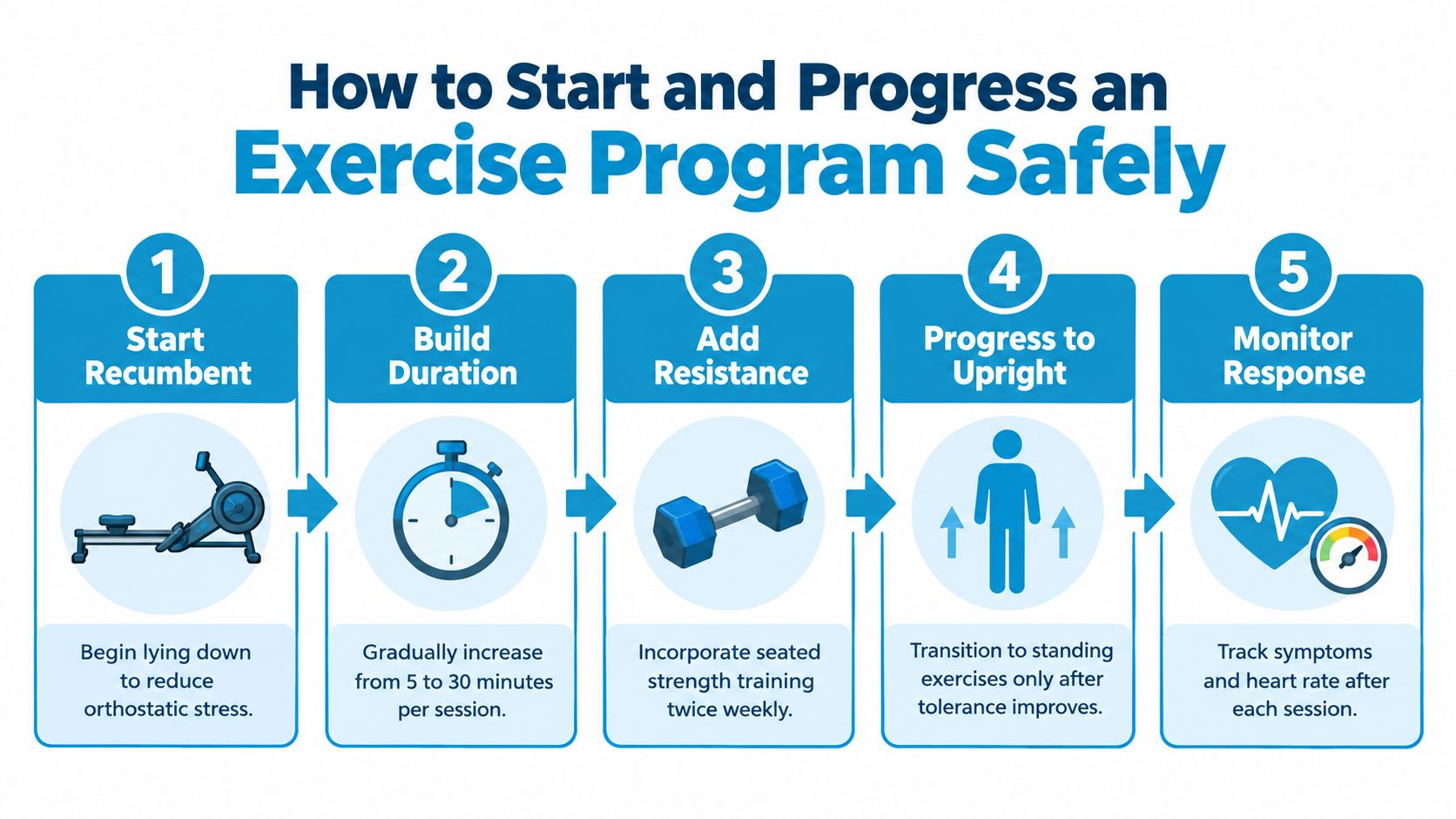
A patient starts treadmill walking because that is what "exercise" means to her, spends two days unable to get through errands, and concludes that conditioning makes her POTS worse. The prescription failed her, not the effort. Start with your current tolerance, not a generic fitness schedule. The conservative protocol described earlier favors non-upright activity before progressing toward upright aerobic exercise and thigh-resistance work.
Rowing, recumbent cycling, and swimming all qualify. Discuss them with your clinician or rehabilitation professional and pick the one you can access reliably and recover from predictably. A modality you can repeat beats an ideal one you cannot reach.
Progress according to recovery
Treat any exercise graphic as an overview, not a personalized starting dose. Your initial duration, resistance, and progression should reflect your symptoms and the clinician's assessment. Then sequence your decisions in this order:
- Starting position. Begin with a supported or recumbent modality that limits upright stress.
- Repeatability. Find the amount you can reproduce without sacrificing the rest of your day afterward.
- Progression. Extend duration before adding substantial intensity, and change one training variable at a time.
- Upright transition. Move toward upright work when your logs support it, not because a certain date arrived.
Run each stage for several weeks before judging it. Record modality, duration, symptoms during activity, your standing heart-rate response, and next-day recovery. When you review that record with your clinician, the question is concrete: stable numbers argue for continuing or advancing, and a pattern of prolonged worsening argues for revising the dose rather than pushing through it.
A practical explanation of the Levine protocol can help you understand the conditioning approach before discussing an adapted program with your care team. Treat it as a framework to modify, not a pass-or-fail test of effort.
Expect improvement, not a promised cure
In a small controlled study summarized in research reporting on exercise training for POTS, a 3-month program improved physical function in all completers, and 53% still met the standing-heart-rate criterion afterward. Encouraging results, but the small sample and the focus on completers limit what you should expect personally.
The useful lesson is that carefully structured conditioning is worth testing with realistic endpoints and attention to who can complete it.
A program you can recover from is more useful than a harder program you repeatedly have to abandon.
If activity produces substantial or prolonged worsening, do not force the next increase. Contact the supervising clinician and revise the plan. Progression is a clinical decision, not a willpower contest. You want a sustainable gain in capacity, not proof that you can tolerate distress.
Common Medications and How They Are Actually Chosen
Medication should solve a defined problem. Before accepting a prescription, ask what feature it targets, what improvement you should notice, and what adverse effects should prompt contact.
The evidence doesn't support pretending there's a universally preferred drug. A systematic review of randomized POTS treatment trials identified 21 trials involving 750 participants from 2000–2023 and concluded that the evidence remained weak, with larger trials needed to establish preferred first-line medications.
Match the option to the clinical pattern
The consensus guidance discussed earlier includes the following options. This is a conversation map, not a menu for self-prescribing.
| Medication approach | What to clarify with your clinician |
|---|---|
| Low-dose propranolol | Whether reducing tachycardia fits your symptoms and blood-pressure pattern |
| Midodrine | Whether orthostatic pressure support is an appropriate target |
| Fludrocortisone | Whether a volume-supporting strategy suits your medical history |
| Pyridostigmine | Why it's being considered and how response will be assessed |
| Ivabradine | Whether your tachycardia pattern resembles the patients studied |
| Clonidine or alpha-methyldopa | Whether prominent hyperadrenergic features justify this approach |
Ivabradine illustrates why patient selection matters. A randomized crossover study included 22 patients with hyperadrenergic POTS, with one month on ivabradine and one month on placebo, and found a significant heart-rate reduction during ivabradine treatment, as summarized in the review of pharmacologic evidence.
That result supports a focused clinical discussion. It doesn't establish that the same medication is appropriate for every presentation or that lowering heart rate will resolve every symptom.
Arrive with a treatment question
Bring a complete list of prescriptions, nonprescription medicines, and supplements. Specifically ask whether any medication blocks the norepinephrine transporter, because the foundational guidance warns that this drug class can worsen symptoms; have your prescriber identify the relevant medicines rather than stopping them yourself.
Your appointment notes should include:
- The target: Which symptom or functional limitation you most want to improve.
- The recent trial: What you changed, whether you could follow it, and what happened.
- The safety context: Blood-pressure observations, other conditions, and adverse effects.
- The review plan: When to reassess and what would justify continuing or changing course.
Medication can support the broader plan without replacing it. Equally, you don't need to prove you've endured every lifestyle intervention before discussing symptom relief. Ask for a rationale, an assessment plan, and clear instructions about when to call.
Tracking Episodes, Symptoms, and Interventions Between Visits
Three weeks on extra salt and compression tells you nothing unless you can answer one question: did standing heart rate, episode duration, and symptoms improve under comparable conditions? Tracking exists to answer that question. Everything else is optional.
Separate the measurement from your interpretation. A heart-rate rise captured on your Apple Watch, paper log, or spreadsheet is an observation. Deciding why it happened takes context, and context is what most logs skip.

Here is what a useful entry looks like:
Stood to prepare lunch, 11:40. Heart rate rose from 78 to 118 and stayed elevated about four minutes. Felt dizzy, sat down, symptoms settled. Poor sleep last night, second day of the new fluid target.
Short, factual, honest. It records the trigger, the numbers, the symptoms, and two pieces of context without theorizing about cause.
Now run the review loop:
- Pick one change and commit. Adjust fluids, salt, compression, or a medication dose as agreed with your clinician, then hold it steady for several weeks before judging it.
- Record episodes and context together. Capture baseline, peak, duration, and time for each meaningful event, plus posture, activity, sleep, illness, heat, meals, and menstrual-cycle timing when relevant. Mark exercise days so a training-related rise isn't read as treatment failure. Include blood pressure and adverse effects if your clinician asked for them.
- Review against fixed markers. Compare standing heart rate, episode duration, and symptom burden before and after the change. A heatmap or resting-heart-rate trend can reveal clustering by time of day, but neither identifies the cause on its own.
- Decide: continue, escalate, or change course. Bring the result to your clinician and make that call together.
A few habits keep the loop honest. Fewer recorded episodes mean little if you spent far less time upright, so note your upright time when you can. Log adherence factually, because compression you couldn't tolerate or an exercise schedule that collapsed in week two is exactly the information your clinician needs. And if an automated report generates your summary, confirm it states its detection rule and separates measured heart-rate events from a clinical diagnosis.
The symptom-tracking guide for chronic illness can help you build a logging routine you'll actually keep. Consistent brief entries beat an abandoned perfect system, and a clean timeline plus a handful of representative episodes supports a sharper appointment conversation than a stack of unexplained graphs.
Red Flags and When to Stop Self-Managing
You wake on day six of a new medication and your resting rate sits far above anything your log has recorded. The tracking loop described throughout this article runs on one assumption: that you are measuring a known condition responding to a known change. Symptoms that break that pattern end the experiment. A familiar POTS diagnosis doesn't make every new symptom safe to manage at home, and the clinical overview of POTS management emphasizes individualized treatment and medical assessment, including caution around volume expansion and medication effects.
Some symptoms are hard stops. Seek emergency assessment for new or severe chest pain, severe breathlessness, confusion, or sudden major vision changes, particularly when they persist or arrive together. Don't delay care to capture one more reading or to test whether extra salt settles things. Fainting deserves clinical attention whenever it is new, recurrent, causes injury, or differs from your established pattern, and sustained resting tachycardia markedly unusual for you warrants prompt assessment rather than automatic attribution to POTS.
You don't need a concerning watch result to justify seeking help.
During an episode, sit or lie somewhere safe and stop the activity; a half-finished log entry is never worth a fall. If dehydration or heat illness is a concern, get medical advice instead of repeatedly pushing intake when you cannot confirm you can safely replace fluids. After a treatment change, contact the prescriber for concerning symptoms or suspected adverse effects and follow the escalation instructions you already agreed on. Speaking of which: ask your care team in advance which symptoms trigger emergency care versus same-day contact, and write that distinction down. Sorting categories while you feel unwell is unreliable.
The loop itself tells you when self-management has run its course. If function declines across review cycles, interventions keep failing, or the diagnosis remains uncertain, ask whether specialist evaluation is appropriate. Depending on the question, that may mean cardiology, electrophysiology, or an autonomic specialist. Bring the full treatment timeline rather than the single worst pulse reading, and ask whether clinical orthostatic measurements, an ECG, or laboratory work should come before further changes. The foundational consensus also discourages routine long-term intravenous saline, because evidence is limited and repeated intravenous access can cause harm, so infusions are not a substitute for that review. Self-management should support medical care, not postpone it. A plan that grows more complicated while you grow less functional is itself a measurement, and it says escalate.
A Practical 4-Week Starter Plan and Common Questions
Use this month as an organizational framework, not a promise that treatment should work by its end. Your clinician may recommend a different pace, particularly if symptoms are severe or your medical history complicates conservative treatment.
Build a plan you can review
| Period | Main task | What to bring forward |
|---|---|---|
| Week 1 | Establish a baseline and confirm the safety of your proposed foundation | A medication list, functional goal, and agreed intake guidance |
| Week 2 | Begin an approved recumbent program and maintain a manageable log | Exercise tolerance, recovery, and representative episodes |
| Week 3 | Assess whether pacing and the routine are practical | Barriers, adverse effects, and questions for your clinician |
| Week 4 | Review the trial and agree on the next decision | What to continue, modify, investigate, or stop |
Don't interpret this as permission to delay care for red flags. It's a planning template for stable symptoms, with medical oversight where needed.
Questions that matter at the review
How long until treatment works?
There isn't a universal deadline. Agree on an intervention-specific review point and assess symptoms, function, tolerability, and measurements together rather than declaring success or failure after a single day.
Are salt and fluids safe for everyone?
No. Use the individualized safety discussion above, especially if another condition affects how your body handles volume or blood pressure.
Can I distinguish an orthostatic episode from panic or a workout spike?
Not reliably from pulse alone. Record posture, activity, timing, and symptoms, and let your clinician interpret uncertain events rather than assigning a cause from the graph.
What should I bring to cardiology?
Bring your medication list, relevant blood-pressure observations, treatment timeline, representative episodes, and the daily task you're trying to make easier. Include what you couldn't tolerate, not just what you completed.
For a printable reminder, keep these prompts together:
- What did I try?
- What changed in symptoms and function?
- What adverse effects or barriers appeared?
- What decision do I need help making?
Good progress means you and your clinician can make a clearer next decision. It doesn't require a flawless graph or an ever-longer treatment list.
Cardiogram offers automatic detection of 30+ bpm rises within 5 minutes, recording baseline, peak, sustained duration, and timing while excluding workouts and recovery periods from episode counts. Visit to explore exportable PDF reports that state the detection criterion and help you bring a structured heart-rate history to your next treatment review, without treating an app flag as a POTS diagnosis.