Inappropriate sinus tachycardia is a symptomatic sinus rhythm with a resting rate above 100 bpm and a 24-hour average above 90 bpm that has no physiologic, medical, or drug-related explanation.
You might be reading this because your watch keeps flagging a fast pulse while you're sitting still. Perhaps your heart pounds during ordinary chores, yet earlier tests were described as normal. Those observations deserve attention, but the explanation takes more than matching a number to a definition.
When Your Heart Races Without a Reason
You're at your desk, not exercising or rushing anywhere, and you notice your heartbeat again. Later, carrying laundry leaves you breathless, and the pounding takes longer than you expect to settle. By the time you reach a medical appointment, your pulse may look less remarkable.
That mismatch can be frustrating. Inappropriate sinus tachycardia, usually shortened to IST, describes a clinical syndrome involving an unexpectedly fast rhythm from the sinus node, the heart's own pacemaker. The word inappropriate describes the rate's mismatch with the situation, not your response to it.
IST isn't just a fast number. It's a fast number with no adequate explanation and real symptoms attached.
The useful questions go beyond how high your pulse gets:
- Criteria: Is the rhythm sinus, and does the overall pattern fit?
- Daily experience: Which symptoms occur, and what activities become difficult?
- Possible explanations: Is another condition or substance driving the rate?
- Posture: Does standing account for most of the change?
- Management: What would improve your symptoms and daily function?
IST generally has a reassuring outlook, but reassurance shouldn't mean dismissal. The practical goal is to establish what's happening, exclude conditions that need different treatment, and make daily life more manageable.
What Counts as Inappropriate Sinus Tachycardia
The sinus node is a small group of cells that starts the electrical signal for each heartbeat. It adjusts the heart's pace as the body's needs change. A faster sinus rhythm during exertion is a normal response; the clinical question is whether the rate remains unexpectedly high when the situation does not call for it.
The 2015 Heart Rhythm Society expert consensus statement defines IST through a combination of heart-rate measurements, distressing symptoms, and the absence of another primary explanation. The thresholds are reference points clinicians interpret alongside the person's history and test results.
Inappropriate sinus tachycardia criteria at a glance
| What is checked | Threshold or requirement | How it is checked |
|---|---|---|
| Rhythm origin | Sinus rhythm, not another tachycardia | Standard ECG showing sinus P waves |
| Resting heart rate | Above 100 beats per minute | Resting ECG or supervised resting measurements |
| 24-hour average heart rate | Above 90 beats per minute | Ambulatory Holter monitor |
| Related symptoms | Distressing symptoms such as palpitations | Symptom history or diary linked to recorded rates |
| Other explanations | No explanatory fever, anemia, thyroid disease, dehydration, stimulants, or drug effects | Targeted blood tests, medication review, and clinical examination |
Symptoms and heart-rate findings are considered together. A measurement above a threshold, without related distress or the rest of the clinical picture, does not by itself establish IST.
A peak and an average also describe different patterns. A brief increase during a busy afternoon may reflect a temporary response to activity. Repeatedly high rates at rest and a higher average across ordinary activities and sleep raise different questions for a clinician.
Why a threshold isn't a diagnosis
A watch can record a pulse rate, but that reading alone cannot show why the rate changed or confirm the heart's electrical rhythm. Consumer sensors can also miss or misread beats, especially when movement or poor contact affects the signal.
Even a consistent wearable pattern is only one part of the assessment. Clinicians consider symptoms, ECG or other rhythm recordings, and possible explanations such as fever, anemia, thyroid disease, dehydration, stimulants, or medication effects. A normal-looking test does not make someone's symptoms unreal; it may mean that a particular test did not capture the pattern or identify its cause.
Posture can help distinguish possibilities. If the rise is closely tied to standing, a clinician may consider POTS; if it occurs in other situations as well, the pattern may point elsewhere. Ordinary increases with exertion or stress can also be appropriate body responses. Wearable data can help show when and how often the heart rate changes, but it cannot decide which explanation applies. The criteria are clinical reference points, not a self-diagnosis kit.
How It Feels and Who Gets It
A fast heartbeat is only part of what people bring to an appointment. The description that helps is how large the response feels next to the task: dishes left half finished because the pounding lingers after you stop, or a short walk that suddenly needs a rest. Daily limits often matter more than the highest number on a graph.
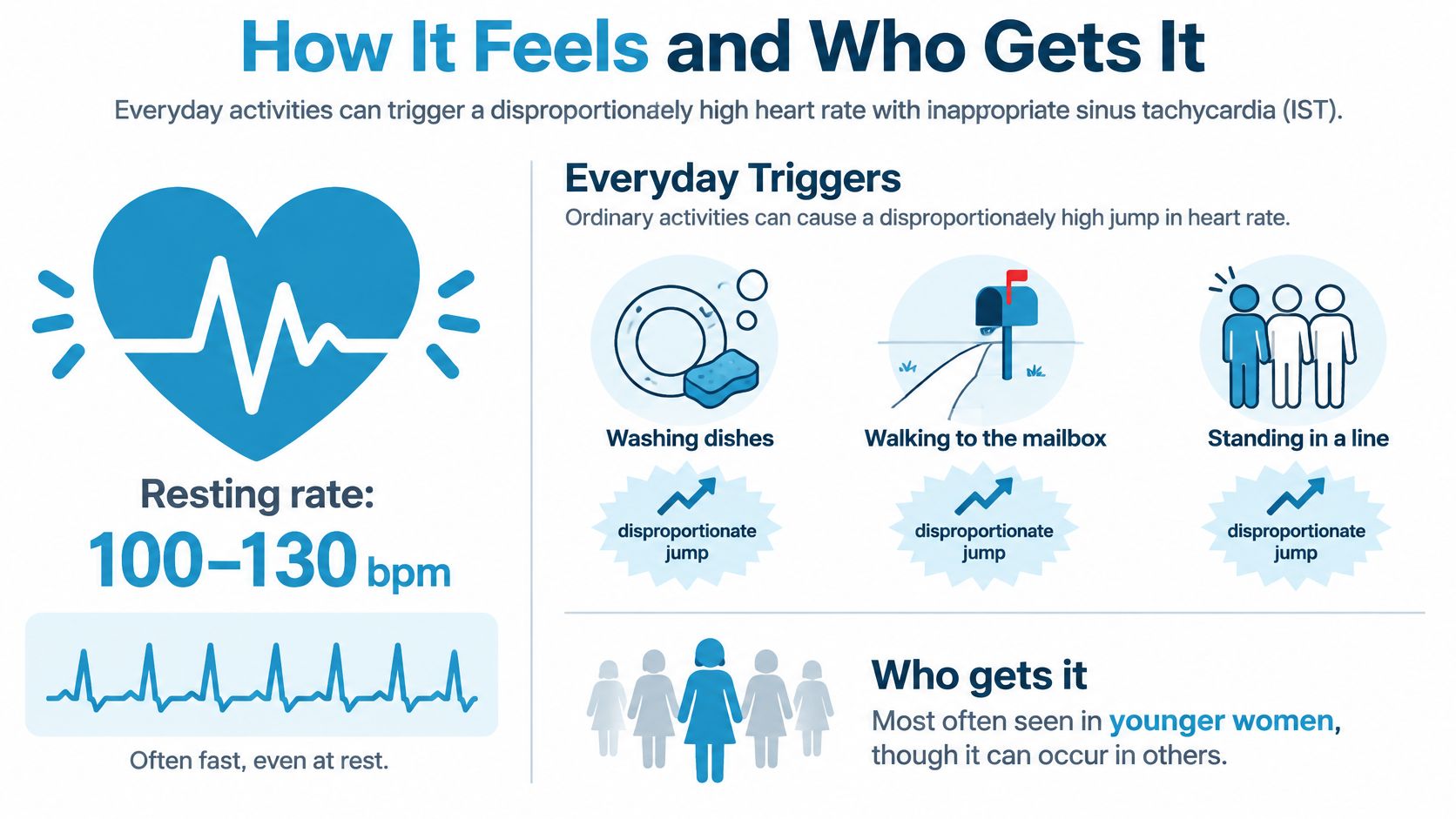
The illustrated heart-rate range is an example, not a required range for IST. People shouldn't use it to decide whether their symptoms count.
Symptoms can affect more than your heartbeat
Palpitations, the sensation of pounding, racing, or unusually noticeable heartbeats, are a common reason people seek help. Fatigue, difficulty tolerating exercise, breathlessness, and dizziness often travel with them.
Those complaints rewrite ordinary plans. You might leave chores unfinished, skip a walk with friends, or need recovery time after an activity that used to feel routine. Naming that burden gives a clinician something a single pulse reading cannot: how the day changed.
A clear account has three parts.
- Describe the sensation: Pounding, breathlessness, and lightheadedness are more informative than feeling unwell.
- Name the activity: Explain whether you were resting, standing, walking, or recovering.
- Describe the consequence: Say whether you had to stop, sit down, or abandon the task.
A trace can show that a rate rose. It cannot show the recovery you needed afterward, or whether the distress felt out of proportion to the work. That mismatch is what you are trying to put into words. Symptoms can stay disruptive even when a brief check looks ordinary.
Who develops IST
A review in the Journal of the American College of Cardiology cites an Icelandic study of randomly sampled people identified through hypertension insurance registries that estimated IST prevalence at 1.16%. That estimate describes the screened population, not everyone experiencing palpitations.
IST is not limited to one age or sex. A familiar pattern can prompt a clinician to consider the diagnosis, but age or sex should not decide whose symptoms get an evaluation. Distress that changes ordinary activity still deserves a look.
The split that matters in the moment is between a familiar pattern that needs assessment and an acute change that needs immediate attention. Chest pain, fainting, severe breathlessness, or a racing pulse with signs of infection shouldn't be assumed to be routine IST.
Why the Sinus Node Speeds Up for No Reason
You are sitting, nothing has startled you, and your heart is already running fast. In that setting, without a reason means clinicians have not found an appropriate external or secondary explanation, while a biological process is still setting the rate.
Several proposed mechanisms involve the pacemaker itself and the nerves that regulate it. They are possible contributors, not a checklist of proven causes in every person.
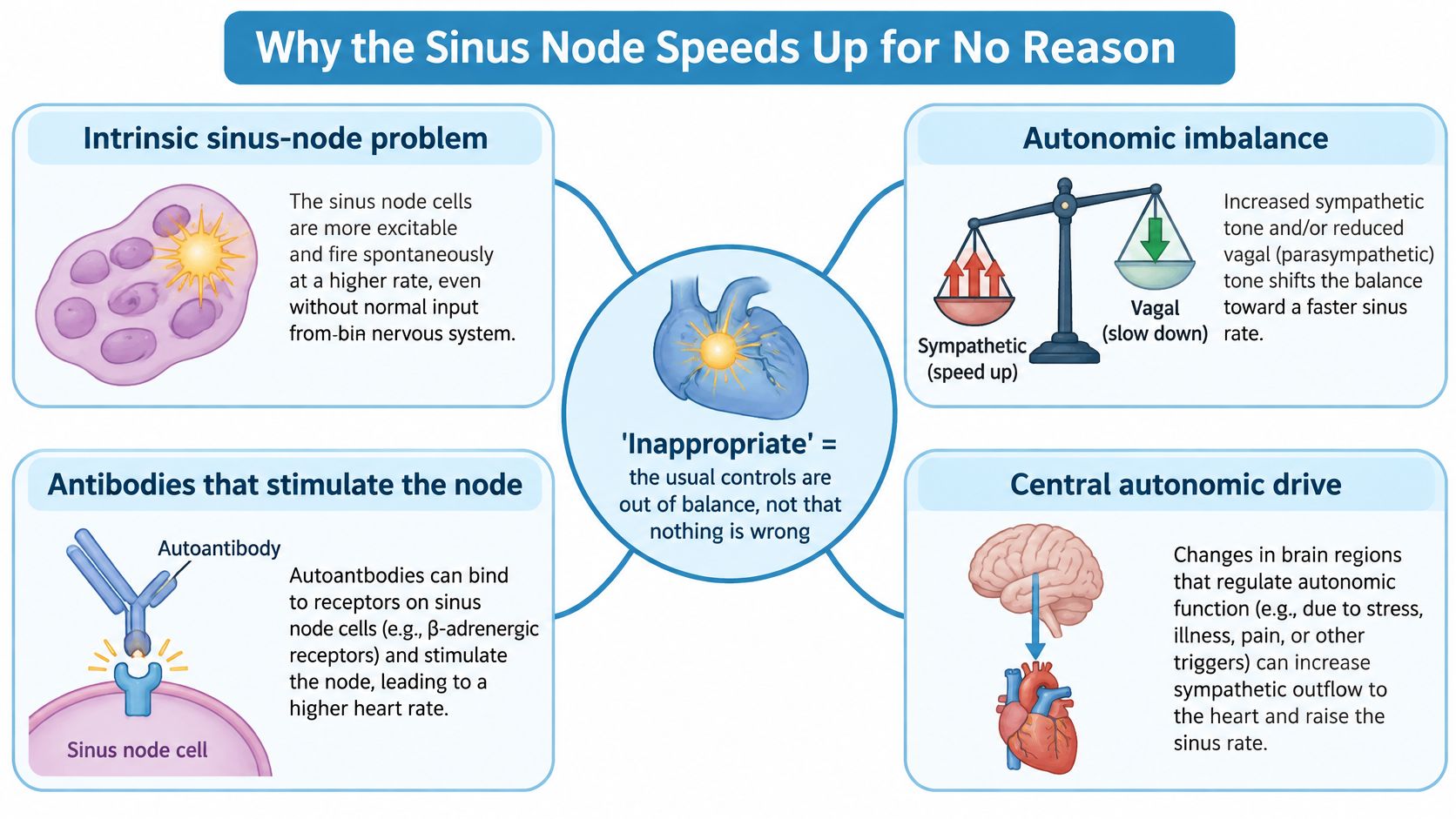
The diagram presents proposed pathways. It should not be read as proof that a particular person has an antibody-related condition or any other specific mechanism.
The pacemaker and its controls
An intrinsic sinus-node abnormality would mean the pacemaker's own cells tend to fire faster. The sinus node works like a thermostat calibrated too high: the starting setting is already different before outside signals arrive.
Autonomic dysregulation involves the autonomic nervous system's balance between speeding up and slowing down. The sympathetic branch helps increase heart rate, while parasympathetic signals help restrain it. A guide to autonomic nervous system dysfunction explains that broader control system.
Two related possibilities sit inside that balance. If the node is unusually sensitive to stress hormones, an ordinary adrenaline signal can produce an oversized rise. Separately, the vagus nerve's slowing effect may be weaker, so the same starting rate drifts upward with less restraint. These explanations can overlap. A clinician usually cannot name your exact mechanism from symptoms or a pulse graph alone, and uncertainty about the mechanism does not make the recorded rhythm less real.
Neither a character flaw nor a shortcut to anxiety
A fast pulse is a measurement of rate. Fitness and anxiety are separate questions: emotional stress can change heart rate, and a psychological condition can exist alongside a physical rhythm problem.
A real symptom can have an uncertain mechanism. You don't need a complete biological explanation before asking for a careful evaluation.
Record the pattern as information. Leave the cause open until a clinician has had a chance to sort through it.
How Doctors Confirm the Diagnosis
Diagnosing IST involves two tasks: confirming the rhythm pattern and excluding explanations that would make the fast rate appropriate or secondary. Skipping either task can lead to the wrong label.
The Heart Rhythm Society consensus published in Circulation supports a workup built around history, examination, a 12-lead ECG, selected laboratory testing, and ambulatory monitoring. Not everyone needs every possible test; the clinician selects investigations according to symptoms and findings.
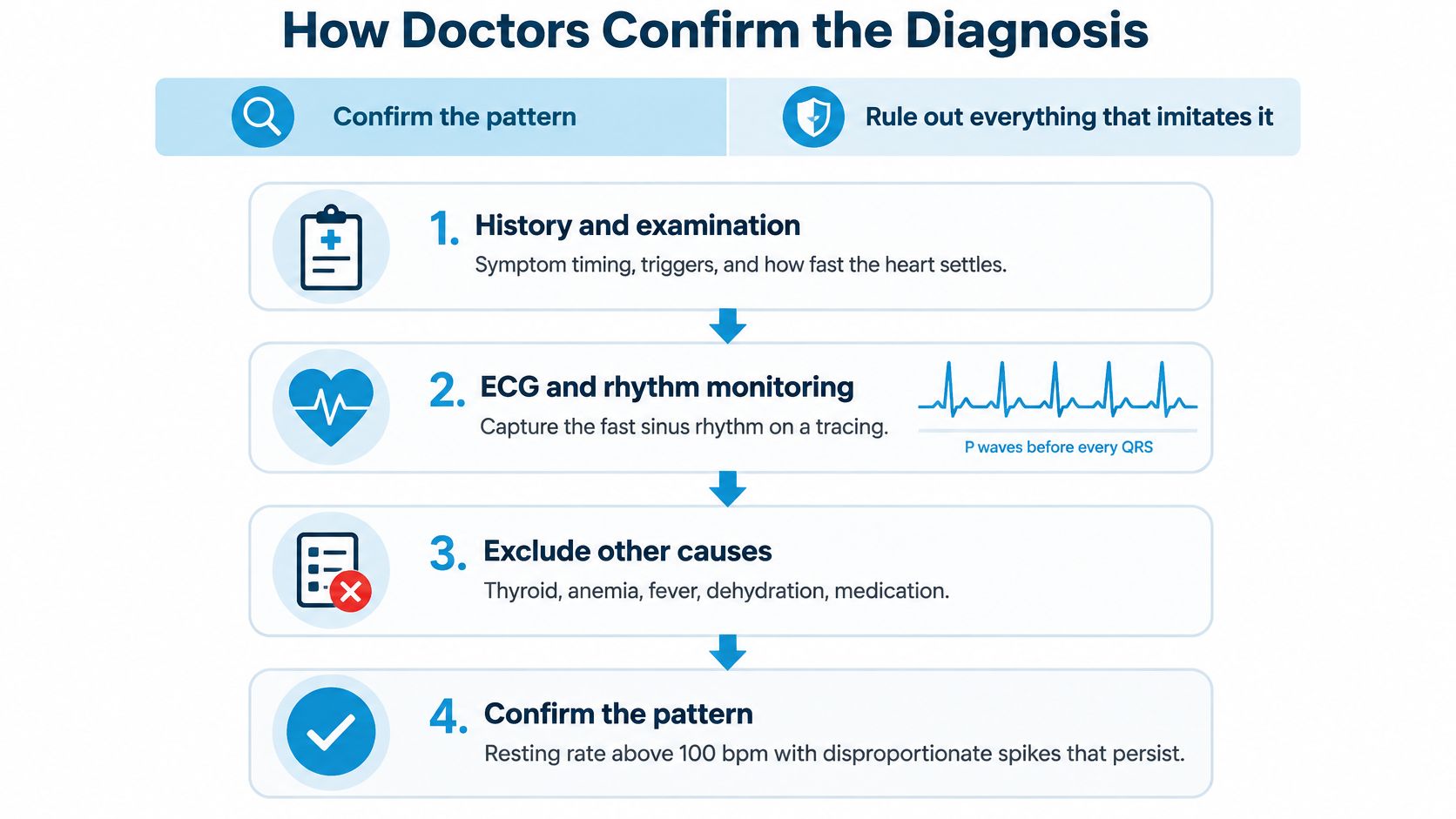
What the workup involves
History and examination. Your clinician asks when symptoms started, what precedes them, and what helps them settle. Bring a medication and supplement list, including stimulant-containing products, caffeine and alcohol use, and recent medication changes or withdrawal.
An ECG to identify the rhythm. The tracing shows electrical activity, including the P-wave pattern that helps establish whether the sinus node is driving the heartbeat. A pulse number alone can't distinguish sinus tachycardia from another fast rhythm.
Targeted blood tests. Thyroid testing can identify hyperthyroidism, and a blood count can reveal anemia. Electrolytes and investigations for infection or other systemic conditions may be appropriate when the history suggests them.
Ambulatory rhythm monitoring. A Holter or another prescribed monitor records the rhythm during daily life and helps connect symptoms with recorded activity. Our guide to ambulatory cardiac monitoring explains what these recordings can contribute.
Orthostatic assessment. Measuring heart rate and blood pressure during a change from lying down to standing helps identify a posture-dependent pattern. A clinician may use a stand assessment or select tilt testing when appropriate.
Further exclusions guided by the presentation. Dehydration, pain, low oxygen, medication effects, panic attacks, and pulmonary disease may require consideration. Pulmonary embolism is an important possible cause in the right clinical setting, not a test everyone routinely needs.
What your wearable contributes
Consumer recordings can help show whether episodes occurred at rest, during activity, or in recovery. However, heart-rate data can be incomplete, delayed, or inaccurate, particularly during movement or poor sensor contact.
Treat the record as evidence for review, not a verdict. Cardiogram is an information tool, not a medical device; we don't diagnose anything or replace a doctor.
The clinical review Challenges in Treatment of Inappropriate Sinus Tachycardia describes IST as a diagnosis of exclusion. That helps explain why normal-looking routine results don't automatically invalidate symptoms: finding no anemia or thyroid problem can narrow the explanation without making the palpitations disappear.
Practical rule: Ask what each normal result ruled out, and what question remains unanswered.
Inappropriate Sinus Tachycardia vs POTS and Other Fast Rhythms
IST, postural orthostatic tachycardia syndrome, or POTS, and ordinary reactive sinus tachycardia can all involve a fast heartbeat. Their patterns overlap, so posture, resting measurements, symptoms, and possible triggers help clinicians distinguish them.
A clinical review of POTS and IST describes the adult POTS pattern as a sustained heart-rate rise of at least 30 beats per minute within 10 minutes of standing, without significant orthostatic hypotension, together with frequent upright symptoms that improve when lying down.
IST vs POTS vs normal sinus tachycardia
The table compares typical patterns. An isolated reading cannot establish a diagnosis.
| Feature | Inappropriate sinus tachycardia | POTS | Normal sinus tachycardia |
|---|---|---|---|
| Resting heart rate | A high resting rate is characteristic | May settle when lying down | Reflects the current trigger |
| Daily average | A raised average supports the pattern | Doesn't establish the diagnosis | Reflects how long the trigger persists |
| Response to standing | A further rise can occur | Sustained adult rise meeting the standing threshold described above | A rise alone doesn't establish a syndrome |
| Main trigger | No adequate cause identified; stress or exertion may amplify it | Upright posture | Exercise, fever, dehydration, stimulants, or other identifiable causes |
| Blood pressure | Must be assessed; not the defining distinction | No significant orthostatic drop | Response follows the underlying situation |
| Hallmark clue | Disproportionate rate beyond standing alone | Upright symptoms improve when lying down | An explanation accounts for the faster rate |
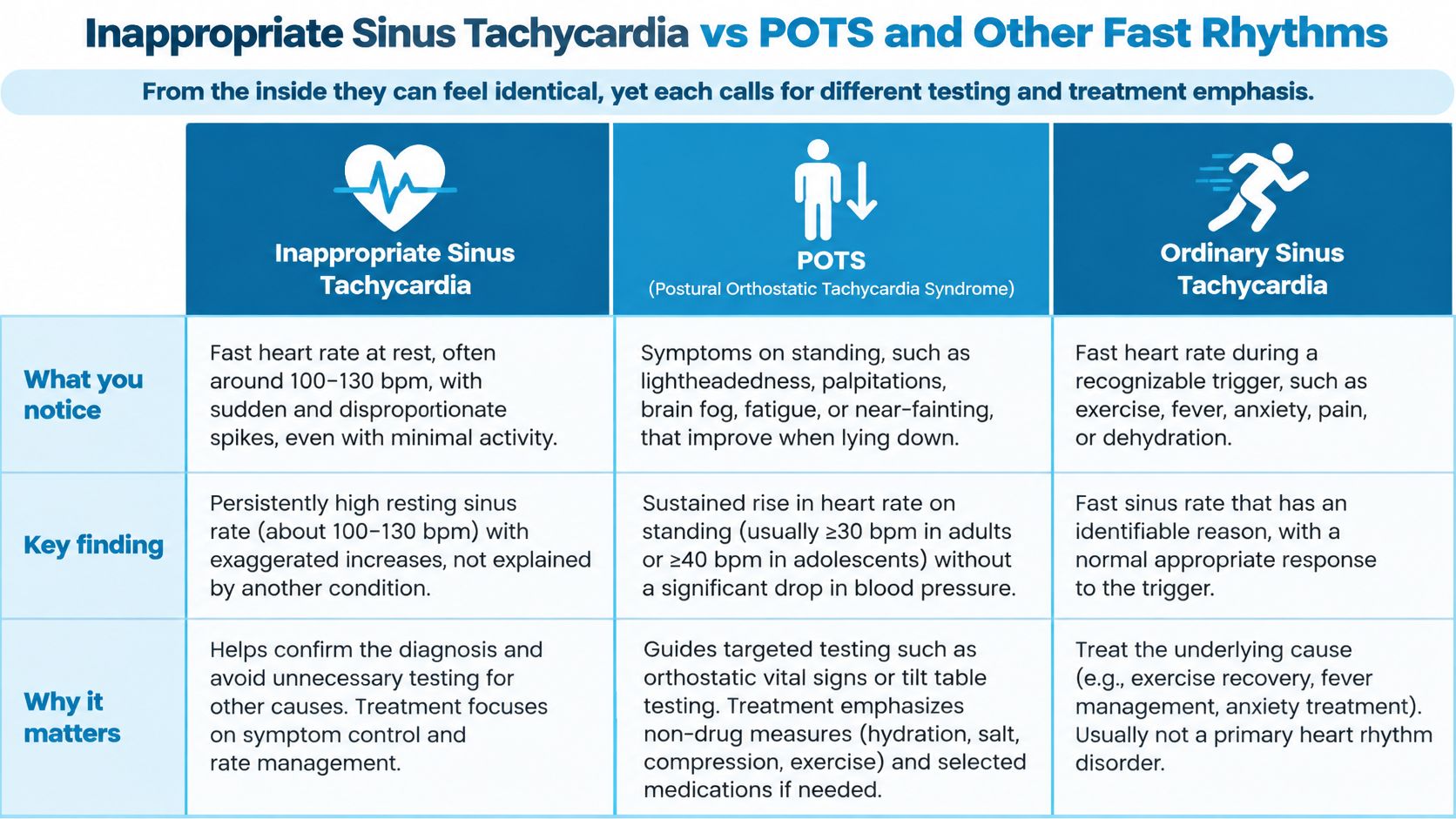
Blood pressure helps interpret the standing response. POTS involves no significant orthostatic hypotension; a blood-pressure drop on standing needs its own clinical interpretation.
Reading the same record in different ways
Consider a heart-rate graph with repeated rises. If symptoms regularly start after standing and ease when lying down, clinicians may investigate an orthostatic pattern. Persistent, disproportionate rates while resting can broaden the questions toward IST.
The same-looking rises may have another explanation. If they occur during fever or dehydration, a clinician would consider a reactive response. The context changes how the pattern is interpreted and what treatment may be appropriate.
For more detail, see this guide to POTS symptoms and assessment.
Overlap doesn't remove the need for confirmation
People can show features of both IST and POTS. Hydration, illness, sleep, medications, and activity can also affect heart-rate patterns, so clinicians consider whether the findings recur rather than relying on one unusually difficult day.
Other tachycardias require interpretation of the electrical rhythm. Pulse height alone cannot reliably distinguish sinus tachycardia from atrial rhythms or other arrhythmias.
Each reading needs its own clinical context: posture, blood pressure, symptoms, rhythm, and possible explanations all shape what a heart-rate measurement means.
Treatment Options and Your Next Step
A quiet afternoon can still produce a resting pulse that looks too fast on a graph, while a smaller rise can stop you halfway through folding laundry. IST is generally considered to have a benign prognosis, but you should not have to live with symptoms that interrupt ordinary tasks. Treatment should follow how you feel and function, not only whether the tracing looks calmer.
The Circulation statement on IST management describes symptom-directed treatment. It notes that beta-blockers and calcium-channel blockers may have limited effectiveness or cause hypotension, and it identifies ivabradine as useful in selected patients. Invasive sinus-node modification is not routine care.
Treatment options for inappropriate sinus tachycardia
| Approach | How it helps | Good to know |
|---|---|---|
| Treat reversible causes first | Addresses thyroid disease, anemia, dehydration, stimulant effects, or another identified driver | An explanatory cause changes the diagnosis and treatment priority |
| Lifestyle foundations | Supports hydration, sleep, activity tolerance, and management of personal triggers | Salt changes and exercise plans should be individualized |
| Ivabradine | Slows sinus-node activity directly | A prescription option for selected patients |
| Beta-blockers | Reduce adrenaline-related heart-rate effects | May help only partly and can cause low blood pressure or fatigue |
| Calcium-channel blockers | Provide an alternative rate-limiting approach | Effectiveness may be limited; low blood pressure is possible |
| Sinus-node modification or ablation | Alters the pacemaker region | Limited benefit and procedural risks mean it is not routine treatment |
Slowing the rate without asking why it rose is a bit like turning down a car radio while the engine is still racing. The number may look better, and the problem that set it off can remain. Lifestyle plans need specifics: how much fluid is appropriate for you, whether extra salt is suitable, and how to start activity without repeatedly exceeding your tolerance. Do not increase salt automatically, especially if another condition requires you to limit it.
If a clinician recommends medication, agree on what improvement would look like in daily life. Fewer stops during chores, a longer comfortable walk, or less distress from palpitations can matter more than hitting one pulse number.
Build a record your clinician can use
Start a short tracking period while you arrange the appointment. Waiting for a perfect dataset only delays care. For a few representative episodes, note:
- Timing and rate: Time of occurrence, baseline, peak, duration, and how recovery felt.
- Posture and activity: Lying down, sitting, standing, walking, or recovering.
- Symptoms: What you felt and whether you had to stop.
- Context: Hydration, salt intake, sleep, illness, and medication timing.
Rise-based detection doesn't test for IST, so pair episode data with resting trends and symptom notes. A cluster of standing rises and a rate that stays high while you are still can look similar in a daily graph. Posture, recovery, and how you felt separate those patterns. The record can show timing and context. It cannot confirm IST, exclude a reversible cause, or replace rhythm testing.
At the appointment, ask whether an ECG, ambulatory monitoring, thyroid testing, and a blood count are appropriate, and whether posture-related symptoms warrant orthostatic assessment. Bring your medication list with the record.
Seek urgent care for chest pain, fainting, severe breathlessness, or a racing pulse with fever or signs of infection. Do not wait to finish a tracking plan when those symptoms occur.
Cardiogram offers a free heart-rate rise calculator and a guided NASA lean test, and neither requires the app. Visit Cardiogram to explore these tools and ways to organize your heart-rate history for a clinician, while keeping the diagnosis where it belongs: with a medical assessment.