A normal pulse oximeter reading for a healthy adult at sea level is typically 95% to 100%. Home devices carry about a ±2% to ±4% accuracy margin, so a single number is an estimate within a range, not a perfectly precise measurement.
You may be checking because you feel slightly winded, you're recovering from an illness, or you want reassurance after clipping the small device onto your finger. The display settles on 97%, but what does that number tell you? It tells you that the device estimates how much oxygen your blood is carrying, not that every part of your breathing and circulation has been checked.
That distinction matters. A reading can be reassuring while symptoms still need attention, and a lower reading can reflect cold fingers, movement, device limitations, altitude, or an individual medical baseline. The useful question isn't only, “Is this number normal?” It's also, “How was it measured, how does it compare with my usual reading, and how do I feel?”
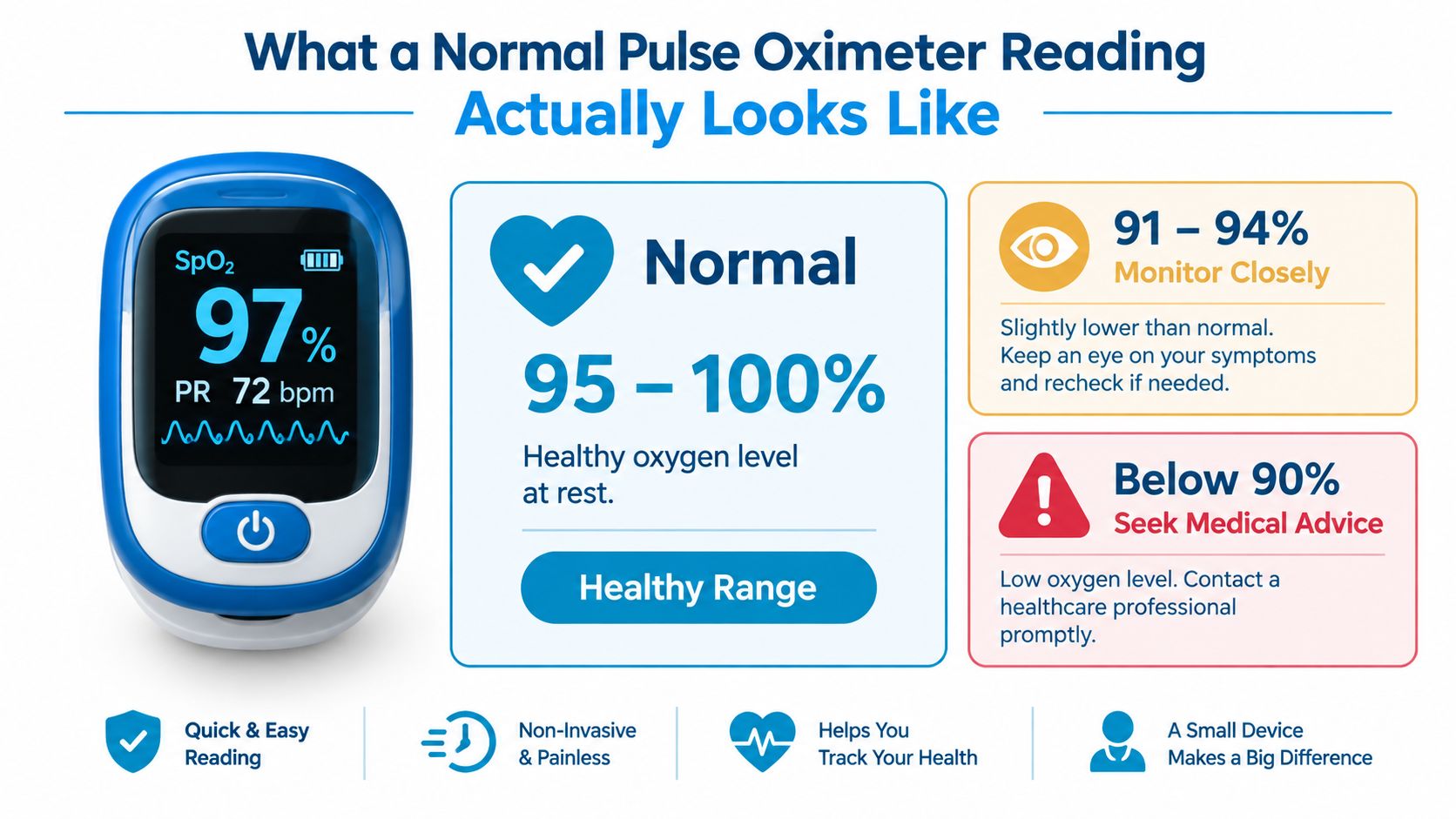
What a Normal Pulse Oximeter Reading Actually Looks Like
You clip the sensor onto your finger at home, watch the digits flicker, and see 97% settle on the screen. For a healthy adult at sea level, that falls within the commonly used normal range of 95% to 100%, as described in clinical reference material from the National Center for Biotechnology Information.
The percentage is called SpO₂, or peripheral oxygen saturation. It estimates how much of the hemoglobin in arterial blood is carrying oxygen. Hemoglobin works like a delivery fleet: it picks up oxygen in the lungs and transports it through the bloodstream to tissues. SpO₂ offers an indirect view of how full those delivery vehicles are.
Read the display as an estimate
A pulse oximeter reading is not an exact laboratory result. Consumer devices generally have an accuracy margin of about ±2% to ±4% compared with arterial blood gas measurement. A displayed 97% could therefore correspond to a somewhat higher or lower true saturation.
The number remains useful, especially when you measure under similar conditions and watch the pattern over time. Treat it like a weather forecast rather than a direct measurement of the sky. A forecast helps you decide whether to carry an umbrella, but it does not describe every cloud. The same principle applies here: interpret the range and the surrounding circumstances instead of chasing each individual percentage point.
Make the measurement easier to interpret
A calm reading after several minutes of rest usually gives more useful information than a glance taken immediately after climbing stairs. Keep your hand still, warm the finger if it feels cold, and wait for the displayed value to stabilize.
Practical rule: A stable reading taken under repeatable conditions tells you more than the first number that appears on the screen.
Your usual baseline, altitude, underlying lung disease, circulation, and symptoms all shape what “normal” means for you. A consumer device also has a built-in accuracy margin and may perform differently across skin tones. The displayed value is therefore a range to interpret, not a single number to pursue. The same result can be reassuring in one situation and worth discussing with a clinician in another.
How a Pulse Oximeter Estimates Oxygen in the First Place
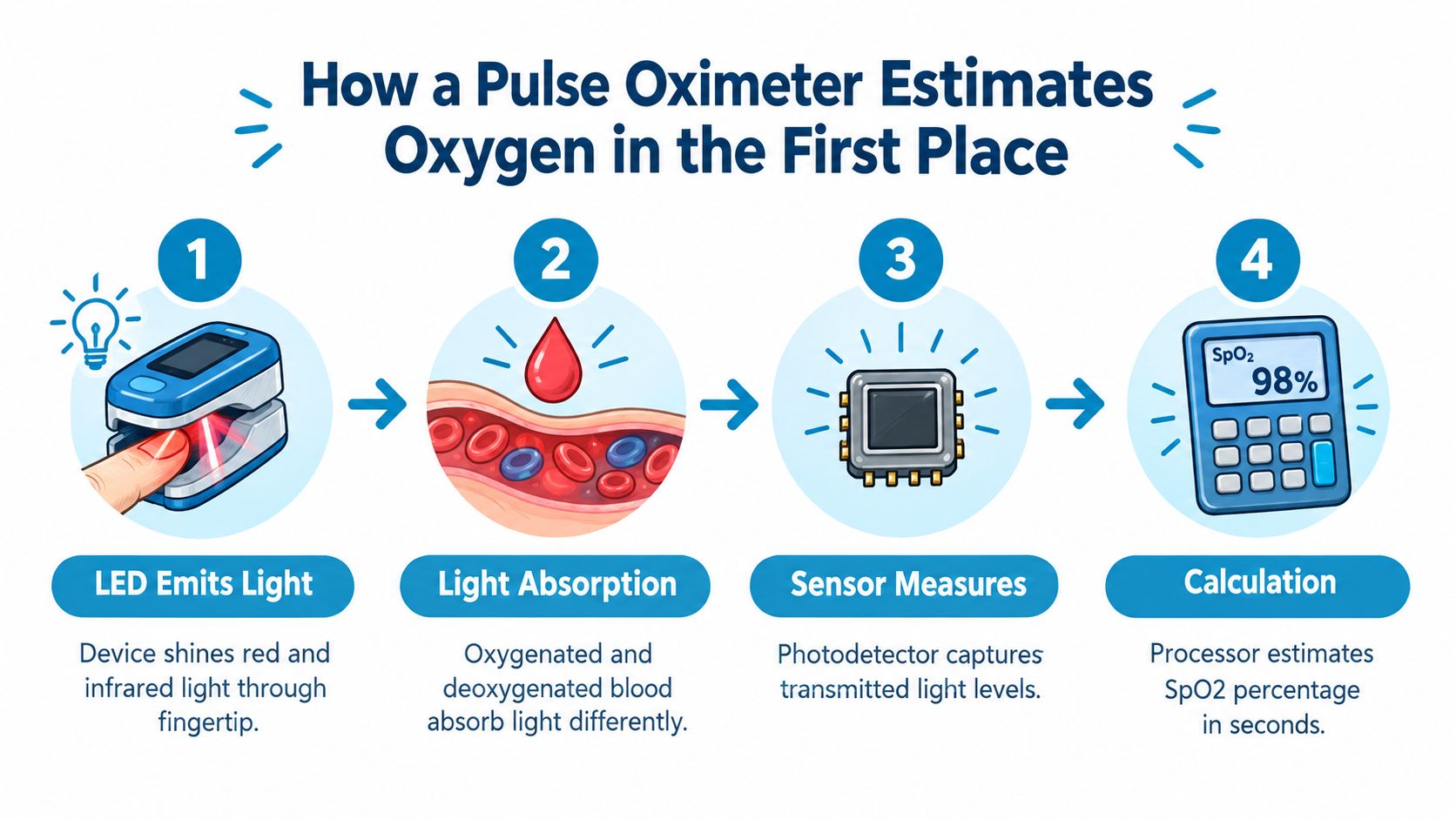
A pulse oximeter doesn't draw blood. Instead, it uses light to make an estimate through the fingertip.
Inside the clip are light-emitting diodes and a sensor. The device sends red and infrared light through the finger, then measures how much light reaches the detector on the other side. Oxygen-rich hemoglobin and oxygen-poor hemoglobin absorb those wavelengths differently. The device analyzes that difference and calculates an estimated oxygen saturation.
A stained-glass comparison
Think of sunlight passing through two panes of glass. Red-tinted glass changes the light in one way, while clear glass changes it another way. If you measure the light after it passes through, the pattern gives you clues about what's between the light source and the sensor.
Blood is more complicated than glass, but the basic idea is similar. The oximeter looks at changing light absorption as blood pulses through the fingertip. It uses the pulse signal to distinguish arterial blood, which expands and changes with each heartbeat, from more stationary tissue and venous blood.
Why stillness helps
Movement changes the amount and path of light reaching the sensor. A trembling hand, shivering, or repeatedly adjusting the clip can make the signal unstable. The device needs a short period of stillness to identify the pulse pattern and produce a steadier estimate.
For readers interested in how sensors interpret cardiovascular signals more broadly, this guide to how a heart monitor works offers useful background. A pulse oximeter, however, isn't a complete heart monitor or a blood gas analyzer. It's a small optical sensor making a calculated estimate from the signal it receives.
That indirect process explains why readings can drift. The device isn't looking directly at oxygen molecules. It's interpreting light, blood flow, pulse timing, and the conditions at the fingertip.
The Full Range From Normal to Dangerous
For most healthy adults at sea level, 95% to 100% is the usual reference range. Clinical sources also describe 94% to 98% as a target range in some adult-care settings, which is one reason you may see slightly different guidance depending on the source and clinical context. The British Thoracic Society guidance distinguishes ordinary target ranges from situations where a person's established medical condition calls for an individualized target.
The ranges below are practical categories, not a diagnosis. A single reading should be repeated under good conditions and interpreted alongside symptoms and personal history.
| SpO₂ Range | Typical Label | Recommended Response |
|---|---|---|
| 95% to 100% | Commonly normal at sea level for a healthy adult | Continue observing if you feel well and the reading is stable |
| 94% | Near-normal or mildly reduced, depending on context | Repeat after resting and consider your baseline and symptoms |
| 92% to 93% | Borderline or abnormal for many healthy adults | Recheck carefully and contact a clinician if it persists or differs from your usual level |
| Below 92% | Abnormally low for many adults | Seek clinical advice promptly, especially with breathing symptoms |
| Below 90% | Clearly abnormal and commonly classified as hypoxemia | Seek urgent medical attention, particularly if the reading is sustained or symptoms are present |
Why the cutoffs aren't identical everywhere
A clinical review identifies oxygen saturation below 94% as hypoxemia, while other clinical references treat less than 90% as a more severe and clearly abnormal threshold. These differences don't necessarily represent a contradiction. Clinicians use thresholds according to the patient population, the measurement setting, the person's medical history, and the decision they're trying to make.
Someone with chronic lung disease may have an individualized acceptable range below the standard benchmark. A person at higher altitude may also have a lower expected saturation because the surrounding air contains less available oxygen. A clinician should establish those targets rather than having a patient choose them from a general chart.
Pair the number with the person
A reading of 94% in someone who's comfortable and speaking normally isn't interpreted the same way as 94% in someone who's becoming short of breath. Symptoms, trend, and measurement quality all change the urgency.
A pulse oximeter can tell you what it estimates. It can't tell you why the value is there.
Don't use the table as permission to ignore worsening breathlessness, chest discomfort, confusion, or a visibly blue color around the lips or fingertips. Those signs deserve medical attention even if the display looks reassuring.
Why Consumer Devices Are Not Perfect
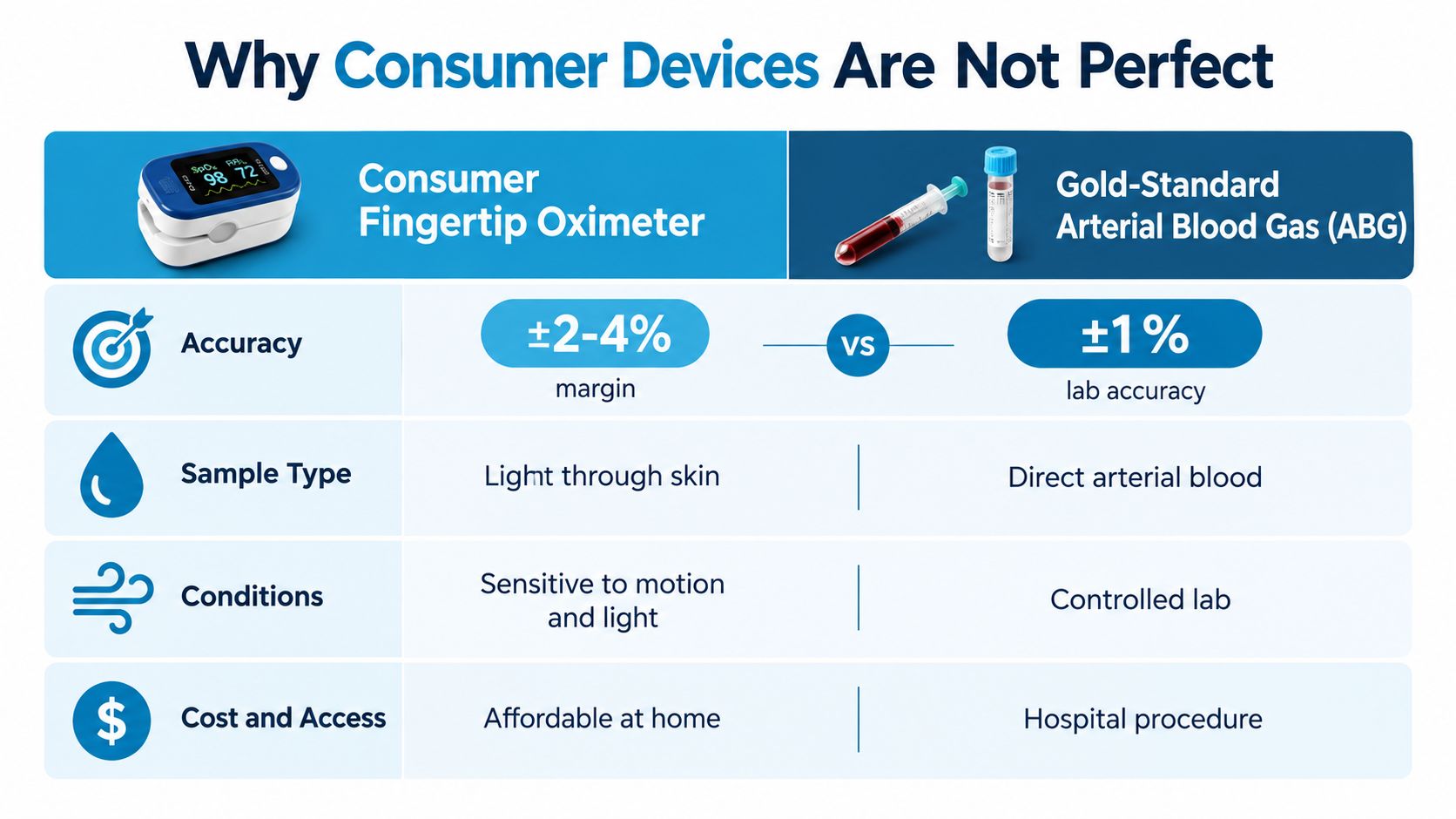
A home fingertip oximeter estimates oxygen saturation through the skin. An arterial blood gas test analyzes blood drawn directly from an artery, so it gives clinicians a more direct measurement. These methods answer similar questions, but they do not produce identical information, especially when a result is close to a treatment decision.
The device's built-in accuracy margin is about ±2% to ±4% compared with arterial blood gas measurement, according to Cleveland Clinic's explanation of blood oxygen testing. A display showing 96% may therefore represent a meaningfully different value. The closer the number is to a decision point, the less sensible it is to treat the screen as an exact measurement.
Skin pigmentation deserves careful attention
In February 2021, the FDA issued a safety communication stating that pulse oximeter readings can be inaccurate in some circumstances, including differences associated with skin pigmentation. Its summary reported pooled mean bias of 1.11% for people with high skin pigmentation and 1.52% for Black or African American patients, as described in the FDA safety communication.
The practical risk is false reassurance. A device can show a value that appears normal while the person's actual oxygen saturation is lower. This concern matters more when oxygen levels may be falling, symptoms are present, or the reading does not fit the person's condition.
A darker skin tone does not make every reading wrong. It does mean the displayed number should be interpreted with care, particularly when it conflicts with how someone feels. “Normal” is therefore a range to assess, not a single number to chase.
Use the oximeter as a trend signal
Hospitals may use arterial blood gas testing when clinicians need a more direct measurement for treatment decisions. At home, a consumer device is usually most useful for trend tracking.
Take readings under similar conditions, repeat an unexpected result, and record symptoms beside the number. The device works like a smoke alarm: it can flag a possible problem, but it cannot identify the cause or confirm a diagnosis.
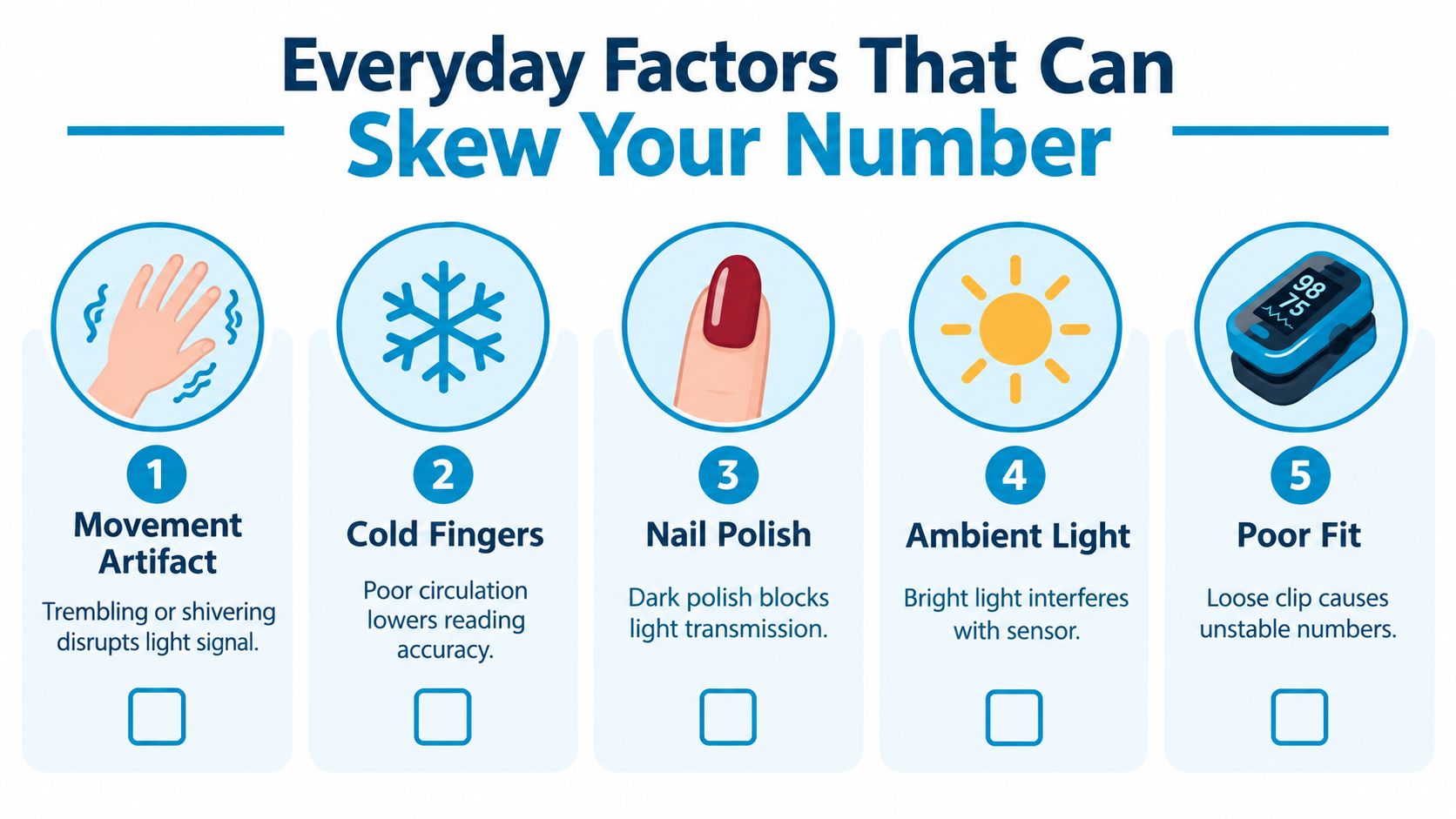
Everyday Factors That Can Skew Your Number
Many unstable readings come from the measurement conditions rather than a sudden change in oxygen delivery. Treat each factor as a small troubleshooting experiment. Change one condition, wait for the display to stabilize, and see whether the result becomes more consistent.
Start with the fingertip and the signal
- Movement: Trembling, shivering, or tapping can disrupt the light signal. Rest your hand on a firm surface and keep the finger still.
- Cold fingers: Cold skin and reduced blood flow can weaken the pulse signal. Warm your hands gradually before repeating the check.
- Poor fit: A loose or poorly positioned clip may let outside light reach the sensor or prevent proper alignment. Place it securely on a clean fingertip.
- Nail products: Dark polish or artificial nails may interfere with light transmission. Remove the product from the tested finger when possible, or follow the device's instructions for an alternative site.
- Bright light: Strong ambient light can interfere with the sensor. Move away from direct sunlight and shield the clip if the display remains unstable.
- Low battery: A weak battery can contribute to unreliable operation. Replace it when the device indicates low power or behaves inconsistently.
Separate signal quality from health status
A low or fluctuating value isn't automatically evidence of low oxygen. If your hands are cold and the number changes rapidly, first improve the measurement conditions. If the reading remains low after you've rested, warmed your hand, and repeated the test, the result deserves more attention.
Some devices display a pulse-strength indicator or perfusion-related signal. A weak signal can make the SpO₂ estimate less dependable, but it isn't a diagnosis by itself. For additional context about that kind of display, see this explanation of what PI means on a pulse oximeter.
Altitude and health history also matter. A person who lives or exercises at higher altitude may have a different baseline, while chronic lung disease can lead a clinician to set an individualized target. Don't compare your reading with a friend's or a generic chart without considering those differences.
How Normal Shifts in Real Situations
Consider someone recovering at home from bacterial pneumonia. Their resting readings had been around 97%, but over two days they begin seeing 91% while sitting. The change is more important than any single display value because it represents a sustained departure from that person's recent baseline.
That person should repeat the measurement carefully and contact a clinician promptly, especially if breathing becomes harder, fever returns, or coughing worsens. The oximeter doesn't establish the cause, but a downward pattern gives the clinical team useful information.
Altitude changes the reference point
Now consider a healthy hiker resting at 11,500 feet, where the air is thinner. A reading around 89% to 92% may occur because less oxygen is available in the surrounding air. That doesn't automatically mean the hiker has the same problem as a healthy adult at sea level with the same number.
Altitude doesn't make symptoms irrelevant. Severe breathlessness, confusion, chest pain, blue lips, or an inability to function normally still require urgent attention. A lower altitude baseline should be interpreted with local conditions and professional guidance.
Chronic disease calls for an individual target
A person with severe COPD may have a personal resting baseline around 90% to 93%. That range might be acceptable for them if it matches the target set by their clinician, even though it would concern many otherwise healthy adults at sea level.
The key lesson is that “normal” can mean normal for this person, in this setting, at this time. A clinician may recommend an individualized range for chronic lung disease or altitude exposure. Don't raise or lower supplemental oxygen based only on a home display unless your medical team has given you a specific plan.
When a Reading Means It's Time to Seek Care
Use the number as one part of a decision, not as a pass or fail score. First ask whether the measurement is stable and credible. Then check how you feel and whether the result is different from your usual baseline.
Seek emergency help now
Call emergency services immediately if the reading is below 90%, especially if it remains there after a careful repeat, or if you have serious symptoms. Emergency warning signs include:
- Severe breathing difficulty: You're struggling to breathe or can't speak in full sentences.
- Chest pain: You have new or significant chest pressure or pain.
- Confusion: You're unusually confused, difficult to wake, or unable to think clearly.
- Blue coloring: Your lips or fingertips appear blue or gray.
- Rapid deterioration: Your condition is worsening quickly, regardless of the displayed number.
Don't wait for the device to become perfectly steady if you're visibly in distress. Symptoms can signal a serious problem even when the oximeter displays a value that falls within a commonly normal range.
Contact a clinician promptly
A sustained reading around 90% to 92% deserves prompt clinical advice for many adults, unless your clinician has already given you a different target. A new, meaningful fall from your established baseline also matters, particularly when it occurs with shortness of breath, fever, cough, unusual fatigue, or worsening illness.
Repeat the reading after resting, warming your hand, and removing obvious sources of interference. If it stays low, call your clinician or use an appropriate urgent-care service rather than relying on repeated home checks.
Arrange routine advice for persistent borderline readings
Readings around 92% to 94% that continue over several days should be discussed with a healthcare professional. A phone or telehealth visit can help determine whether you need an examination, testing, or a personalized monitoring plan.
A person who's gasping at 96% needs attention. A person who feels well and briefly sees 92% during a poor-quality measurement may need a careful repeat rather than panic. The number matters, but symptoms and change from baseline matter just as much.
Putting It All Together and What to Track Over Time
The best answer to “what are normal pulse oximeter readings?” is a range plus context. For a healthy adult at sea level, the familiar benchmark is 95% to 100%, but the device itself has an accuracy margin of about ±2% to ±4%, and skin pigmentation, circulation, altitude, illness, and symptoms can change how confidently you should interpret the display.
A reliable monitoring habit is more valuable than finding one perfect number. Use the same basic conditions each time:
- Rest first: Sit for a few minutes before measuring.
- Keep conditions consistent: Use the same position and, when practical, a similar time of day.
- Wait for stability: Don't record the first number that flashes onto the screen.
- Write down context: Note the time, SpO₂, how you feel, recent activity, cold hands, nail products, and any illness symptoms.
- Watch the pattern: Look for repeated changes from your baseline rather than obsessing over one isolated dip.
- Share the record: Bring your log to a clinician instead of trying to diagnose yourself from the display.
A written record can also help you connect oxygen readings with broader symptoms, such as dizziness, fatigue, palpitations, or changes in activity tolerance. If you already track heart-rate information through Apple Health, you can learn more about exporting Apple Health data for a clearer discussion with your care team.
Your oximeter is a trend tracker, not a diagnostic tool. Use it to notice a persistent change, confirm a careful repeat, and communicate specific information to a clinician. Don't let a reassuring number override serious symptoms, and don't let one unstable reading create unnecessary fear.
Cardiogram helps people organize heart-rate patterns, symptoms, and related context into clearer longitudinal records for clinician conversations. If you're tracking palpitations, dizziness, or autonomic symptoms alongside home measurements, visit Cardiogram to see how it can turn existing Apple Watch and Apple Health data into useful summaries.

