Perhaps your watch shows a racing pulse when you shower, or you have nearly passed out while standing in a warm queue. Working out whether those experiences share one cause starts with timing.
POTS produces a sustained heart-rate rise on standing without a significant blood-pressure drop. The standard adult threshold is a rise of at least 30 beats per minute within 10 minutes of standing, and 40 beats per minute for ages 12 to 19. Vasovagal syncope works differently: a reflex drops blood pressure abruptly, often slowing the heart, and may end in a faint.
The two overlap. Someone can meet that early POTS pattern and still faint once the 10-minute window has passed, because the reflex can arrive later than the period clinicians usually watch. The most useful clues are when symptoms start, what blood pressure does, and what happens before and after each episode.
POTS vs Vasovagal Syncope at a Glance
POTS primarily causes ongoing difficulty tolerating upright posture; vasovagal syncope causes a reflex episode that may end in fainting. This side-by-side comparison describes typical patterns, not rules that can diagnose an individual.
| Feature | POTS | Vasovagal syncope |
|---|---|---|
| Core problem | Excessive upright heart-rate response associated with impaired circulatory regulation | Reflex loss of vascular tone, sometimes with heart-rate slowing |
| Onset and timing | Develops after standing as part of a chronic pattern | Episodic, sometimes after a prolonged upright period |
| Heart rate | Rises excessively and remains elevated while upright | May rise initially, then slow during the reflex event |
| Blood pressure | No sustained orthostatic hypotension during the qualifying upright response | Falls abruptly during the event |
| Consciousness | Usually preserved; fainting isn't required | Brief loss of consciousness defines syncope; a similar reflex can cause near-fainting |
| Between episodes | Recurrent symptoms during ordinary upright activities | Often well between events, although fatigue may follow a faint |
| Hallmark test | Standing or tilt assessment showing sustained postural tachycardia with symptoms | Tilt-table reproduction of a characteristic reflex response, interpreted alongside the history |
Fainting isn't the defining feature of POTS, whereas vasovagal episodes often include a warning phase called a prodrome, such as warmth, sweating, nausea, or narrowing vision. The distinction is between a recurring upright burden and a discrete reflex event, although neither pattern prevents the other from occurring in the same person.
What POTS and Vasovagal Syncope Actually Are
POTS begins with the standing position itself. Gravity shifts blood toward your lower body, and when blood return, blood volume, or blood-vessel responses fall short, the heart compensates by beating faster. The result is orthostatic intolerance: symptoms that appear or worsen while upright, such as a pounding pulse, foggy thinking, and weakness that ease only when you sit or lie down.
Postural orthostatic tachycardia syndrome involves a circulation problem that appears when you stand, and the mechanism varies between people. The racing heart is only the visible sign of that problem, which is why a single fast reading doesn't establish the condition.
The diagnostic anchor for POTS
The clinical review of POTS diagnosis and physiology describes a sustained heart-rate increase of at least 30 beats per minute within 10 minutes of standing or head-up tilt in adults, or at least 40 beats per minute at ages 12 to 19, without sustained orthostatic hypotension. The same review defines orthostatic hypotension as a fall of at least 20 mmHg systolic or 10 mmHg diastolic and estimates that approximately 20% to 30% of people with POTS faint.
Those measurements must occur alongside chronic orthostatic symptoms and after other explanations for sinus tachycardia are excluded. Acute illness, medication effects, and dehydration can each produce a racing pulse without establishing POTS. When someone with POTS does faint, the faint may reflect coexisting vasovagal syncope instead of the tachycardia.
What happens during a vasovagal faint
A vasovagal faint follows a different sequence. In a reflex response, blood vessels lose tone and the heart may slow, reducing blood flow to the brain until consciousness is briefly lost. The reflex can strike quickly, as during a blood draw, but it can also build during prolonged standing, so a comfortable first few minutes upright doesn't rule it out. Our guide to the vasovagal response and syncope explains that reflex in more detail.
Vasovagal syncope is common: a 2024 systematic review in Frontiers in Cardiovascular Medicine analyzed 12 studies including 36,156 people and estimated global prevalence at 16.4%, with a wide 95% confidence interval of 6% to 37.5%.
Feeling faint and losing consciousness aren't interchangeable. Tell your clinician whether you stayed aware, became unresponsive, or aren't sure what happened.
Both conditions can produce lightheadedness and near-fainting, and the two labels describe physiological patterns rather than fixed categories. Watching only the first minutes of standing can miss the slower-building reflex, so what happens across a whole upright period carries diagnostic weight.
How Heart Rate and Blood Pressure Behave
A heart-rate graph captures only part of an upright episode. To understand the rest, a clinician needs the starting position, elapsed upright time, blood-pressure response, and accompanying symptoms.
Start with the resting baseline. A pulse recorded while lying down can't be compared meaningfully with a later reading unless the activity between them is known. Walking upstairs, stepping out of a hot shower, and standing still are different physiological challenges.
The review of POTS and reflex syncope physiology explains that POTS produces sustained upright tachycardia without orthostatic hypotension, whereas vasovagal syncope may preserve blood pressure initially, often for more than 10 minutes during tilt, before an abrupt hypotensive event, frequently with relative heart-rate slowing.
Follow the sequence, not a stopwatch prediction
The following phases are an illustrative sequence, not a timetable everyone follows. A spontaneous faint can happen sooner, and someone with vasovagal susceptibility may never faint during a particular standing period.
| Phase | POTS | Vasovagal syncope |
|---|---|---|
| Supine baseline | Resting heart rate provides the comparison point | Resting measurements may look unremarkable |
| Early upright phase | Heart rate rises excessively; symptoms may begin | Initial compensatory responses may maintain circulation |
| Sustained standing window | Tachycardia persists alongside upright symptoms | Blood pressure may remain preserved before the reflex develops |
| Prolonged upright period | Standing may remain uncomfortable | Warmth, nausea, sweating, or visual changes may emerge |
| Late phase | An abrupt blood-pressure crash isn't required for the POTS pattern | Abrupt hypotension, often with relative bradycardia, can cause a faint |
| Recovery lying down | Upright symptoms generally ease | Consciousness usually returns promptly, though tiredness may linger |
Relative bradycardia means the heart rate is inappropriately slow for the circulatory situation. It doesn't require the pulse to reach an unusually low absolute value on a watch display. Some vasovagal events are dominated by blood-pressure loss rather than dramatic heart-rate slowing.
This explains why the highest pulse isn't necessarily the most informative measurement. A rising pulse may represent compensation before a later reflex event, and a seemingly ordinary pulse can coexist with dangerously low blood pressure.
What a wearable can contribute
A useful home record includes:
- Baseline and change: Record the starting pulse and how far it rises, not just the peak.
- Duration: Note whether the rise is sustained or briefly appears during movement.
- Context: Add whether you were lying, sitting, standing, walking, or recovering from activity.
- Symptom timing: Mark when dizziness began and whether warmth, nausea, or visual narrowing appeared later.
- Recovery: Describe what improved after sitting or lying down.
Watch-based heart-rate monitoring doesn't measure beat-to-beat blood pressure or reliably confirm posture. Consumer readings can also be incomplete, delayed, or inaccurate during movement or poor sensor contact.
Practical rule: A pulse graph can help reconstruct an episode. It can't establish what blood pressure was doing at the moment you nearly fainted.
Don't deliberately remain standing to capture a more dramatic graph. If symptoms escalate, get safely seated or lying down and document the sequence afterward.
Real-Life Triggers and Symptoms
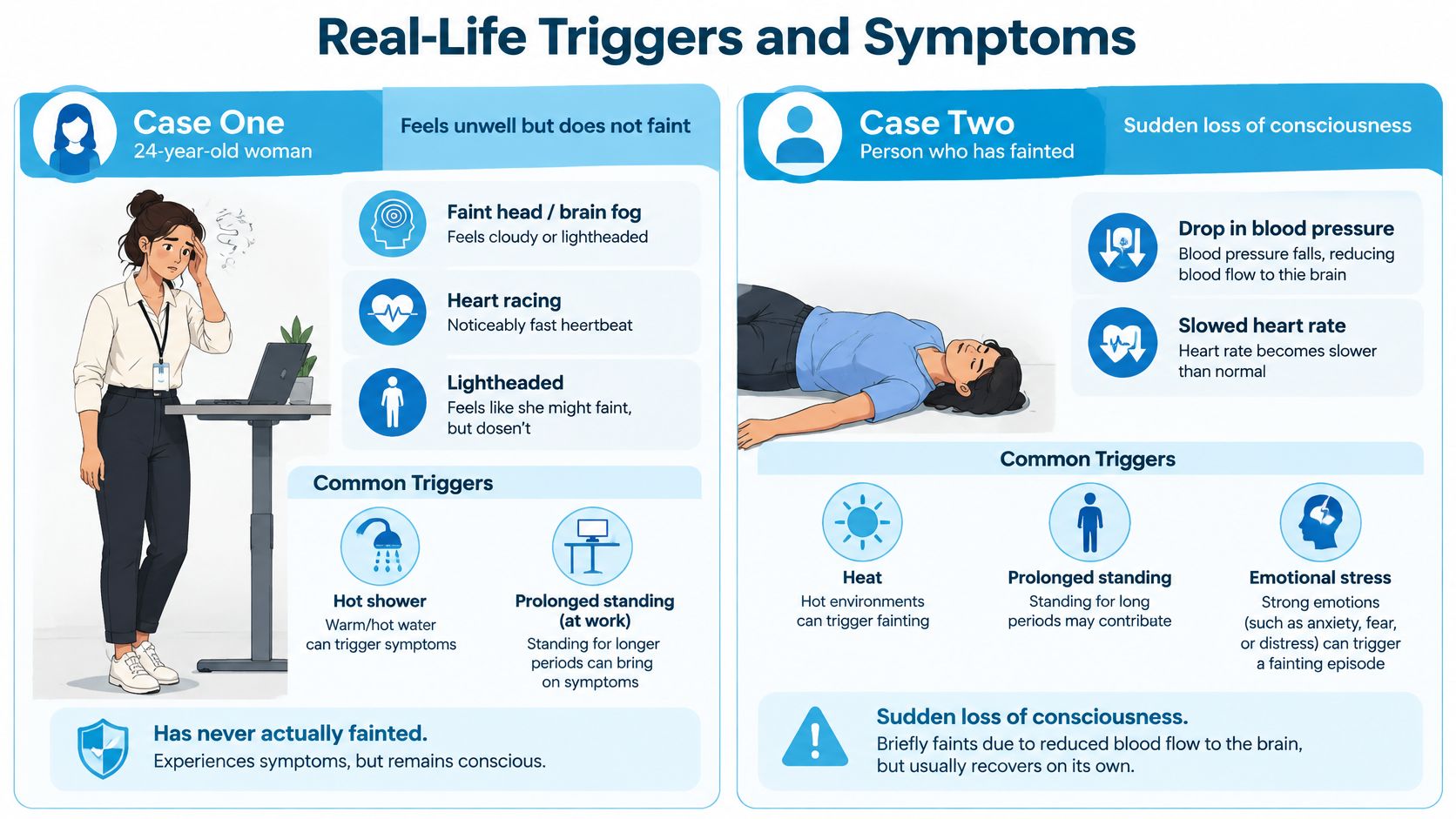
A woman whose pulse races in the shower and a man who faints in a hot queue can have very different conditions. She feels lightheaded and mentally foggy, needs frequent sitting breaks, and has never lost consciousness. That recurring relationship with upright activity resembles a POTS-type pattern, and it still deserves clinical evaluation. He generally feels well until blood draws or crowded, overheated spaces leave him sweaty and nauseated; his vision narrows, he faints briefly, and awareness returns once he is laid flat. That sequence resembles vasovagal syncope.
Shared triggers don't establish a shared diagnosis
Heat and standing can aggravate either condition. The ACC/AHA/HRS syncope guideline identifies prolonged standing, heat, emotional stress, pain, and medical procedures as relevant clues to a vasovagal history, while emphasizing the importance of the overall event description.
Timing adds a second wrinkle. A vasovagal faint can arrive after prolonged standing, well past the first ten minutes upright, so a diary that only covers the moment you stand up can miss it entirely.
For a symptom diary, separate the circumstance from the response:
- Upright tasks: Did symptoms begin while showering, preparing food, or standing at work?
- Circulatory stressors: Were you overheated, dehydrated, ill, or unusually tired?
- Situational triggers: Did pain, a needle, seeing blood, or emotional distress immediately precede the event?
- Personal associations: Do meals, menstruation, or exertion consistently coincide with worse symptoms?
Record repeated associations as leads for the clinician to test. A hot shower that reliably provokes a racing pulse is a useful observation to bring to an appointment, and so is dizziness that clusters around needles. The pattern guides the evaluation; the evaluation assigns the mechanism.
Compare the texture of the symptoms
With POTS, the burden often extends beyond a single dramatic event. Palpitations, fatigue, brain fog, and difficulty remaining upright can interfere with ordinary routines, and that limitation stays real even in someone who has never fainted.
With vasovagal episodes, the order of symptoms can be especially informative. Warmth followed by sweating, nausea, visual dimming, and loss of awareness tells a different story from ongoing upright palpitations without a clear endpoint.
Ask whether your log describes a recurring posture-related problem, discrete warning-and-faint episodes, or both. Include exceptions rather than forcing every experience into one category. A mixed pattern gives the clinician a reason for broader assessment, and presenting both sides of the record serves you better than settling on whichever label seems closest.
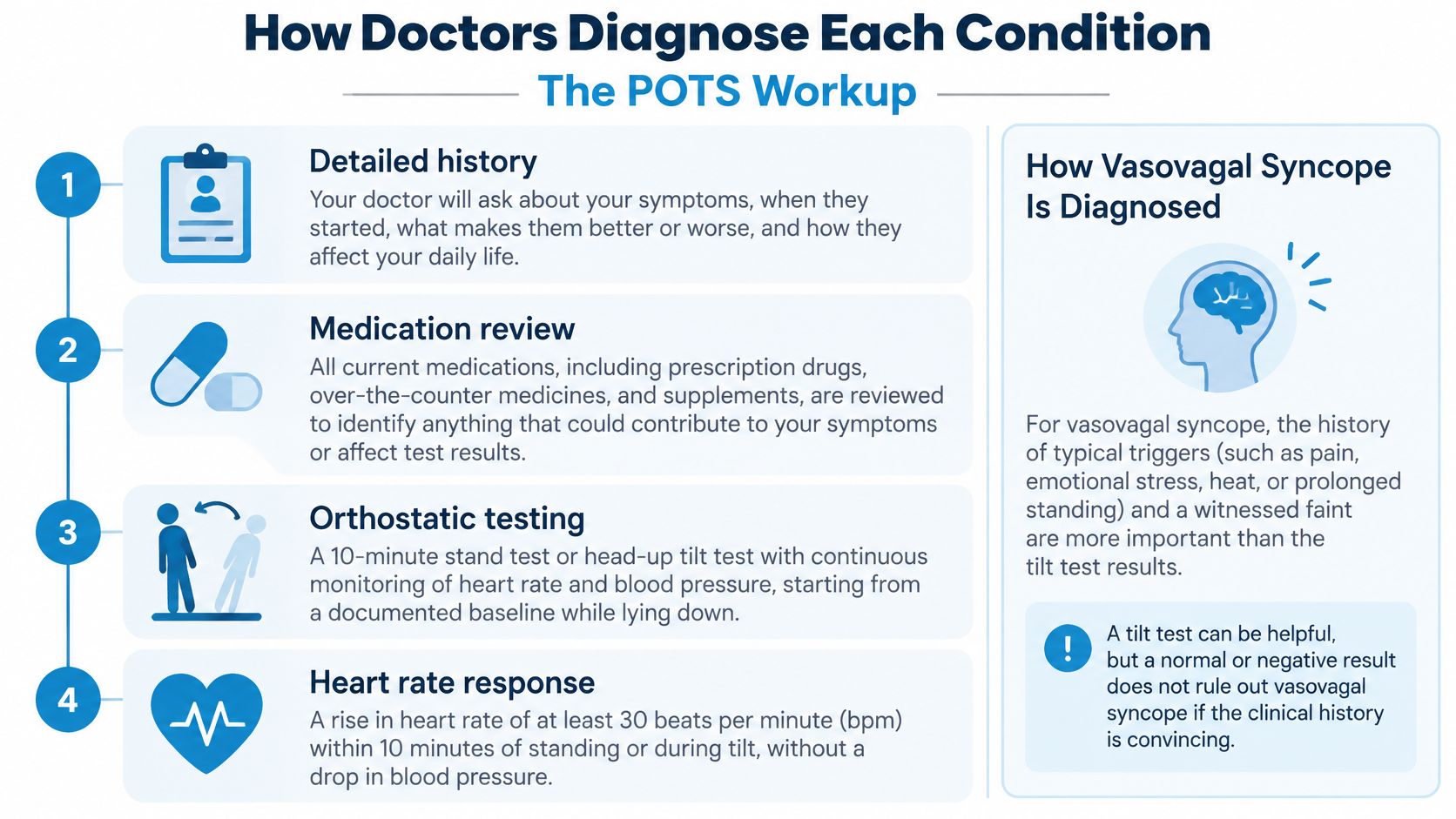
How Doctors Diagnose Each Condition
A clinician's first job is to reconstruct what happened and consider alternatives. That includes symptom history, medication and supplement review, examination, and appropriate cardiovascular assessment. An ECG can help identify clues to rhythm or conduction problems that shouldn't be mistaken for an autonomic faint.
For suspected POTS, orthostatic testing links symptoms to measured circulation. The clinician documents a resting baseline, then follows heart rate and blood pressure during standing or head-up tilt. Evaluation may also include blood tests for anemia or thyroid disease and review of illness, hydration, stimulants, and other medications.
What tilt testing can and can't prove
A guide to tilt-table testing can help you understand the procedure before an appointment. Its purpose is to observe the circulatory response under controlled conditions, not to produce a faint.
The Heart Rhythm Society expert consensus statement reports vasovagal tilt-test sensitivity approaching 78% to 92% in groups with a strong pre-test probability and specificity of approximately 90% against asymptomatic controls. Those figures describe selected testing populations, not a guarantee for an individual patient.
A positive result shows susceptibility, not proof that a particular spontaneous faint had that mechanism. More aggressive provocation can identify additional responses while reducing specificity.
Conversely, the autonomic testing recommendations state that tilt testing isn't sensitive enough to exclude vasovagal syncope when the result is negative. A normal brief assessment therefore doesn't erase a convincing history.
Make home records clinically useful
Bring observations that help a clinician test a hypothesis:
- Repeated patterns: Include symptomatic and ordinary days rather than only the most extreme reading.
- Activity separation: Distinguish quiet standing from exercise and recovery.
- Event reconstruction: Include posture, warning symptoms, awareness, and any witness description.
- Potential confounders: Note heat, hydration, sleep loss, illness, and medication timing.
At Cardiogram, we monitor Apple Health heart-rate data and automatically log 30+ bpm rises within 5 minutes, including time, baseline, peak, and duration; you can add symptoms as they happen. Our reference thresholds include a 30 bpm rise, and 40 bpm for ages 12 to 19, but these are tracking reference points, not diagnostic criteria.
An automatically detected event doesn't establish sustained postural tachycardia or explain a faint. Its value is in improving the history you bring to a clinician, alongside formal blood-pressure measurements and clinical assessment.
Managing POTS and Vasovagal Syncope Day to Day
Management starts with a shared objective: support circulation without creating new risks. Hydration, clinician-advised salt intake, appropriate compression, and less motionless standing can help form a practical plan. Heat avoidance may mean a cooler shower, a shower seat, or arranging standing tasks for a cooler part of the day.
These aren't universal prescriptions. People with high blood pressure, kidney disease, heart failure, or other relevant conditions may need different fluid or salt advice. Don't stop prescribed medication because you suspect it's contributing to symptoms.
Shared foundations and different priorities
| Strategy | POTS | Vasovagal syncope |
|---|---|---|
| Fluids and salt | Individual targets set with the clinician | Maintain hydration, particularly before known trigger situations |
| Compression | Waist-high or thigh-high garments may support upright tolerance | May help during prolonged standing |
| Exercise | Graded recumbent aerobic and resistance work, adapted to tolerance | General conditioning as tolerated |
| During an episode | Sit or lie down, elevate legs if comfortable, and cool down | Lie flat promptly; raise legs if safe; use taught counter-pressure techniques during warning symptoms |
| Medications | Selected options include midodrine, fludrocortisone, beta-blockers, or ivabradine | Often unnecessary; selected treatment may be considered for recurrent episodes |
| Main goal | Improve daily upright function | Prevent faints, falls, and injuries |
Compression choices matter because pooling isn't limited to the calves. Discuss garment coverage, fit, and tolerability rather than buying solely by appearance; our guide to compression socks for vasovagal syncope explains practical considerations.
Build a routine and an episode plan
For POTS, rehabilitation often starts with recumbent movement because upright exercise may be difficult. A clinician or physical therapist can help adjust aerobic and resistance work to your capacity. Smaller meals and, in selected circumstances, raising the head of the bed may also be discussed.
Exercise shouldn't become a test of willpower. If activity causes marked or prolonged symptom worsening, ask for an adapted plan rather than pushing through a generic progression.
For vasovagal syncope, recognizing the warning phase creates an opportunity to act. Lie down before you fall; if you can't immediately do so, sit safely and use clinician-taught muscle-tensing manoeuvres when appropriate.
Safety first: Don't try to walk to another room once your vision is narrowing. Getting low safely matters more than reaching your preferred resting place.
Improvement is possible: the follow-up table from a 2025 adolescent study reported no symptoms in 59% of both the vasovagal syncope group and the POTS group. That observation isn't a forecast for every patient or proof that one treatment caused recovery.
Medication selection belongs with the prescriber. The right choice depends on blood pressure, heart rate, other illnesses, and which symptoms most limit daily life.
Can You Have Both and What to Do Next
Yes, POTS and vasovagal syncope can coexist. You don't have to choose between an early upright racing-heart pattern and a later reflex faint if both are present.
The European autonomic and tilt-testing consensus explains that a 10-minute upright period can support POTS assessment but may miss a later vasovagal response during prolonged upright stress. If your symptoms sometimes build slowly, ask your clinician whether a longer supervised assessment would capture the full sequence.
Overlap has also appeared in selected clinical testing groups: a 2025 study by researchers affiliated with Ben-Gurion University found tilt-induced vasovagal syncope in 5 patients (24%) in one POTS subgroup and 2 patients (28.5%) in another. Those results show that overlap is possible in practice; they do not measure how common it is across everyone with POTS.
Turn uncertainty into an appointment plan
Keep an episode diary that runs past 10 minutes. Record time, posture, activity, trigger, symptoms, heart rate, and duration. A vasovagal response can develop after the window typically used to assess POTS, so keep logging through the whole upright period and for the 15 to 30 minutes after you first stand, noting anything that develops late rather than only the first few minutes. Stop and get safely down if symptoms worsen.
Ask for blood-pressure assessment. Request orthostatic vital signs rather than relying on pulse alone. Bring a medication and supplement list so your clinician can interpret the measurements in context.
Escalate concerning fainting. Seek prompt assessment for fainting without warning, injury, exertional syncope, or a family history of sudden death. Chest pain, severe breathlessness, or a serious injury warrants urgent care rather than waiting for a routine appointment.
Bring structured records. A diary and heart-rate summary covering both the early and late parts of each episode give your clinician a sequence to review, rather than a single snapshot.
The question for your clinician is specific: Do early tachycardia, a later blood-pressure fall, or both best explain my episodes? That framing is more useful than asking a watch graph to choose a label.
Cardiogram Pro offers automatic episode detection, real-time alerts, trends, heatmaps and insights, unlimited heart-rate history, and doctor-ready PDF reports to help organize the racing-heart part of your symptom history. It is not a medical device, and its reports support rather than replace a clinical assessment. Visit Cardiogram to explore the 3-day free trial, with no payment taken at the start, and bring clearer tracking records to your next appointment.