You stand up to get a drink, your heart starts pounding, and you reach for your watch. By the time you sit down again, you're wondering whether the reading means anything, and how you'll explain it at an appointment.
A POTS test at home can help you document what happens when you become upright. The useful result isn't a screenshot of your highest pulse. It's a time-stamped record of your resting measurements, standing readings, symptoms, and testing conditions, collected without putting yourself at risk.
Thresholds to Check Your Readings Against
The headline heart-rate criterion is a sustained rise of at least 30 beats per minute in adults within 10 minutes of standing, with a higher threshold for adolescents, as summarized in this clinical review indexed by PubMed. A home active stand test models the clinic procedure, but it produces screening evidence for a clinician, not a diagnosis by itself.
Home stand test thresholds and timing
| Measure | Adults | Ages 12-19 | When to check |
|---|---|---|---|
| Heart-rate rise on standing | At least 30 bpm | At least 40 bpm | Sustained within 10 minutes |
| Systolic blood pressure fall | 20 mmHg or more | 20 mmHg or more | Within the first 3 minutes |
| Diastolic blood pressure fall | 10 mmHg or more | 10 mmHg or more | Within the first 3 minutes |
| Supine rest before standing | 5-10 minutes | 5-10 minutes | Quiet, temperature-controlled room |
| Reading points after standing | 1, 3, 5, 8 and 10 minutes | 1, 3, 5, 8 and 10 minutes | Record heart rate and blood pressure each time |
The table combines the heart-rate and blood-pressure criteria with the measurement schedule described in the clinical guide to POTS diagnosis and management.
Read the change, not just the standing pulse
Baseline means your measurement while resting flat before standing. Compare each upright heart-rate reading with that baseline, rather than with your usual seated pulse or your watch's daily resting average. Our guide to orthostatic heart-rate change explains that distinction in more detail.
Blood pressure answers a different question. Systolic is the upper number and diastolic is the lower number. An early substantial fall can point toward orthostatic hypotension, which needs clinical interpretation rather than being counted as evidence of POTS.
Before you begin: Copy the thresholds and reading schedule onto a phone note or card. Keep the reference beside your log, rather than trying to remember it while you're feeling unwell.
Compatible chronic symptoms and the exclusion of other causes remain essential. Meeting the pulse threshold alone doesn't settle the diagnosis.
How to Run the Active Stand Test Step by Step
Set everything within reach before lying down. You'll need a timer, a heart-rate device, a place to record results, and preferably an upper-arm blood-pressure cuff. Keep a bed or sturdy chair directly behind you and clear the floor around it.
If fainting is possible, have another person present. They can operate the cuff, watch the timer, and write while you concentrate on standing safely. Read the stop rules before starting, not after symptoms develop.
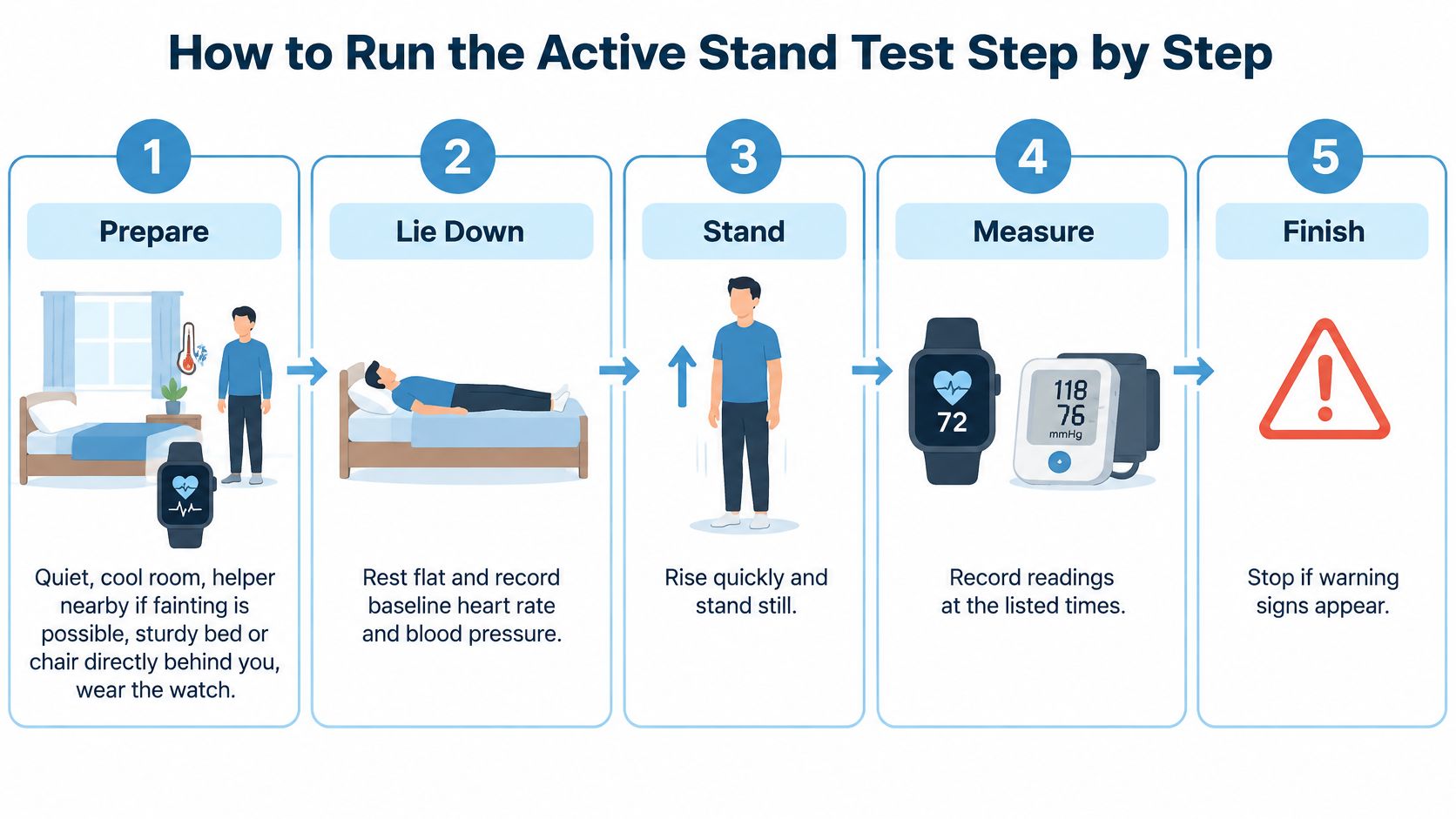
Prepare and establish your baseline
Choose a quiet, comfortably cool room. Turn off distractions and arrange your recording sheet so your helper can use it without leaving you. Wear your watch securely and fit the cuff according to its instructions.
Lie flat and let yourself settle. Use the supine rest period in the schedule, without talking or scrolling through something stressful. Supine means lying on your back, not sitting propped against pillows.
Record your starting measurements. Write down your resting heart rate and blood pressure, along with the clock time and any symptoms already present. If you don't have a cuff, mark blood pressure as unavailable rather than assuming it stayed normal.
Keep the cuff on the same arm throughout. Position it on bare skin, and support the arm at heart level for measurements without clenching your hand or gripping furniture.
Stand, measure, and describe symptoms
Stand in one smooth movement. Keep the bed behind you and have your helper start the timer as you become upright. Don't turn the transition into a race or jump to your feet.
Keep your feet still. Minimize talking, shifting your weight, and fidgeting. Stand beside the sturdy surface for safety, but don't improvise a different leaning posture midway through the test.
Measure at each scheduled point. Record heart rate and cuff blood pressure at approximately 1, 3, 5, 8, and 10 minutes, following the active stand schedule in the clinical guide cited with the table. Write the actual measurement time if a cuff cycle finishes late, rather than making the record look more exact than it was.
Add symptoms as they happen, then finish safely. Use plain descriptions such as lightheaded, pounding, foggy, shaky, or nauseated. If you feel unsafe, sit or lie down and stop; completing the schedule is never more important than avoiding a fall.
A complete run contains a resting baseline, a clearly marked standing start, and upright readings with symptoms beside them. An incomplete run can still be useful: record when you stopped and why, leaving later entries blank rather than guessing what they might have shown.
Readings That Mislead and How to Avoid Them
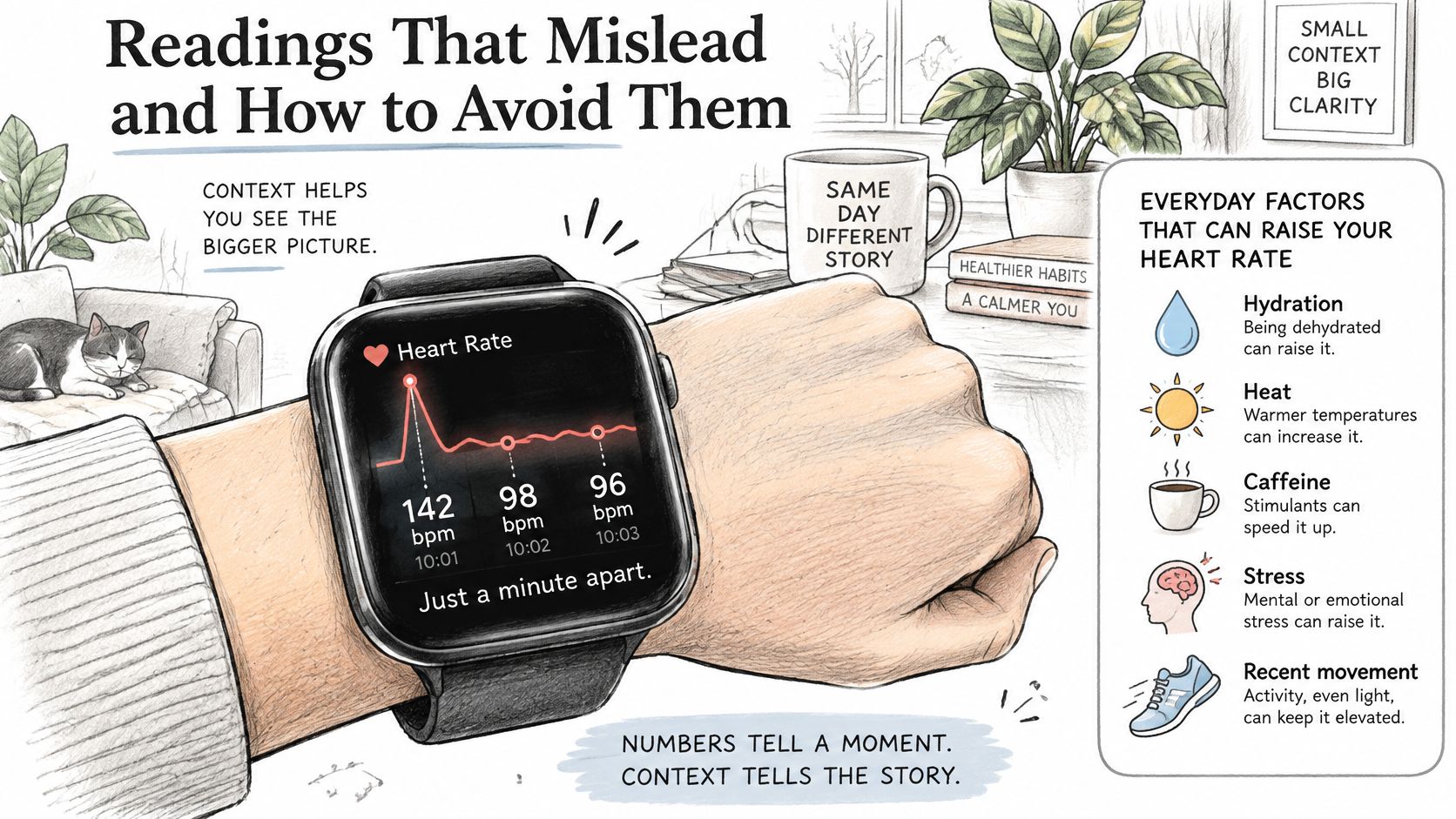
The most common mistake is treating the highest point on a graph as the result. Sustained means more than a brief peak: the POTS Foundation active standing protocol describes at least two increased readings one minute apart and notes that a 30 bpm rise can occur in healthy people, particularly younger adults.
That makes context essential. Hydration, heat, meals, caffeine, alcohol, illness, sleep loss, anxiety, exercise, and medication can change the response. Orthostatic tachycardia also fluctuates and is often greater in the morning.
Reading problems, causes and fixes
| Variable | Why it skews the result | What to do instead |
|---|---|---|
| One isolated high reading | A brief movement- or anxiety-related spike can resemble a sustained rise | Look for repeated elevation, not only the maximum |
| Dehydration or a hot room | Fluid status and heat can raise heart rate | Note hydration and use a comfortably cool room |
| Caffeine, alcohol or a large meal | They can change cardiovascular responses | Log timing and repeat under comparable conditions without these influences |
| Illness, poor sleep or medication | They can alter baseline readings and symptoms | Record them before testing; don't stop prescribed medication yourself |
| Moving, talking or standing unsupported | Muscle activity adds measurement noise, and an unsafe setup increases fall risk | Keep feet still and remain beside a sturdy surface |
| Only one test day | Upright responses fluctuate, including with time of day | Repeat on separate days at a consistent time |
Keep the protocol recognizable
Leg movement can change how blood returns toward the heart. Pacing, calf tightening, leaning, and standing still aren't interchangeable testing conditions, so write down any change in posture.
Device readings also need judgment. Our explanation of Apple Watch heart-rate accuracy can help you distinguish a wearable trend from a dependable measurement record.
Don't try to provoke the biggest possible rise. Try to collect the clearest, safest comparison.
Keep ordinary routines consistent rather than deliberately dehydrating yourself, loading extra salt, or changing treatment. Compare whole test records, including symptoms and pressure readings, instead of choosing whichever graph looks most convincing.
Logging Results and Sharing Them With Your Doctor
A clinician needs to know what you were doing when the pulse changed. A graph without posture or symptoms leaves them guessing whether you stood up, climbed stairs, or were already feeling unwell.
Start with a reusable checklist. Paper is fine, and a phone note works just as well if your helper can enter information easily.
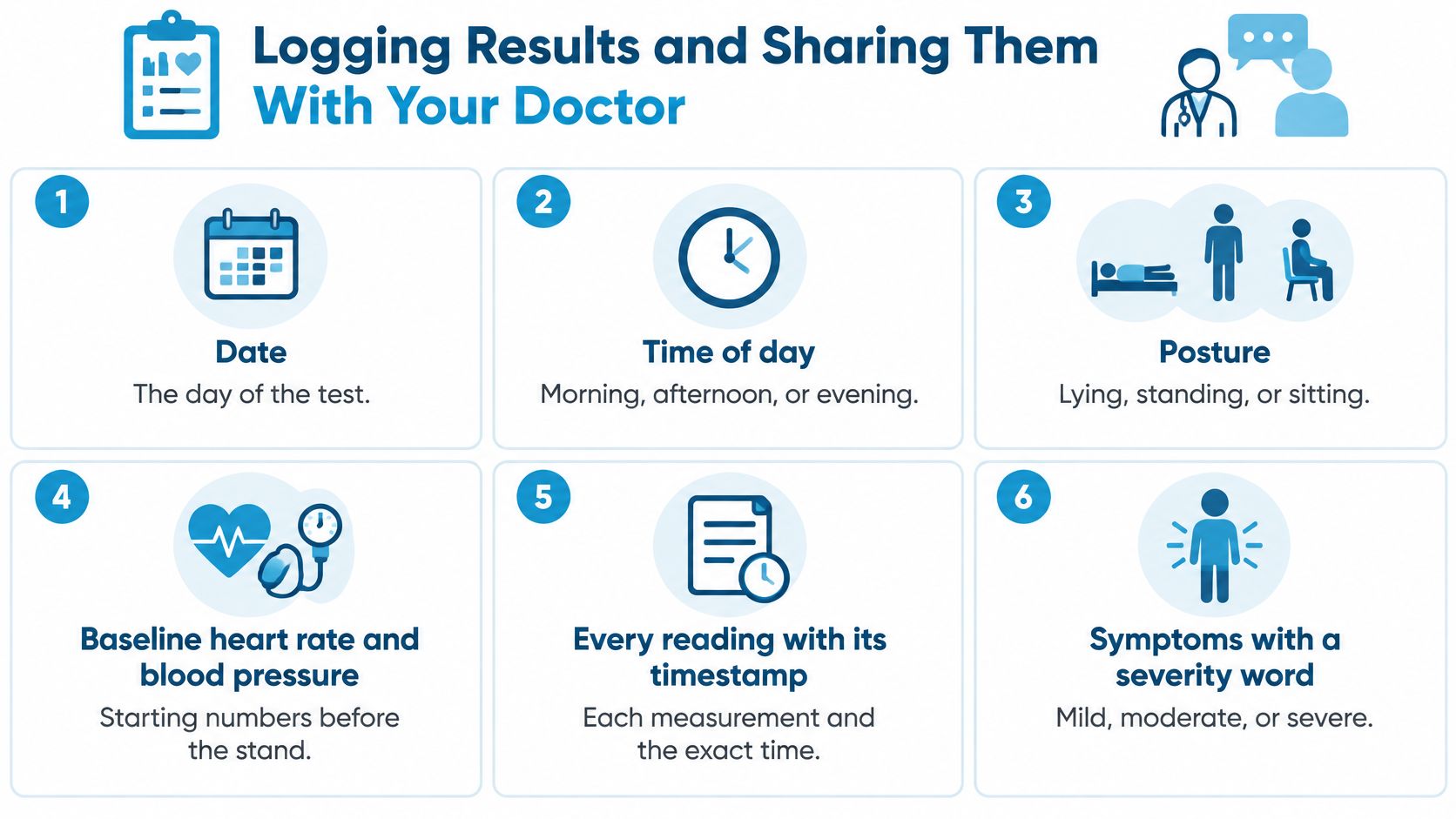
Copy these fields into your log
- Date and time of day. Include the clock time you started standing.
- Posture. Label measurements lying, standing, or sitting, including any unexpected posture change.
- Baseline measurements. Record resting heart rate and cuff blood pressure before standing.
- Every timed reading. Preserve the measurements themselves, not just the calculated rise.
- Symptoms and severity. Add mild, moderate, or severe beside a plain description.
- Daily context. Note fluids, salt, caffeine, recent meals, sleep, illness, exercise, and medication timing.
- Device and interruptions. Identify which device supplied each measurement and note errors or missing readings.
- Reason for stopping. Include symptoms and timing if you couldn't finish.
Use an upper-arm cuff for the blood-pressure portion. Don't substitute a watch pulse reading for blood pressure, and don't assume a watch measures pressure unless that capability is specifically established for your device.
Add watch records without losing context
For Apple Watch users, our setup begins by connecting Apple Health with one tap using read-only access. Cardiogram then logs every 30+ bpm rise within 5 minutes, including its baseline, peak, and duration, and lets you add symptoms as they happen.
That automatic detection rule is not the complete clinical stand-test criterion. It uses its own time window and doesn't independently establish posture, exclude a blood-pressure fall, or apply the adolescent diagnostic threshold. Keep your manually timed test alongside the app record.
When exporting a heart-rate series or PDF, check that timestamps remain visible and the detection criterion is named. Add symptom notes when they occur rather than reconstructing everything from memory later.
Keep each test together as its own entry. If a device misses a sample, label the gap; a clearly incomplete record is more useful than an apparently complete one containing estimates.
Stop Rules and What a Negative Result Means
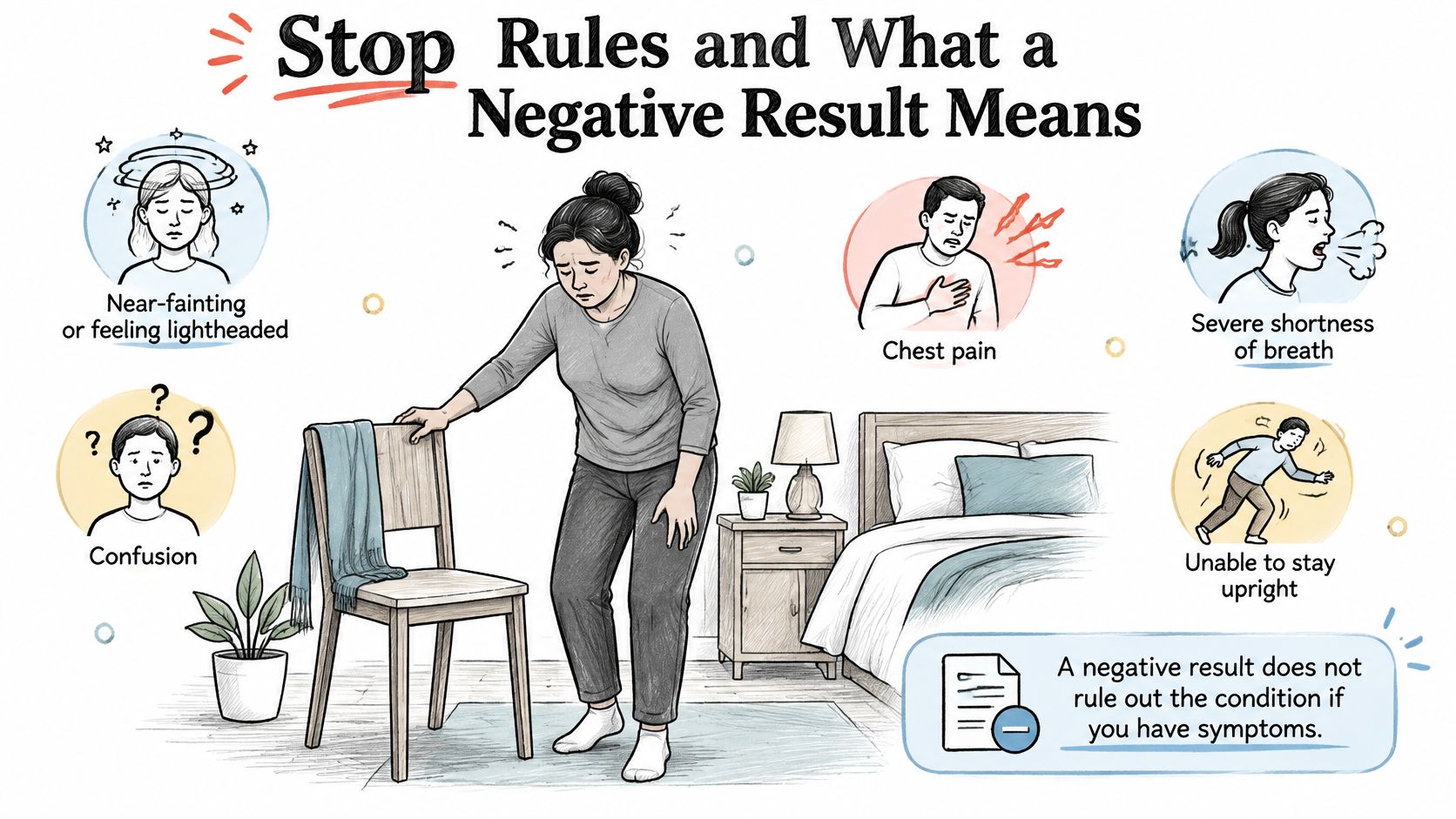
Step 7 of the walkthrough carries the basic rule: when you feel close to fainting, the test ends and you sit or lie down. Treat that as information. The same goes for chest pain, severe breathlessness, or confusion. Getting off your feet early is a result you can report, and a clinician can work with it.
Ask before you test at home if you have low blood pressure, possible arrhythmia symptoms, pregnancy, or medication effects you are unsure about. Anyone at risk of fainting needs another person in the room, and a history of unpredictable collapse may make supervised assessment the safer route.
Know when to seek help
- Chest pain or severe breathing difficulty. Seek urgent medical assessment rather than assuming POTS explains it, especially if symptoms are new, severe, or persist after lying down.
- Confusion, collapse, or injury. Get immediate help when symptoms are concerning or you have injured yourself.
- A rapid or irregular heartbeat with marked symptoms. Don't keep testing to see whether it settles into a recognizable pattern.
Safety comes first: An early stop is a clinical observation worth reporting.
A normal result doesn't close the question
The POTS Foundation diagnostic guidance explains that a negative test may not exclude POTS and that repeat assessment can be considered when suspicion remains. A shorter test, or one performed differently, may fail to capture the response that matters.
Persistent symptoms deserve attention even when your home numbers stay below the heart-rate criterion. Clinicians weigh other explanations too: dehydration, medication effects, arrhythmias, thyroid disease, anemia, and structural heart problems.
Active standing and passive tilt testing measure different responses, so a result from one does not settle the other. A Journal of the American College of Cardiology review describes how tilt can produce greater tachycardia and lower specificity, which means a larger rise does not automatically make it the more definitive test.
Access to tilt testing varies by location. Your clinician can use the record and symptom history to decide whether a supervised stand, tilt test, or another investigation fits. Repeating home measurements should feed that decision and build a clearer picture, not become an effort to prove a diagnosis on your own.
Take Your Log to Your Next Appointment
Bring a small collection of tests performed on separate days, with the same fields completed for each. Don't delay seeking care while trying to assemble a perfect record, particularly if symptoms are interfering with ordinary activities.
Put the entries into a single document, either a paper sheet or an exported PDF. Keep the resting baseline, standing start, upright readings, symptoms, and context together so the clinician doesn't have to match separate screenshots.
Turn the record into useful questions
- Which heart-rate criterion applies to me? Ask the clinician to interpret your age, baseline, and sustained response together.
- What do the blood-pressure readings show? Ask whether they suggest orthostatic hypotension or require repeat measurement.
- Should we repeat testing under supervision? Discuss whether an office active stand or tilt test would answer the remaining question.
- Could something else explain this pattern? Bring your medication and supplement list for review.
- What happens if these results are borderline or normal? Ask for a plan to investigate persistent symptoms rather than leaving without a next step.
Describe the daily impact as well as the measurements. Being unable to stand through a shower or prepare a meal gives the clinician information a pulse graph can't provide. Our guide to patient-provider communication can help you organize that conversation.
Make the handover easy to interpret
Flag any early stops, missing cuff readings, or changes in testing posture. If your report includes automatically detected episodes, retain the exact detection rule so nobody mistakes an app flag for a confirmed diagnosis.
Book your appointment this week, with the log, your current medicines, and notes about daily fluid intake ready to bring. Wait for the clinician's review before changing medication, salt intake, or other treatment.
We built our app for people with POTS and dysautonomia, with PDF reports that bring episodes, trends, and symptoms together and state the exact detection criterion used. Visit Cardiogram to organize your standing-heart-rate records for a medical appointment. Cardiogram Pro starts with a 3-day free trial, and no payment is taken at the start.