You stand up from bed, take a few steps toward the kitchen, and feel the familiar wave of dizziness. Your Apple Watch shows a sudden heart-rate rise. Is that number a meaningful sign of orthostatic tachycardia, or did movement and a loose band create a noisy reading?
For people with POTS or dysautonomia, Apple Watch heart rate accuracy matters for more than exercise zones. You may be trying to understand whether your heart rate rises after standing, how long an episode lasts, or whether symptoms follow changes in sleep, hydration, salt intake, or medication. A watch reading can help with that picture, but it isn't the same as an ECG, and a single number shouldn't carry the whole interpretation.
The most useful answer isn't “accurate” or “inaccurate.” Apple Watch readings are generally close to ECG measurements on average, while individual readings can differ by several beats per minute. The size and meaning of that difference depend on whether you're sitting, walking, exercising, or moving through a rapid change in posture.
Introduction to Apple Watch Heart Rate Accuracy for Everyday Life
The practical question is whether your watch is reliable enough to help you notice patterns. For many everyday situations, the answer is yes, especially when your wrist is still and your heart rate is changing steadily. The answer becomes more cautious when you're running, gesturing heavily, adjusting the watch, or checking immediately after a sudden movement.
That distinction matters for POTS. A small difference may not change the interpretation of a broad resting trend. It may matter more when you're trying to identify a short tachycardic episode, compare your baseline with your standing peak, or decide whether a rise is sustained rather than momentary.
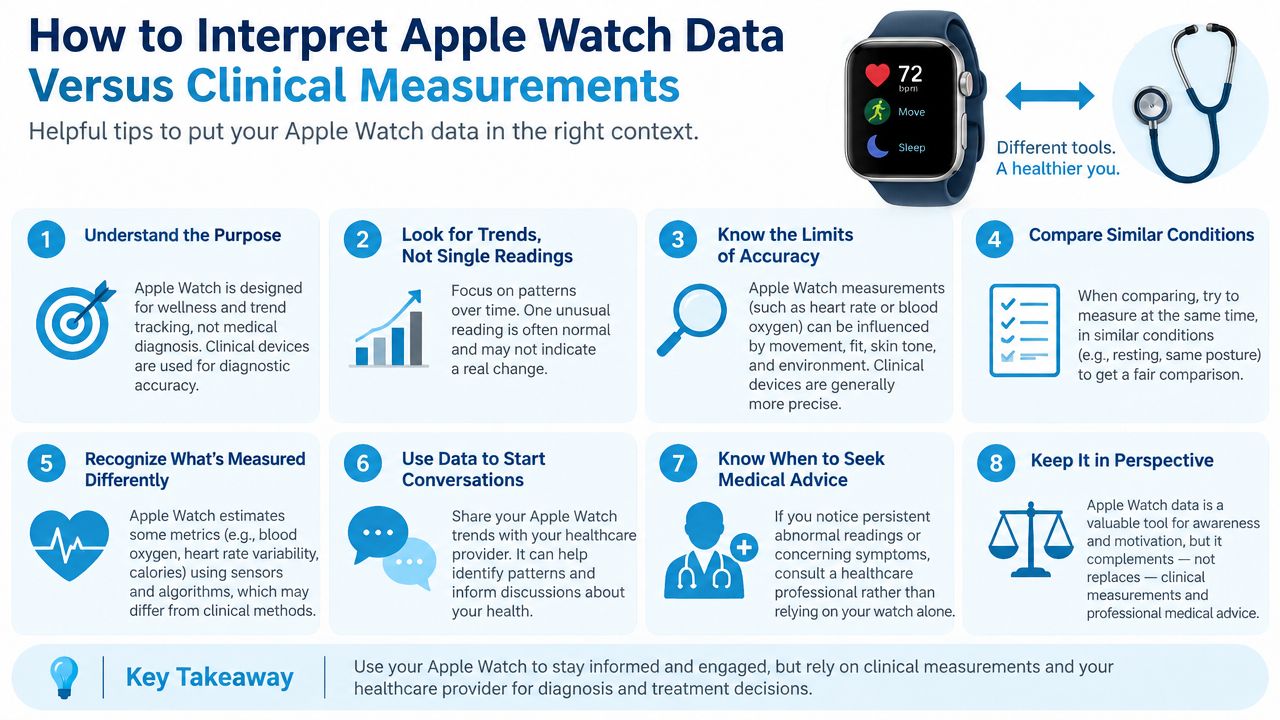
Practical rule: Treat the watch as a pattern monitor, not as a replacement for clinical measurement.
The sensor uses light to estimate blood flow, then software converts that optical signal into beats per minute. An ECG measures the heart's electrical activity directly, so the two devices are observing related but different signals. A difference between them doesn't automatically mean the watch failed.
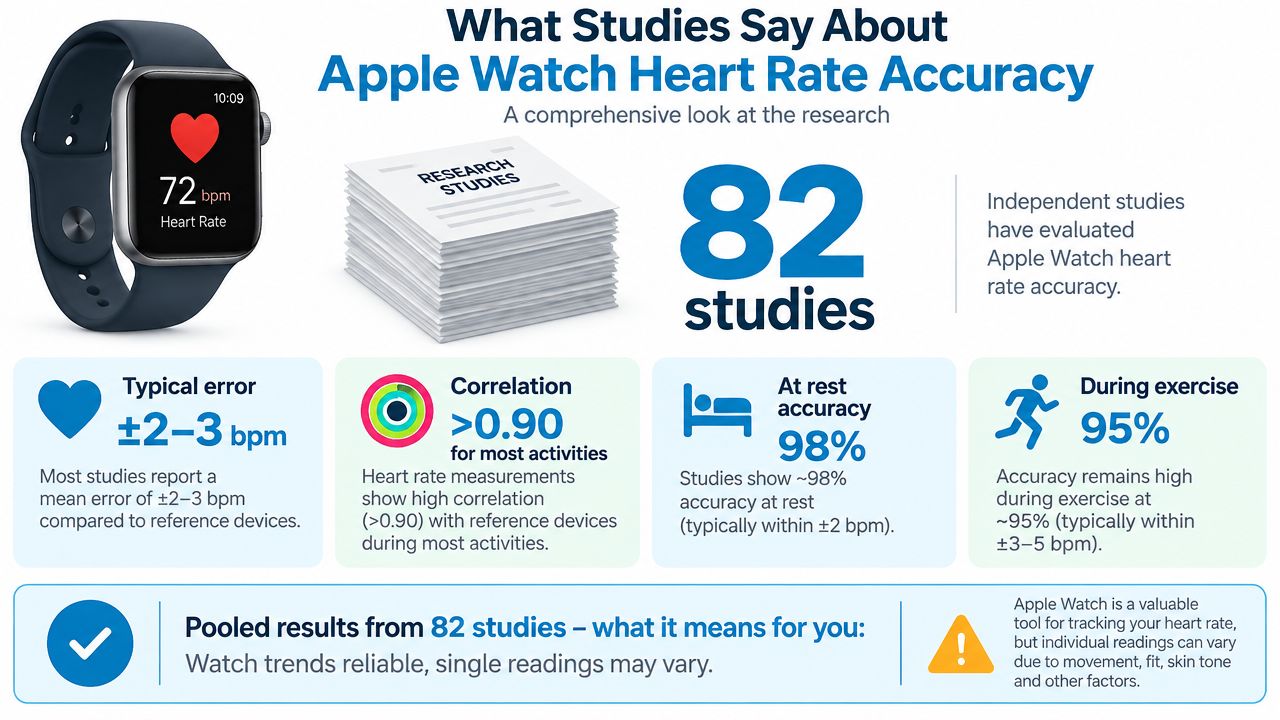
The evidence supports a balanced view. A 2026 living systematic review in npj Digital Medicine synthesized 82 Apple Watch accuracy studies and found very small average heart-rate bias overall, while also showing that individual readings can vary by several beats per minute. Earlier validation work reached a similar practical conclusion: performance was generally strong during resting and moderate activity, but accuracy became less dependable as movement and intensity increased, as described in a 24-hour Apple Watch validation study.
You'll get the most useful information by asking three questions: How was the reading collected? What conditions could have distorted it? Does the same pattern appear repeatedly? Those questions help you respond calmly to an isolated spike while still taking recurring, symptom-linked changes seriously.
How Apple Watch Measures Heart Rate Behind the Scenes
Apple Watch estimates heart rate through photoplethysmography, often shortened to PPG. The name sounds technical, but the basic idea is simple. The watch shines light into the skin and watches for changes in the amount of light returned as blood flow pulses through tissue.
Think of shining a small flashlight through your fingertip. The light doesn't see your heart directly. Instead, it detects changes in the tissue caused by each pulse. Apple Watch uses green light-emitting diodes for heart-rate sensing, then applies algorithms to identify a repeating pattern and estimate beats per minute.
From light signal to heart-rate estimate
The process has several steps:
- Light enters the skin. The sensor emits light against your wrist.
- Blood flow changes the returned signal. Each heartbeat alters the optical pattern.
- The watch searches for a rhythm. Software separates a likely pulse pattern from background noise.
- The device reports an estimate. The result appears as a heart-rate value rather than a direct electrical tracing.
That last point explains why a watch and ECG won't always match beat for beat. An ECG records electrical signals from the heart through electrodes. A wrist device estimates pulse-related blood-flow changes from an optical signal. The watch is measuring a useful proxy, not reproducing the clinic's electrical recording.
Why collection conditions matter
Apple Watch can collect heart-rate data in the background and during workouts. Background readings may be spaced differently from workout measurements, while workout mode is designed to follow heart rate more continuously during activity. That doesn't make one mode universally “right.” It means the watch may be sampling under different conditions and using different opportunities to clean up the signal.
Fit matters too. If the watch shifts as you move, the sensor sees changing contact between the skin and the device. If the band is too loose, light can escape and motion can create extra fluctuation. If it's uncomfortably tight, you may change your wrist position or reduce local comfort, which can also complicate consistent collection.
For a reusable mental model, remember this:
Cleaner optical signal plus a steadier wrist usually means a more dependable estimate.
You can read more about the underlying sensor principles in this plain-language explanation of how heart monitors work. For POTS tracking, that model helps you decide when a number deserves attention and when it deserves a quiet recheck.
What Studies Say About Apple Watch Heart Rate Accuracy
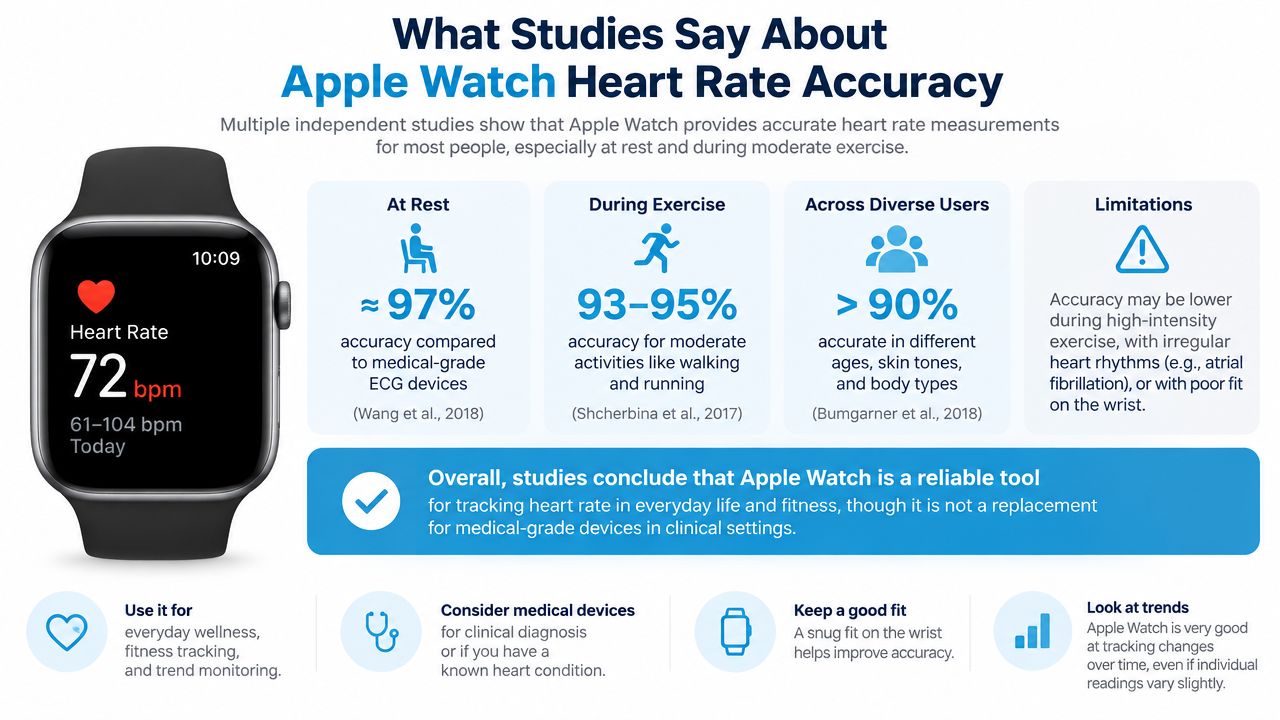
If your watch shows a heart rate a few beats different from an ECG, that does not automatically make the reading useless. The better question is whether the difference changes what you conclude. Current evidence supports a context-dependent view: average error is small, while individual readings can vary more widely.
A recent living review combined results from 82 studies. Its pooled mean heart-rate bias was 0.36 beats per minute, with limits of agreement from -5.08 to 5.80 beats per minute, according to the published review in npj Digital Medicine. In the subgroup covering recent Apple Watch models, mean bias was -0.27 beats per minute, with limits of agreement from -7.19 to 6.64 beats per minute.
What mean bias tells you
Mean bias is the average difference between the watch and a reference measurement. A value near zero means the watch was not consistently higher or lower across the study group. That is reassuring, but it does not mean every individual reading will be close.
A small mismatch can come from the device, the reference measurement, or the conditions at that moment. If the watch reports one value while an ECG reports another, ask whether the difference changes the clinical meaning of the event. Identical numbers are not required for a trend to remain useful.
What limits of agreement add
Limits of agreement describe the spread of individual readings around the reference. For recent models, the reported range extended roughly 7 beats per minute in either direction from the criterion measurement. The watch can therefore be close on average while occasionally showing a noticeably different value than a clinical device.
Earlier research adds real-world context. A 24-hour validation study of Apple Watch Series 3 reported a mean difference of -1.80 beats per minute versus ECG and a mean absolute error of 5.86% under real-world conditions, with 95% agreement, as reported in the continuous validation study. Exercise-focused research found mean absolute percentage error ranging from 1.14% to 6.70% across exercise stages and reported lower accuracy as intensity increased.
That does not make workout data automatically unusable. It means fast changes and irregular arm movement can widen the error. A separate independent comparison of Apple Watch heart-rate performance found stronger performance during walking and recovery than during more intense activity.
For POTS, the size of the error matters relative to the question. A 5 to 7 beats-per-minute swing may matter little when you are following a stable resting trend. It matters more when you are checking whether standing produced a 30-plus beats-per-minute rise, whether that rise persisted, or whether a brief spike was movement noise. Repeating the measurement under similar, calmer conditions can help separate a meaningful postural pattern from a single uncertain value.
Key Factors That Make Readings More or Less Accurate
A watch reading is most useful when you understand the conditions surrounding it. Optical sensors work best when the device maintains stable contact and the pulse signal remains distinguishable from movement. They struggle when the wrist moves independently from the rest of the body or when the sensor loses consistent contact.
Stable conditions compared with noisy ones
At rest, your wrist may be still and your pulse relatively regular. During a walk, the signal can remain useful if your pace and arm movement are steady. During running, vigorous activity, or a rapid transition from sitting to standing, motion artifact can interfere with the optical pattern.
Temperature and circulation can also influence signal quality. Cold hands may have less surface blood flow, while changes in skin perfusion can make the pulse signal harder to detect. Tattoos, hair, sweat, and band placement may affect the optical path or the stability of contact. These factors don't make a reading automatically wrong, but they give you a reason to repeat an unexpected value under calmer conditions.
| Condition | Typical Accuracy | Why It Happens |
|---|---|---|
| Quiet rest | Usually strongest | The wrist is stable, and the pulse signal is easier to separate from noise |
| Steady walking | Often useful for trends | Movement is present but may remain rhythmic and predictable |
| Running or vigorous activity | More variable | Arm swing, impact, sweat, and rapid physiological changes add signal noise |
| Immediate postural change | Interpret cautiously | The body and wrist may move at the same time as heart rate changes |
| Loose or shifting band | Less dependable | Changing contact alters the amount and quality of returned light |
Fit and placement
Wear the watch snugly enough that it stays in place without causing discomfort. Keeping it in a consistent position helps you compare one reading with another. If you move the device from one wrist to the other, or change how tightly you wear it, note that change when reviewing your data.
Rapid intensity changes create a special problem for POTS interpretation. A genuine rise after standing may occur alongside arm movement, walking, or reaching for something. If the watch shows a brief spike during those actions, pause before labeling it an episode.
A noisy reading needs context, not panic.
You can reduce misleading events by using context-aware false-positive reduction that separates exercise and recovery noise from patterns you may want to discuss with a clinician.
Practical Tips to Improve Accuracy for POTS and Dysautonomia
Small routine changes can make your Apple Watch data more consistent. The goal isn't laboratory perfection. The goal is to collect comparable readings under comparable conditions, so your trends have a clearer meaning.
Start with the band
Wear the watch snugly but comfortably, with the device positioned about one finger above the wrist bone. It shouldn't slide during ordinary movement, but you shouldn't need to tighten it until your skin feels pressured or irritated. Use the same wrist and a similar placement whenever possible.
Before checking a standing heart rate, stop moving. Stand in the way your clinician has asked you to stand, keep the watch stable, and allow about 30 seconds of stillness before treating the displayed value as a useful observation. If you're symptomatic, prioritize safety. Sit or lie down if you feel faint rather than continuing a measurement for the sake of a cleaner data point.
Make the surrounding details visible
A heart-rate value becomes more interpretable when you record what was happening around it. Add brief context about:
- Symptoms: Dizziness, palpitations, fatigue, brain fog, or near-fainting.
- Posture: Lying down, sitting, standing, or walking.
- Hydration and salt: Record meaningful changes in your usual intake.
- Sleep and medication: Note poor sleep, timing changes, or missed doses.
- Activity: Mark workouts, recovery, errands, and other movement.
This context helps distinguish a recurring orthostatic pattern from an isolated value collected after climbing stairs or rushing across a room.
Keep exercise separate from episode review
Exercise naturally raises heart rate, and recovery can keep it raised afterward. Counting those periods alongside spontaneous postural episodes can make your history look more alarming or more chaotic than it is. A POTS-focused review should identify which readings occurred during ordinary daily posture changes and which came from deliberate exertion.
Use a repeatable checklist
Before an appointment, ask:
- Was the band secure and in its usual position?
- Was I still when I checked the reading?
- Did the rise follow standing, walking, exercise, or another trigger?
- Did symptoms occur at the same time?
- Did the change recur under similar conditions?
- Did the rate persist, or was it only a brief spike?
Consistent collection beats constant checking. A smaller set of well-described episodes can be more useful than a large collection of unexplained alerts.
How to Interpret Apple Watch Data Versus Clinical Measurements
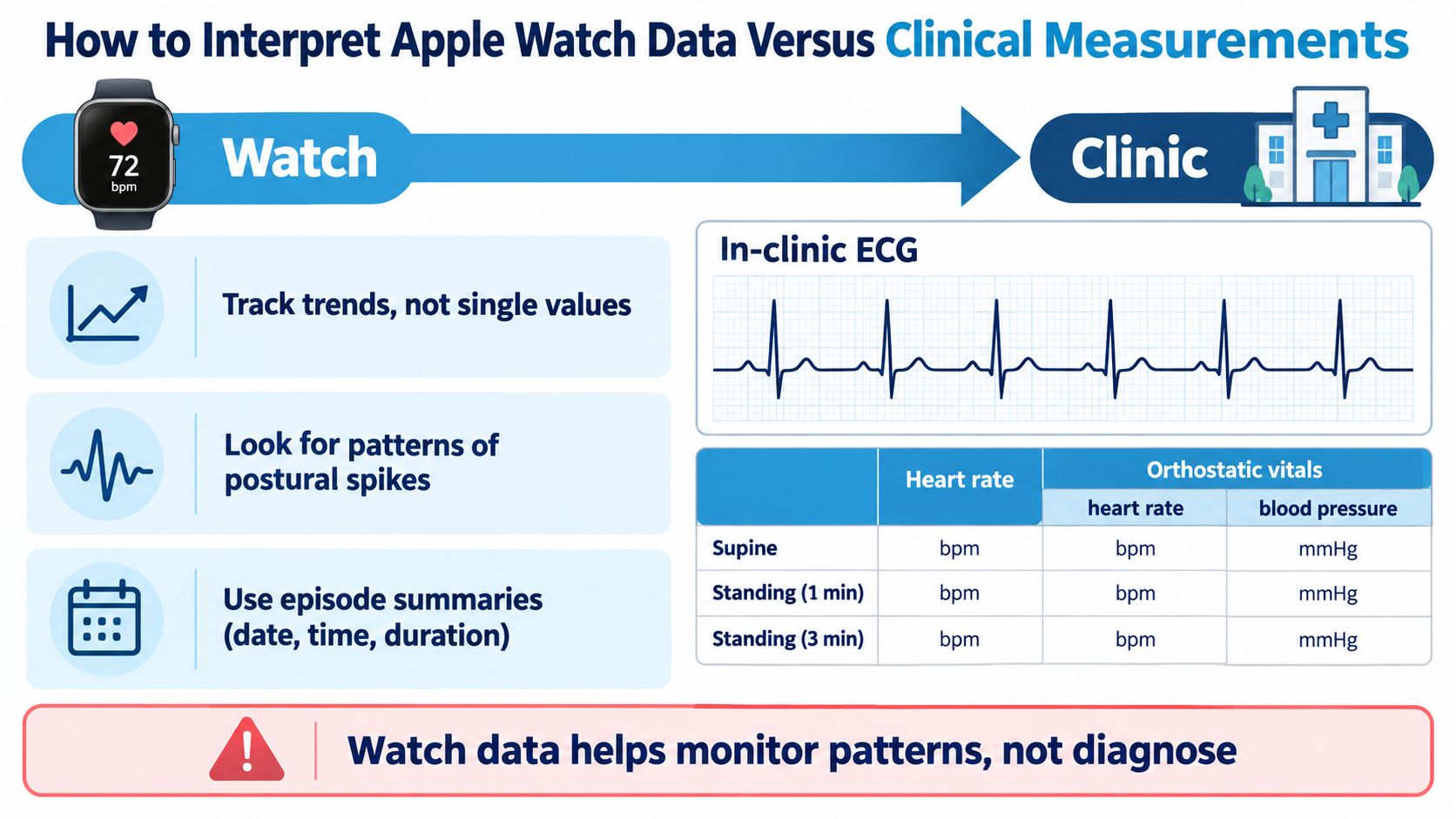
Apple Watch data and clinical measurements answer related questions, but they don't answer the same question in the same way. The watch can help reveal what happens across ordinary days. An ECG provides a clinical electrical recording, while orthostatic vital signs measure posture-related changes using a structured clinical process that can include both heart rate and blood pressure.
For POTS, the pattern usually matters more than the highest number. A useful history includes your baseline, the change after standing, the duration of the rise, the symptoms that accompanied it, and the circumstances that might have affected the reading.
Read episodes as a sequence
Instead of asking, “What was my heart rate?” ask:
- What was the baseline before standing?
- How much did it rise?
- Did the rise occur within the relevant observation window?
- Did it remain high?
- Did symptoms appear at the same time?
- Was I exercising, recovering, or standing?
A 30-plus-beat-per-minute rise within 5 minutes is the type of criterion Cardiogram is designed to detect from Apple Health heart-rate data, recording baseline, peak, sustained duration, and time of occurrence. That automated screening doesn't diagnose POTS, and it can't replace a clinician's assessment, but it can help organize a history that is otherwise difficult to reconstruct from memory.
Build a clinician-ready record
Weekly summaries and episode heatmaps can show whether events cluster at particular times or follow repeated triggers. A report is more useful when it combines the heart-rate pattern with symptoms, posture, hydration, salt, sleep, medication timing, and activity context.
A practical appointment packet might include:
- A short description of your usual baseline.
- Several representative episodes rather than every isolated spike.
- The time, posture, symptoms, peak, and duration for each episode.
- Notes about exercise or recovery periods that were excluded.
- Questions you want the clinician to answer.
You can explore the value of longer-term heart-rate trend tracking when isolated readings don't explain how you feel.
Know where the watch stops
A watch can't confirm a diagnosis, identify every rhythm abnormality, or measure blood pressure by displaying heart rate. Seek urgent medical help for severe or new symptoms such as chest pain, severe breathlessness, fainting, or a sustained concerning rhythm, rather than waiting for a watch reading to settle the question.
Bring the device history, but bring your symptom story too. Clinicians can decide whether a structured standing assessment, ECG, ambulatory monitoring, or another evaluation is appropriate.
Making Apple Watch Heart Rate Work for You
Apple Watch heart-rate accuracy is best understood as context-dependent measurement quality. Stable rest and repeatable posture checks can provide useful trend information. Fast movement, loose contact, cold skin, and exercise recovery can make individual readings less dependable.
Use a simple decision rule:
- Trust the pattern when similar readings recur under similar, documented conditions.
- Recheck the number when it appears during movement or conflicts sharply with how you feel.
- Share the episode history when rises are recurring, sustained, symptom-linked, or difficult to explain.
For POTS, trends usually tell a clearer story than isolated peaks. Baseline, rise, duration, posture, symptoms, and triggers give your clinician something they can evaluate, while a single unexplained number offers much less context.
Keep your routine realistic. Wear the watch consistently, pause before checking, separate exercise from orthostatic episodes, and log only the details you can maintain. A structured summary can turn a stressful collection of heart-rate screenshots into a calm account of what happened and when.
Cardiogram can analyze Apple Health heart-rate data on device, identify 30-plus-beat-per-minute rises within 5 minutes, exclude workouts and recovery periods from episode counts, and create summaries and PDF reports for clinical review. Visit Cardiogram to see how its pattern-focused approach can help you organize Apple Watch data for POTS and dysautonomia conversations.