You stand up to make breakfast and your heart suddenly races. A wearable records the spike, but it doesn't tell you whether dehydration, poor sleep, medication timing, heat, exertion, or a genuine orthostatic episode played the larger role. By the time you see your clinician, you may have weeks of graphs but no clear explanation of what changed.
That gap makes POTS syndrome management frustrating. The useful question isn't just “How high did my heart rate go?” It's “What was happening before, during, and after the episode, and what did it prevent me from doing?” A practical plan combines symptom relief, careful lifestyle changes, medical supervision, and a record that turns daily experience into decisions your care team can act on.
Understanding POTS Management Beyond Symptom Tracking
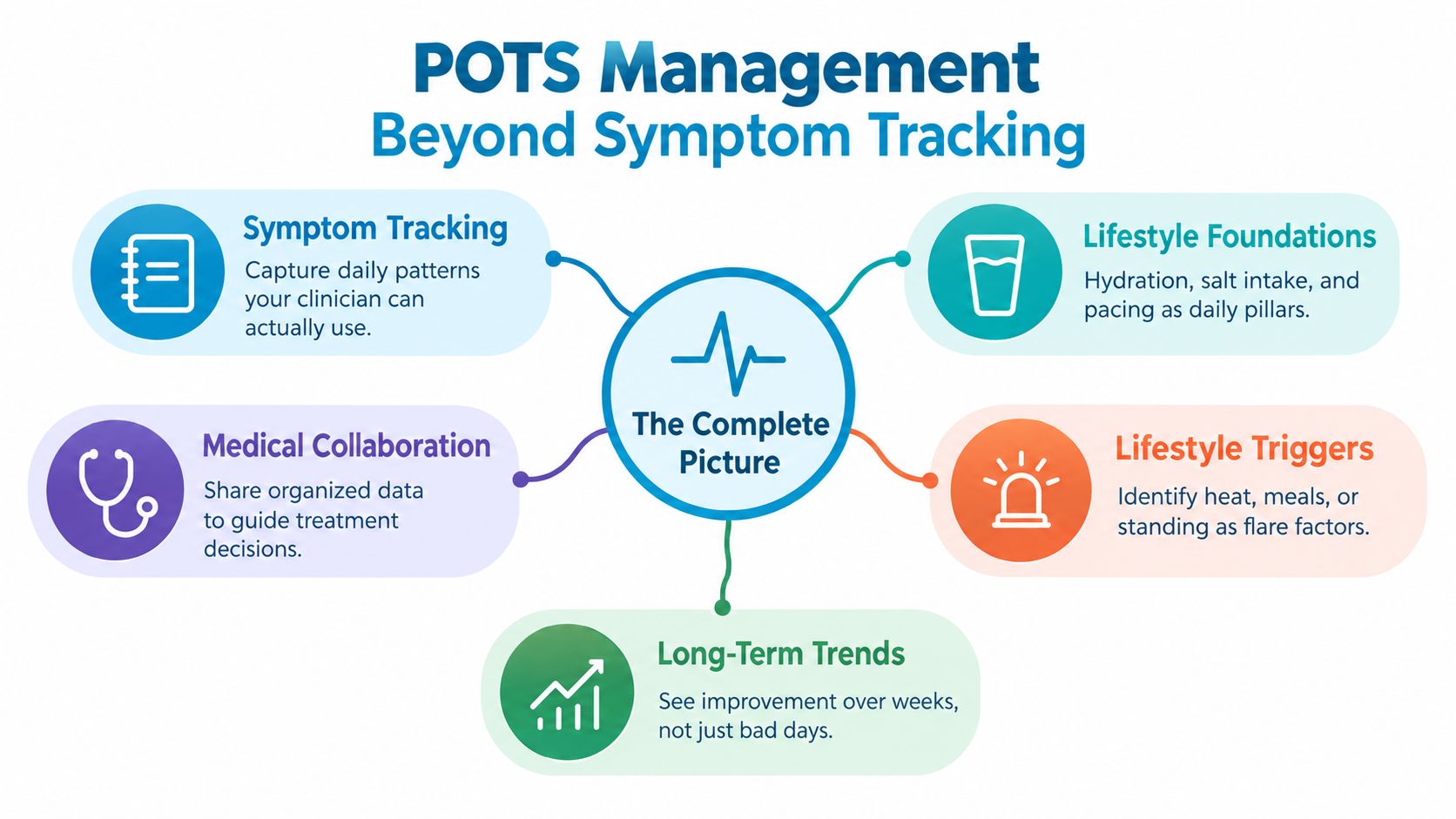
POTS management becomes more effective when you stop treating heart-rate data as the whole story. A pulse spike is a signal, not a diagnosis and not automatically proof that a treatment has failed. Clinicians also need posture, blood pressure, timing, symptoms, duration, medical history, and possible alternative explanations.
In adults, the commonly used diagnostic milestone is a sustained heart-rate increase of at least 30 beats per minute within 10 minutes of moving from supine to upright posture, without orthostatic hypotension. For adolescents aged 12 to 19, the threshold is at least 40 beats per minute. Evaluation commonly includes a period of supine rest followed by measurements at one, three, five, eight, and 10 minutes after standing, as described in the NIH consensus material on POTS evaluation. Compatible orthostatic symptoms matter, and other causes of sinus tachycardia must be considered.
From isolated readings to patterns
A useful record answers five practical questions:
- When did it happen? Record the time, posture, activity, and whether the episode began after standing, walking, eating, bathing, or resting.
- What changed physiologically? Capture baseline heart rate, peak heart rate, sustained duration, and blood pressure when available.
- What did you feel? Note dizziness, palpitations, fatigue, brain fog, nausea, weakness, presyncope, or other symptoms.
- What surrounded the episode? Include hydration, salt intake, sleep, heat, illness, stress, exercise, and medication timing.
- What was the functional effect? State whether you had to sit down, stop working, abandon a meal, miss an activity, or recover in bed.
That structure turns “my heart was high all day” into a clinically useful account. It also helps distinguish an episode that is unpleasant but brief from a recurring pattern that is limiting daily function.
Why context changes the decision
Suppose your wearable shows frequent tachycardia, but most events occur during workouts and resolve during recovery. That pattern needs a different discussion from episodes that begin while standing still, occur with dizziness, and repeatedly interrupt routine tasks. Similarly, a lower heart rate doesn't always mean you're better if you're now too fatigued to walk, sleep well, think clearly, or complete basic activities.
POTS commonly requires a combination of approaches rather than one intervention. A clinical review describes nonpharmacological measures, exercise reconditioning, symptom reduction, and improved quality of life as central parts of care, while also noting that there is no established cure and that treatment response should be judged over time rather than by isolated pulse readings. The broader autonomic context is explained in this guide to autonomic nervous system dysfunction.
Practical rule: Track enough information to answer your next clinical question. More data isn't automatically better data.
Building Your Foundation with Lifestyle Changes
Lifestyle measures are often the first layer of POTS syndrome management because they address circulation, conditioning, and daily triggers without asking you to rely on a single medication. They also require individualization. Salt and fluid strategies that help one person may be unsuitable for someone with kidney disease, heart disease, high blood pressure, pregnancy-related considerations, medication interactions, or electrolyte concerns.
Start with a supervised fluid and salt plan
Clinical guidance commonly discusses approximately 2 to 3 liters of fluid per day and, for some patients, a gradual increase in salt intake to about 10 grams daily. These figures come from general management guidance, not a universal prescription, so discuss the target with your clinician before changing intake. The practical details of supporting POTS symptoms with daily strategies should fit your medical history and blood-pressure pattern.
A safer implementation is gradual and observable:
- Agree on a target with your care team. Ask whether your blood pressure, kidney function, heart health, pregnancy status, and medications make increased salt or fluid appropriate.
- Spread intake across the day. A consistent routine is easier to evaluate than a large, last-minute increase after a flare begins.
- Record what you consume. A note such as "usual fluids" isn't useful for comparison. Use a simple estimate and include unusually hot days, illness, or disrupted routines.
- Watch for problems. New swelling, breathlessness, unusual blood-pressure changes, or worsening symptoms deserve medical review rather than more salt or fluid by default.
Use compression and counter-maneuvers purposefully
Compression garments can reduce blood pooling for some people, particularly during standing periods. Fit, comfort, temperature, and the amount of time you can tolerate them matter. They shouldn't become a reason to ignore worsening symptoms, and your clinician can advise whether they're appropriate for your circulation and skin health.
Physical counter-maneuvers can be useful during an early warning phase. Crossing your legs, contracting the leg and abdominal muscles, shifting position, or sitting down may help you respond before symptoms escalate. These techniques are tools for immediate safety, not substitutes for evaluation when episodes are severe, new, or associated with concerning symptoms.
Recondition without forcing a flare
Exercise reconditioning is usually introduced with low-intensity, predominantly recumbent activity such as rowing, swimming, or recumbent cycling. Programs then progress gradually toward more upright activity as tolerance improves, often over roughly three months, according to the clinical review in NCBI Bookshelf's POTS overview. The progression should be guided by symptoms and function, not by a rigid calendar.
During an acute flare, pushing harder can be counterproductive. A patient may tolerate several minutes of recumbent movement but feel significantly worse after standing exercise, and that response doesn't mean the entire program has failed. Begin at a level you can repeat, allow recovery, and ask a clinician or physical therapist how to adjust when symptoms persist rather than repeatedly testing your limit.
Understanding Medication Options and Limitations
Medication can be reasonable when symptoms remain severe despite foundational measures, but it should be approached as a monitored trial, not a promise of a cure. No medication has been specifically approved for POTS in North America, and extensive multicenter randomized controlled trials of drug therapy haven't been conducted. That means your clinician must balance symptom relief, side effects, blood pressure, functional goals, and uncertainty.

Compare the purpose, not just the pulse effect
Beta-blockers may be considered when upright tachycardia and palpitations are prominent, but lowering heart rate can be unhelpful if it worsens fatigue, exercise tolerance, dizziness, or low blood pressure. Midodrine may be discussed when impaired vascular constriction and low blood pressure are part of the clinical picture, yet it requires attention to blood-pressure response and dosing timing. Pyridostigmine is another option clinicians may consider, particularly when autonomic symptoms remain difficult to control.
These are not interchangeable treatments. The right conversation is not “Which drug lowers my heart rate most?” It's “Which symptom or mechanism are we targeting, what harm should we watch for, and how will we decide whether the trial helped?”
A recent evidence synthesis found only 21 randomized clinical trials involving 750 patients across POTS treatments and concluded that definitive treatment strategies remain lacking, including for beta-blockers, midodrine, and pyridostigmine, as reported in this 2025 treatment evidence review. That limitation doesn't make medication useless. It does mean expectations should remain precise and individualized.
Define success before starting
Before a medication change, agree on a review plan. Choose outcomes that matter to your life, such as fewer presyncope episodes, improved standing tolerance, better sleep, clearer thinking, or the ability to complete a specific daily task. Record medication timing alongside symptoms because a delayed or missed dose can look like treatment failure.
Keep the evaluation structured:
- Target symptom: What problem is the medication intended to improve?
- Possible harm: Which new symptom or vital-sign change should prompt a call?
- Review point: When will you and your clinician assess the pattern?
- Next decision: Will you continue, adjust, switch, or stop under supervision?
Don't change doses, combine treatments, or use repeated intravenous saline without medical direction. Older clinical guidance warns that repeated intravenous saline isn't recommended without evidence and can create harm through chronic venous access. A careful trial is safer than reacting to every difficult day.
Creating an Effective Tracking System for Your Care Team
A tracking system should reduce uncertainty, not become a second illness. Start with the smallest record that can answer your clinician's likely questions. If manual logging drains your energy, use brief entries and let wearable data provide the time series, then add context only when something clinically meaningful happens.
Capture the episode, not just the peak
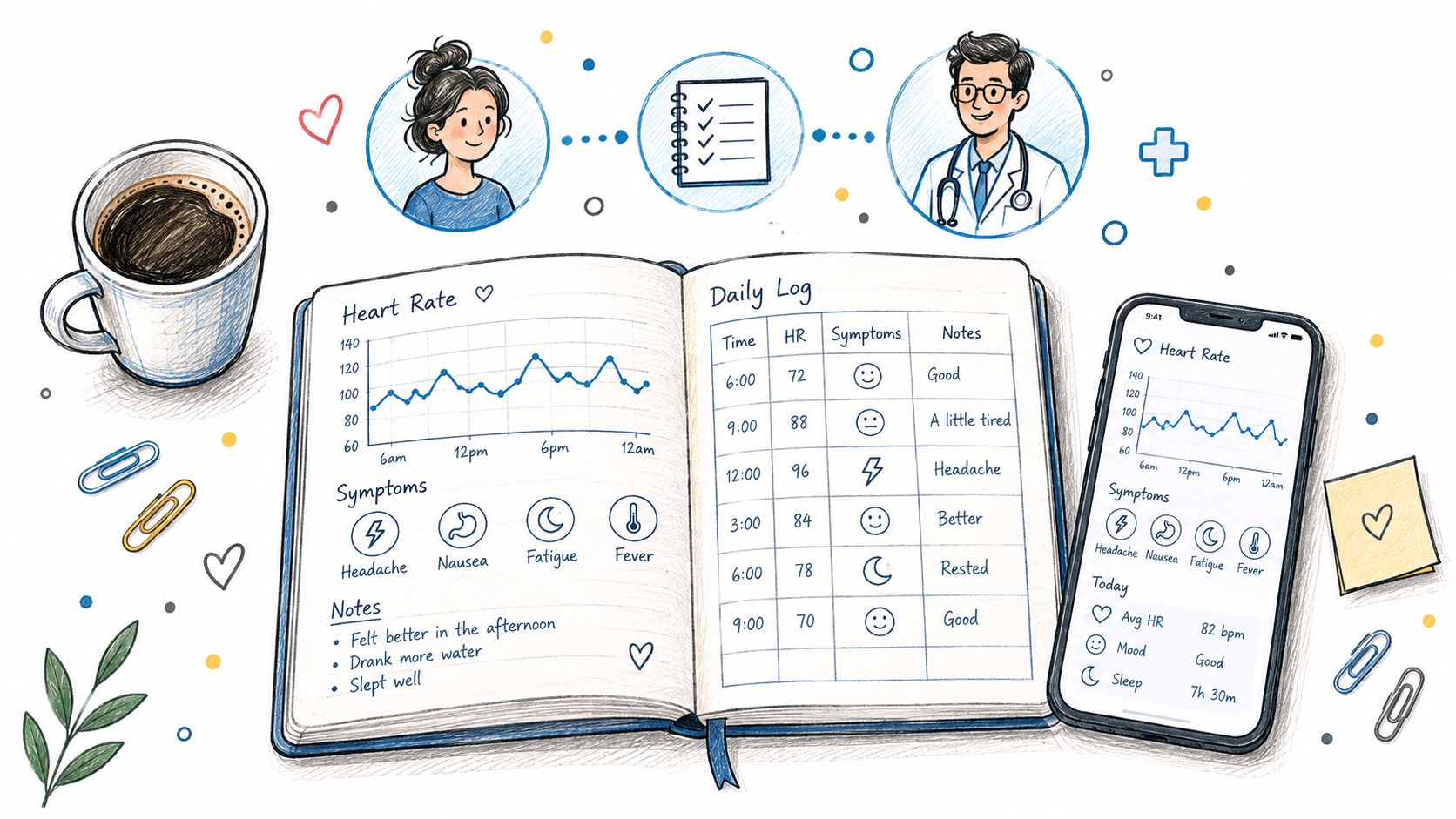
For each suspected orthostatic event, record:
- Timing and posture: Note when it began and whether you were lying down, seated, standing, walking, or changing position.
- Heart-rate change: Preserve the baseline, peak, sustained duration, and time of occurrence.
- Symptoms: Rate the main symptom in a consistent way, such as mild, moderate, or severe, and identify whether you felt dizzy, weak, breathless, cognitively impaired, or close to fainting.
- Blood pressure: Add readings when you have a validated home device and your care team has shown you how to use it.
- Context: Log sleep, hydration, salt exposure, heat, meals, exercise, illness, stress, and medication timing.
- Function: Describe what you couldn't do or what required recovery.
A graph with a high peak but no posture or symptom context is difficult to interpret. A shorter episode linked to standing, dizziness, and repeated activity interruption may deserve more attention than a higher reading during planned exercise.
Reduce noise before you draw conclusions
Wearables can miss posture, misread motion, or capture physiological changes that aren't specific to POTS. Exercise and recovery are particularly important sources of noise. Marking those periods prevents you from treating ordinary exertion as an orthostatic event.
You also don't need to log every heartbeat. A sustainable chronic illness symptom tracker should help you identify patterns across days and weeks. Choose a small set of symptoms and use the same labels each time, because changing the scale makes trends harder to compare.
Build a repeatable review habit
At a regular review point, look for clusters rather than isolated outliers. Ask whether episodes occur at a particular time of day, after poor sleep, during heat exposure, around meals, after medication changes, or when hydration and activity routines shift. Then compare those patterns with function and symptoms.
A useful tracking system doesn't predict what your clinician will prescribe. It gives both of you a clearer basis for deciding what to test next.
Use automatic reports cautiously. A trend can support a clinical conversation, but it can't independently establish POTS because diagnosis still depends on blood pressure, posture, compatible symptoms, history, and assessment of alternative causes.
Preparing Clinician-Ready Reports for Appointments
A clinician usually has limited time, so bring a short narrative rather than an unfiltered data archive. Your report should make the pattern easy to scan and the decision you need easy to identify.
Start with a one-paragraph summary:
“Since the last review, suspected upright episodes have become more or less frequent. The main symptoms are dizziness and fatigue. They occur mostly during standing and are more disruptive after poor sleep. My activity tolerance has changed in this specific way. I want to review whether the current plan is helping function, not just whether it lowers heart rate.”
Then add a compact table:
| Area | What to include |
|---|---|
| Episode pattern | Timing, posture, baseline and peak heart rate, sustained duration |
| Symptoms | Main symptoms, severity, presyncope, recovery time |
| Context | Sleep, hydration, salt, meals, heat, exercise, illness |
| Treatment | Medication name, dose changes made by the clinician, timing, side effects |
| Function | Standing, walking, work, school, household tasks, sleep |
| Questions | Two or three decisions you want to discuss |
Organize around decisions
Don't lead with the most dramatic graph. Lead with the question your care team needs to answer. Examples include whether symptoms are improving despite persistent heart-rate changes, whether a medication trial is causing fatigue, whether episodes cluster around a particular trigger, or whether your exercise plan is progressing too quickly.
Include representative examples rather than every event. Choose a typical episode, a severe episode, and a day that went relatively well. Explain what changed between them. This comparison often reveals more than a long list of peaks.
Separate observation from interpretation
Write “episodes occurred after standing and were accompanied by dizziness” rather than “my medication stopped working.” The first is an observation your clinician can evaluate. The second is a conclusion that may or may not be correct.
Bring the report in a format your care team can review, and keep the original record available if they need more detail. Ask directly:
- What outcome should we use to judge improvement?
- Which symptoms or readings should prompt earlier contact?
- Should I change the tracking variables?
- When should we reassess the current plan?
- What should I do during an acute flare?
A good appointment ends with a plan for the next observation period. Without that, tracking becomes documentation without direction.
Avoiding Common POTS Management Mistakes
The most common tracking mistake is assuming that more information automatically produces better care. It doesn't. Endless monitoring can increase vigilance, interrupt sleep, and make every fluctuation feel urgent while still failing to answer the question your clinician needs to address.
Mistake one is treating heart rate as the treatment target
A lower pulse can coexist with worse fatigue, dizziness, sleep, cognition, or activity tolerance. Conversely, a persistent heart-rate rise doesn't necessarily mean that every part of your plan is failing. Evaluate episode burden, symptom severity, blood pressure, function, and recovery, then discuss the combined pattern.
A treatment that makes the graph look calmer but leaves you unable to stand may not be meeting its purpose. Ask whether the intervention improves the life you're trying to live, not only the number displayed on your wrist.
Mistake two is escalating salt, fluid, or exercise during every flare
A flare may reflect heat, dehydration, illness, poor sleep, overexertion, medication effects, or another problem that requires assessment. Increasing salt immediately or forcing exercise can be inappropriate for people with specific cardiovascular, kidney, blood-pressure, pregnancy, or medication-related risks.
A 2025 systematic review found that exercise studies generally used recumbent aerobic and strength training followed by gradual progression toward upright activity, while also describing the literature as small and at high risk of bias, as detailed in this evidence review of exercise and POTS. Exercise can be valuable over time, but acute intolerance is a reason to seek guidance, not a reason to push through blindly.
Mistake three is reacting to one difficult day
POTS symptoms fluctuate. A bad day deserves attention, but it shouldn't erase a broader improvement in standing, sleep, activity, or recovery. Review trends over a meaningful period and mark disruptions such as illness, travel, heat, medication changes, or unusual exertion.
Use the same caution with a good day. Temporary improvement doesn't prove that a single intervention caused the change. Keep the context so you and your clinician can test explanations rather than assign credit too quickly.
Mistake four is changing the plan alone
Don't stop prescribed medication, increase a dose, begin aggressive salt loading, or launch a demanding exercise program without discussing it with your care team. Seek prompt medical assessment for symptoms that are new, severe, rapidly worsening, associated with injury, or otherwise unlike your usual pattern.
The better goal: Make your record calm, selective, and useful enough to support the next safe decision.
Cardiogram analyzes Apple Health heart-rate data to identify tachycardic episodes, connect them with symptoms and context, and create structured trends for clinical review. If you use an Apple Watch and want a more organized way to prepare appointment data, visit Cardiogram to explore its tracking and export features.