You just stood up for a glass of water. Before you reach the kitchen, your heart is pounding, the edges of your vision look grey, and you need to sit down again. If that sounds familiar, you're not imagining it, and you don't have to treat every fast pulse the same way. Sorting episodes by posture, timing, and what else was happening can make a confusing day much easier to read.
What a Flare-Up Feels Like
A typical POTS flare up often starts. You stand, walk to another room, or stand in a warm shower, and symptoms that might already be present at a low level suddenly move to the front. Your heart pounds, your head feels light, and an ordinary task can end with an hour on the couch.
A flare-up is a period when your usual orthostatic symptoms become stronger, more frequent, or harder to settle. It isn't always a switch from feeling well to feeling sick. In the 2024 Journal of the American Heart Association survey of 227 people with POTS, 99% reported ongoing symptoms, while only 0.9% (2 of 215) reported no symptoms during the preceding month. For many people, a flare is therefore a clear change in intensity against their usual baseline.
Some episodes arrive within minutes of standing. Others build slowly after heat, exertion, poor sleep, or a demanding morning. Matching your own experience to common descriptions can help you explain it later.
Common Symptoms and What They Feel Like
| Symptom | What it feels like | When it tends to appear |
|---|---|---|
| Lightheadedness | Dizzy or faint, often easing when lying down | Within minutes of standing |
| Palpitations | Pounding, racing or skipping heartbeat | With standing, heat or exertion |
| Fatigue | Heavy, drained, sudden loss of stamina | Builds through the day or after exertion |
| Brain fog | Slowed thinking and trouble finding words | During or after an episode |
| Visual disturbance | Greying, blurring or tunnel vision | Briefly, when rising from a seat or bed |
| Exercise intolerance | Heart rate climbs at low effort | With walking or household tasks |
| Tremor or leg weakness | Shaky or heavy legs | During prolonged standing |
You might notice a different order each time. Palpitations might come first on one day, while shakiness or blurred vision warns you on another. Fatigue can also linger after your pulse settles, which is why an episode can affect much more time than the racing heartbeat alone.
A flare doesn't have to look dramatic to be disruptive. The key change is that symptoms rise above your usual level and limit what you can safely do.
The practical approach is to notice what changed, ease the episode safely, record the context, and know which symptoms shouldn't wait for a routine appointment.
Why a Flare Makes Your Heart Race
Think of your blood vessels as a flexible system of tubes. When you stand, gravity pulls blood toward your legs and abdomen. Less blood returns to your heart for a moment, so your body normally tightens blood vessels and raises heart rate slightly to keep blood flowing to your brain.
In POTS, that adjustment doesn't work smoothly. Blood may pool in the legs because vessels don't constrict well, circulating blood volume may be low, or the autonomic nervous system may compensate too strongly. Your heart then beats faster to try to maintain output. The racing pulse is therefore best understood as an exaggerated compensation, not a heart deciding to speed up at random.
The Numbers Clinicians Use as Reference Points
According to the contemporary consensus definitions in Clinical Autonomic Research, POTS combines chronic symptoms of orthostatic intolerance with a sustained heart-rate increase of at least 30 beats per minute when moving from lying down to standing or during head-up tilt. For adolescents aged 12 to 19, the threshold is generally at least 40 beats per minute, assessed within approximately 10 minutes of standing.
| Criterion | Adults | Adolescents aged 12-19 |
|---|---|---|
| Heart-rate rise on standing | At least 30 bpm | At least 40 bpm |
| Timing of measurement | Within about 10 minutes of standing | Within about 10 minutes of standing |
| Blood pressure | No sustained systolic fall of 20 mmHg or diastolic fall of 10 mmHg | Same as adults |
| Symptom duration | At least 3 months | At least 3 months |
| Other causes of tachycardia | Excluded by clinical assessment | Excluded by clinical assessment |
Orthostatic hypotension must be absent, commonly meaning there's no sustained fall of at least 20 mmHg in systolic blood pressure or 10 mmHg in diastolic blood pressure. Reviews also commonly require symptoms for at least 3 months and exclusion of other causes of tachycardia.
These details explain why the highest pulse on your watch isn't enough information by itself. A useful record preserves your baseline heart rate, how much it rose, when the rise happened, your posture, and how long it lasted. A rise from 68 to 102 bpm shortly after standing tells a different story from the same peak during a workout.
Practical rule: Record the change and the timing, not just the peak. Posture turns a number into a pattern.
The 30-bpm adult threshold is a diagnostic reference point, not proof that one episode is POTS. Exercise, fever, pain, anxiety, caffeine, dehydration, and some medical conditions can also make your heart race. Only a clinician can assess the full pattern and make a diagnosis.
Triggers That Set a Flare Off
A high pulse isn't automatically a flare. That distinction can save you a lot of worry. A careful explanation of how POTS is diagnosed stresses that a high pulse alone is not evidence of a flare or a diagnosis, because heat, dehydration, caffeine, meals, exercise, infection, pain, stress, and medication effects can all cause temporary tachycardia.
Treat triggers as clues for sorting, not as a list of things to fear or avoid. The table below gives each one a useful record field.
| Trigger | How it tends to act | What to record |
|---|---|---|
| Heat and hot showers | Blood vessels in the skin dilate, so less blood returns to the heart | Temperature, duration and time of day |
| Dehydration | Lower blood volume makes standing harder | Fluid intake across the day |
| Caffeine | Raises heart rate directly | Amount and time consumed |
| Meals | Blood flows to the gut after eating, which can add to the orthostatic drop | Size and timing of the meal |
| Exercise | Expected rise in heart rate, which must be separated from orthostatic episodes | Activity type and effort level |
| Infection or illness | Fever and inflammation raise pulse and fatigue | Temperature and other symptoms |
| Pain or stress | Sympathetic activation raises heart rate | Pain score or stress level at onset |
| Medication changes | Some drugs raise heart rate or lower blood pressure | Drug name, dose and start date |
| Menstrual cycle | Hormonal shifts can change symptom severity | Cycle day when symptoms began |
After a large meal, postprandial hyperemia is one example of blood being directed toward digestion, so meal timing belongs in your notes.
A Three-Label Way to Sort a Spike
- Possible orthostatic: Your pulse rises after standing, symptoms match your usual upright pattern, and there's no obvious exertional or situational explanation.
- Likely situational or exertional: There's a clear trigger, such as a workout, hot shower, large meal, caffeine, fever, or acute stress.
- Needs medical review: The episode is new, unusual, severe, or paired with chest pain, fainting, fever, confusion, or other concerning symptoms.
Infection deserves particular attention because it can do more than worsen an existing pattern. In the 2025 Yale LISTEN cohort study, 167 of 578 adults with long COVID, or 28.9%, reported new-onset POTS. That doesn't mean every post-illness fast pulse is POTS, but it does mean new or persistent orthostatic symptoms after illness are worth discussing rather than dismissing.
How to Ease a Flare Right Now
During a flare, your first job is safety, not analysis. Work through these steps calmly and stay seated or lying down until you're steady.
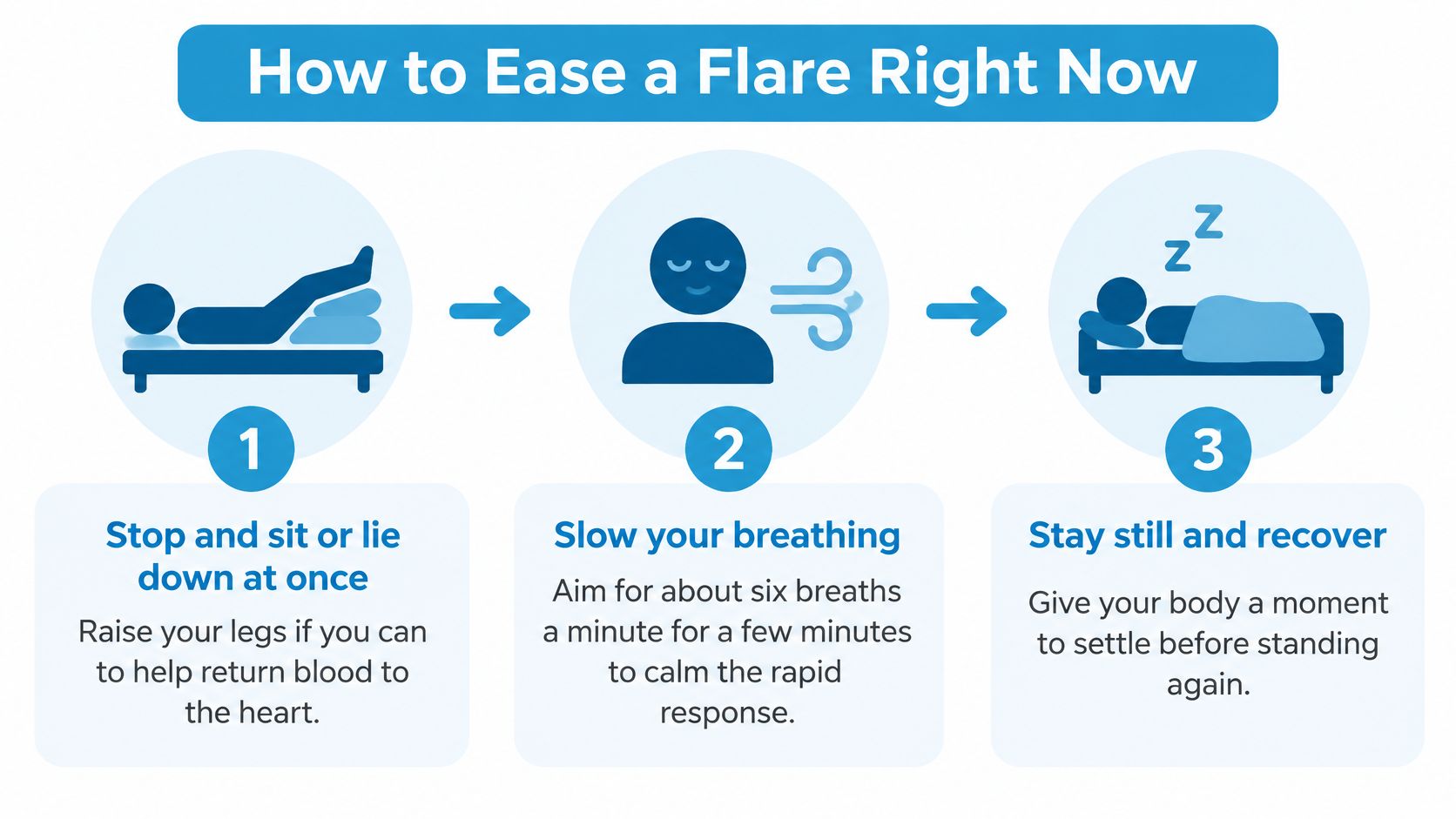
- Stop and sit or lie down at once. Raise your legs if you can. Removing the upright challenge helps blood return toward your heart and lowers your fall risk.
- Slow your breathing to about six breaths a minute. Continue for a few minutes if it's comfortable. Longer, slower exhalations can help calm the rapid response.
- Drink a measured glass of water or an oral rehydration drink. Follow your provider's plan for fluids and salt. The relationship between hydration and heart rate makes measured intake more useful than guessing.
- Cool down. Move to a cooler room if someone can help you, loosen extra layers, and avoid a hot shower until you've recovered.
- Hold off on caffeine and alcohol. Both can complicate heart rate, blood volume, or blood vessel tone while symptoms are active.
- Stay still until your heart rate settles. Then rise in stages. Sit first, pause, stand while holding support, and sit again if symptoms return.
- Use rescue medication only as prescribed. Don't improvise with someone else's medicine or take an extra dose to chase a watch number.
- Note the start time and heart rates. Add the details using the checklist in the next section once you feel safe.
Common Slips That Can Restart Symptoms
Standing quickly just to test whether you've recovered is a frequent mistake. You may feel better lying down because the trigger has been removed, not because you're ready to resume everything. Drinking a very large volume of plain water at once can also backfire if it doesn't match your care plan. Sip a measured amount and follow the fluid and salt guidance you've been given.
Skipping the record is understandable when you're tired, but even a brief note helps. Many episodes ease within an hour of lying down. If yours doesn't settle or feels different from your usual pattern, use the escalation rules below rather than waiting it out alone.
Tracking Patterns Across Days and Cycles
One hard day rarely tells the whole story. Tracking lets you compare mornings with evenings, workdays with rest days, and one menstrual cycle with the next. Patterns that look random in the moment can become clearer after several weeks.
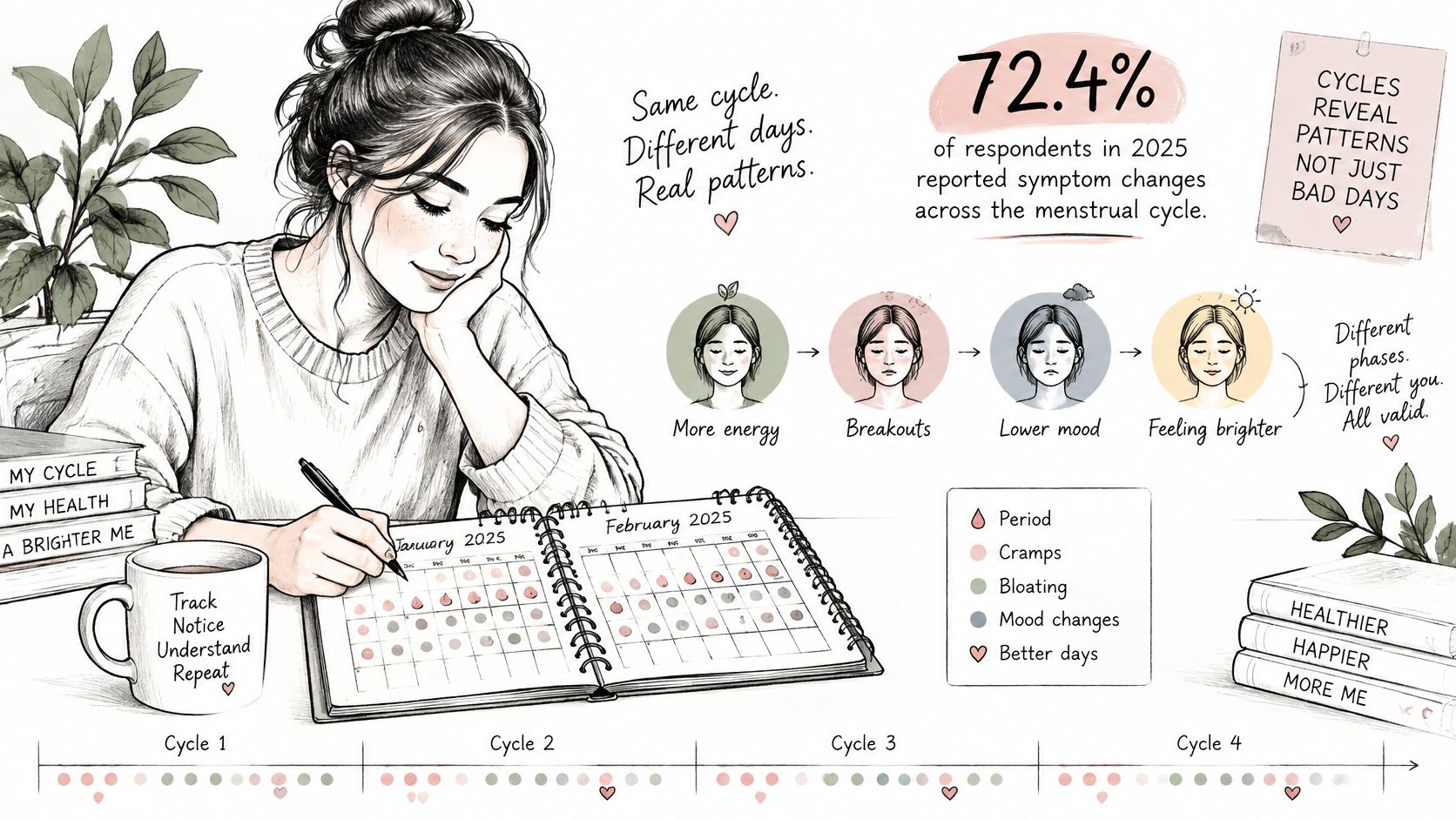
Cycle timing is one example. In a 2025 survey table, 72.4% of respondents reported POTS symptom changes across the menstrual cycle. Among those identifying a worst phase, 73.9% selected days 1 to 5 of menstruation, while 24.3% selected the 1 to 10 days before flow.
Those figures don't prove hormones caused any individual flare. Read cycle day alongside sleep, bleeding severity, hydration, medication changes, infection, and posture. Heavy bleeding, missed meals, poor sleep, and being upright for longer could all cluster in the same week.
A Short Checklist for Each Episode
- Time and posture: When it started and whether you were lying, sitting, standing, or walking.
- Baseline and peak heart rate: Include how quickly the rise happened.
- Duration: When symptoms and pulse began to settle.
- Symptoms: Use plain descriptions such as grey vision, shakiness, or trouble finding words.
- Daily context: Workouts, fluids, salt, caffeine, meals, and sleep.
- Medications: Note new drugs, dose changes, and doses taken that day.
- Cycle day: Add it if relevant, along with bleeding severity.
Compare episode frequency and heart-rate rise across several cycles before drawing conclusions. A pattern repeated three times is more informative than one difficult month, especially if illness or travel disrupted your routine.
A structured chronic illness symptom tracker can keep those fields together instead of scattering them across notes. A read-only Apple Health tracker such as Cardiogram can hold these fields for each episode, but the log is a record for clinical review, not a diagnosis.
When to Call Your Doctor Promptly
Use two levels of response. Contact your provider soon if flares become more frequent, last longer, stop responding to your usual steps, begin with new symptoms, or start limiting work, school, driving, or basic daily tasks. Also call if you notice a clear change after starting a medication.
Seek emergency care right away for fainting, near-fainting with injury, chest pain or pressure, shortness of breath, a racing heartbeat with confusion, a heart rate that doesn't settle after lying down, or weakness on one side of your body.
Don't assume every change is just another POTS flare up. Anemia, thyroid disease, infection, dehydration, blood loss, and some medications can mimic or worsen tachycardia. A clinician can check whether something else is contributing, particularly when the pattern changes suddenly or your resting heart rate rises for several days.
Bring evidence that's easy to review. Choose the three most disruptive episodes and show the date, time, posture, baseline and peak heart rate, duration, symptoms, and likely context. A brief PDF or written summary is more useful than scrolling through weeks of raw watch data during a short appointment.
Patterns across several weeks or months usually carry more weight than one reading. Your clinician can see whether rises cluster after standing, occur mainly after meals, follow poor sleep, or intensify at a particular point in your cycle. That view supports better questions about testing, medication effects, hydration, activity, and other possible causes.
Start with one habit this week. You could record posture and baseline heart rate for every episode, label each spike as possible orthostatic, likely situational, or needs medical review, or prepare a one-page summary for your next visit. Decide in advance who you'll contact if a flare escalates. A small, consistent record gives you calmer decisions in the moment and gives your provider a clearer story later.
If you're using an Apple Watch, Cardiogram can organize heart-rate rises into episodes with baseline, peak, duration, symptoms, and context, then summarize trends in a report for your clinician. Visit Cardiogram to start building a clearer record of your next flare, while keeping the diagnosis and treatment decisions with your own care team.