You get up from the sofa, your heart starts racing, and you reach for your watch. By the time you check it, you're wondering whether the number means anything, especially if you also feel dizzy or shaky.
An active stand test replaces that isolated reading with a timed record of what happens when you move from lying down to standing. At home, its most useful outcome isn't a pass or fail. It's a clear set of readings and symptoms you can bring to a clinician.
Active Stand Test Thresholds at a Glance
Suppose your pulse is 70 bpm lying down and 102 bpm standing. That's a hypothetical rise of 32 bpm, but the arithmetic alone doesn't tell you whether you have postural orthostatic tachycardia syndrome, or POTS. You also need to know whether the increase persisted, what happened to your blood pressure, and how you felt.
The clinical review of stand and tilt testing describes the adult threshold as a sustained rise of at least 30 bpm within 10 minutes, with a higher threshold of at least 40 bpm for adolescents aged 12 to 19; it also discusses the original 1993 criteria, which accepted a rise of 30 bpm or more, or a maximum heart rate of 120 bpm or more, without a blood-pressure decline.
Active stand thresholds by group
| Group | Time window | Heart-rate rise | Blood-pressure fall |
|---|---|---|---|
| Adults | Within 10 minutes | Sustained rise of 30 bpm or more | A substantial fall requires assessment for orthostatic hypotension |
| Adolescents aged 12 to 19 | Within 10 minutes | Sustained rise of 40 bpm or more | A substantial fall requires assessment for orthostatic hypotension |
| Original 1993 criteria | Within 10 minutes | Rise of 30 bpm or more, or maximum of 120 bpm or more | No blood-pressure decline |
Read the change, not just the standing number
In the hypothetical example, the increase reaches the adult heart-rate threshold only if it's sustained. A reading taken during the movement of standing isn't enough.
You can use the heart-rate rise calculator to check the subtraction, but keep the individual readings too. A clinician needs the sequence, not merely the calculated difference.
Keep the conclusion narrow: A threshold-reaching response is a reason to investigate, not a diagnosis of POTS.
Clinicians also consider orthostatic symptoms, meaning symptoms associated with being upright, and alternative explanations such as dehydration, anemia, thyroid disease, medication effects, or acute illness.
Recording Heart Rate and Symptoms Accurately
Set up your recording sheet before you start. You'll want a timer, a way to measure pulse, an upper-arm blood-pressure cuff, and somewhere to write without bending down or walking around.
The POTS UK quick-reference guide recommends a baseline after at least 5 minutes lying supine, followed by repeated measurements, commonly every minute or at 1, 3, 5, 7, and 10 minutes; it also identifies a fall of at least 20 mmHg systolic or 10 mmHg diastolic during the first 3 minutes as a pattern requiring assessment for orthostatic hypotension.
Recording sheet for one active stand run
| Time point | Heart rate (bpm) | Blood pressure | Symptoms and notes |
|---|---|---|---|
| Baseline, lying down | Enter resting pulse | Enter systolic/diastolic | Describe symptoms before standing |
| Immediately after standing | Enter measured pulse | Enter reading if obtainable safely | Note immediate changes |
| Minute 1 | Enter measured pulse | Enter systolic/diastolic | Record symptoms or none |
| Minute 3 | Enter measured pulse | Enter systolic/diastolic | Record symptoms or none |
| Minute 5 | Enter measured pulse | Enter systolic/diastolic | Note any worsening or improvement |
| Minute 7 | Enter measured pulse | Enter systolic/diastolic | Record symptoms or none |
| Minute 10 | Enter measured pulse | Enter systolic/diastolic | Note completion or reason for stopping |
Choose a measurement method you can use safely
A manual pulse count can provide a checkpoint, but it requires attention while you're standing. A blood-pressure cuff provides both pressure and pulse readings, though it doesn't produce a continuous record.
A chest strap or ECG-capable device may offer more detailed heart-rate information. A smartwatch is convenient for following a trend, but don't assume every displayed value reflects an instantaneous change. If a reading looks unexpected, note it and check your pulse if you can do so safely.
Record sensations alongside measurements
Log dizziness, light-headedness, blurred or dim vision, nausea, fatigue, headache, and palpitations. Also note visible signs such as sweating, trembling, or blotchy, bluish legs.
For example, a hypothetical row might read: minute 3, 98 bpm, 118/76, light-headed, no water since breakfast. That's more informative than writing only that you felt bad.
Add the time of day, time since your last meal, fluid intake, caffeine, sleep, and medication timing above the table. Keep each run in the same heart-rate log format so you can compare mornings without reconstructing the conditions from memory.
How to Run the Active Stand Test at Home
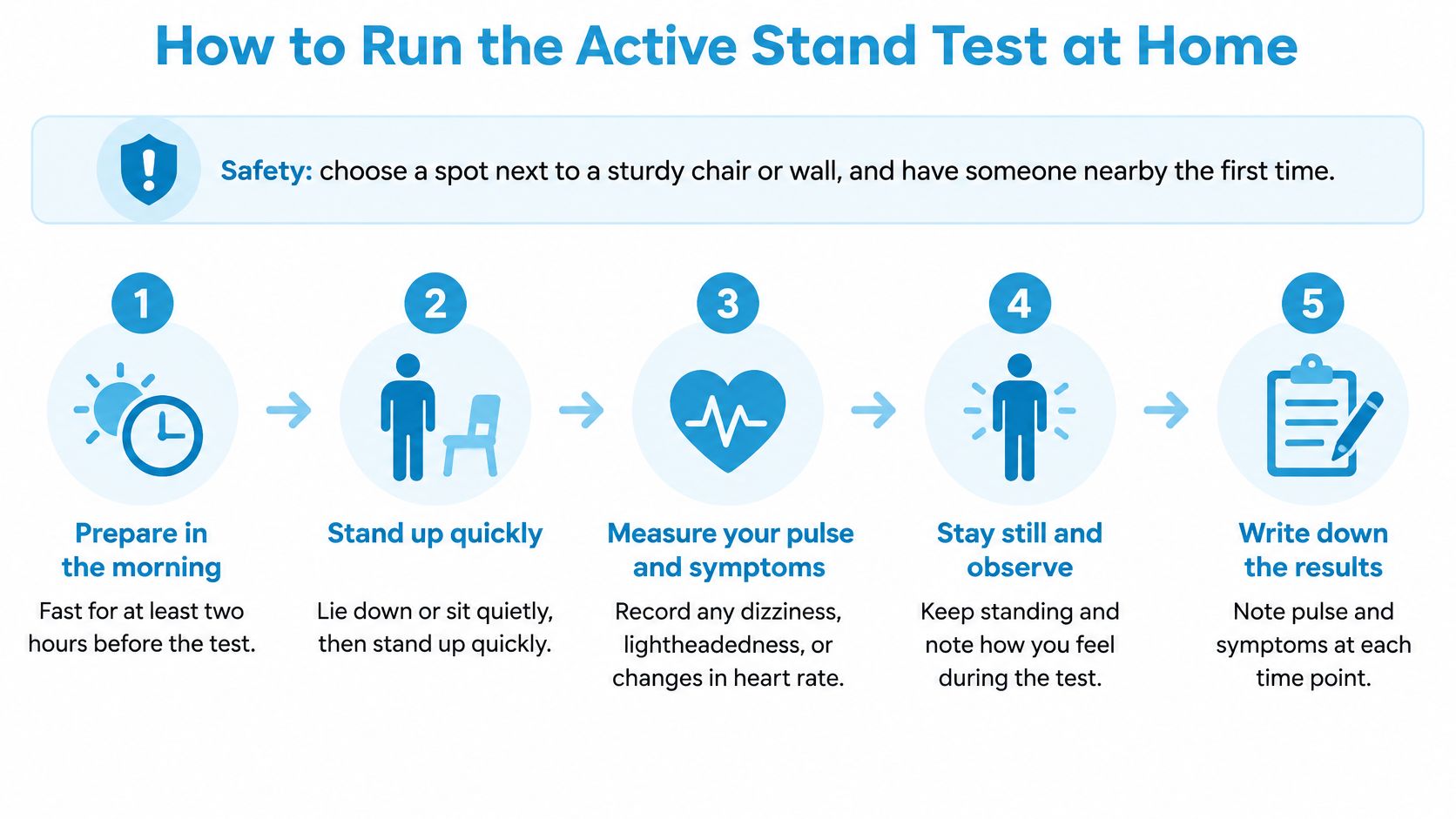
Safety: choose a spot next to a sturdy chair or wall, and have someone nearby the first time. Clear the floor and make sure you can sit or lie down immediately. If you've fainted during standing before, ask a clinician whether home testing is appropriate rather than attempting it alone.
The infographic offers a quick overview. For an active stand test, use a lying baseline, not a seated one, and stand unsupported rather than leaning against the wall.
Follow a consistent sequence
The Heart Rhythm Alliance active stand guidance calls for at least 5 minutes of quiet supine rest, baseline measurements, then unsupported standing for up to 10 minutes, with measurements immediately after standing and ideally every minute; it also flags sustained pressure falls greater than 20 mmHg systolic or 10 mmHg diastolic for concurrent assessment.
Prepare your equipment and conditions. Choose a morning when you haven't just exercised, drink as you normally would, and write down your medications and when you took them. Don't skip prescribed medication or deliberately restrict fluids to provoke a result.
Lie flat and settle. Stay quiet for the resting period, without scrolling, chatting, or repeatedly checking the display. You're establishing a resting comparison, not trying to force your pulse as low as possible.
Record the baseline. Write down heart rate, blood pressure, and any symptoms while you're still lying down. Keep the cuff in place so you don't have to fit it while upright.
Stand in a smooth movement. Start the timer when you become upright and stand with your feet comfortably apart. Have your helper manage the timer and notes if possible, so you aren't juggling equipment.
Remain still and unsupported. Avoid leaning, talking, fidgeting, marching, or repeatedly tightening your calves. Leg-muscle activity helps move blood back toward the heart and can change the response you're trying to observe.
Take the scheduled readings. Use the prepared sheet, recording symptoms even when the pulse doesn't look remarkable. If you miss a checkpoint, write the actual measurement time rather than assigning it to the intended one.
Stop if you feel unsafe. Sit or lie down if you feel faint, develop chest pain, or become severely unwell. Recheck blood pressure once safely positioned if practical, but don't delay getting help to finish a measurement.
Record recovery. After sitting or lying down, note whether symptoms ease and how your pulse settles. If you ended early, preserve the readings you obtained and explain why you stopped.
Completing the timer isn't more important than preventing a fall. An interrupted test can still provide useful information.
A complete record has a resting baseline, a timed standing sequence, and symptom notes. If you only measured heart rate, label that limitation clearly. Don't describe blood pressure as stable when you didn't measure it.
Reading Results and Avoiding False Alarms
The most common mistake is scanning the record, picking the highest number, and calling the test positive. A stand test works more like a short film than a photograph: a single frame tells you little, while the sequence tells you whether the heart rate stayed up. A brief spike and a persistent rise carry different weight, and a short, uneventful observation can miss a response that only appears later in the record.
Clinical guidance on postural tachycardia supports this patient approach. It emphasizes repeated or continuous measurements, notes that morning testing may improve sensitivity, and cautions that testing conditions and measurement methods affect interpretation. The Heart Foundation's clinical guidance also recommends fasting for at least two hours beforehand to reduce meal-related confounding.
Check the conditions before judging the pattern
Before you compare your numbers against the threshold, ask whether something else pushed them around. Several everyday factors can create, shrink, or disguise a rise.
Confounders that distort a stand test
| Factor | How it skews the reading | What to do |
|---|---|---|
| Dehydration | Can raise standing heart rate and resemble a threshold-reaching pattern | Drink normally, then retest another morning if safe |
| Exercise or a long walk that morning | Can leave baseline and standing heart rate higher than usual | Avoid exercise beforehand and allow quiet rest |
| Recent meal | Can lower blood pressure and complicate interpretation | Use the fasting interval described above, if medically appropriate |
| Anxiety or stress | Can alter resting pulse and the standing response | Rest quietly and record how you felt |
| Medications, including stimulants, beta-blockers, and diuretics | Can alter heart rate, blood pressure, or both | Record names and timing; ask a clinician before changing anything |
| Inadequate lying rest | Can make the baseline unrepresentative and the apparent rise smaller | Complete the quiet resting period |
| Leg-muscle movement or leaning | Can improve venous return and reduce the apparent response | Note the movement; repeat unsupported only if safe |
Standardization makes conditions comparable. Skipping a medication dose, overdrinking water, or repeating the test until the numbers look the way you expected produces a record you cannot trust.
Look for persistence, then summarize
Read the sequence minute by minute and ask two questions: did the rise reach the threshold, and did it stay there?
Consider a hypothetical baseline of 72 bpm, followed by 108 bpm at minute 1 and 103 to 104 bpm at minutes 3, 5, and 7. The later readings remain 31 to 32 bpm above baseline, showing persistence rather than an isolated early peak. The minute-1 reading alone would not establish that pattern. If your own record shows a spike that settles within a minute or two, note it, but weigh it differently from a rise that holds across several checkpoints.
Results reported for a validated clinical protocol do not transfer automatically to a home run on a smartwatch. Different equipment, observation periods, and patient groups can produce different numbers, so describe what you measured and how, rather than borrowing certainty from a published study.
Finish each run with a plain-language summary covering the heart-rate rise, how long it persisted, any blood-pressure change, symptoms, and each confounder you noticed. For example: pulse stayed high across the later checkpoints, light-headedness developed while upright, and a morning walk may have affected the run. That summary, along with the raw timed readings, is what to bring to a clinician. A home result is a starting point for that conversation, not a diagnosis.
Warning Signs That Mean Getting Care Now
A racing pulse on your watch is information to record. Some symptoms are different: they end the test on the spot and shift the question from "what did my heart rate do?" to "am I safe right now?" If you feel unsafe at any point, the stopping rule from the test steps applies: sit or lie down where you are and let your helper stay with you.
Symptoms that need urgent assessment rather than a routine appointment:
- Chest pain or significant shortness of breath, particularly if new, severe, or not settling after you lie down.
- Fainting or near-fainting, especially with an injury, repeated episodes, or difficulty recovering.
- Confusion or reduced alertness, including difficulty responding normally to the person helping you.
- A racing heartbeat at rest that won't settle, particularly when accompanied by weakness, chest discomfort, or breathlessness.
- A marked blood-pressure fall with symptoms, especially if you remain faint or unwell after stopping.
Call emergency services for severe or ongoing symptoms, loss of consciousness, or any doubt about whether you can stay safe. If you recover quickly but the episode was new or alarming, seek urgent medical advice about what to do next. Don't drive yourself while dizzy, faint, or otherwise impaired.
Arrange a visit for recurring problems
You don't need an emergency symptom to justify a clinician appointment. Dizziness or palpitations that keep returning and start to shape your choices, whether that's cutting a commute short, avoiding driving, or limiting how long you stand, deserve assessment even when no single episode felt dramatic.
Worth booking for, specifically: a persistent upward change in resting heart rate, symptoms that keep returning despite an unremarkable home test, or symptoms that start after a new medication. Bring your timed record rather than a verdict. The most useful entries are the minute-by-minute readings, the symptoms noted beside them, and a short description of when the problem began and how it affects ordinary days. That record gives a clinician something concrete to work with; "my watch went high once" does not.
Act on symptoms, not the schedule: If a reading worries you and you feel unwell, don't wait for the next planned test to decide whether to seek help.
There is no benefit in repeating a test immediately after a frightening episode just to confirm it. Save the record you already have, note how you recovered, and let a healthcare professional help determine whether further testing is safe.
Confirm Results with a Clinician Before Acting
A home test gives you evidence for a clinical conversation. If testing was well tolerated and a clinician hasn't advised otherwise, the next step is building a small set of comparable records rather than collecting endless isolated screenshots.
A few comparable mornings tell a clearer story than one striking number.
- Repeat on separate mornings if safe. A single run can be skewed by whatever the day before held, so consistent conditions matter more than a dramatic result. Keep completed sheets, including interrupted runs, instead of bringing only the most dramatic reading.
- Attach the context. Include symptoms, sleep, hydration, caffeine, medication timing, and anything unusual about the day.
- Book an appointment. Ask whether a supervised active stand, tilt-table test, ECG, or ambulatory rhythm monitor would answer the clinical question.
Ask why a particular test fits
Active standing uses your leg muscles and balance control, while passive tilt supports your body without the same muscular activity. Each protocol stresses your circulation differently.
Aetna's clinical policy review summarizes an adolescent comparison in which a 5-minute active stand using a 26-bpm threshold had 70.6% sensitivity and 68.2% specificity, while a 10-minute tilt using a 40-bpm threshold reached 94.1% sensitivity and 95.1% specificity. Those figures describe the protocols tested in that comparison.
The review also describes older comparative work in which tilt exaggerated tachycardia in patients and controls, while active standing was more specific. The useful question is which test addresses your symptoms and circumstances.
A clinician will also weigh other explanations for a fast heart rate. The common contributors are listed in the Thresholds section, so review them before your visit and note which ones might apply to you.
Our PDF report puts episodes, trends, and symptoms together and states the exact criterion used. Treat wearable records as supporting evidence, and use this guide to patient-provider communication to prepare your questions.
For the appointment, bring:
- The full log, including blood pressure and stopped tests.
- Your medication list and symptom timing.
- Questions about test choice, why it fits, and what result would change the care plan.
We offer a free heart-rate rise calculator and a guided NASA lean test, and neither requires the app. Visit Cardiogram to explore these resources and prepare a clearer record for your clinician, while remembering that a lean test uses a different posture from an unsupported active stand.