Yes, dark chocolate can lower blood pressure, but only modestly, roughly 2 to 3 mmHg systolic and 1 to 2 mmHg diastolic at typical trial doses. That makes it a reasonable food adjunct for some adults, not a treatment for hypertension.
The counterintuitive part is that the benefit comes from cocoa flavanols, not from chocolate as a candy category. A carefully selected, flavanol-rich product may help blood vessels relax, while a heavily sweetened bar can add calories, sugar, and stimulants that work against your broader heart-health goals. If you take blood-pressure medication or track palpitations and tachycardia, the right question isn't whether dark chocolate is “healthy.” It's whether a specific product, portion, and timing help or hurt your own readings and symptoms.
What the Research Shows
Randomized trials say yes, but the effect is small. A 2025 Cochrane review covering 40 treatment comparisons and 1,804 mainly healthy participants found that flavanol-rich cocoa products lowered both systolic and diastolic blood pressure by 1.76 mmHg. The trials lasted 2 to 18 weeks, with a mean duration of 9 weeks. That supports a short-term average change, not proof that chocolate prevents cardiovascular events or replaces medication. The Cochrane review characterized the effect as small.
Earlier evidence reached a similar conclusion. A 2010 meta-analysis of 15 cocoa and chocolate trial arms found a systolic reduction of 3.16 mmHg and a diastolic reduction of 2.02 mmHg, with the strongest signal among people with hypertension or prehypertension. It found no significant reduction below 140 mmHg systolic or 80 mmHg diastolic. Flavanol-rich chocolate is therefore not a universal blood-pressure intervention. The 2010 meta-analysis supports using it only as an adjunct.
| Study type | Duration | Average systolic change | Average diastolic change |
|---|---|---|---|
| 2010 cocoa and chocolate meta-analysis | Not uniform across trial arms | −3.16 mmHg | −2.02 mmHg |
| 2025 Cochrane review | 2 to 18 weeks, mean 9 weeks | −1.76 mmHg | −1.76 mmHg |
| 2026 meta-analysis | Trial durations varied | −2.734 mmHg | −1.848 mmHg |
The newer 2026 meta-analysis of 25 studies involving 1,167 participants reported average reductions of 2.734 mmHg systolic and 1.848 mmHg diastolic, across daily flavanol doses ranging from 10.6 to 1,680 mg. The 2026 analysis shows why “eat dark chocolate” is poor guidance on its own. Trial products and flavanol exposure differ substantially, so a standard bar cannot automatically be treated as equivalent to a controlled cocoa product.
What the evidence does not prove
These studies do not establish that an ordinary supermarket bar produces the same effect as a controlled cocoa product. They also do not show that people with normal or well-controlled pressure will notice a meaningful improvement. The evidence is short-term, doses vary, and the intervention groups are generally small compared with studies assessing standard hypertension treatment.
Clinical bottom line: If your blood pressure runs high, flavanol-rich cocoa may add a small improvement on top of your existing plan. It will not replace medication, sodium reduction, exercise, sleep, weight management, or regular monitoring.
Track readings under similar conditions rather than judging the effect from one measurement. People monitoring trends can review how to track blood pressure with an Apple Watch. If you also notice palpitations or tachycardia, record those symptoms with the timing and amount of chocolate, then discuss a repeated pattern with your clinician.
How Cocoa Flavanols Lower Blood Pressure
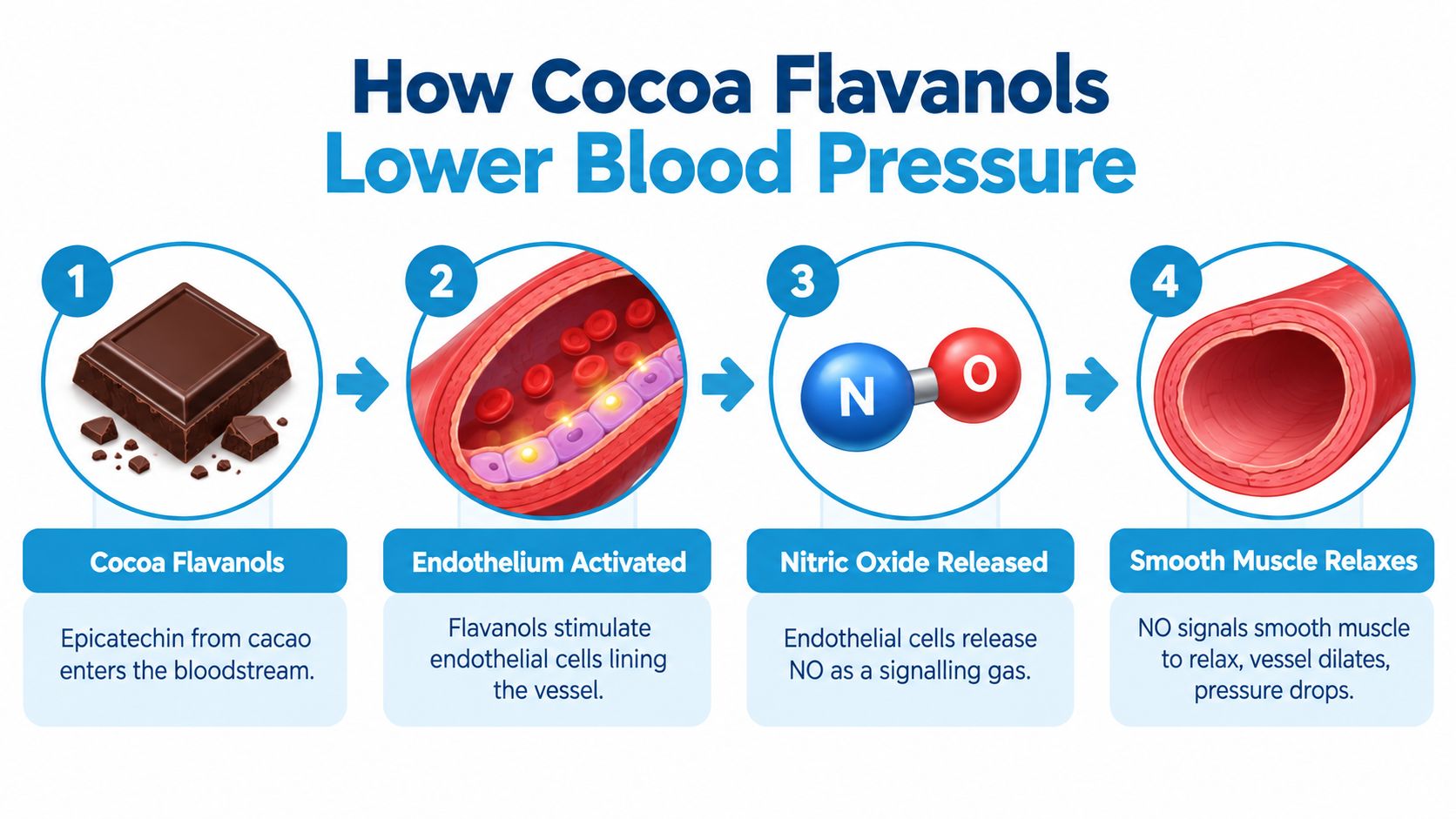
Cocoa flavanols appear to help the inner lining of blood vessels, called the endothelium, produce more nitric oxide. Nitric oxide acts as a signal to the muscular layer around an artery. When that muscle relaxes, the vessel widens and blood encounters less resistance.
Think of a garden hose. If the hose is tight and narrow, the water faces more resistance. Relaxing and widening the hose can reduce pressure downstream without changing the pump. Cocoa flavanols don't act like a powerful switch, but they may make the vessel slightly more responsive to its normal signals.
Why nitric oxide matters
A review of short-term trials found an average blood-pressure reduction of about 1.8 mmHg with flavanol-rich cocoa products. Another analysis of 10 randomized trials involving 297 participants found reductions of 4.5 mmHg systolic and 2.5 mmHg diastolic. A nitric-oxide-related marker, S-nitrosoglutathione, also increased alongside reductions in mean systolic and diastolic pressure in one cited analysis. The vascular evidence review makes vasodilation a plausible explanation rather than a marketing story.
That pathway explains the direction of the result, but it doesn't make the result large. Blood pressure reflects many inputs at once, including sodium intake, body weight, sleep, stress, physical activity, kidney function, and prescribed treatment. A small change in endothelial signaling competes with all of them.
Cocoa isn't automatically equivalent to chocolate
Processing matters. Heavy roasting and Dutch processing can reduce the flavanol content that gives cocoa its vascular activity. That means a high-cacao percentage doesn't guarantee a high flavanol dose. A minimally processed cocoa product may be more biologically relevant than a very bitter product whose cocoa has been heavily alkalized.
The mechanism is credible, but the dose and product still determine whether you get a useful amount. Treat the physiology as a reason to choose carefully, not as permission to eat unlimited chocolate.
How Much Dark Chocolate Helps
There is no universal blood-pressure serving. Trial doses vary widely, and commercial chocolate bars rarely disclose their flavanol content. Use a small, consistent portion of a product with clear cocoa or flavanol information instead of treating an unknown bar like a measured supplement.
A sensible starting point is about 20 to 30 grams daily of dark chocolate with at least 70% cacao, provided it fits your calorie and sugar targets. That portion is consistent with the serving sizes used in the flavanol trials summarized above. Cocoa drinks and supplements in those studies can provide roughly 200 to 500 mg of flavanols, while ordinary bars do not reliably provide an equivalent amount. The 2026 review cited in the research section reports a range of 10.6 to 1,680 mg per day, showing how differently the trial products were formulated.
A workable portion
Choose one format and measure it:
- A measured chocolate portion: Start with 20 to 30 grams, then stop. Do not eat from an open-ended bar.
- Unsweetened cocoa: Stir one to two tablespoons into milk, yogurt, or oatmeal. Check whether the powder has been alkalized.
- A labeled product: Prefer a bar that reports flavanol or polyphenol testing rather than relying only on its cacao percentage.
The cacao percentage is only a rough proxy. An 85% cacao bar can contain less active flavanol than a less processed 70% bar if the higher-percentage product was heavily alkalized or roasted.
Why more isn't better
Larger portions mainly increase calories, sugar, fat, caffeine, and theobromine. They also blur the line between a food choice and a treatment. The expected blood-pressure effect is modest, so eating more chocolate is a poor substitute for prescribed medication, dietary changes, or clinical follow-up.
Use a portion you can repeat, preferably earlier in the day if stimulants affect your sleep or heart rate. Keep the amount stable for a week or two while monitoring blood pressure, sleep, and symptoms. If you track tachycardia with an app such as Cardiogram, record chocolate intake alongside symptom changes. This is an adjunct, not a treatment.
Reading Labels and Choosing the Right Bar
A cacao percentage tells you how much of the bar comes from cacao ingredients. It doesn't tell you the exact flavanol content, and it doesn't reveal whether the cocoa was heavily processed. For blood-pressure purposes, flavanol information matters more than bitterness.
Start at the ingredient list, then look for testing information. A manufacturer that states a cocoa flavanol or polyphenol amount gives you more usable information than a label that offers only a percentage. If a product provides a serving with flavanol content near 200 mg or more, it may more closely resemble the type of product used in flavanol research, although the evidence doesn't establish that every such bar will produce a particular blood-pressure response.
| Bar type | Typical flavanol content | Sugar load | Best for |
|---|---|---|---|
| Minimally processed, flavanol-tested bar | More transparent, product-specific | Usually easier to compare | Readers prioritizing cocoa compounds |
| Dark bar with a high cacao percentage but no testing | Unknown | Must be checked on the label | Occasional use when options are limited |
| Heavily alkalized cocoa bar | Potentially reduced by processing | Varies | Taste preference, not a flavanol strategy |
| Sweet dark chocolate with sugar high on the list | Unclear | Higher relative burden | Dessert, not targeted blood-pressure support |
The label filter I use
Look for cocoa solids near the beginning of the ingredient list, a short list overall, and a sweetness level you can tolerate without eating extra. Avoid products where sugar, milk fat, or vegetable oil dominate the formulation. Nuts and flavorings aren't automatically a problem, but they can make portions harder to judge and may add calories.
“Single-origin” sounds attractive, but it doesn't prove a therapeutic flavanol dose. The useful question is whether the producer explains processing and publishes testing. If it doesn't, treat the cacao percentage as a flavor and texture guide, not a medical measurement.
Practical rule: Pick the least sweet bar you enjoy, verify the portion, and don't assume the darkest-looking product is the most active.
When Dark Chocolate Can Backfire
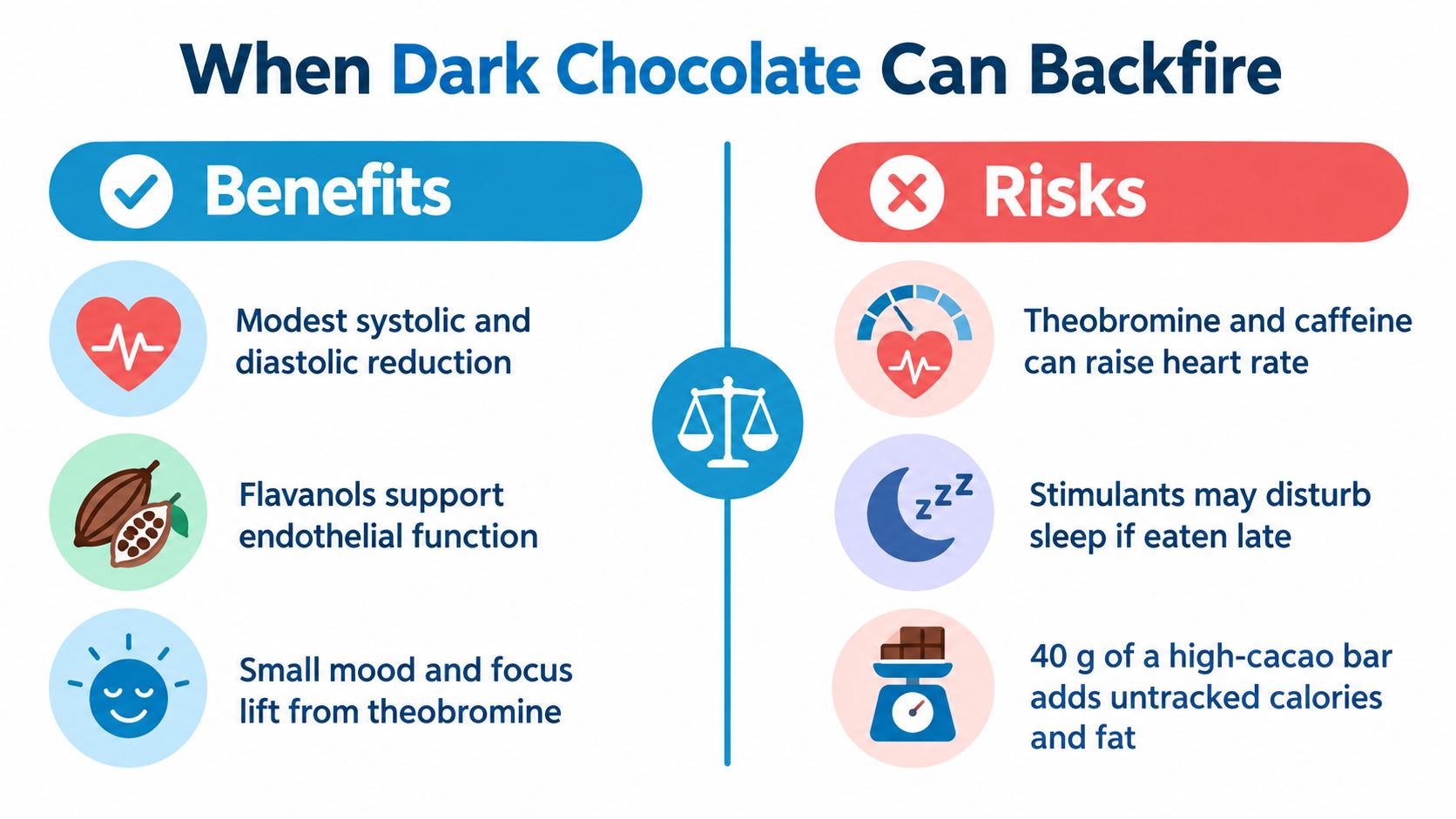
The same food that may nudge blood pressure down can make some people feel worse. Caffeine and theobromine are stimulants, and sensitive people may notice a faster heartbeat, more awareness of palpitations, reflux, anxiety, or disrupted sleep after eating high-cacao chocolate.
The amount varies by product, so don't treat a package serving as harmless by default. A larger portion also adds calories and fat, and a sweetened bar can undermine weight and metabolic goals that matter for blood pressure. The problem isn't that every dark chocolate bar is unhealthy. The problem is that “dark” doesn't cancel dose, composition, or individual sensitivity.
Pay attention to symptoms, not just pressure
Someone with tachycardia or dysautonomia may care more about the heart-rate response than a small change in resting blood pressure. A bar eaten late in the day can also impair sleep, and poor sleep may make next-morning readings and symptoms harder to interpret.
If you track heart-rate trends, log the food, portion, time, sleep, and symptoms together. Understanding how caffeine affects heart rate can help you interpret why a small blood-pressure benefit doesn't necessarily mean the food is a good fit for your symptom pattern.
Stop treating symptoms as background noise
Reduce or stop the product if you repeatedly notice:
- Palpitations: A new or stronger awareness of skipped, pounding, or racing beats deserves attention.
- Sleep disruption: Move the serving earlier or remove it if sleep changes after consumption.
- Reflux or headache: Cacao compounds and stimulants can aggravate symptoms in susceptible people.
- Unhelpful eating patterns: If one square routinely becomes a large serving, the calorie tradeoff may outweigh a modest vascular benefit.
People with POTS or dysautonomia should be especially practical. Don't add dark chocolate during a period of changing medication, poor sleep, dehydration, or unusually active symptoms, because you won't know which variable caused a change. Introduce one product at a time and keep the portion consistent.
Interactions and Who Should Be Cautious
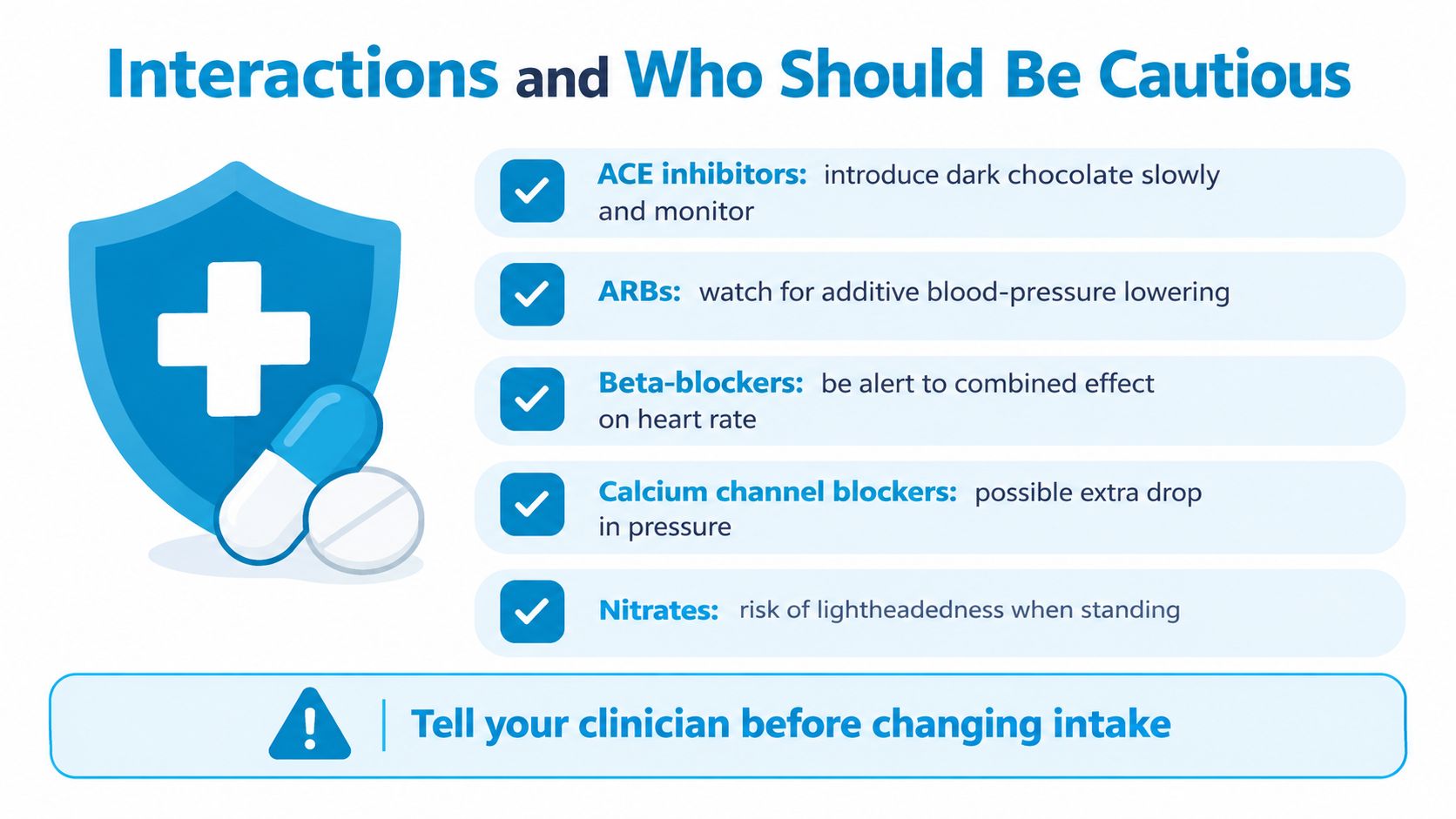
Dark chocolate can be reasonable for many people, but medication and symptom context matter. Cocoa flavanols may add to blood-pressure lowering from ACE inhibitors, ARBs, beta-blockers, calcium channel blockers, or nitrates. That doesn't mean you must avoid chocolate. It means you shouldn't use a new high-flavanol product while changing medication and then assume dizziness is unrelated.
Start with a small portion and watch for lightheadedness, weakness, or unusually low readings. If you take prescribed treatment, don't lower or stop it because your home readings improve after adding cocoa. The research supports an adjunct, not a replacement.
Ask before making it a daily habit
Speak with a clinician or pharmacist before making a concentrated cocoa product routine if you use medication affecting blood pressure, clotting, mood, or heart rhythm. Extra caution is sensible with MAOIs, some antidepressants, blood thinners such as warfarin, a history of atrial fibrillation, migraines, reflux, or pregnancy.
People using warfarin should avoid large swings in intake and should discuss consistency with their clinician. The concern isn't a single square. It's introducing a variable dose into a treatment plan without telling the person managing your medication.
Make monitoring useful
Log the product and timing alongside blood pressure, pulse, sleep quality, dizziness, and palpitations. If a pattern appears, take that record to your clinician rather than trying to diagnose the interaction yourself.
Seek prompt medical care for severe chest pain, fainting, severe breathlessness, or a sustained racing heartbeat. Dark chocolate should never delay evaluation of potentially serious symptoms.
A Practical Way to Use Dark Chocolate
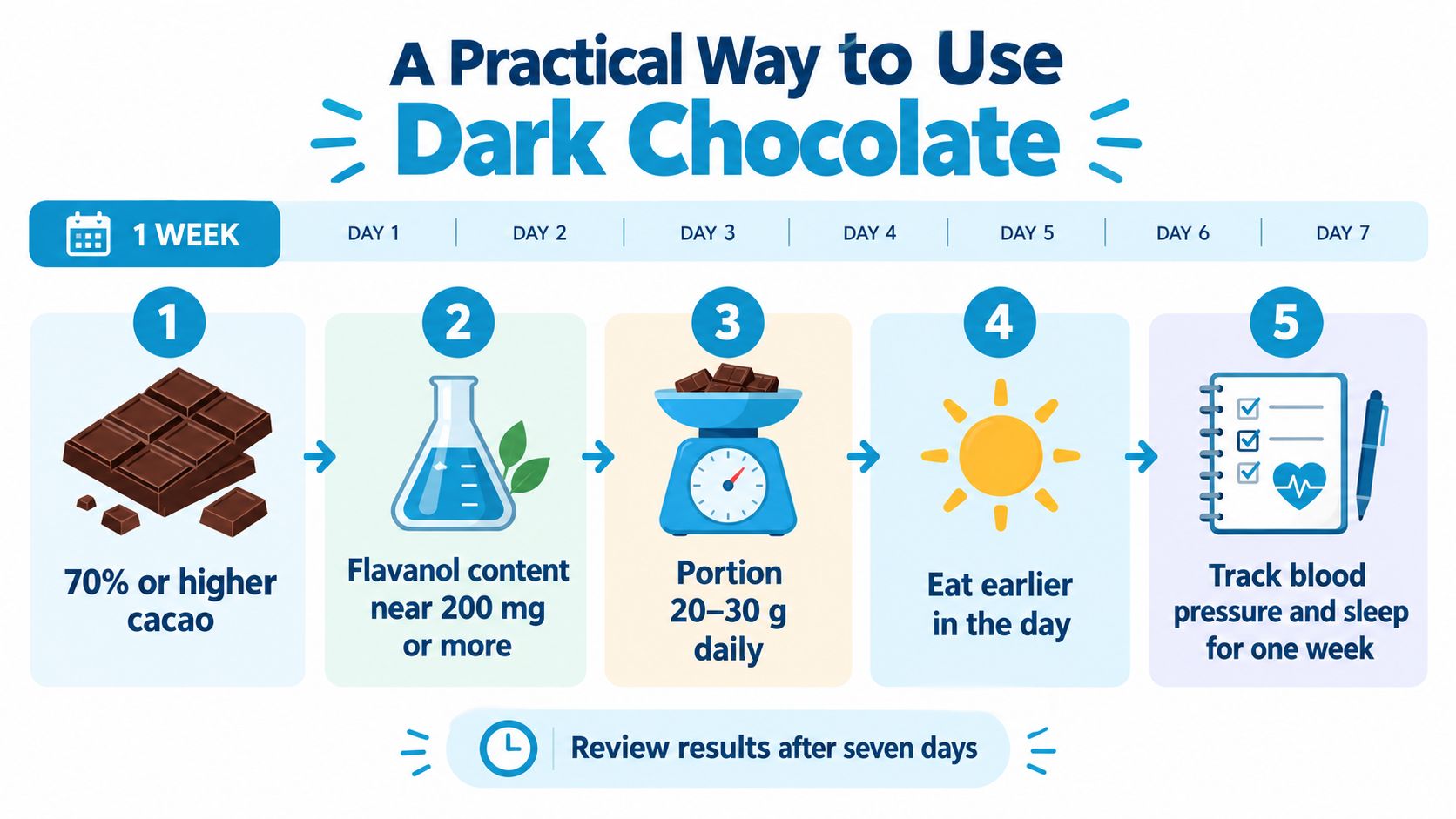
Use a simple decision rule. Choose a minimally processed bar with at least 70% cacao and transparent flavanol information, keep the serving around 20 to 30 grams, eat it earlier rather than late, and track what changes. If the product adds excessive sugar or worsens symptoms, it isn't the right tool for you.
A one-week trial without self-deception
For a patient already taking antihypertensive medication, the plan can be straightforward:
- Choose one product: Don't switch between bars with unknown formulations.
- Measure the serving: Weigh the portion instead of estimating from the wrapper.
- Eat it earlier: Avoid introducing a stimulant close to bedtime.
- Keep other habits steady: Don't simultaneously change salt intake, exercise, supplements, and medication unless your clinician directs you.
- Record the response: Note blood pressure, pulse, sleep, palpitations, dizziness, and the exact time of consumption.
Someone monitoring tachycardia through an Apple Watch can pair those observations with a heart-rate episode log. Cardiogram can organize Apple Health heart-rate data into episodes and trends, support symptom and trigger notes, and provide a blood pressure log for manual systolic and diastolic entries. That kind of longitudinal record is more informative than checking one number after eating chocolate.
Don't expect the average trial effect to appear clearly in daily life. A 2 to 3 mmHg systolic change can matter across populations, but day-to-day readings move with posture, stress, sleep, hydration, meals, and measurement technique. Look for a sustained pattern, not a dramatic immediate response.
A Mediterranean-style eating pattern, regular activity, adequate sleep, and prescribed treatment remain the foundation. This guide to a Mediterranean diet for high blood pressure offers a broader framework in which a small portion of dark chocolate can fit.
If you try it, report recurring palpitations, headaches, dizziness, sleep disruption, or blood-pressure swings to your clinician. Keep your medication unchanged unless you're told otherwise, and remove the product if the symptom tradeoff is clearly unfavorable.
Cardiogram helps you review heart-rate episodes, symptom and trigger patterns, sleep context, and blood-pressure entries from your existing Apple Health data. Visit Cardiogram to turn scattered measurements into a clearer record you can discuss with your clinician.