You stand up after resting and your heart suddenly pounds. Maybe you feel light-headed, weak, foggy, or close to fainting. A wearable may show a dramatic heart-rate rise, but that number alone can't tell you whether the response fits postural orthostatic tachycardia syndrome, or POTS.
The Dallas protocol for POTS gives clinicians a controlled way to study what happens during the transition from lying down to standing. It combines posture, timing, heart rate, blood pressure, and symptoms. That combination matters because a temporary spike after exercise, dehydration, anxiety, caffeine, medication, or pain isn't automatically POTS.
What the Dallas Protocol Actually Measures
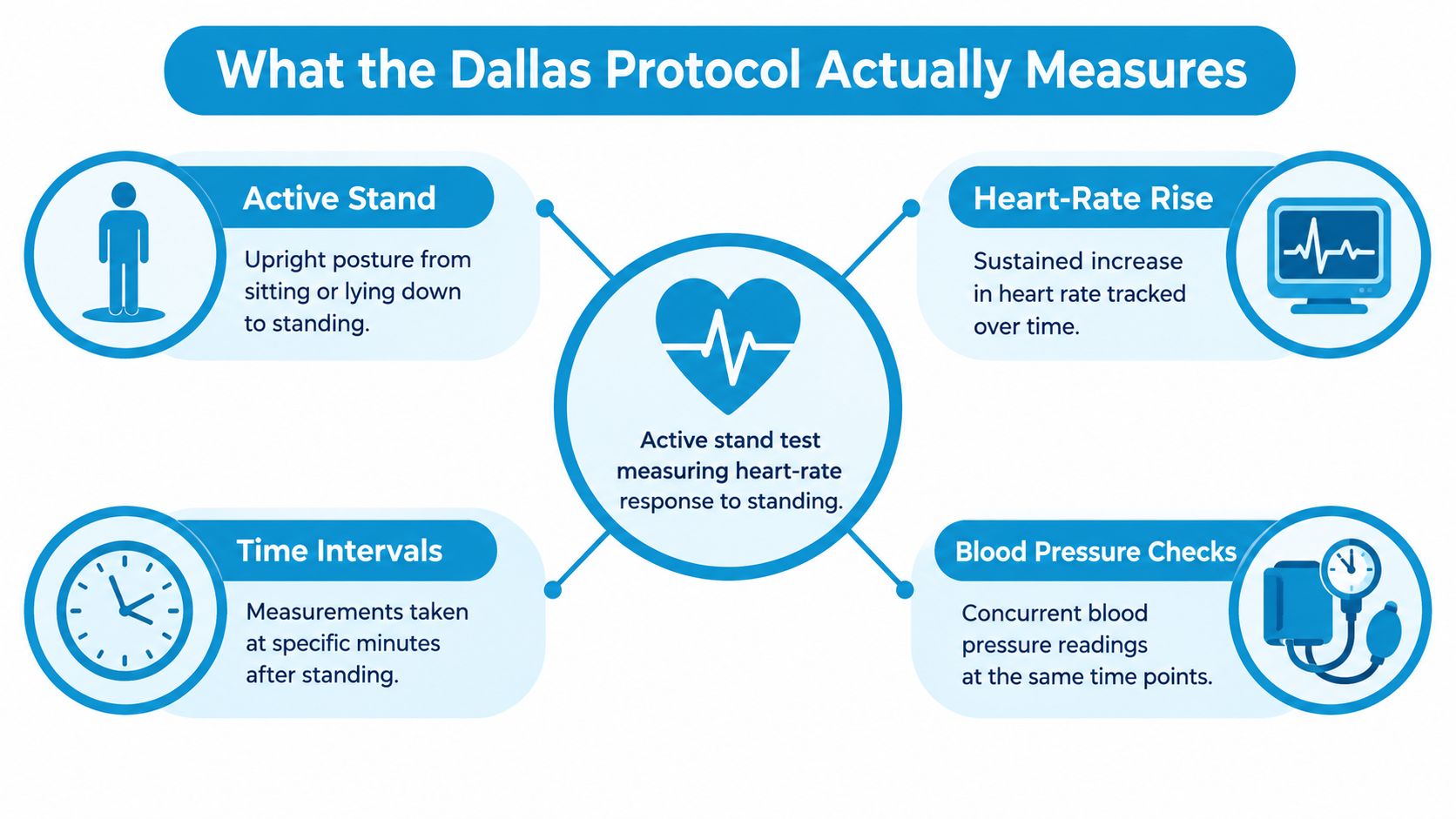
You lie down, settle for a few minutes, then stand up and stay there while someone watches what your body does minute by minute. That is the heart of the Dallas protocol. It measures an active stand response under controlled conditions, so the focus is not just a fast pulse, but the pattern of change after posture shifts.
Standing asks the circulation to do quick compensation work. Blood moves downward into the legs and lower body. To keep blood reaching the brain, the nervous system adjusts blood-vessel tone, heart rate, and blood pressure. In POTS, that adjustment can become inefficient. The heart rate may stay unusually high while upright, and symptoms can appear alongside it, including palpitations, light-headedness, weakness, blurred vision, fatigue, or reduced exercise tolerance, as described in this clinical overview of POTS and its evaluation.
A wearable can add context here. It may show that your heart rate tends to climb during everyday standing, walking to the kitchen, or waiting in line. That is useful background. It does not replace the stand test, because the formal protocol checks posture, timing, repeated measurements, blood pressure, and symptoms in the same window.
Why one heart-rate reading isn't enough
One number is a snapshot. The protocol is more like a short movie. A clinician needs a resting baseline, then repeated upright readings to see whether the rise starts after standing, whether it persists, and whether the pattern matches orthostatic symptoms rather than stress, recent activity, pain, or another temporary trigger.
Blood pressure is measured at the same time because a meaningful drop changes the interpretation. Symptoms matter too. The question is how the whole system behaves during those upright minutes, and how the person feels while that response continues.
Practical rule: A heart-rate spike matters clinically only when posture, timing, persistence, blood pressure, symptoms, and other possible explanations are assessed together.
The 10-minute window helps make the test consistent and comparable, rather than relying on a vague report that standing sometimes makes the heart race.
The Heart-Rate Threshold and Why 30 Beats Matters
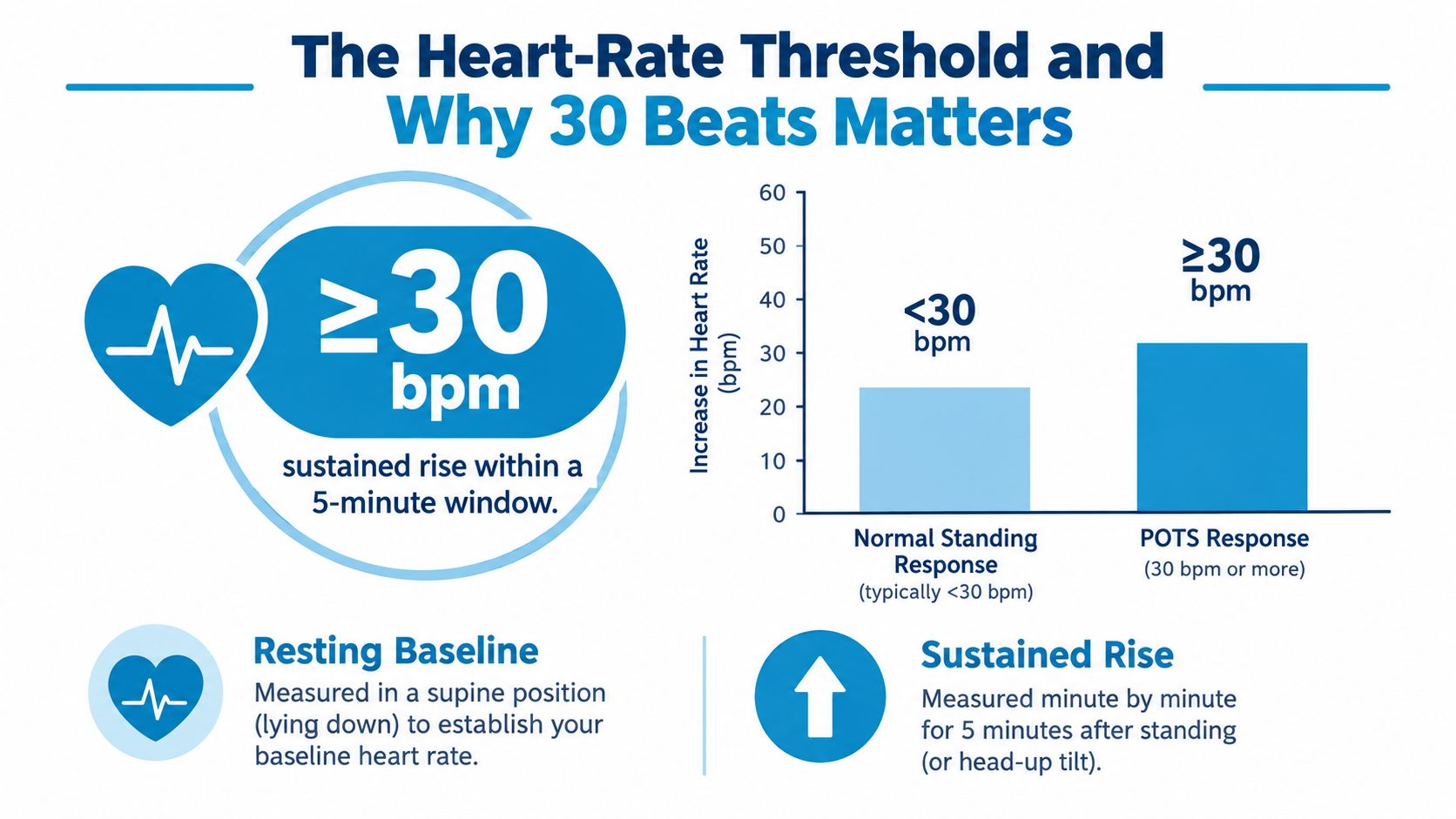
A lot of confusion starts with the number itself. Thirty beats per minute is not a label pasted onto any fast pulse. It is a threshold measured against your own resting baseline during the first 10 minutes upright. For adults, the Dallas-style criterion is a sustained heart-rate increase of at least 30 beats per minute within the first 10 minutes of standing or head-up tilt. For adolescents aged 12 to 19, the threshold is at least 40 beats per minute. These criteria are summarized in this explanation of the POTS heart-rate threshold.
Here is the practical way to read it. If your resting supine heart rate is 72 beats per minute and it rises to 102 beats per minute or more after you stand, the adult numerical threshold is met. But the protocol is still asking a bigger question. Does the rise persist across the upright window, do symptoms appear in that same period, and is there another reason the heart rate climbed?
The word sustained does important work
A single spike can mislead. Standing up, talking, shifting your weight, feeling nervous, or recovering from recent activity can all push the number up for a moment. What clinicians want to see is a rise that remains present in the upright posture, because that pattern says more than one isolated peak.
Blood pressure matters at the same time. POTS criteria generally require the absence of orthostatic hypotension, commonly defined as a fall of at least 20 mmHg in systolic blood pressure or at least 10 mmHg in diastolic blood pressure after standing, as described in clinical references on POTS diagnostic features.
This is also where wearables can help without replacing the formal test. A watch or chest strap may show that your heart rate often climbs during ordinary standing in daily life. That pattern can support the story you bring to clinic. The diagnosis still depends on a controlled stand or tilt assessment that checks posture, timing, blood pressure, symptoms, and alternative explanations such as dehydration, anemia, hyperthyroidism, medication effects, or prolonged bed rest. The threshold opens the door to evaluation. It does not settle the diagnosis by itself.
How the Active Stand Test Is Performed Step by Step
A supervised active stand test follows a simple sequence, but the details protect the result from misleading readings. You can ask the clinic how long you'll rest beforehand, which measurements they'll take, and how they'll respond if you become very symptomatic.
Before standing
You usually rest while lying down for at least 5 to 10 minutes. The clinician records a baseline heart rate and blood pressure after that rest period, then explains how you'll stand and where you'll place your feet. The research description of active standing in POTS emphasizes controlled posture, repeated readings, and concurrent blood-pressure assessment.
Once you stand unsupported, try to remain as still as safely possible. Walking, shifting repeatedly, crossing your legs, or tensing large muscle groups can alter venous return and make the response harder to interpret.
During the upright period
Measurements are commonly repeated at approximately 1, 3, 5, 8, and 10 minutes. At each checkpoint, the clinician may record:
- Heart rate: The change from your supine baseline is followed across the stand.
- Blood pressure: Systolic and diastolic values help identify a qualifying pressure drop.
- Symptoms: Report dizziness, palpitations, weakness, visual changes, nausea, fatigue, or cognitive difficulty as they occur.
- Posture and activity: The clinician notes whether you remained upright and unsupported.
The exact schedule can vary between services, but the purpose remains the same: capture a time-linked response rather than a random standing value.
If you feel close to fainting, tell the clinician immediately. Safety takes priority over completing an interval.
Repeated measurements also help distinguish a sustained response from a transient surge. A clinician may stop the assessment if symptoms become severe, if you need to lie down, or if the blood-pressure pattern requires attention. Bring a medication and symptom list, and mention recent illness, hydration changes, stimulants, or unusual exertion before the test.
Comparing the Dallas Protocol to Other Orthostatic Tests
Orthostatic tests ask related questions, but they don't all create the same conditions. An active stand uses your own muscles and balance, while a tilt-based assessment moves you passively from horizontal to upright. Some tests use intermittent readings, while others capture cardiovascular changes continuously.
| Protocol | Posture | Typical duration | Monitoring | Best for |
|---|---|---|---|---|
| Dallas active stand | Unsupported standing | 10 minutes | Repeated heart-rate and blood-pressure checks | Observing a practical posture transition |
| 10-minute stand | Unsupported standing | 10 minutes | Timed vital signs and symptom recording | Structured outpatient assessment |
| Lean-style stand assessment | Standing with controlled support or lean | 10 minutes | Heart rate, blood pressure, and symptoms | Reducing muscle-pump variation during standing |
| Head-up tilt assessment | Passive tilt from supine to upright | Often longer, depending on the service | Intermittent or continuous cardiovascular monitoring | Controlled autonomic evaluation |
| Extended tilt assessment | Passive upright tilt | Up to 45 minutes in some protocols | Continuous or repeated monitoring, sometimes with additional provocation | Investigating responses that develop later |
The Dallas approach sits between a casual home measurement and a highly controlled laboratory evaluation. It preserves the actual challenge of standing, but adds a defined rest period, timed checkpoints, and blood-pressure data.
A tilt assessment may be useful when a person can't safely stand unsupported or when a specialist needs more controlled conditions. An active stand may reveal a response that feels more representative of daily posture changes, but movement and muscle contraction can also influence the readings. No method automatically replaces clinical judgment. The most useful option depends on the question being asked, your safety, and the equipment available.
For terminology and preparation questions, see this guide to POTS diagnosis testing.
Where Wearable Heart-Rate Monitoring Fits In
A wearable can show what happens between appointments, when you stand to make breakfast, walk to another room, shower, or begin a normal day. That longitudinal view can reveal patterns that a single supervised assessment can't capture, especially when symptoms fluctuate.
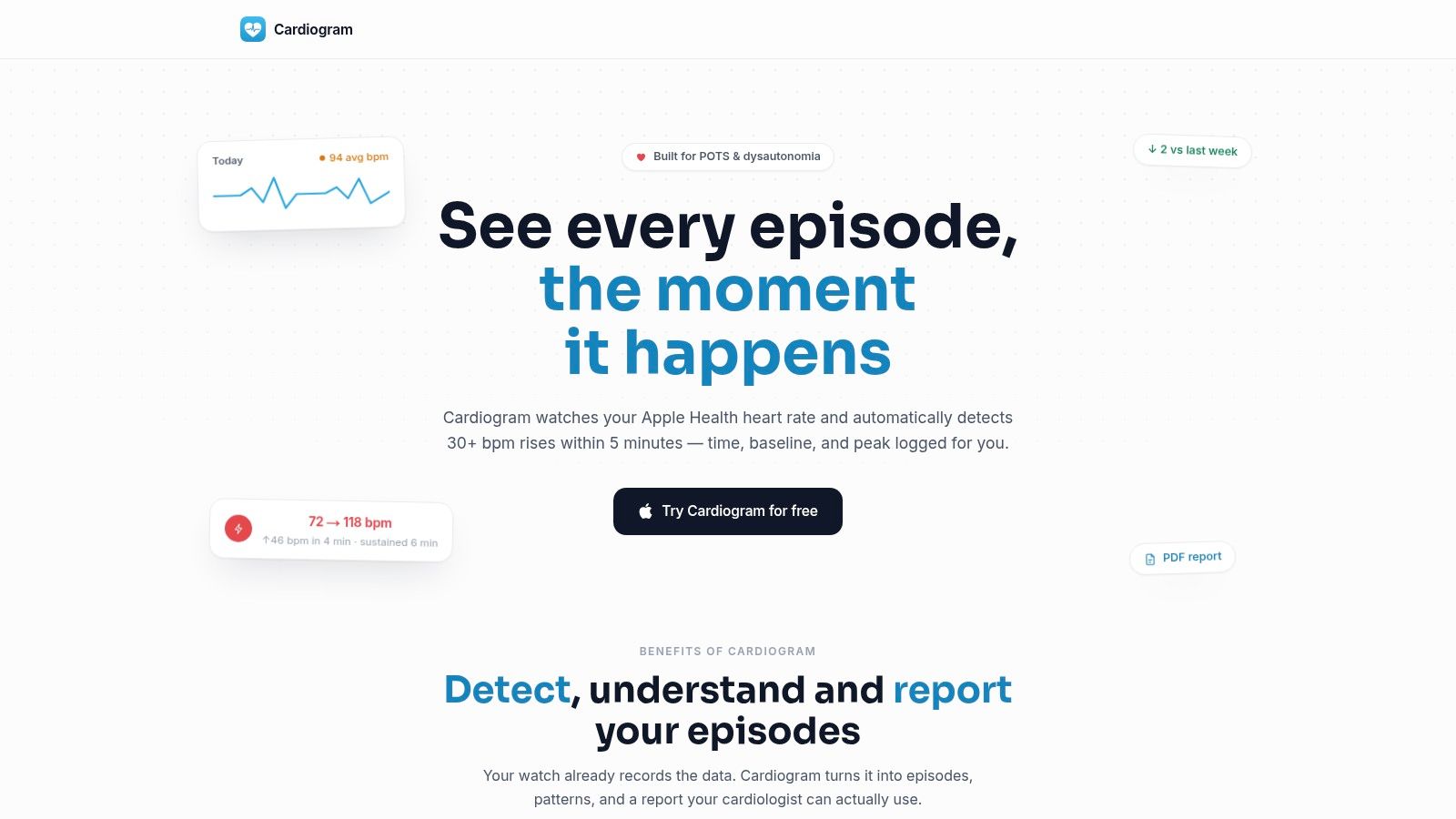
Cardiogram analyzes Apple Health heart-rate data to identify episodes involving a 30 beats-per-minute or greater rise within a 5-minute window, while recording the baseline, peak, sustained duration, and time of occurrence. It can also connect episodes with logged symptoms and context, including dizziness, palpitations, fatigue, brain fog, hydration, sleep, salt intake, and medication changes.
What wearable data can and can't show
Automatic episode detection can help you find repeated patterns. It may show that rises happen mostly after waking, during prolonged upright activity, after poor sleep, or around medication changes. A weekly view can be easier to discuss than a long list of isolated screenshots.
It can't independently establish the Dallas result. A wearable generally won't know whether you had a controlled supine baseline, whether you were standing unsupported, what your blood pressure was doing, or whether dehydration, anemia, thyroid disease, medication effects, caffeine, alcohol, pain, panic, or recent exercise contributed. It also can't confirm that your symptoms matched the heart-rate event.
That makes the device a complement, not a substitute. For a broader explanation of how consumer data can support clinical conversations, read this guide to wearable heart monitoring.
An exportable PDF can state the detection rule used and summarize episodes, trends, and logged context. Share it with your clinician alongside formal stand-test results, rather than presenting it as a diagnosis.
Why Personalization Matters More Than a Rigid Schedule
Exercise recommendations for POTS often follow a familiar pattern, beginning with recumbent activity and gradually introducing more upright work. That logic may help some people, but a fixed schedule doesn't account for every body, trigger, or comorbidity.
A 2024 review reports that the original high-intensity Dallas or Levine program excluded or didn't account for conditions including ME/CFS, hypermobile Ehlers-Danlos syndrome, hypermobility spectrum disorders, and mast-cell activation syndrome. It also reports that nearly 60% of participants in the original high-intensity program didn't complete it. These findings don't prove that exercise is harmful or useless. They show why “exercise helps” can't be translated into “the standard progression is tolerable for everyone.” Read the 2024 review of exercise, POTS, and comorbidities for the full context.
Use response, not the calendar, as your guide
Joint instability may require different strengthening choices. Heat intolerance may change when and where you exercise. Medication effects can alter heart-rate targets. A history of delayed post-exertional worsening deserves particular caution and clinical guidance rather than a push to progress.
Ask your care team:
- What counts as a flare: Should you pause after worsening symptoms, joint pain, or delayed deterioration?
- Which progression fits you: Should the next increase depend on symptoms and recovery rather than a predetermined date?
- Who should supervise: Would a clinician or physical therapist familiar with dysautonomia, hypermobility, or ME/CFS make the plan safer?
- What to measure: Should you track recovery, upright tolerance, function, and symptoms alongside heart rate?
A 2025 systematic review found overall support for therapeutic exercise but described the available literature as relatively small and at high risk of bias, while calling for more research on comorbidities and tolerability. Personalization isn't a failure to follow the protocol. For many patients, it's the more evidence-aligned way to apply its underlying principles.
How to Read a Dallas Protocol Result Alongside Wearable Data
Start with the controlled test, then use daily data to add context. The stand assessment tells you how your cardiovascular system responded under defined conditions. Wearable records can show whether similar patterns occur repeatedly outside the clinic and what tends to accompany them.
A useful review asks several questions rather than focusing on one headline value:
- Was the posture clear? Separate lying, sitting, standing, walking, and exercise whenever possible.
- Was there a known baseline? Compare the upright reading with a documented period of quiet supine rest.
- Did the response persist? Look for a pattern across the observation period or episode duration, not only the highest peak.
- What happened to blood pressure? A heart-rate interpretation without pressure data is incomplete.
- What did you feel? Link palpitations, light-headedness, weakness, visual symptoms, fatigue, and brain fog to the timing.
- What else changed? Record sleep, hydration, illness, medication, caffeine, alcohol, pain, and recent exertion.
A lower standing heart rate may look encouraging, but it isn't automatically meaningful if you still can't remain upright or complete daily tasks. The reverse can also be true. Better function, longer upright tolerance, or easier recovery may represent valuable progress even when tachycardia remains.
For clinicians, an episode feed, weekly trend, or PDF summary can provide a longitudinal frame around the formal result. For patients, the most useful report is specific: date, posture, baseline, peak, duration, symptoms, and relevant context. That shared vocabulary makes the next appointment more productive and reduces the temptation to interpret every isolated reading as a diagnosis or setback.
Bringing the Dallas Protocol Into Your Daily Life
The protocol becomes easier to use when you separate its three jobs. First, it defines the controlled question: what happens to heart rate and blood pressure after moving from supine rest to upright posture? Second, it gives the clinician a repeatable sequence, with baseline measurements and timed checks across the standing period. Third, daily monitoring shows whether related episodes appear in ordinary life.
You can prepare for a clinical visit by writing down:
- Your posture: Were you lying down, sitting, standing, walking, or exercising?
- Your timing: How long had you rested, and when did symptoms begin?
- Your symptoms: What did you feel, and did the symptoms improve after lying down?
- Your context: Were sleep, hydration, medication, illness, heat, caffeine, or exertion different?
- Your questions: Which measurements will be taken, and how will blood pressure affect interpretation?
Don't try to reproduce a diagnostic assessment unsafely at home. If you become faint or severely symptomatic, stop and seek appropriate medical guidance. A clinician can decide whether an active stand, tilt-based assessment, or another evaluation fits your situation.
A wearable can make the conversation more concrete by organizing baseline, peak, sustained duration, episode timing, and symptom context. Used alongside formal measurements, that record can help your care team distinguish a recurring posture-related pattern from noise caused by activity or other triggers.
Understanding the 30-beat sustained threshold, the blood-pressure rule, and the timed stand doesn't turn you into your own diagnostician. It does give you clearer language for describing what happens when you stand, what your data captures, and what you want to investigate next.
Cardiogram organizes Apple Watch heart-rate data into tachycardia episodes, trends, symptom context, and clinician-ready reports that can complement a formal POTS evaluation. Visit Cardiogram to review how it can help you track posture-related patterns between appointments.