You're standing in the kitchen, your heart rate suddenly climbing, your vision feeling unsteady, and your watch showing a number that may or may not explain what's happening. By the time you sit down and open the app, the episode has faded. Later, you're left with a vague memory, a graph, and the uncomfortable question of whether the spike reflected postural tachycardia, ordinary activity, or sensor noise.
That's the central problem with using a wearable heart monitor for POTS and dysautonomia. Fitness tracking asks whether your heart rate rose during movement. Autonomic tracking asks a harder question: did heart rate rise in relation to posture, symptoms, and daily context? A useful system must connect those pieces without treating every high reading as a medical event.
The right device can help you build a longitudinal record, but it can't replace clinical assessment. Wearables are strongest at revealing patterns, timing episodes, and giving you something concrete to discuss with a clinician. They're weaker at confirming a diagnosis from one reading, especially during motion or peak exertion.
The Challenge of Capturing Autonomic Episodes
A patient may notice the same sequence repeatedly: standing after breakfast, walking from one room to another, or waiting in line causes palpitations, dizziness, fatigue, or brain fog. The heart-rate rise may last long enough to feel significant, yet disappear before a scheduled appointment or a short office measurement captures it.
A standard fitness tracker usually records the rise but not the story around it. It might show a higher pulse, steps, and an activity label, but it won't necessarily tell a clinician whether the person had just stood up, whether symptoms appeared, or whether the reading occurred during exercise recovery. That distinction matters because a normal cardiovascular response to exertion can look similar to an autonomic episode if the data has no context.
Why a high reading isn't enough
A single heart-rate value has limited clinical meaning. A higher number during exercise, emotional stress, illness, dehydration, or recovery doesn't carry the same interpretation as a sustained rise after standing still. The wearable needs to preserve the sequence, not just the peak.
For practical tracking, each possible episode should answer several questions:
- What was the baseline? Record the heart rate before the rise rather than focusing only on the highest value.
- How quickly did it change? A rapid postural increase has a different meaning from a gradual climb during a walk.
- How long did it remain high? Sustained height is more useful for review than an isolated sample.
- What was happening? Posture, exercise, sleep, hydration, meals, medication timing, and symptoms can change interpretation.
- Could motion explain it? Arm movement, cadence, loose contact, and recovery can create misleading readings.
Practical rule: Treat an elevated reading as a prompt for context, not as proof of an autonomic event.
The patient experience needs to reach the report
Manual notes often fail at the exact moment they're needed. During dizziness or palpitations, opening an app and writing a detailed entry may be unrealistic. A workable workflow should capture heart-rate episodes automatically, then make it easy to add symptoms and triggers afterward.
In this regard, context-aware monitoring differs from step counting. The useful output isn't “your heart rate was high.” It's a time-stamped episode showing the baseline, rise, duration, symptoms, and whether exercise or recovery should exclude it from the episode count.
Longitudinal data can also reveal patterns that brief office testing misses. Recent POTS-focused implementation work has reported positive reception of wearable apps and found that continuous data can reveal standing-related heart-rate changes that aren't present during a short clinical encounter, while a review of consumer wearables emphasizes that independent validation remains necessary (research on clinician-ready longitudinal wearable workflows). That makes the wearable valuable for pattern discovery and documentation, but not a standalone diagnostic authority.
Comparing Wearable Hardware for Continuous Tracking
The most suitable hardware depends on whether the priority is everyday adherence, signal quality during movement, clinical recording, or passive overnight use. No form factor wins every category. For autonomic monitoring, the device you'll wear consistently often produces more useful evidence than a technically stronger sensor that stays in a drawer.
| Device Type | Sensor Method | Best Use Case | POTS Suitability |
|---|---|---|---|
| Smartwatch | Wrist-based optical PPG, sometimes user-initiated ECG | Daily wear, passive heart-rate history, symptom-timed checks | Strong baseline for continuous real-world tracking, with motion limitations |
| Chest strap | Electrode-based electrical sensing | Exercise validation and high-motion measurements | Useful for targeted comparisons, less practical for all-day wear |
| Medical patch | Clinical electrical recording through skin electrodes | Clinician-directed rhythm evaluation and diagnostic monitoring | Strong when prescribed, but less convenient for everyday context logging |
| Ring sensor | Optical sensing at the finger | Comfortable sleep and background trend monitoring | Potentially useful for trends, but less suited to frequent posture-linked episode capture |
Smartwatches
A smartwatch is usually the most practical baseline because it combines continuous wear, motion information, phone alerts, and an established health-data pathway. Its optical sensor estimates pulse from changes in light absorption, so fit, movement, skin contact, temperature, and device placement all affect the signal.
The main advantage is adherence. If the watch stays on during sleep, standing, meals, and ordinary household activity, it can build the timeline needed to understand daily autonomic burden. The main limitation is that wrist-based optical data can become less reliable during irregular movement or strenuous exercise.
A watch with an active ECG feature can add a short electrical recording when symptoms occur, but that still isn't the same as continuous clinical ECG monitoring. Use it to document an event for review, not to make an independent diagnosis.
Chest straps
Chest straps measure electrical activity closer to the heart and generally perform better during structured exercise. They're valuable when you need to compare a wrist reading with a more stable reference during a specific activity or suspected artifact.
They're less appealing for POTS baseline tracking because comfort, skin contact, charging, and daily wear become barriers. A strap can answer “what happened during this workout?” more effectively than “what happened during an ordinary day of standing, resting, and moving around the house?”
For an accessible explanation of how different heart-monitoring methods capture pulse and rhythm, see this overview of how heart monitors work.
Medical patches and rings
Medical patches are designed for clinician-directed monitoring and can provide higher-quality electrical data over an assigned period. They're appropriate when a clinician needs to investigate rhythm concerns, but they don't always support the flexible symptom, posture, and trigger logging that patients need for day-to-day dysautonomia documentation.
Rings can be comfortable, especially overnight, and may provide useful background trends. Their placement can improve optical contact, but they're not automatically ideal for detecting rapid, posture-specific transitions. Sampling schedules, battery constraints, and limited interaction can make it harder to mark an episode as it unfolds.
For most users building a first longitudinal record, a consistently worn smartwatch offers the most workable balance. Add clinician-directed medical monitoring when the clinical question requires electrical rhythm analysis, and use a chest strap when you need targeted validation during exercise rather than all-day coverage.
Understanding Sensor Accuracy and Clinical Margins
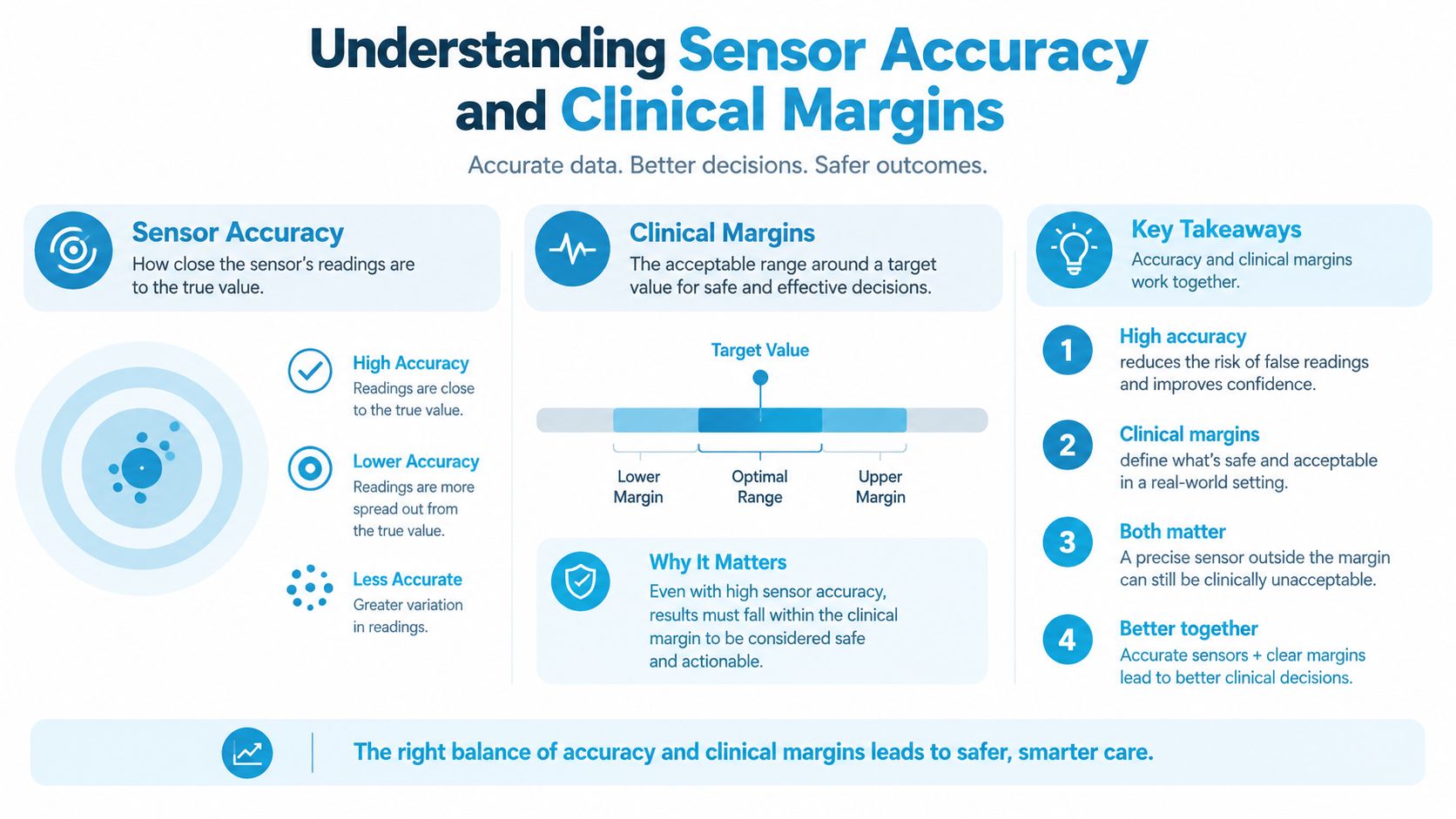
A heart-rate reading is only as useful as its context. Accuracy changes with the device, activity, body position, skin contact, signal quality, and reference method. A wearable may track ECG closely while you are resting, then drift during rapid movement, changing contact pressure, or peak exertion. For autonomic tracking, the practical question is whether the signal remains reliable enough to connect heart rate with posture, symptoms, and episode duration.
A 2024 living umbrella review synthesized 249 non-duplicate validation studies involving 430,465 participants and found that only about 11% of commercially available wearables released to date had been validated for at least one biometric outcome. Across heart-rate findings, the review reported an overall mean bias of about ±3%, while some reviews estimated average error near −3.39 beats per minute against criterion measures. Wrist-based monitoring can therefore support longitudinal trends, but individual readings may differ from the reference by several beats per minute.
Resting accuracy and moving accuracy are different
A small average bias does not make every sample equally dependable. At rest, the wrist is relatively still and the optical pulse signal is easier to interpret. During exercise or abrupt movement, arm motion, muscle contraction, altered contact pressure, and cadence can interfere with pulse estimation.
A 2023 cardiac-rehabilitation validation study showed how performance can vary by device and setting. The electrode-based Polar H7 had the strongest agreement with ECG, while the tested wrist devices showed lower agreement, with reported correlation values ranging from approximately 0.52 to 0.80 (the cardiac-rehabilitation validation study). In patients with cardiovascular disease during structured exercise, the study found optically based wrist monitors less accurate than electrode-containing chest straps.
A newer 2026 living meta-analysis of Apple Watch heart-rate measurement found a mean bias of −0.27 beats per minute, with limits of agreement from −7.19 to 6.64 beats per minute. During exercise, the watch underestimated heart rate by 0.63 beats per minute, with limits of agreement from −6.86 to 5.60 beats per minute (the Apple Watch heart-rate meta-analysis). The average error appears small, but the limits show why one fast reading should not determine whether an episode is clinically meaningful.
What this means for POTS tracking
For a sustained orthostatic rise, a few beats of measurement drift may not obscure the overall pattern. A record becomes more useful when baseline, timing, posture, symptoms, and duration point in the same direction. Error matters more during a brief transition, a near-threshold reading, or a sharp peak accompanied by movement.
Peak exertion requires separate handling. Independent clinical evidence reported mean absolute differences versus ECG reaching 13.8 beats per minute in sinus rhythm and 28.7 beats per minute in atrial fibrillation at peak exercise, with both overestimation and underestimation observed (the 2026 heart-rate accuracy study). In a POTS or dysautonomia workflow, classify workouts and recovery periods separately from posture-related episodes, then review symptoms and the remaining data together.
Controlled studies have also reported pooled arrhythmia detection sensitivity and specificity of 100% and 95%, respectively, in selected settings within the umbrella review. Those results apply to the studied conditions, not automatically to every device or daily situation. Wearables can support screening and longitudinal observation, while uncertain findings still require clinician review.
Filtering Exercise Noise from True Tachycardia
A workout can create exactly the kind of graph that looks alarming in a generic heart-rate app: a rapid rise, a high peak, and a gradual decline. Recovery can create a second elevation that appears disconnected from the activity unless the software knows when the workout ended.
The first filtering rule is simple: don't count exercise as an orthostatic episode. The system should identify marked workouts and their recovery windows, then keep those periods separate from posture-related events. That doesn't make the readings useless. It gives them the correct category.
Build context into the detection workflow
A practical filter combines heart-rate data with activity and user input. It shouldn't depend on one label because automatic activity recognition can be imperfect. Use several signals together:
- Identify active periods. Mark structured workouts, brisk walking, and other obvious exertion before reviewing possible autonomic episodes.
- Separate recovery. Keep the early post-workout period out of the episode feed because heart rate may stay high while the body returns toward baseline.
- Check posture and movement. A rise after standing still deserves more attention than a rise during stairs, household lifting, or fast walking.
- Review duration. Sustained increase is more informative than a lone sample that disappears on the next reading.
- Attach symptoms. Log dizziness, palpitations, fatigue, brain fog, breathlessness, or an absence of symptoms.
- Add likely triggers. Hydration, salt intake, sleep quality, meals, medication timing, heat, and illness can make a pattern easier to interpret.
A context-aware workflow can automatically remove workouts and recovery periods, while still allowing you to inspect them separately. Guidance on reducing misleading detections is available in this practical guide to false-positive reduction.
Don't overcorrect the data
Filtering shouldn't erase every episode near movement. People with dysautonomia may become symptomatic while walking slowly, standing in a queue, or transitioning between rooms. The point isn't to delete anything that happened during activity. It's to distinguish exercise intensity from postural demand and preserve enough context for a clinician to make the judgment.
Use a short note when an event is ambiguous: “stood from sofa,” “walking slowly,” “after shower,” or “no symptoms.” These small details can prevent a clinician from treating a normal workout response and a standing-related episode as the same phenomenon.
A useful review question: “What was the body doing immediately before the rise?” The answer often matters more than the peak itself.
Building Clinician-Ready Reporting Workflows
A patient arrives with several weeks of wearable readings, but the record does not show which episodes mattered. The clinician must still determine when the rise began, how long it persisted, what the patient was doing, and whether symptoms occurred.
A useful report converts continuous data into a limited set of reviewable events. Each event should include the detection rule, timing, baseline, peak, sustained duration, symptoms, posture, activity status, and any exclusions. Preserve enough underlying detail for the clinician to verify an event without asking the patient to rebuild the timeline from memory.

What belongs in the summary
A clinician-ready workflow compresses the record while making its assumptions visible. Include:
- Detection criterion: State exactly what qualifies as an episode, including the rise threshold, time window, and duration rule.
- Episode feed: Show the date, time, baseline, peak, sustained duration, and whether exercise or recovery caused the event to be excluded.
- Symptom context: Link dizziness, palpitations, fatigue, brain fog, or no symptoms to the corresponding episode.
- Trigger context: Record posture, hydration, salt intake, sleep, medications, meals, heat, and recent exertion when available.
- Trend views: Use weekly summaries, resting-heart-rate trends, and heatmaps to show clustering by time or circumstance.
- Export format: Provide a readable PDF that the patient can attach to an appointment message or bring to a visit.
The report should state that wearable history supports clinical reasoning and does not establish a diagnosis. A clinician can use the record to decide whether additional testing, structured orthostatic assessment, rhythm monitoring, or another evaluation is appropriate.
Why longitudinal records help
POTS symptoms can appear intermittently. A report spanning several weeks of ordinary life can show clustering by time of day, posture, heat, meals, medication timing, or other triggers that may not occur during an appointment. Repeated context makes the record more useful than a dramatic isolated graph.
The practical value lies in organizing the timeline for review. Separate suspected postural episodes from exercise and recovery, label uncertain events, and preserve representative heart-rate traces alongside the summary. This structure helps a clinician assess whether a pattern reflects postural demand, exertion, or another rhythm concern without treating every elevation as equivalent.
Keep the handoff selective
Do not send every raw sample unless the care team requests it. Lead with a concise summary, then include representative episodes and the underlying record when needed. The handoff should answer five questions: when did it occur, how high did the rate rise, how long did it last, what was happening, and what did the person feel?
A short methods note also belongs with the report. Record the wearable source, collection period, episode rule, activity exclusions, symptom-logging method, and known gaps in measurement. This gives the clinician enough information to judge the record's limits without sorting through an uninterrupted stream of numbers.
Prioritizing Privacy in Biometric Data Processing
Heart-rate history can reveal more than pulse. Over time, it may expose sleep patterns, work routines, medication timing, illness, symptoms, and daily limitations. A monitoring service should therefore be evaluated not only by its detection features, but also by where analysis occurs, what permissions it requests, and whether it stores identifiable health data outside your control.
A cloud-dependent design sends data to remote servers for processing and may retain copies according to its privacy policy. That architecture can support centralized analysis, but it increases the number of places where sensitive information exists. A privacy-first design keeps computation on the device whenever possible and limits synchronization to an account controlled by the user.
Permissions deserve close attention
Read-only health access is an important boundary. An app that only reads heart-rate data can analyze existing records without writing invented or altered values back into the health repository. Review the permission screen carefully and reject access that doesn't serve the monitoring task.
Local processing also changes the risk profile. If episode detection, symptom association, and report generation happen on the device, the raw stream doesn't need to travel to a vendor server for every calculation. Personal cloud synchronization can preserve access across the user's own devices while keeping the data within that account's ecosystem.
Questions to ask before installing
- Where is analysis performed? Look for a clear statement about on-device processing versus server-side analysis.
- What is stored remotely? Check whether raw heart-rate history, symptoms, reports, or account identifiers leave the device.
- Are permissions read-only? Confirm that the app doesn't write data back into the health record without a clear reason.
- How is syncing handled? Understand whether synchronization uses a personal encrypted account or an external data store.
- Can you export and delete? Make sure you can create a report and remove the account or stored information if you stop using the service.
- Who receives the report? Decide whether you're sharing it directly with a clinician, a caregiver, or nobody else.
A privacy-focused approach to health-data handling can help frame these decisions. Privacy isn't a premium feature added after detection works. It should be part of the architecture from the beginning, especially when the data describes symptoms that may affect employment, insurance, or personal relationships.
Choosing the Right Monitoring Solution for Your Needs
Start with the clinical question, not the device catalogue. If you want to understand whether standing triggers symptoms, prioritize consistent wear, reliable timestamps, context logging, and a report your clinician can review. If you need rhythm evaluation for palpitations, ask your clinician whether a medical ECG-based test is more appropriate than a consumer wearable.
| Your situation | Practical starting point | What to prioritize | What to avoid |
|---|---|---|---|
| Newly tracking unexplained tachycardia | A comfortable smartwatch already worn during daily routines | Continuous history, symptom notes, posture context, exportable summaries | Judging the condition from isolated peaks |
| Frequent symptoms during movement | Smartwatch plus careful activity and recovery exclusions | Motion filtering, event review, comparison of rest and activity | Counting every workout rise as autonomic tachycardia |
| Need for targeted exercise validation | Clinician-approved or electrode-based chest sensing | Stable exercise measurements and event comparison | Expecting a chest strap to replace all-day monitoring |
| Possible rhythm concern | Clinician-directed assessment, potentially including a medical patch | Electrical rhythm data and professional interpretation | Treating a consumer alert as a diagnosis |
| Privacy-sensitive monitoring | A solution with local analysis and limited, read-only health permissions | On-device processing, personal-account sync, transparent deletion controls | Sending raw biometric history to unknown servers |
Set up the workflow before the first episode
- Define the question. Write down whether you're tracking standing-related tachycardia, symptoms, recovery, rhythm concerns, or a combination.
- Wear the device consistently. Gaps around sleep, mornings, showers, or routine standing can hide the pattern you're trying to understand.
- Set a clear detection rule. A rule such as a 30-plus beats-per-minute rise within five minutes should be stated explicitly and reviewed with a clinician, rather than hidden inside an unexplained score.
- Log symptoms immediately when possible. Add a later note if symptoms make real-time entry impractical.
- Exclude exercise and recovery. Keep those periods available for inspection, but don't let them inflate the primary autonomic episode count.
- Review trends on a schedule. Look for recurring timing and context instead of checking the live number compulsively.
- Export a concise report. Bring episode summaries, heatmaps, symptom links, and the detection criterion to the appointment.
A practical option for Apple Watch users is Cardiogram, which reads heart-rate data through read-only HealthKit access, detects the stated rise criterion, links episodes with symptoms and triggers, excludes workouts and recovery periods, and creates clinician-oriented PDF summaries. Its analysis is performed on the device with synchronization through the user's iCloud ecosystem, so review the permissions and privacy terms before deciding whether it fits your needs.
For your appointment: Bring the report, explain how the data was collected, identify exercise exclusions, and describe symptoms in your own words. Don't change medication or treatment based only on a wearable reading.
A wearable heart monitor works best as a structured observation tool. Choose hardware you'll wear consistently, filter readings by posture and activity, record symptoms alongside heart rate, protect the underlying data, and ask your clinician to interpret the resulting pattern. If you want to turn Apple Watch heart-rate history into context-aware episodes, trend summaries, and a clinician-ready report, visit Cardiogram and review how it can support your POTS or dysautonomia tracking workflow.