A primary care clinician has a patient whose Apple Watch repeatedly captures sudden heart-rate changes, dizziness, and palpitations. The patient exports a six-hour report and sends it through the practice portal. The primary care clinician wants a cardiologist's opinion before ordering more testing, but the patient doesn't need an immediate face-to-face specialist visit.
That workflow is where CPT code 99446 can fit. It captures a patient-specific, provider-to-provider consultation in which a consulting clinician reviews the case, discusses the medical question with the requesting clinician, and sends a verbal and written report. The code can be useful, but it's also easy to submit incorrectly. Payers scrutinize the request, the relationship between the clinicians, the time record, the report, and whether the interaction was a formal consultation rather than informal “curbside” advice.
What CPT Code 99446 Covers in Modern Care Coordination
A primary care clinician needs a specialist's opinion on a patient-specific question but does not need to send the patient for an immediate specialist visit. The clinician asks a cardiology colleague to review the available record, discuss the interpretation, and recommend an appropriate next step. That requesting-and-consulting relationship defines the practical use of CPT code 99446.
The service captures specialist work performed without direct patient contact. The interprofessional consultation guidance describes a consultative physician or other qualified health care professional providing a verbal and written report to the requesting clinician after 5 to 10 minutes of medical consultative discussion and review. A review of patient-generated data can support the question, but data review alone does not establish a billable consultation.
Wearable reports have made this workflow more common, particularly when they organize patient-generated information into a timeline. An overview of digital health solutions can provide context for that type of information flow. The clinical issue remains the same: the consultant must interpret the information in relation to the patient's history and the question posed by the requesting clinician.
The code is not a patient visit. The patient does not receive the consultation service directly from the consultant. The requesting clinician remains responsible for the patient's care and uses the specialist's opinion to guide diagnosis, testing, treatment, or referral.
Who requests and who furnishes the service
The requesting clinician initiates the consultation, identifies the patient, supplies relevant clinical information, and frames the question. The consulting clinician reviews that information, conducts the medical discussion, forms a specialty opinion, and sends the response back in verbal and written form. The consultant may be a physician or another qualified health care professional authorized to furnish the service under applicable rules.
The question needs to be specific enough to produce a clinical opinion. “Please review” gives the payer little evidence of a consultation. A stronger request asks whether the reported rhythm pattern warrants additional monitoring, whether the available findings change the differential diagnosis, or whether specialty referral is appropriate.
Document the communication route and retain the written report. A consumer-device summary can inform the review, but it does not establish a diagnosis on its own. The consultant should state relevant limitations rather than treating the device output as definitive.
Service Descriptor and the 99446 Family of Codes
The supplied descriptor for 99446 describes a consultative physician or other qualified health care professional who provides a verbal and written report to the requesting clinician, with 5 to 10 minutes of medical consultative discussion and review. That wording matters because it identifies the service as more than data reading. The consultant must provide a clinical opinion through the required communication pathway.
99446 sits at the entry point of the 99446 through 99449 family. The time ladder is:
| Code | Cumulative consultative time |
|---|---|
| 99446 | 5 to 10 minutes |
| 99447 | 11 to 20 minutes |
| 99448 | 21 to 30 minutes |
| 99449 | 31 minutes or more |
The four codes describe the same broad type of interprofessional consultation, with the code changing as the qualifying time increases. The code choice should follow the documented work. It shouldn't be selected first and supported later with a vague estimate.
The 2023 descriptor change
In 2023, the descriptor was updated to add “other qualified health care professional.” That change broadened who could furnish the service under the code. It also reflects how specialty care is delivered in modern practices, where qualified clinicians may participate in consultation workflows within their lawful scope and payer rules.
That update doesn't eliminate the need to verify credentialing, enrollment, scope of practice, or payer policy. A clinician may meet the professional description and still face a payer edit if the plan applies additional restrictions.
What the family does not solve
The code family standardizes time-based interprofessional consultation, but it doesn't guarantee payment. A documented request, identifiable patient, clear clinical question, consultant opinion, and report are still essential. Payers may also differ on whether the service is separately reimbursable.
A short wearable-data review may feel clinically substantial, yet the claim can fail if the record shows only that a specialist “looked at the PDF.” The code is tied to a documented consultation relationship, not to the existence of specialist work alone.
Time Ranges and the Medical Discussion Rule
For 99446, the qualifying time band is 5 to 10 minutes. The consultant should record cumulative time for the medical consultation, including the relevant review and consultative discussion. The record should make clear what was clinical work and what was administrative handling.
A useful distinction is the difference between medical review and medical discussion. For the 99446 through 99448 range, more than 50% of the billable time must be actual medical consultative discussion rather than record review alone. The coding guidance for interprofessional consults emphasizes that the consultant's time is the relevant time and that the discussion component must meet the applicable threshold.
How the clock works in practice
Suppose a cardiologist reviews a heart-rate report, checks the relevant clinical history, discusses the interpretation with the primary care clinician, and documents the recommendation. If the qualifying cumulative time falls within the 5-to-10-minute band and more than half of that time reflects medical consultative discussion, 99446 may be appropriate.
If the qualifying work reaches 12 minutes, 99446 is no longer the right time tier. The consultant should assess the next applicable code, 99447, provided the interaction otherwise meets the requirements. A longer consultation that reaches the next time band belongs under the corresponding sibling code, not under 99446 merely because the original request was short.
Not every minute spent near the chart belongs in the calculation. Scheduling, routing a message, finding a phone number, waiting for a callback, and correcting an administrative error don't become medical consultation time because they occurred during the same workflow.
Practical rule: Record the clinical activity, the qualifying time, and the communication back to the requesting clinician separately. A single total with no explanation is difficult to defend.
Time bands across the 99446 through 99449 family
| Code | Cumulative time | Discussion rule | Typical scenario |
|---|---|---|---|
| 99446 | 5 to 10 minutes | More than half of qualifying time must be medical consultative discussion | Focused review of a patient-specific wearable report |
| 99447 | 11 to 20 minutes | More than half of qualifying time must be medical consultative discussion | Broader specialty interpretation with a longer clinician exchange |
| 99448 | 21 to 30 minutes | More than half of qualifying time must be medical consultative discussion | Complex review involving multiple clinical questions |
| 99449 | 31 minutes or more | Apply the applicable family requirements and document the qualifying work | Extended interprofessional consultation |
Documentation Requirements That Determine Payment
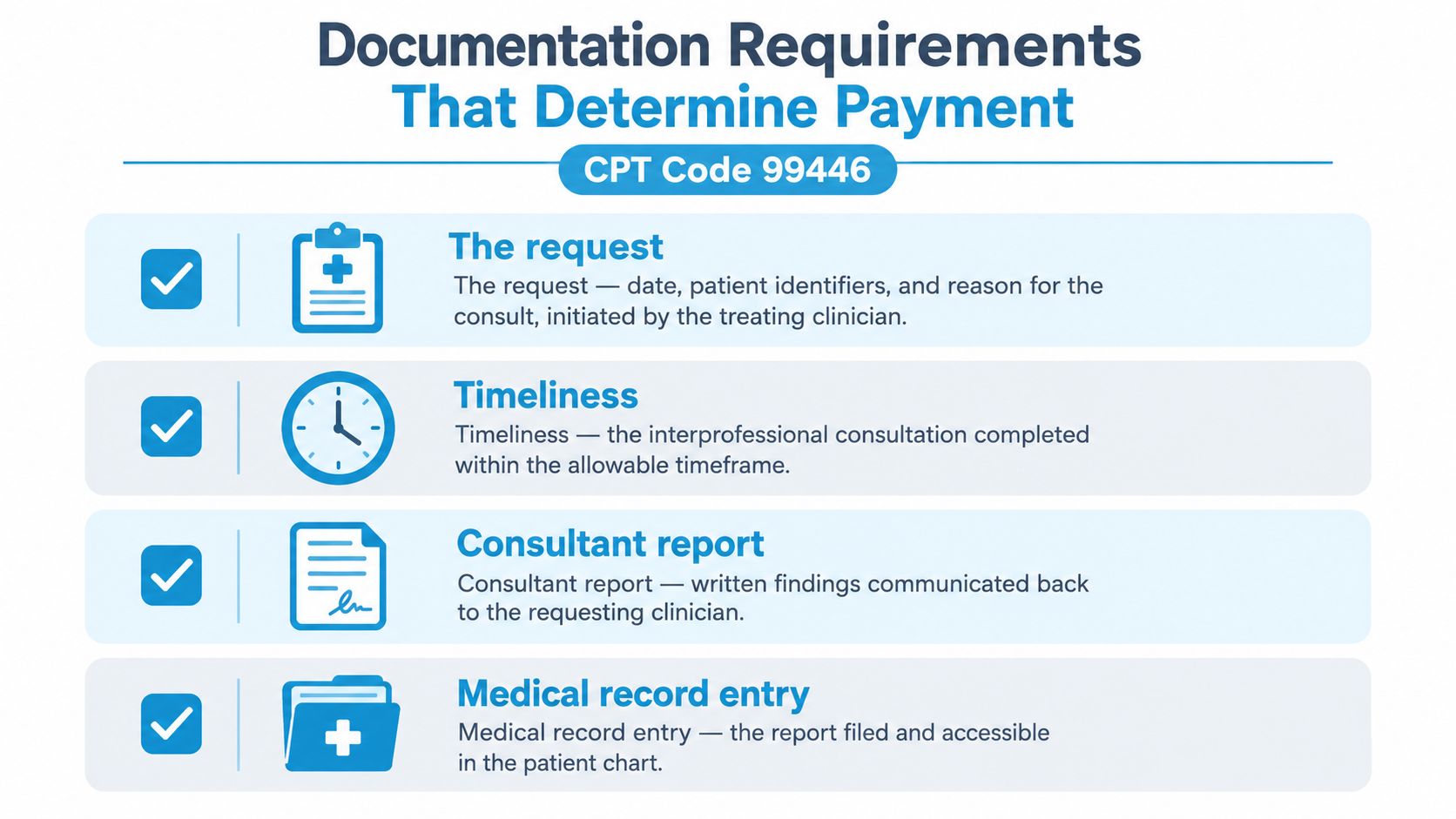
Most payment problems aren't caused by a consultant's medical conclusion. They're caused by a record that doesn't prove what happened. A defensible 99446 note should allow a reviewer to identify the request, the participants, the clinical question, the consultant's opinion, the qualifying work, and the report sent back.
The service also has an important timing limitation. The consultation cannot be reported when the consultant sees the patient within 14 days before or after the consultation for the same clinical matter. That rule should be checked before billing, not after a denial.
Four pillars to capture
The request: Record the date, patient identifiers, requesting clinician, clinical condition, data supplied, and focused question. The request should come from the treating or requesting clinician and should not be a casual message with no identifiable purpose.
The consultant opinion: The consultant should document the interpretation, not merely state that records were reviewed. For a heart-rate report, that might include whether the available information supports sinus tachycardia, raises concern for another rhythm, or requires better monitoring.
The requesting entity: Name the treating physician or qualified health care professional who is managing the patient and seeking the advice. The record should show who needs the answer and why the consultant's opinion will affect care.
The verbal and written report: Document how the consultant communicated the findings and file the written report in the patient's record. A note that says only “discussed with cardiology” doesn't establish the required deliverable.
A pre-billing check
Before the claim leaves the practice, confirm:
- Clinical question: The request identifies the condition, relevant data, and decision requiring specialty input.
- Traceable participants: Both clinicians and their roles are identifiable.
- Time support: The note separates medical consultation activity from administrative work.
- Consultant response: The opinion and recommendation are documented in the patient's chart.
- Timing exclusion: The consultant's related face-to-face encounters have been checked.
- Communication trail: The verbal and written report are linked to the request.
The exact payer requirements can vary, so this checklist supports review rather than replacing the applicable policy.
Worked Example Reviewing a Heart-Rate Episode Report
Dr. Lin, an internist, is evaluating a patient with palpitations and possible autonomic symptoms. The patient sends an Apple Watch episode PDF through the clinical portal. Dr. Lin attaches the report to a consultation request for Dr. Park, a cardiologist, and asks whether the pattern supports further rhythm evaluation and what testing should come next.
Dr. Park reviews the report and related symptoms, then discusses the findings with Dr. Lin. The consultant documents the work and sends a written report. The report explains that the data came from a consumer wearable rather than a validated Holter monitor, so the available information can suggest a pattern but cannot confirm an arrhythmia.
What the written report should say
A useful report might state, in substance:
- The consultant reviewed the patient-specific wearable report and the symptoms supplied by the requesting clinician.
- The recorded pattern may be compatible with sinus tachycardia, but the available report cannot establish that interpretation with diagnostic certainty.
- The wearable data don't independently confirm or exclude atrial fibrillation.
- Clinical-grade ambulatory monitoring should be considered if the symptoms continue or the rhythm question remains unresolved.
- The requesting clinician should use the patient's symptoms, examination, history, and other testing to decide the next step.
That report answers the actual question. It doesn't overstate what the device can prove, and it gives the requesting clinician a clinically usable recommendation. A well-structured clinician-ready report can make the consultant's reasoning easier to follow, but formatting alone doesn't satisfy billing requirements.
Why the example can support 99446
The consultation is patient-specific, provider-to-provider, and directed toward care management. The consultant's medical review and discussion must fall within the 99446 time band, with more than half of the qualifying time devoted to medical consultative discussion rather than record handling alone.
Dr. Lin should file the original request, the consultant's report, the communication details, and documented patient consent in the chart. If the actual qualifying work exceeds the 99446 band, the practice should use the appropriate higher time code instead. If the consultant later sees the patient for the same issue within the restricted window, the practice must reassess whether the interprofessional consultation is reportable.
The Apple Watch PDF is the input. It isn't the service. The billable work is the documented clinical consultation built around that information.
Why Quick Phone Consults Often Fall Outside 99446
A two-minute call between clinicians isn't automatically billable. The common “curbside” exchange usually lacks one or more required elements: a formal request, an identifiable patient, qualifying time, a documented medical opinion, or the required verbal and written report.
The 5-minute minimum also matters. A clinician can spend meaningful effort thinking about a case, but if the documented qualifying consultation doesn't reach the applicable threshold, 99446 isn't supported. A phone call that includes scheduling, a quick question, and a promise to look later shouldn't be converted into a billable consult after the fact.
Four questions to ask before charging
- Was there a formal request? The requesting clinician should identify the patient, the problem, the data, and the question.
- Was there a qualifying medical discussion? More than half of the relevant time must involve medical consultative discussion for the applicable lower time bands.
- Was a report completed? The consultant's opinion must be communicated back and documented.
- Was the timing rule satisfied? A consultant's related face-to-face visit within 14 days before or after the consultation can make the service non-billable.
The 14-day rule is particularly easy to miss. A specialist may provide a legitimate opinion today and see the patient shortly afterward. That later visit can change the billing analysis for the prior consultation, especially when it concerns the same clinical problem.
A real clinical conversation can still be a non-billable interaction. Clinical value and reportability are related, but they aren't the same test.
The safest workflow starts with the consultation order rather than the charge. Require the requesting clinician to identify the question, capture consent, and select the communication pathway before the consultant begins. Then require the consultant to complete the report and time record before billing staff review the claim.
Patient Consent and Payer-by-Payer Reimbursement Reality
Patient consent should be obtained and documented before the consultation begins. The record should identify whether consent was verbal or written, when it was obtained, and who obtained it. The consultant is reviewing protected patient information for a provider-to-provider discussion, so consent and privacy handling shouldn't be treated as optional administrative details.
Payment is less uniform than the code family suggests. Medicare-linked guidance recognizes these services when the documentation and operational requirements are met, but commercial payer policies may treat interprofessional consultation codes as incidental or not separately reimbursable in particular contexts. The interprofessional consultation coding overview also cautions that patient consent and payer-specific rules can affect successful reimbursement.
Build the payer check into charge entry
A practice shouldn't assume that one successful claim establishes a universal rule. Check the plan's policy for the patient's coverage, the consultant's eligibility, documentation requirements, and whether the code is bundled or excluded.
A payer matrix can sit inside the EHR or billing workflow:
| Payer category | Typical coverage approach | Key caveat |
|---|---|---|
| Medicare-linked coverage | May reimburse when the required request, opinion, report, timing, and consent rules are satisfied | Documentation and enrollment details must still be checked |
| Commercial coverage | May reimburse under defined conditions | Some policies treat the service as incidental or not separately reimbursable |
| State Medicaid coverage | Varies by state and program | Confirm local policy, clinician eligibility, and any specialty restrictions |
| Employer or managed-plan products | May follow the underlying commercial policy or add edits | Verify the specific product rather than relying on the payer name alone |
The patient-provider communication workflow should also support a secure record of the request and response. Personal messaging channels and undocumented email threads create avoidable uncertainty, even when the clinical exchange itself was appropriate.
When coverage is uncertain, explain the possibility to the patient and follow the practice's established financial communication process. Don't promise payment based solely on the code descriptor.
Common Denial Reasons and How to Prevent Them
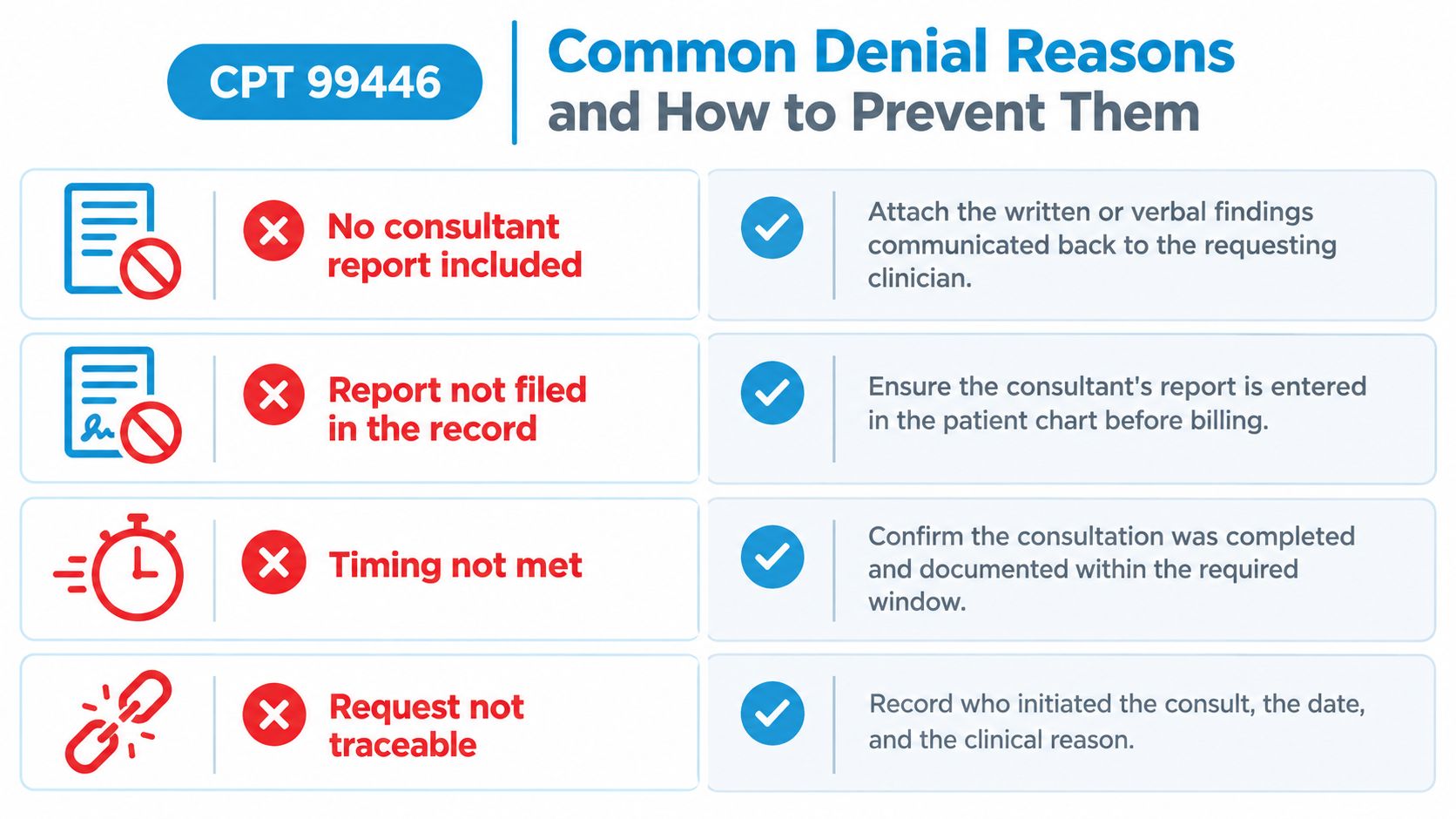
Denials usually reveal a missing link in the record. The consultant may have done legitimate work, but the claim still fails if the practice can't show who requested it, what was discussed, how much qualifying time was spent, and what report was delivered.
Four recurring failure patterns
No consultant report: The chart contains the request and perhaps a brief call note, but no consultant opinion returned to the requesting clinician. Fix it by requiring a completed report that states the interpretation and recommendation, then file it in the patient's record.
Unsigned or untraceable request: The request doesn't identify the initiating clinician or lacks a reliable attribution trail. Use an EHR consultation order that records the requesting clinician, date, patient, clinical question, and relevant identifiers.
Insufficient qualifying discussion: The note reports a total time but doesn't distinguish medical consultative discussion from chart review and administration. Record the components clearly and confirm that more than half of the qualifying time meets the discussion requirement.
Face-to-face exclusion: The consultant saw the patient for the same matter within 14 days before or after the consultation. Check the consultant's encounter history before submitting the claim and document the result of that check.
What to include in an appeal
An appeal should be factual, not argumentative. Identify the consultation date, the requesting clinician, the consultant, the patient-specific question, the qualifying time breakdown, and the location of the written report.
Attach the report and the original request. Explain how the clinical discussion met the applicable time and medical-content requirements. If the denial says the consultant's opinion wasn't communicated, show the communication record and where the report appears in the chart.
Don't use an appeal to repair a record that never existed. If the report, consent, or request was not documented at the time of service, the practice should consult its compliance process rather than reconstructing facts from memory.
Comparing 99446 With 99451 and 99452
The key distinction is who performed the work and how the consultation was communicated. 99446 is the consultant's code for the lower time band in the interprofessional consultation family, involving medical discussion and a verbal and written report under the verified descriptor. 99451 is associated with the consultant's written or internet consultation work, while 99452 is associated with preparation by the requesting clinician.
That means a written-only exchange shouldn't be forced into 99446 just because the specialist reviewed the same type of information. Conversely, a requesting clinician's preparation work shouldn't be attributed to the consultant's code.
| Element | 99446 | 99451 | 99452 |
|---|---|---|---|
| Primary billing party | Consulting physician or qualified health care professional | Consulting physician or qualified health care professional | Requesting or treating clinician |
| Core work | Medical consultation with verbal and written communication | Written or internet-based consultant response | Preparation and submission of the consultation request |
| Patient contact | No direct patient contact for the consultation | No direct patient contact for the consultation | No direct patient contact for the consultation |
| Main record anchor | Request, qualifying discussion, opinion, and report | Written consultant response and transmission record | Clinical question, preparation work, and request transmission |
| Common mistake | Billing a curbside exchange as a formal consult | Treating an incomplete written response as sufficient | Billing the requesting clinician's preparation as consultant time |
Use the code that matches the documented role and communication format. If both clinicians perform separately reportable work, each practice should verify whether the payer permits the related services and how it wants them submitted.
Quick Reference Card for Busy Clinicians
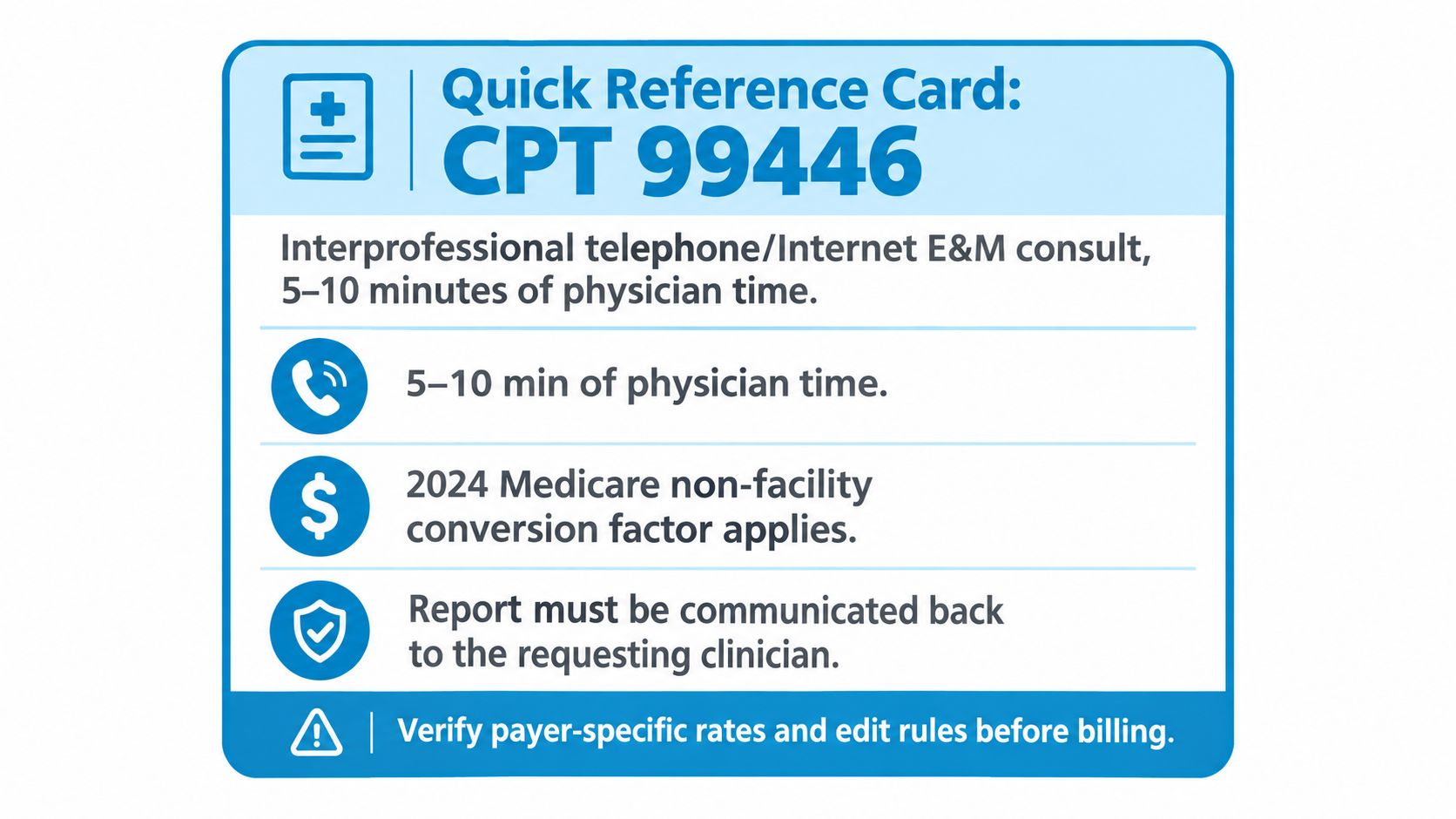
CPT code 99446: interprofessional telephone, internet, or electronic health record consultation with 5 to 10 minutes of medical consultative discussion and review, plus a verbal and written report to the requesting clinician.
- Who bills: The consulting physician or other qualified health care professional.
- Who doesn't bill 99446: The requesting clinician doesn't bill this consultant code for the specialist's work.
- Record first: Document the patient-specific request, clinical question, participants, and consent.
- Time matters: More than half of the qualifying time must be medical consultative discussion.
- Report matters: File the consultant's verbal and written communication in the patient's chart.
- Check timing: The related face-to-face exclusion applies when the consultant sees the patient within 14 days before or after the consultation.
- Check payment: Medicare-linked rules and commercial payer policies can differ, and some commercial policies treat these services as incidental.
Frequently Asked Questions About Billing 99446
Does the telehealth platform change the rule?
No. The platform doesn't determine whether 99446 is appropriate. A compliant verbal exchange and the required written report still need to exist. A secure message with no medical discussion may fit a different consultation pathway, but it doesn't satisfy the discussion requirement for 99446.
Must the clinicians practice in different specialties?
No. The central issue is the interprofessional consultation and the consultant's qualified clinical input, not whether the specialties differ. The related face-to-face and payer rules still apply.
Can repeated consultations be billed?
Each consultation must independently meet the applicable requirements. The documented qualifying time determines whether the work falls in the 99446, 99447, or 99448 band, subject to payer policy and other restrictions.
Can a resident bill the code?
The consulting professional must be qualified and independently authorized to furnish the service under applicable rules. Training status alone doesn't establish billing eligibility.
Does an Apple Watch or other wearable PDF change the service category?
No. The data source is only the material reviewed. The service remains an interprofessional consultation when the request, clinical discussion, consultant opinion, report, consent, and payer requirements are satisfied.
Cardiogram helps patients organize Apple Watch heart-rate data into structured episodes and clinician-ready reports, giving practices clearer information to review during care coordination. If your patients are bringing wearable reports into tachycardia or dysautonomia evaluations, visit Cardiogram to see how those summaries can support a more focused clinical conversation.