You're making tea, you stand up from the couch, and suddenly you can feel your heart thumping hard in your chest. It settles in a minute, but the question stays. Was that stress, coffee, standing too fast, or something with the rhythm itself? You're not looking for a list that scares you. You want a way to sort what you felt into a clearer next step, and that's exactly what the pattern of an episode can help you do.
Heart Palpitations Causes at a Glance
A heartbeat can feel fast, forceful, irregular, fluttery, or as if it has skipped. These sensations are called palpitations. They are symptoms, not a diagnosis. The American Academy of Family Physicians review on palpitations reports that roughly 10% of people experience them at some point in their lifetime, and they account for approximately 16% of outpatient clinic visits. According to the AAFP review, a U.S. analysis estimated 684,000 emergency-department visits where palpitations were the primary reason for presentation, equivalent to 0.58% of emergency-department visits. Palpitations are a common reason to seek care, and clinicians use the details of an episode to help work out what may be causing them.
The same sensation can come from different heart rhythms or from the body's response to a change. A normal rhythm may speed up, an extra beat may interrupt the rhythm, or a fast rhythm may begin and continue on its own. The table offers a starting map, not a way to diagnose yourself.
The Ten Cause Groups to Compare
| Cause group | Typical pattern | Common examples |
|---|---|---|
| Physiological sinus tachycardia | Steady fast rhythm that rises with a body stressor | Fever, pain, anemia, blood loss, dehydration, low blood pressure |
| Stimulants and substances | Pounding or racing after use | Caffeine, nicotine, decongestants, alcohol, cocaine, amphetamines |
| Medications | Racing that starts or changes with a new drug or dose | Some prescription and over-the-counter medicines |
| Anxiety or panic | Surge with worry, dread, or breathlessness | Panic attacks, anxiety disorders |
| Endocrine and metabolic | Persistent fast beat alongside other symptoms | Hyperthyroidism, electrolyte disturbance |
| Orthostatic intolerance or POTS | Heart rate climbs after standing and eases when lying down | Low effective blood volume, weak vasoconstriction |
| Premature atrial or ventricular beats | Skipped beat followed by a forceful beat | Often harmless, common at rest |
| Supraventricular tachycardia | Sudden start and stop of a regular fast rhythm | Re-entry circuits |
| Atrial fibrillation or atrial flutter | Ongoing irregular or fluttering rapid beat | Atrial arrhythmias |
| Ventricular tachycardia | Fast rhythm that can threaten consciousness | Higher-risk cardiac disease; needs urgent assessment |
Compare the pattern, not just the sensation. A heartbeat that speeds up gradually differs from one that starts and stops suddenly. A single skipped beat followed by a thump also differs from a sustained irregular rhythm.
One episode may fit more than one row, and the table cannot confirm a cause. Note which pattern seems closest and what details support it. A useful first distinction is whether the rhythm sped up gradually, started suddenly, or seemed to skip once and settle.
Reading Your Episode Pattern to Narrow the Cause
A racing heart that appears after standing, worsens in the shower, and eases when you sit down has a different pattern from one that begins during exercise or after a medicine change. Posture is a useful clue. A gradual heart-rate rise while upright can occur with orthostatic intolerance, including POTS, but that pattern alone cannot identify the cause. POTS has specific diagnostic criteria, and a home observation is not enough to establish a diagnosis.
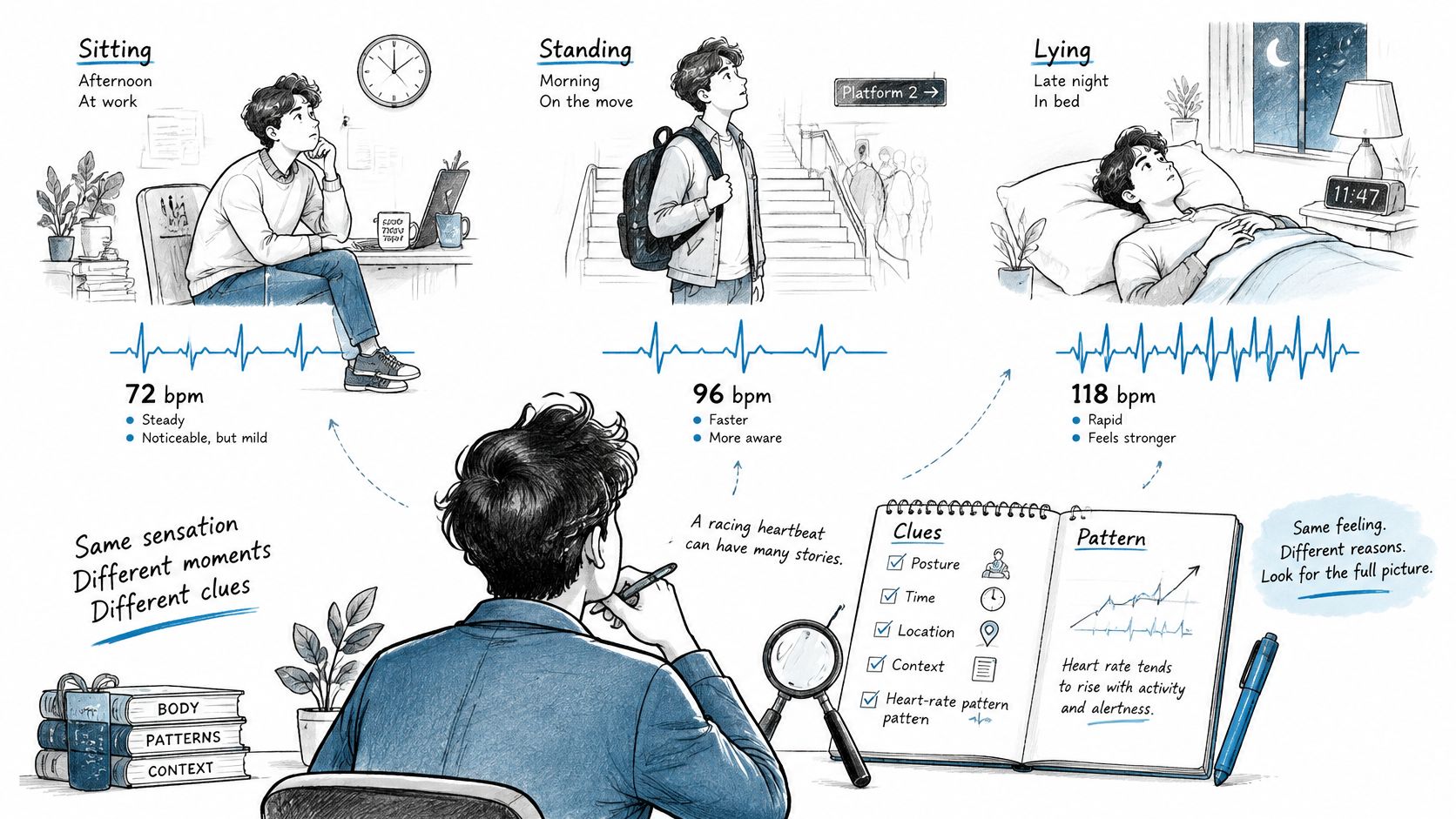
Collect data over a week the way a detective collects evidence: when, where, and with what. Note whether the heartbeat starts gradually or suddenly, and whether it happens while standing, sitting, lying down, or exercising. Fever, poor sleep, coffee, a new medicine, and low fluid intake can also help explain the circumstances.
Matching Patterns to a Next Check
| Episode pattern | Points toward | Next check |
|---|---|---|
| Heart rate climbs after standing and eases when lying down | Orthostatic intolerance, including POTS | Record the change with posture and note how you feel |
| Episodes follow coffee, alcohol, nicotine or decongestants | A possible stimulant effect | Note the amount, timing, and whether the pattern recurs |
| Racing with fever, vomiting, diarrhea or heavy sweating | A possible compensatory rise related to illness or fluid loss | Note the illness and whether the racing eases as you recover |
| Episodes begin during exercise or physical exertion | A cause that needs medical assessment | Contact a clinician promptly rather than waiting for more examples |
| Racing that began after a new medicine or dose change | A possible medication effect | Bring the medication name and dose to your clinician |
| Racing with worry, dread or breathlessness | Anxiety or panic may contribute, but the pattern cannot rule out other causes | Describe the symptoms and ask whether rhythm evaluation is appropriate |
| Brief skipped or forceful beats while at rest | Premature beats or another rhythm cause | Note how often they happen and how long they last |
Compare each episode with the table, looking for a pattern rather than a perfect match. For example, a recurring episode after a decongestant may make its timing worth discussing with a clinician. Racing during exertion deserves prompt medical assessment rather than more days of tracking.
A Simple Seven-Day Log
Use a phone note or notebook, and keep the entries brief:
- Time and duration: When it started, whether onset was gradual or sudden, and how long it lasted
- Position and activity: Whether you were lying, sitting, standing, walking, or exercising
- Context: Sleep, illness, recent activity, hydration, and temperature if you feel feverish
- Intake and medicines: Caffeine, alcohol, nicotine, decongestants, and any new medicine or dose change
- Other symptoms: Dizziness, fainting, chest discomfort, breathlessness, or no other symptoms
These details can help a clinician decide what to check, but they cannot distinguish every cause on their own. Dehydration, anemia, thyroid disease, medication effects, and rhythm problems can produce overlapping symptoms. A week of clear observations is more useful than trying to name the cause from one episode.
Benign Causes Behind a Racing or Pounding Heart
A pounding heartbeat after coffee, a fever, or a stressful moment can have different explanations. The timing and surrounding circumstances help narrow them down, although they cannot identify a cause by themselves.
Stimulants That Push Rate and Force
Caffeine, nicotine, and some decongestants can stimulate the body and make the heart beat faster or more forcefully. Alcohol may also be relevant when episodes tend to occur during or after drinking. If coffee or energy drinks seem connected to your symptoms, read more about how caffeine affects heart rate.
Compare the timeline rather than relying on memory. For example, if you drink coffee in the afternoon and notice pounding soon afterward on several occasions, record the drink, time, and episode duration. A repeated pattern is useful context for a clinician, but it does not prove that caffeine caused the symptoms. Do not stop a prescribed medicine to test a theory. Note any suspected connection and discuss it with the prescriber.
Where Anxiety Fits and Where It Misleads
Anxiety and panic can cause a racing heart, and a fast or forceful heartbeat can also make someone anxious. The sensation alone may not reveal which came first.
A clinical review of palpitations describes a study of 190 patients in which investigators identified an underlying explanation for 84% of cases. The reported causes included cardiac conditions in 43%, anxiety or panic in 31%, medications or illicit drugs in 6%, and other non-cardiac medical causes in 4%; 16% remained unexplained. These figures describe that study group, not the likelihood that any one person's palpitations have a particular cause.
Ask a clinician to assess recurring or concerning episodes rather than assigning them to anxiety based only on how they feel. A careful evaluation may include your history, a physical examination, an ECG, and, when indicated, tests for possible contributors.
If you suspect a trigger that you can safely change, record what changed and whether the episodes became less frequent, shorter, or stopped. Include the timing in your notes so your clinician can judge whether the pattern is meaningful.
Arrhythmias That Cause Skipped and Fluttering Beats
The first thump after a pause is often the one people remember. A single extra beat can feel like a skip followed by a forceful beat, while a sustained rhythm may feel fast or continuously irregular. Describing how the sensation begins, continues, and ends gives your clinician a useful starting point.
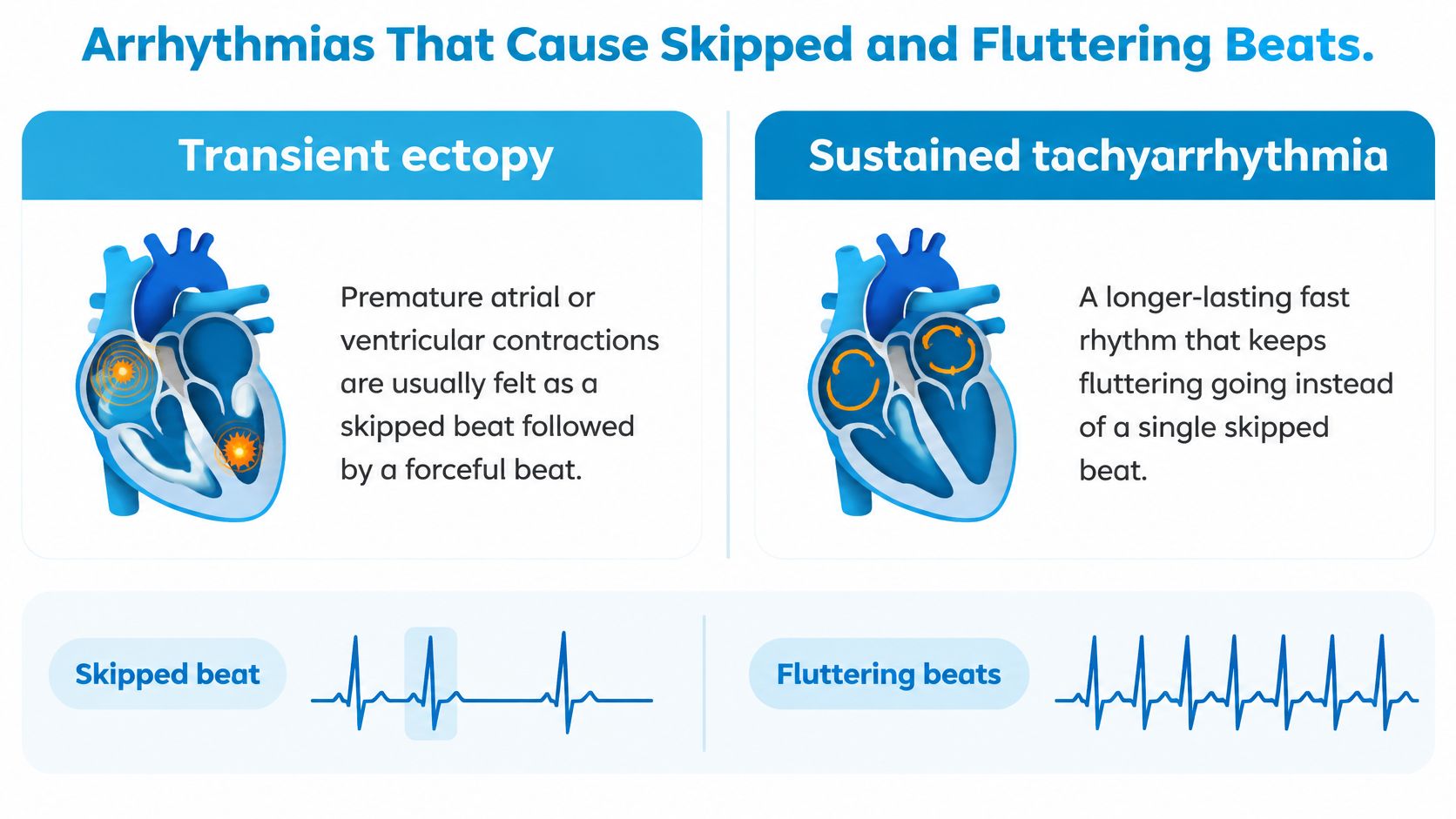
Transient ectopy means isolated premature atrial or ventricular contractions. The Merck Manual professional review of palpitations explains that these are commonly perceived as a skipped beat or a forceful beat after a pause. Isolated premature beats are often harmless, particularly when they occur at rest and settle quickly.
Sustained tachyarrhythmia continues beyond a single beat. A regular fast rhythm that starts and stops abruptly can fit supraventricular tachycardia better than a gradual rise associated with stress. A continuously irregular rapid heartbeat can occur with atrial fibrillation, which is discussed in this guide to whether you can feel atrial fibrillation. Atrial flutter may also cause a rapid fluttering sensation, sometimes regular and sometimes less so.
A Concrete Comparison
Suppose a fast heartbeat starts abruptly while you are sitting and then stops just as abruptly. That pattern differs from one skip followed by a thump while resting on the sofa. The first suggests a sustained rhythm change; the second may reflect an early beat interrupting an otherwise regular sequence.
Ventricular tachycardia is a fast rhythm from the lower chambers. It is particularly concerning when structural heart disease is present or an episode affects consciousness. Sensation and heart rate alone cannot identify this rhythm.
Why Rate Alone Cannot Name the Rhythm
A watch can show how fast the heart is beating, but not the electrical pathway producing that rate. Sinus acceleration, re-entry, atrial fibrillation, ectopy, and ventricular arrhythmia can overlap in rate. Identifying the rhythm requires an ECG waveform. A 12-lead ECG can confirm a rhythm and reveal conduction problems, but a brief recording may not capture an intermittent episode.
When symptoms come and go, ambulatory monitoring can record the rhythm over time. Matching a recording to the moment you feel symptoms helps clinicians interpret what happened. Describe whether the episode starts and stops suddenly, feels continuously irregular, or feels like one skipped beat followed by a thump. These details can help your clinician choose a suitable monitor and monitoring period.
Warning Signs That Need Urgent Medical Care
Some episodes shouldn't go into a log for discussion next month. If palpitations come with any sign below, stop tracking and seek urgent medical assessment now.
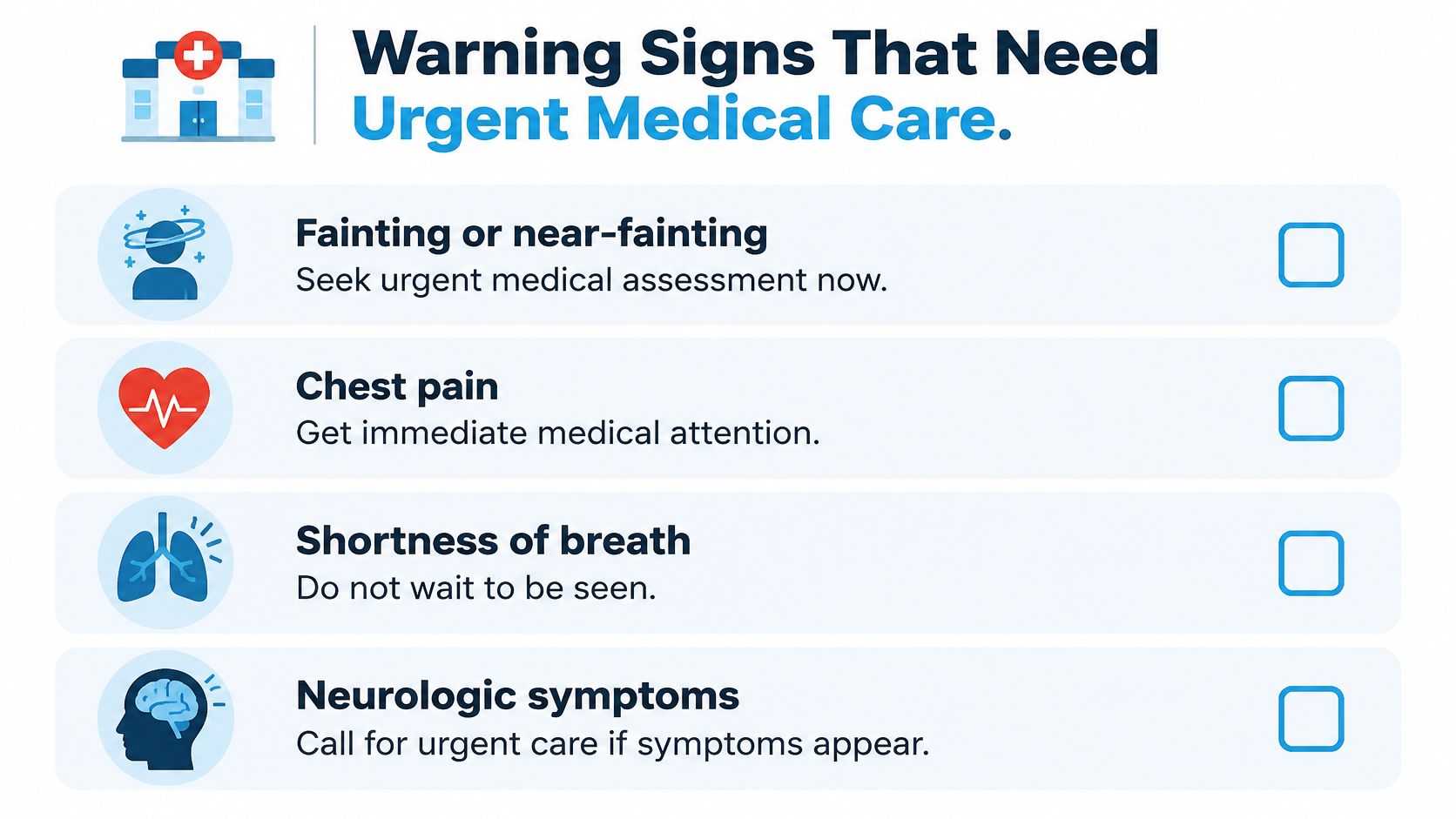
Stop and Act Checklist
- Fainting or near-fainting: Losing consciousness suggests blood flow may have dropped during the rhythm, which raises the stakes quickly.
- Chest pain or pressure: Pain with a racing or irregular beat needs immediate assessment rather than watchful waiting at home.
- Severe shortness of breath: Struggling to breathe during an episode can signal that the heart isn't keeping up.
- Racing that begins with exertion: Symptoms triggered by exercise shouldn't be tested by trying the workout again.
- Family history of sudden death: This history changes how urgently and thoroughly a new rhythm symptom should be evaluated.
- Known structural heart disease: A fast rhythm in a heart with known structural problems carries higher risk.
- Severe dizziness on standing: Marked lightheadedness or a spinning feeling with palpitations can precede a fall or faint.
- Palpitations during marked illness or high fever: Severe illness can strain the heart and hide dehydration, infection, or metabolic problems that need treatment.
Don't wait for the next watch reading to decide. A normal looking number after you've recovered doesn't cancel chest pain, a faint, or severe breathlessness that happened during the episode. Contact emergency services or go to the nearest emergency department when a warning sign appears, and don't drive yourself if you feel faint, breathless, or unwell.
The other side of the split is calmer. Recurring episodes without warning signs can usually be handled as a planned visit, where your clinician can arrange an ECG or ambulatory monitoring based on how often episodes happen. New, more frequent, or longer episodes still deserve an appointment soon, even when they aren't emergencies. You're not choosing between panic and ignoring it. You're choosing the right speed of care for the features in front of you.
Reading Your Watch Data and Preparing for the Visit
A watch can help you describe when your heart rate rose, how high it went, and how long it stayed increased. Patterns across several episodes may also show whether rises tend to happen at a particular time or alongside changes in posture, activity, sleep, hydration, or medication. That record gives your clinician details to review rather than relying on memory alone.
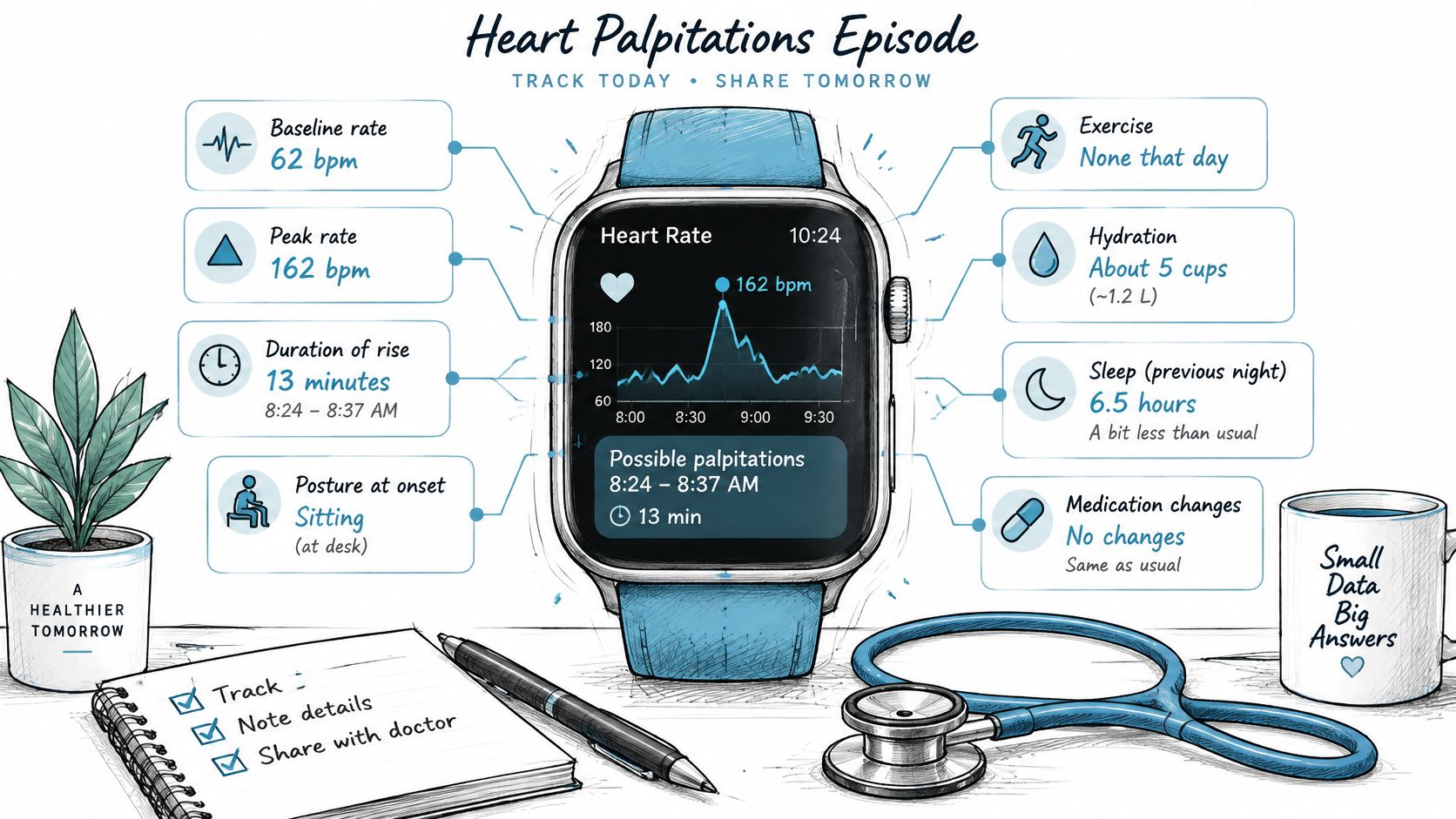
Heart-rate data from consumer hardware can be incomplete, delayed, or inaccurate, particularly during movement or when the sensor does not sit well against the skin. A loose strap, a cold wrist, or vigorous arm movement can leave gaps or produce a reading that does not match how you felt. Check the surrounding readings and your activity before treating a single spike as a reliable account of an episode.
Cardiogram's thresholds include a 30 bpm rise, and 40 bpm for ages 12 to 19. These are reference points, not diagnostic criteria. A rise after exercise, during fever or dehydration, or after coffee needs context; crossing a threshold by itself does not establish a cause.
A normal reading afterward cannot rule out a problem either. The watch may not have captured the episode clearly, or your heart rate may have settled before you checked it. Cardiogram is an information tool, not a medical device. It does not diagnose conditions or replace a doctor. A clinician can assess your symptoms and decide whether further testing is appropriate.
Practical rule: Use your watch to document timing, magnitude, and repeatability. Medical testing is needed to assess the cause.
What to Save and What Not to Conclude
Use the episode log from the previous section as your starting point, rather than rebuilding the same record. For the visit, add two details that can change how a clinician interprets a rise: how long it remained above baseline, and whether it occurred during exercise or recovery. Cardiogram automatically detects rises of 30+ bpm within 5 minutes and logs the time, baseline, and peak. Workout and recovery periods should be identified separately when reviewing the pattern.
The Visit Sequence
- Book the right visit: Start with a primary care clinician, or see a cardiologist if you have been referred or have known heart disease.
- Bring the record: Take your episode log, watch summaries, and medication and supplement list.
- Ask about rhythm capture: Ask whether a 12-lead ECG is appropriate or whether ambulatory monitoring may help. If a Holter monitor is suggested, learn what a Holter monitor records.
- Discuss possible contributors: Ask whether thyroid problems, anemia, electrolyte changes, dehydration, medication effects, or posture-related causes fit your symptoms.
- Agree on next steps: Clarify what symptoms call for urgent care, whom to contact after hours, and when to review results.
Before leaving, make sure you know which test is planned, what it can show, and what to do while waiting. If a warning sign appears, seek urgent care rather than saving it for the next appointment.
Consider a posture-linked pattern: repeated rises shortly after standing that ease when lying down, with no exercise involved. That pattern gives the clinician a focused reason to consider posture testing and assess other possible causes. A single abrupt, regular episode at rest with lightheadedness points toward a different question: whether the rhythm can be captured during an episode. The lesson is to bring the pattern, not a self-diagnosis.
If your watch records unexplained rises, Cardiogram can organize heart-rate episodes and context into a clinician-ready summary. It can automatically detect rises, and you can log symptoms such as dizziness, palpitations, fatigue, and brain fog, along with hydration, salt, sleep, and medications. Use the record to discuss what further assessment may be appropriate with your clinician.